
How to Vet a Low-MOQ Sunglasses Supplier for Growth
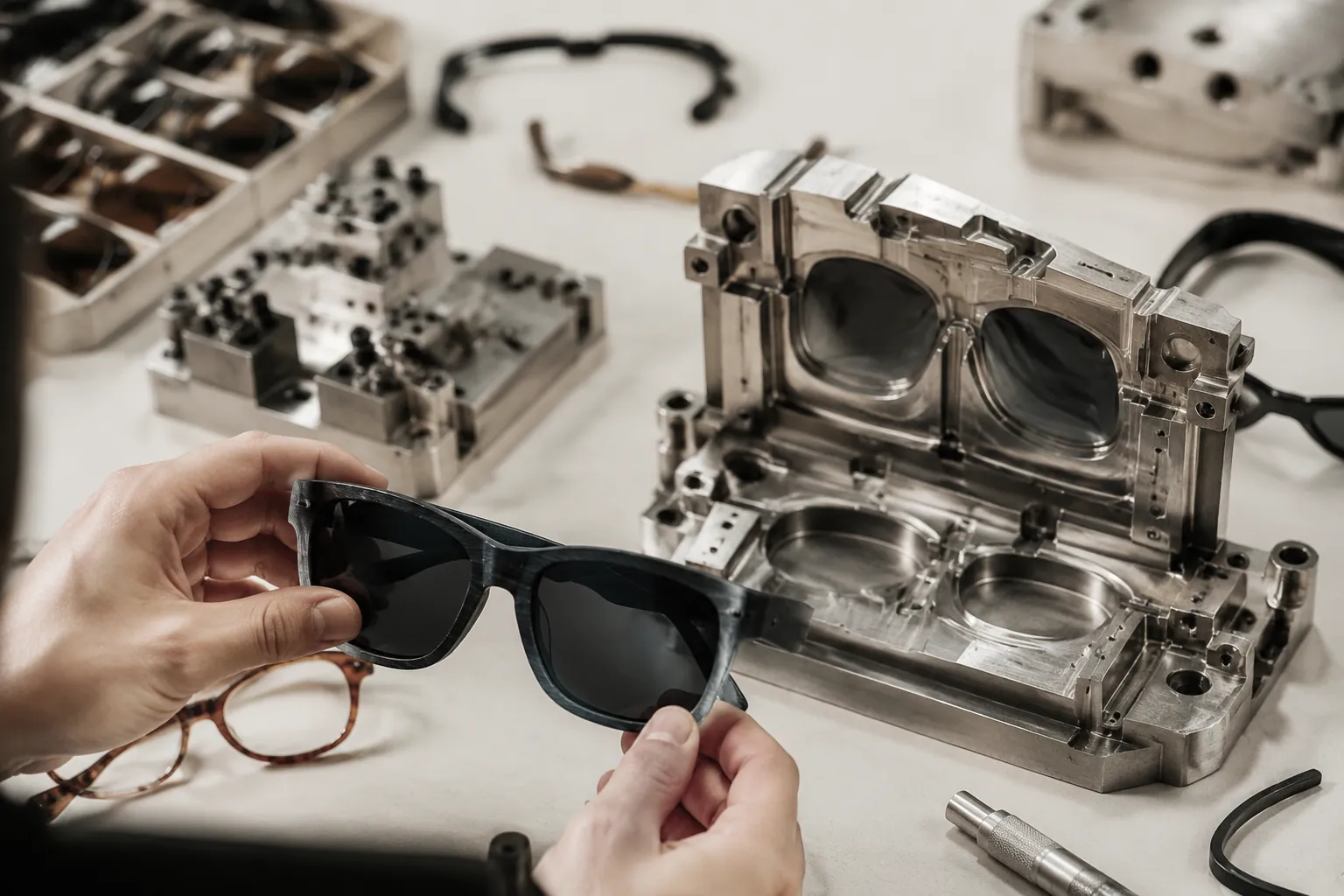
This guide is for brand owners, importers, distributors, and retailers who want small sunglasses orders without getting stuck with a supplier that cannot grow with them. The real question is not whether a factory will accept 50 pairs today. It is whether it can reproduce the same approved standard at 300, 1,000, or 5,000 pairs. Low MOQ helps with market entry. It does not prove process control, compliance discipline, or repeat-order consistency. The checks below help buyers separate a sample-friendly workshop from a manufacturer with documented processes, traceable approvals, and enough control to support growth.
Start with scale-up, not sample price
Many buyers screen suppliers backwards. They look at sample fees, reply speed, and whether the factory accepts a 50-pair MOQ. Those things matter. They are not enough.
The better question is simple: can this supplier reproduce the approved standard when the order moves from 50 pairs to 300, 1,000, or 5,000?
A supplier that can scale should explain the process in production terms, not just sales language. After sample approval, ask how the approved sample is identified and stored, how the bill of materials is frozen, how frame color and lens tint references are recorded, how logo placement is controlled, and how packing details are locked before bulk production starts. Ask who approves each record and how it is tied to the purchase order. If the answer is vague, key steps may be undocumented.
For sunglasses, drift usually shows up first in frame color, lens tint, logo position, and fit consistency. The supplier should be able to say what it checks and how it decides pass or fail. That may include logo placement tolerance, color reference matching, hinge alignment, dimensional checks, and a final packing checklist. If there is no measurable standard, quality becomes opinion.
Also confirm which stages are in-house and which are outsourced. Outsourcing is not automatically bad. It does add handoff risk. You need to know who is responsible for each stage and how the supplier keeps the bulk order aligned with the approved sample.
Run a five-point factory check before any deposit
Before you pay, run a basic five-point check. It is not a full audit. It will tell you fast whether the supplier is organized enough to support repeat business.
- Check process ownership. Ask which stages are done in-house and which are subcontracted. For sunglasses, higher-risk outsourced stages often include frame production, lens tinting, logo application, coating, and final QC. If an important stage is external, ask how lead time, defect handling, and approval standards are controlled.
- Check capacity logic. Ask how the same style is scheduled at 50, 300, and 1,000 pairs. A real factory should explain line planning, mold or machine availability, color changeovers, and whether a larger order runs in one batch or in multiple runs.
- Check document control. Request a sample approval sheet, production specification sheet, and QC checklist. The production sheet should cover material, frame color, lens type, decoration method, size, packing details, and carton requirements. If that paperwork does not exist, scale-up will be hard to manage.
- Check compliance fit. Confirm which standards matter for your market and whether the supplier supports them with current testing and material controls. Typical references include CE EN ISO 12312-1, ANSI Z80.3, AS/NZS 1067, REACH, FDA registration where relevant, ISO 9001, and BSCI.
- Check repeat-order discipline. Ask how repeat purchase orders are matched to prior approvals. Strong answers include retained reference samples, material lot records, decoration guides, and production records linked to the purchase order number.
If a supplier cannot answer these five points clearly before deposit, the problem usually gets worse during production. Not better. A low MOQ does not make up for weak control.
Verify the factory process, not just the showroom
Different constructions create different risks. Injection-molded sunglasses usually scale more predictably once tooling, resin grade, and color settings are fixed. Acetate styles can look more premium, but they depend on more manual and semi-manual steps: sheet selection, rough cutting, CNC shaping, polishing, tumbling, hinge fitting, and heat adjustment. More handwork means more room for variation unless QC is controlled.
Ask for the actual process flow for your construction type. An injection model may move through resin preparation, molding, trimming, deburring, hinge installation, lens fitting, logo application, cleaning, and final inspection. An acetate model may add sheet selection, cutting, CNC milling, tumbling, polishing, hinge riveting, fitting, and hand adjustment.
Then ask where defects usually appear. A capable manufacturer should know its weak points. Common sunglasses defects include lens stress marks during insertion, temple warp after heat exposure, front asymmetry, metal logo misalignment, paint rub on decorated parts, and visible color variation between components. Ask where inline checks happen: after polishing, after CNC, before assembly, before final cleaning.
- Injection frames usually scale more predictably once tooling, material, and color settings are fixed.
- Acetate frames need tighter control because polishing, tumbling, and fitting add more hand-finish variation.
- Lens tinting and decoration are common repeat-order risk points because small process changes can alter appearance.
- Final QC should cover symmetry, hinge feel, lens seating, logo position, and packaging.
The point is not to force every supplier into the same factory structure. The point is to confirm that the process for your product is defined, monitored, and repeatable enough to handle a larger order without drift.
Treat MOQ, price, and lead time as production signals
MOQ and lead time are not just commercial terms. They also tell you how the supplier works. A factory willing to start at 50 pairs per design may rely on shared raw materials, standard hardware, standard lens options, or flexible scheduling. That can help a new brand. It also means you need to check what changes as volume increases.
| Order Size | Typical Use Case | What To Verify | Commercial Signal |
|---|---|---|---|
| 50 pairs | Market test, influencer drop, pilot launch | Golden sample lock, color reference method, minimum carton plan | Highest unit price and the largest setup burden per pair |
| 300 pairs | First proper production run | Line scheduling, defect sorting, packaging consistency, final QC method | Unit price often improves once setup cost is spread across more units |
| 1,000 pairs | Repeat order for a proven SKU | Material reservation, lot traceability, stable daily output, shipment planning | Pricing may improve further if the style fits standard materials and efficient scheduling |
| 5,000+ pairs | Seasonal volume, retail chain, distributor demand | Capacity planning, QC staffing, batch staging, carton palletization | Commercial terms should reflect stronger planning efficiency, not vague volume promises |
Ask what could extend lead time for your exact model. Common causes include new tooling, custom acetate lamination, special metal logo plates, mirrored or gradient lens programs, outsourced coatings, and non-standard gift box packaging. A precise answer is more useful than a fast one.
Do not compare price without comparing process burden. A frame with CNC-shaped acetate fronts, applied metal logos, and layered lens effects should not be benchmarked against a basic injected frame with a standard smoke lens. If the supplier quotes both at nearly the same unit price, ask which assumptions differ in materials, finishing, or inspection.
Compliance is not a PDF with a logo on it
Overseas buyers need to match compliance to the destination market and product type. For sunglasses, the question is not whether the factory has a document on file. It is whether the shipped goods still match the tested sample in material, lens performance, and chemical control.
- CE EN ISO 12312-1: commonly relevant where sunglass performance and safety requirements apply.
- ANSI Z80.3: commonly relevant for the US market for non-prescription sunglasses.
- AS/NZS 1067: relevant for Australia and New Zealand.
- REACH: important where chemical substance restrictions apply.
- FDA registration: confirm scope and relevance instead of treating it as a substitute for product testing.
- ISO 9001 and BSCI: useful for management systems and social compliance, but not substitutes for product-level testing.
Ask which materials are controlled to support these requirements: lens substrate, colorants, mirror coatings, UV additives, frame resin, acetate sheets, nose pads, inks, and adhesives. Then ask how lot changes are handled. If the supplier changes a lens vendor, acetate sheet source, coating process, or ink after testing, the old report may no longer represent the shipped goods.
A careful buyer requests the latest reports relevant to the target market, confirms whether they apply to the same model or material family, and checks dates, issuing laboratory details, and product descriptions. For larger orders or higher-risk constructions, add a pre-shipment inspection and, where it makes sense, a third-party lab check against the applicable standard.
Make the sample stage act like production
Many sourcing failures happen because the approved sample is treated only as a design sample. It should also work as a production reference. That means the same material family, lens construction, logo method, and finishing standard intended for bulk production.
During sampling, ask the supplier to lock the following points in writing:
- Exact frame material, such as injected TR90, PC, or cellulose acetate, plus a defined color reference.
- Lens material and category, such as TAC, PC, or nylon, plus tint reference and whether the lens is solid, gradient, polarized, mirrored, or coated.
- Logo method, such as pad printing, laser engraving, silk screening, hot stamping, or an applied metal logo plate.
- Key dimensions, including eye size, bridge, temple length, front width, and temple spread.
- Fit checks, including hinge tension, left-right symmetry, lens seating, opening and closing feel, and face-fit alignment.
- Packing details, including polybag, pouch, gift box, barcode label, master carton quantity, and shipping mark layout.
Tolerance matters. Hand-finished acetate parts will vary a little, but acceptable limits should be agreed before bulk starts. Logo placement should not drift visibly. Left and right lens color should match the approved reference. The frame should sit properly after adjustment under the agreed inspection standard. If those points are informal, disputes get messy.
Ask the supplier to retain the approved sample as a golden sample, attach it to the production specification, and reference it on the purchase order. Also request clear photos of the sample next to the spec sheet so the approval record is not spread across chat messages.
Questions that expose weak scale-up capacity fast
You do not need a long audit to find the main risks. A short set of direct questions usually tells you whether the supplier thinks like a factory or only like a salesperson.
What changes operationally between a 50-pair order and a 1,000-pair order for the same style?
Which stages are subcontracted, and how do you control quality and lead time at those stages?
How do you keep lens tint and frame color consistent from approved sample to repeat order?
What is your standard QC flow: inline checks, assembly checks, final inspection, and defect grading or AQL method?
What would realistically delay the quoted bulk lead time for this exact model?
A real factory answers with process detail: material booking lead time, first-article confirmation, in-process inspection during molding or CNC, decoration position checks, appearance inspection, and final carton verification before shipment. A weak supplier gives broad assurances and little else.
Also ask how your order fits the supplier's real capacity. Which department handles this construction type? What happens in peak season? How are repeat orders prioritized when several customers need similar delivery windows? Those questions help you judge whether the supplier can support growth without pushing your order into an uncontrolled schedule.
Use a pass-fail checklist before a larger repeat PO
Before you issue a bigger repeat PO, score the supplier on evidence, not optimism. This simple screen works well.
| Check | Pass Standard | Warning Sign |
|---|---|---|
| Process control | Clear in-house versus outsourced breakdown for frame, lens, decoration, and QC | Supplier avoids naming who handles key steps |
| Sample discipline | Approved sample tied to a written production spec sheet | Sample approved only by photos or chat messages |
| Compliance support | Relevant current reports plus material control logic | Generic certificates with no product connection |
| Lead-time realism | Specific explanation for sample and bulk timing | Same lead time quoted for every product regardless of complexity |
| QC system | Defined checkpoints, appearance criteria, and defect handling method | No clear final inspection standard |
| Scale economics | Transparent pricing breaks at 300, 1,000, and 5,000+ | Price changes without quantity or specification logic |
If a supplier passes these checks, a low MOQ becomes useful. You can test the relationship with limited exposure before scaling. If the supplier fails them, the low MOQ can hide bigger risks in repeat orders: delays, rework, or quality drift.
That is why scale-up vetting matters early. Start small if you want. Verify the production system first.
Have a custom sunglasses project in mind?
Send us your styles, target market and quantities and we will return a detailed quote with MOQ, lead time and a sample plan.
Get a QuoteWhy source this from Wenzhou with LumiShades
Wenzhou in Zhejiang Province is widely regarded as China’s eyewear manufacturing capital, producing a large share of the world’s sunglasses. That concentration matters to buyers: a deep local supply chain for acetate sheet, hinges, lens blanks, plating and packaging means shorter component lead times, easier color and material matching, and a workforce with decades of eyewear-specific skill. LumiShades has manufactured in this ecosystem since 2009, and our vertical integration — in-house injection molding, acetate cutting, CNC milling, lens tinting, decoration and quality control — means no part of your order is quietly subcontracted to a workshop you cannot audit.
For international buyers, that vertical control translates into accountability. When a single factory owns every step, defects are traced and fixed at source rather than bounced between vendors, and your specifications survive intact from first sample to bulk. We back this with 15+ years of experience, shipments to 60+ countries, more than 5 million pairs produced per year and a 98.5% on-time delivery rate. Our certifications — CE EN ISO 12312-1, FDA registration, ANSI Z80.3, AS/NZS 1067, REACH, ISO 9001 and BSCI audit — mean the compliance documentation your market requires already exists. Explore our manufacturing capabilities and quality control process to see how this works in practice.
Frequently asked questions
Can a 50-pair MOQ supplier still be a serious long-term manufacturing partner? Yes, if the supplier can prove repeatability. Ask for a written production specification, a retained golden sample, a clear in-house versus outsourced process map, a QC checklist, and an explanation of how the same style would run at 50, 300, and 1,000 pairs. If it cannot document those controls, the low MOQ is just a sales feature.
What is the biggest warning sign during sunglasses sampling? A good-looking sample with no controlled specification behind it. Before approval, make sure the supplier fixes the frame material, lens material, lens tint reference, logo method, dimensions, fit checks, and packing details in writing. If approval lives only in chat messages or photos, the supplier has too much room to reinterpret the order in bulk.
How should I verify compliance for my market? Start with the destination market and identify the applicable requirements, such as CE EN ISO 12312-1, ANSI Z80.3, AS/NZS 1067, REACH, or FDA registration where relevant. Then request the latest reports and check whether they match the same model or material family, the same lens type, and the same construction you are buying. Confirm the issuing lab, issue date, and product description, and ask how the supplier controls material changes after testing. For larger orders, add a pre-shipment inspection and consider a third-party lab test if the risk justifies it.
What lead times are reasonable for low-MOQ custom sunglasses? There is no single correct number. Lead time depends on construction, materials, decoration, and packaging. What matters is whether the supplier can break the timeline into sampling, approval, material preparation, production, inspection, and packing. Ask what specific factors add time, such as new tooling, custom acetate, special logo hardware, mirrored or coated lenses, or non-standard boxes. A reliable supplier should explain the lead time by process stage, not just give one headline number.
At what quantity should I expect pricing to improve materially? Pricing often improves once setup cost, material planning, and production time are spread across more units, commonly from the first meaningful bulk run upward. Ask the supplier for price breaks at 50, 300, 1,000, and 5,000-plus, and require an explanation for each change. The explanation should link back to production logic, such as material purchasing, changeover efficiency, standard packaging, or line utilization. If the pricing shifts without a clear operational reason, treat that as a warning sign.
Ready to start?
Explore our shield & oversized sunglasses or request a quote — our sales team replies within 12 hours.
Request a Quote