
Existing Molds vs New Tooling for Custom Sunglasses
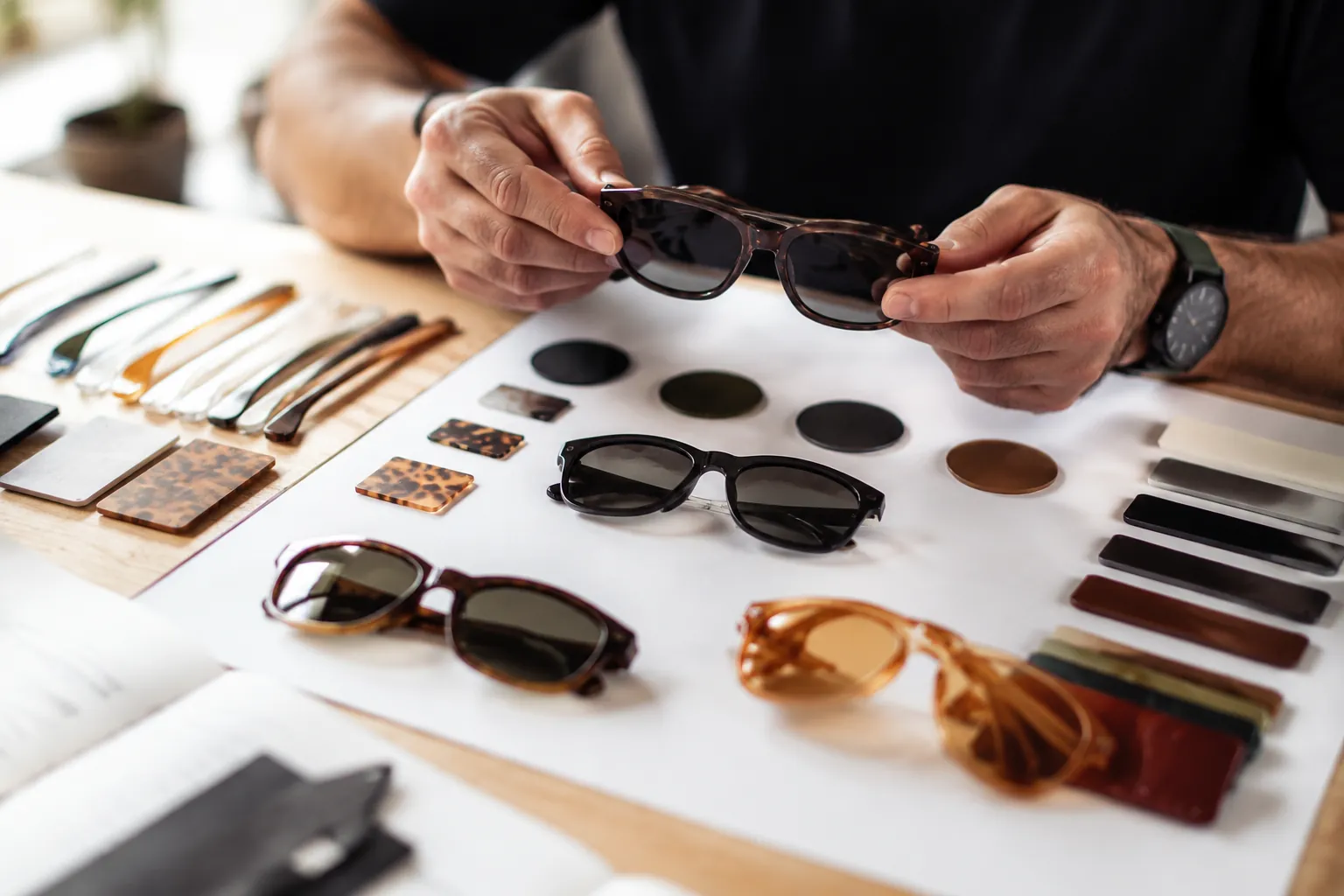
This guide helps brand owners, importers, distributors, and retail buyers decide whether to use a factory's existing sunglass mold or pay for new tooling. The choice affects launch speed, development cost, compliance work, product exclusivity, and how much control you have over the final frame. Get it wrong and the damage shows up fast: extra sample rounds, tooling spend that never pays back, or a delayed launch because the product needed more engineering than expected. Get it right and the sourcing plan matches your forecast volume, design brief, testing needs, and timeline from the start.
Start with the business case, not the sketch
Many buyers start with a rendering and ask for a fully custom frame. Sometimes that is the right move. Often it is not the first question to answer.
Start with the commercial case. Do you need a fast launch with controlled development cost? Or do you need a frame shape that is exclusive to your brand and built around a specific fit or design language?
If speed is the priority, existing molds usually make more sense. The factory already knows the frame geometry, assembly sequence, and core component layout. That does not remove development work, but it usually lowers early-stage risk because the supplier is working from a known platform.
If exclusivity or a non-standard shape is the priority, new tooling is easier to justify. That is especially true when the design depends on a custom front shape, bridge profile, temple architecture, logo recess, or another physical feature that cannot be achieved by changing color, decoration, lenses, or packaging on a stock frame.
Simple rule. Use house molds when the goal is speed, lower up-front investment, and flexible branding. Use new tooling when the goal is shape ownership, repeat volume, or a design brief that an existing platform cannot meet.
Head-to-head: cost, lead time, MOQ, and exclusivity
The tradeoff is clear. Existing molds cut up-front development work and usually shorten the path to approval. New tooling adds time and capital cost, but gives you more control over frame architecture.
| Option | Typical use case | Up-front cost | Sample lead time | Bulk lead time | MOQ logic | Exclusivity |
|---|---|---|---|---|---|---|
| Existing mold, stock spec | Private label market test | Usually no tooling fee | Usually shorter than new tooling | Usually shorter than new tooling | Often the most practical route for lower trial volumes | Low |
| Existing mold, branded trim changes | Faster launch with visible differentiation | Low setup cost for decoration or trim, depending on method | Usually shorter than new tooling | Usually shorter than new tooling | Useful when testing several branded variants | Low to medium |
| Existing mold, minor structural rework | Limited fit or detail changes if technically feasible | Moderate development cost | Longer than stock-spec sampling | May require re-approval before bulk | More sensible when repeat volume is likely | Medium |
| New tooling | Exclusive shape or strict design brief | Highest investment | Longest development cycle | Bulk starts after tool and sample sign-off | More justifiable when repeat orders are expected | High |
Unit economics matter as much as design. A supplier may accept a low MOQ for a trial order, but low-volume pricing usually carries more overhead per pair because setup, decoration, packaging coordination, and quality control are spread across fewer units.
That is why tooling should be judged against expected reorder behavior, not just the first PO. If you are testing one SKU at low volume, heavy tooling cost is often hard to recover. If you expect repeat orders across multiple seasons, the tooling investment can make commercial sense because it is spread across more units and gives you tighter control over a long-life style.
What can change on an existing mold
Many buyers assume an existing mold only allows a logo swap. Not true. A capable supplier can usually customize more than that without cutting new steel, but only within the limits of the original frame geometry, lens shape, and assembly method.
- Usually easy: frame color, finish, lens tint, gradient, mirror effect, polarized lens upgrade, logo application, and packaging.
- Usually possible with technical review: metal logo insert, hardware color changes, temple-tip color changes, and some detail edits that do not change the underlying frame structure.
- Usually not practical without tooling: major eye-shape changes, bridge redesign, significant lens-size changes, large wrap-angle changes, thicker frame architecture, or a new temple cross-section.
For injection-molded frames, the main limit is the mold cavity and how material fills, cools, and releases from it. Changes that affect wall thickness, material flow, ejection, or hinge-area construction often trigger tooling work because they change how the frame is made, not just how it looks.
Acetate styles can offer more flexibility because parts are cut and machined rather than defined entirely by one injection cavity. Even so, limits remain. Lens seating, groove design, polishing loss, hinge placement, and overall balance still need to work in production.
That is why an early technical review matters. Do not ask whether a change looks small on paper. Ask whether it stays inside the limits of the existing production method.
When new tooling is the better business decision
New tooling is not only for premium positioning. It is the right choice whenever an existing frame cannot meet the brief without hurting fit, durability, or brand identity.
Choose new tooling when the silhouette itself carries product value. If the front shape, bridge line, or temple architecture is what makes the style recognizable, a shared house mold weakens that position. The same applies when you need engineering features built into the frame, such as a dedicated recess for hardware or branding, a specific hinge construction, or a lens seating design that differs from the supplier's standard platform.
Fit is another valid reason. Bridge profile, wrap, coverage, and temple geometry are structural issues. Not decoration issues. If your market needs a specific fit profile, those requirements may call for a new frame design rather than a cosmetic update to an existing one.
Then apply the volume filter. If the style is likely to become a repeat program, tooling cost is easier to justify because the product has time to earn it back. If the order is a one-season test, new tooling often adds cost and delay without enough return.
How timelines shift in real production
Existing-mold projects usually move faster because the platform already exists. The sample phase often focuses on confirming the sellable specification: color, finish, logo execution, lens option, and packaging.
New tooling adds more approval gates. These can include technical drawing review, mold fabrication or modification, first-off samples, fit or construction corrections, and final sign-off before bulk production starts. Every revision cycle adds time. Especially if the buyer is still adjusting dimensions or styling details during development.
The calendar also moves with material behavior and process complexity. Injection-molded frames may need adjustment after first samples if the finished part does not hold the intended shape or assembly condition. Acetate styles may need refinement after machining, polishing, or fitting. Added trims, coatings, or metal inserts can create extra checkpoints because those details also need approval.
Buyer response time matters too. Projects often slow down because drawings are not approved promptly, or because first samples are judged only on appearance and not on fit, function, and compliance impact. If shelf timing is critical, an existing mold is usually the lower-risk route unless the unique shape is non-negotiable.
Compliance, testing, and material control still apply
Whichever path you choose, the product still has to meet the rules of the destination market. A frame does not become compliant because it looks correct or because the base mold has been used before.
For export programs, buyers often ask suppliers about CE EN ISO 12312-1, ANSI Z80.3, AS/NZS 1067, REACH, FDA registration, ISO 9001, and BSCI. These are not interchangeable. They do not cover the same thing.
Product standards such as CE EN ISO 12312-1, ANSI Z80.3, and AS/NZS 1067 relate to sunglass performance and labeling requirements in the relevant market. REACH relates to chemical compliance obligations for applicable materials and substances. FDA registration is a US regulatory point some buyers ask about depending on product category and import setup. ISO 9001 and BSCI relate to factory management systems and social compliance. They do not prove that the sunglasses meet product-performance standards.
The sourcing point is simple: changing the mold does not remove testing, and using an existing mold does not guarantee that the final approved specification still meets the required standard. If you change lenses, coatings, materials, or labeling claims, confirm with the supplier what testing or document review needs to be repeated.
Set the compliance path before sample approval. Confirm which market standard applies, what test reports or supporting documents are available for the final specification, what material declarations can be provided for REACH-related requests, whether FDA registration is relevant to your import program, and which factory certifications such as ISO 9001 or BSCI are current. Have that conversation before packaging claims are finalized and before bulk production is booked.
A practical framework for first orders and repeat programs
The safest sourcing approach with a new supplier is often staged, not dramatic. Start with an existing mold where possible, validate demand and execution, and move to new tooling only when the market gives you a clear reason to invest.
| Buyer question | If the answer is yes | Recommended path |
|---|---|---|
| Do you need launch speed more than shape exclusivity? | You need samples and bulk moving quickly | Existing mold |
| Is demand still uncertain at low trial volume? | You are still testing sell-through | Existing mold |
| Is the exact silhouette central to the brand? | The shape itself must be protected | New tooling |
| Do you need controlled fit geometry? | Bridge, wrap, or dimensions are non-negotiable | New tooling |
| Will this become a repeat-volume SKU? | You expect ongoing reorders | New tooling is easier to justify |
A disciplined first brief should include the target market, applicable standard, frame material, lens specification, logo method, target price, MOQ, annual volume estimate, and which features must be exclusive versus which can stay standard. That gives the factory enough information to recommend either the nearest house mold or a tooling route based on manufacturability.
A practical first-order sequence often looks like this:
- Run a branded order on an existing mold if speed and lower development risk matter most.
- Check sell-through, return reasons, and fit feedback in your actual market.
- Review finish quality, hinge performance, lens consistency, and packaging execution.
- Use the results to refine dimensions, materials, and decoration for the next round.
- Move to new tooling only if the shape must change or the SKU becomes a repeat program.
This staged approach helps prevent a common sourcing mistake in custom eyewear: paying for unique tooling before there is enough evidence that the market wants the style and that the supplier can execute it consistently.
Have a custom sunglasses project in mind?
Send us your styles, target market and quantities and we will return a detailed quote with MOQ, lead time and a sample plan.
Get a QuoteWhy source this from Wenzhou with LumiShades
Wenzhou in Zhejiang Province is widely regarded as China’s eyewear manufacturing capital, producing a large share of the world’s sunglasses. That concentration matters to buyers: a deep local supply chain for acetate sheet, hinges, lens blanks, plating and packaging means shorter component lead times, easier color and material matching, and a workforce with decades of eyewear-specific skill. LumiShades has manufactured in this ecosystem since 2009, and our vertical integration — in-house injection molding, acetate cutting, CNC milling, lens tinting, decoration and quality control — means no part of your order is quietly subcontracted to a workshop you cannot audit.
For international buyers, that vertical control translates into accountability. When a single factory owns every step, defects are traced and fixed at source rather than bounced between vendors, and your specifications survive intact from first sample to bulk. We back this with 15+ years of experience, shipments to 60+ countries, more than 5 million pairs produced per year and a 98.5% on-time delivery rate. Our certifications — CE EN ISO 12312-1, FDA registration, ANSI Z80.3, AS/NZS 1067, REACH, ISO 9001 and BSCI audit — mean the compliance documentation your market requires already exists. Explore our manufacturing capabilities and quality control process to see how this works in practice.
Frequently asked questions
Can I make an existing mold look different enough for my brand? Often yes, if your differentiation comes from color, finish, lenses, decoration, trims, or packaging. Usually no, if your brand depends on a unique front shape, bridge geometry, wrap profile, or temple architecture. To assess this properly, send the factory marked reference images or drawings and ask for a written split between cosmetic changes possible on the house mold and structural changes that would require new tooling.
At what order size does new tooling start to make sense? There is no fixed break-even quantity because tooling cost, frame material, and development scope vary by project. In practice, new tooling makes more sense when you expect repeat orders and need a shape or fit that existing molds cannot deliver. Ask the supplier for two quotations in the same specification where possible: one based on the closest existing mold and one based on new tooling, with tooling cost shown separately. Then compare the difference against expected reorder volume and product lifespan.
Does using an existing mold mean the product is not private label? No. A product can still be private label if it is sold under your brand with your approved specification and packaging. The real issue is exclusivity, not whether the product is private label. Before placing the order, ask the supplier in writing whether the underlying frame shape is a shared house model, whether any part of the configuration is reserved for your brand, and whether the same shape can be sold to other buyers.
Will compliance be easier if I choose an existing mold? It may reduce frame-development risk because the supplier already knows the platform, but compliance still depends on the final approved product. If you change lens tint, coatings, polarization, materials, or labeling claims, confirm what evidence is available for CE EN ISO 12312-1, ANSI Z80.3, or AS/NZS 1067 as applicable, and ask for supporting information on REACH-related material requests. Also keep product compliance separate from factory credentials such as ISO 9001 or BSCI, which do not replace product testing.
What should I send the factory before asking for a tooling recommendation? Send a clear sourcing brief: target market, applicable standard, frame material preference, lens specification, logo method, target price, MOQ, expected annual volume, and the features that are non-negotiable. Add reference images or drawings with notes on the exact points that matter, such as front shape, bridge style, temple profile, coverage, and branding location. Then ask the supplier to reply in a structured way: closest existing mold option, what can be changed without tooling, what requires new tooling, expected development steps, and what compliance documents or certifications are relevant to the program.
Ready to start?
Explore our rimless sunglasses or request a quote — our sales team replies within 12 hours.
Request a Quote