
OEM vs ODM Sunglasses: Speed, Cost, and Control
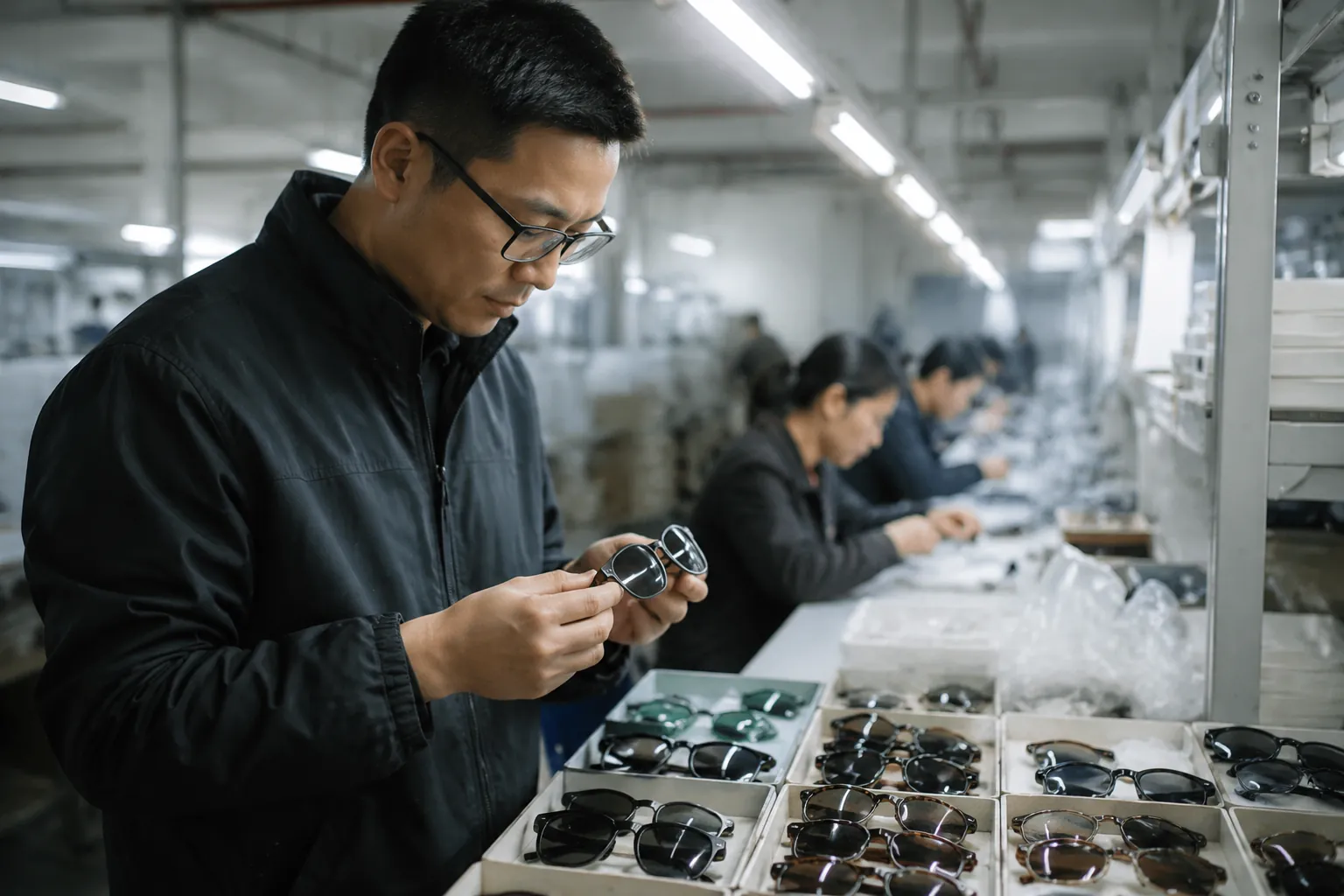
This guide is for brand owners, importers, distributors, and retail buyers comparing OEM and ODM sunglasses programs. The choice is not just about design freedom. It affects launch timing, development cost, order volume, compliance exposure, and how reliably the product can be repeated later. This comparison stays practical. It focuses on the factory-side decisions that shape the result: starting platform, sample flow, tooling exposure, MOQ logic, compliance checks, and reorder control.
Pick the commercial model before you start sketching
Many buyers treat OEM versus ODM as a design question first. It is usually a commercial question first. ODM starts from an existing factory style, frame platform, or proven construction. Buyers then customize visible elements such as frame color, lens tint, logo application, surface finish, or packaging. OEM starts from a buyer drawing, tech pack, physical reference sample, or original concept and usually needs new engineering review, new tooling or programming, and more sample validation.
That distinction matters because sunglasses are a multi-part product. A style combines frame material, hinge construction, lens geometry, decoration method, and cosmetic finish. Change one point and the cost, timing, or function can shift elsewhere. A thicker acetate front may increase machining time and weight. A different lens coating may force a check on whether existing test documents still cover the final version.
For most buyers, the split is simple:
- Choose ODM if you need a faster launch, lower upfront development exposure, and a lower-risk first order for a seasonal line or market test.
- Choose OEM if you need a shape, construction, or branded detail package with tighter control and you expect enough repeat volume to justify development work.
- Use both if your range needs quick-turn commercial styles plus a smaller number of signature frames with stronger differentiation.
Before asking for quotes, decide what matters most: speed to market, lower initial cash outlay, stronger design control, or tighter long-term repeatability. Make that call first. It usually tells you whether ODM or OEM is the better starting point.
Head-to-head: speed, tooling exposure, and margin logic
| Factor | ODM sunglasses | OEM sunglasses |
|---|---|---|
| Starting point | Existing factory frame, lens shape, or platform with established construction | New design from drawing, concept, or physical reference sample |
| Sample timing | Usually faster when changes are limited to color, logo, lens tint, finish, and packaging | Usually slower because fit, geometry, lens seating, hardware, and tooling details need validation |
| Tooling cost | Often low for standard modifications; extra cost may apply for custom packaging components or special logo hardware | Often higher because new molds, CNC programs, dies, or custom components may be required |
| MOQ pressure | Usually lower entry risk because development cost is lighter | Usually higher in practice because one-time development cost needs to be spread across more units |
| Unit-price behavior | Can work well for smaller or mid-volume launches where speed matters more than exclusivity | Can become more attractive over repeat orders if development cost is amortized over stable volume |
| Differentiation | Moderate; visible details can change, but the underlying platform may also be offered to other buyers | Higher potential; dimensions, profile, trim, and construction can be specified more tightly by the buyer |
| Reorder control | Good when the platform stays active and the approved final specification is documented clearly | Potentially stronger when tooling, approved samples, and technical specifications are formally locked |
Do not judge margin by ex-factory unit price alone. That is too narrow. Look at total launch cost. A low first quote can turn expensive if the project needs repeated sample rounds, extra testing, or later rework on reorders. An OEM program with higher upfront cost can still make sense if the style repeats across multiple seasons and the volume is reliable.
The core tradeoff is direct: ODM usually cuts launch risk and saves time. OEM can improve control and margin over time if the product has a long enough life cycle.
How lead time really moves from concept to shipment
ODM usually reaches market faster. But only if the buyer stays within the limits of the existing platform. If the base structure already exists, the critical path is often color confirmation, logo method, lens specification, packaging, and sample approval.
A typical ODM workflow looks like this:
- Select the base platform and confirm material category such as injection, acetate, metal, or mixed construction.
- Confirm lens specification, logo method, finish, packaging, and shipping marks.
- Review the development sample and record corrections against a written approval standard.
- Approve the revised sample or pre-production sample.
- Start bulk production only after the final specification and compliance basis are confirmed.
OEM adds more moving parts. A revised temple angle can affect fit. A deeper bevel on acetate can add processing time. A custom metal logo may need separate die work or sourcing approval. A different lens curve must still match the front geometry during assembly. None of this is unusual. It does make OEM less predictable than a straightforward ODM program.
Buyers also lose time through avoidable revisions. Common examples include changing logo size after the first sample review, changing lens appearance after approving the initial lens, or requesting a different gloss level without an approved reference. Small changes add up. Fast.
The practical rule is simple: spend development time on changes that improve sell-through, compliance readiness, or brand clarity. Cosmetic changes without a clear retail payoff often slow launch more than they help the product.
Where the money goes: MOQ, tooling, materials, and price breaks
Too many cost comparisons stop at unit price. That is not enough. The useful view is one-time cost plus recurring cost across the first several orders.
With ODM, buyers usually pay for materials, processing, decoration, packaging, and quantity. With OEM, buyers may also pay for new molds, new machining programs, custom hardware, engineering time, and more sample development before bulk production begins. On a small first order, those one-time costs can change the real margin quickly.
The commercial logic usually works like this:
- At lower opening volumes, ODM often makes more sense because development cost is limited and the market is still being tested.
- At planned repeat volume, compare total landed cost across multiple purchase orders, not only the first one.
- At stable larger volume, OEM may become more attractive if the design is fixed and the upfront cost can be spread over enough units.
Material choice changes the picture too. Injection frames are common when buyers want a lower entry cost and an efficient private-label program. Acetate often supports stronger perceived value and richer color presentation, but it adds processing steps. Mixed-material styles can add premium feel, but they also add assembly complexity and more tolerance points to control.
Ask the factory to split one-time and recurring costs in the quote. Buyers should be able to see mold cost, custom hardware cost, sample charges, packaging cost, and ex-factory unit price by quantity tier. Without that split, ODM and OEM are hard to compare fairly.
Differentiation comes from the full spec stack
Many buyers assume a new front shape alone creates defensible product. Usually it does not. In eyewear, real differentiation often comes from the full specification package: dimensions, material choice, finish level, lens appearance, branding method, and packaging consistency.
ODM can still produce a distinct retail result if the buyer controls the details. A standard platform with a disciplined finish, the right lens look, precise logo placement, and stronger packaging can look very different from the same base shape sold with generic specs.
Better ways to create separation on an ODM platform include:
- Adjusting lens tint or category to fit your channel instead of accepting the default lens option.
- Specifying gloss, matte, rubberized, or textured finish with a clear approval reference.
- Selecting a material appearance or colorway that supports your price point and target customer.
- Using a restrained branding method, such as a metal insert, laser mark, or well-positioned print, instead of oversized surface branding.
- Building a packaging set that matches the retail proposition, whether that means a pouch, case, rigid box, barcode label, or retailer-specific pack-out.
If you choose OEM, spend the budget where customers notice it: profile, proportion, temple section, hinge feel, lens look, and logo integration. Those details do the real work on shelf.
Compliance can decide the safer sourcing path
For export buyers, compliance is not a side issue. It affects market access, launch timing, and risk. Directly.
The most commonly referenced documents in sunglasses sourcing include CE EN ISO 12312-1, ANSI Z80.3, AS/NZS 1067, REACH, FDA registration, ISO 9001, and BSCI. They do not mean the same thing. CE EN ISO 12312-1, ANSI Z80.3, and AS/NZS 1067 are product standards used for sunglasses performance in different markets. REACH covers restricted substances. FDA registration is an administrative point for the U.S. market, not a substitute for product performance testing. ISO 9001 relates to quality management systems, and BSCI relates to social compliance and audit practice rather than lens or frame performance.
OEM usually carries more compliance exposure because new materials, coatings, lens colors, or thicknesses may require fresh checks on whether testing or documents still apply. ODM can reduce that risk when it uses an existing, already-documented construction, but only if the final approved bill of materials still matches the basis of those documents.
Ask precise questions before bulk approval. Which exact lens material is covered by the report? Does a mirror coating affect visible light transmission? If lens thickness changes, does the existing documentation still apply? If the frame material changes, is the restricted-substance documentation still valid? These are not paperwork questions. They decide whether the shipment moves on time or gets delayed.
If the target market is compliance-sensitive and the timeline is tight, ODM is often the safer option because it reduces the number of variables that must be rechecked. Even then, the buyer still needs to confirm that the production version matches the documented version on every compliance-relevant point.
Reorder control is where profit is kept or lost
Many buyers manage the first order carefully and then relax on the second and third. That is where margin often leaks. A style that launches well can become difficult if the next run shifts in gloss, lens darkness, logo position, hinge feel, or fit consistency.
ODM reorders can be efficient when the platform remains active and the approved specification is documented properly. Problems start when approval is based only on memory or a loosely marked sample. A black frame can vary in gloss. A smoke lens can shift in apparent darkness. A logo can move just enough to look wrong at retail.
OEM offers stronger control in theory, but only if the technical file is complete. Paying for molds without locking the final specification just raises cost. It does not fix repeatability.
Your reorder control file should include, at minimum:
- Front width, bridge width, temple length, lens size, and any other critical dimensions used for approval.
- Material callouts for frame, lens, hinges, pads, and any trim or decorative parts.
- Color references, finish standard, and approved master-sample photos kept against the production file.
- Logo artwork revision, method, position, and size.
- Packaging method, carton standard, shipping marks, and barcode or retailer label details.
- QC checkpoints for alignment, lens seating, hinge action, decoration adhesion, and cosmetic defects.
The rule is blunt: if the buyer and factory do not write it down, it is harder to repeat. Clear approval documents matter in both ODM and OEM programs because they protect future purchase orders, not just the first shipment.
A practical decision framework for buyers
| Buyer situation | Better model | Why |
|---|---|---|
| New brand testing a small number of styles with limited development budget | ODM | Lower upfront risk, faster setup, and easier market testing |
| Retailer launching a seasonal private-label line | ODM | Speed, lower development burden, and a simpler path usually matter more than fully exclusive geometry |
| Established brand building a signature frame for repeat seasons | OEM | Higher potential for design control, specification ownership, and long-term differentiation |
| Importer scaling a proven shape across repeat orders | Depends on volume and development spread | If repeat demand is stable, OEM may improve economics over time after upfront cost is absorbed |
| Compliance-sensitive market with low tolerance for launch delays | Often ODM | An existing documented platform can reduce validation risk if modifications stay within the approved construction basis |
The short version is clear. Choose ODM when speed, lower opening cost, and lower launch risk matter most. Choose OEM when the style matters to your brand, the design needs tighter control, and projected volume is strong enough to justify development work. If the range is broad, a hybrid model often works best: use ODM for fast-turn commercial styles and reserve OEM for the frames that carry the most brand value or repeat potential.
Have a custom sunglasses project in mind?
Send us your styles, target market and quantities and we will return a detailed quote with MOQ, lead time and a sample plan.
Get a QuoteWhy source this from Wenzhou with LumiShades
Wenzhou in Zhejiang Province is widely regarded as China’s eyewear manufacturing capital, producing a large share of the world’s sunglasses. That concentration matters to buyers: a deep local supply chain for acetate sheet, hinges, lens blanks, plating and packaging means shorter component lead times, easier color and material matching, and a workforce with decades of eyewear-specific skill. LumiShades has manufactured in this ecosystem since 2009, and our vertical integration — in-house injection molding, acetate cutting, CNC milling, lens tinting, decoration and quality control — means no part of your order is quietly subcontracted to a workshop you cannot audit.
For international buyers, that vertical control translates into accountability. When a single factory owns every step, defects are traced and fixed at source rather than bounced between vendors, and your specifications survive intact from first sample to bulk. We back this with 15+ years of experience, shipments to 60+ countries, more than 5 million pairs produced per year and a 98.5% on-time delivery rate. Our certifications — CE EN ISO 12312-1, FDA registration, ANSI Z80.3, AS/NZS 1067, REACH, ISO 9001 and BSCI audit — mean the compliance documentation your market requires already exists. Explore our manufacturing capabilities and quality control process to see how this works in practice.
Frequently asked questions
Is ODM always cheaper than OEM? Not always. ODM is usually less expensive at the start because it often avoids new tooling and reduces engineering work. OEM can become more economical over time if the style repeats and the one-time development cost is spread across enough units. Ask suppliers to quote one-time charges and recurring unit prices separately so you can compare the first order and later reorders on the same basis.
How small can I start with a custom sunglasses order? The minimum order depends on the supplier, construction type, and how much is being customized. Ask for the MOQ by style, by color, and by logo application method, because those may differ. Also confirm whether the MOQ changes if you choose acetate, custom hardware, or retailer-specific packaging. Do not approve the program until the opening MOQ and repeat-order MOQ are both clear in writing.
How much faster is ODM in practice? ODM is usually faster because it starts from an existing platform. The actual timing depends on how many changes you request and how quickly approvals are returned. To move faster, keep the first round focused on the base style, lens specification, logo method, finish, and packaging, then freeze the specification after approval. Ask the supplier for a written timeline covering sample preparation, revision rounds, pre-production approval, and bulk production.
Do I need new compliance testing if I change the lens color? Possibly. A change in tint, mirror coating, material, thickness, or another compliance-relevant component may affect whether existing documentation still applies under standards such as CE EN ISO 12312-1, ANSI Z80.3, or AS/NZS 1067. Before bulk production, ask the supplier which exact bill of materials is covered by the available reports and whether your final configuration needs additional verification or updated documentation.
What should I lock down before approving bulk production? Approve a final specification file, not just a sample by eye. At minimum, it should include approved dimensions, materials, color and finish references, lens specification, logo artwork and placement, packaging details, shipping marks, and QC checkpoints for alignment, lens seating, hinge function, decoration adhesion, and cosmetic appearance. Keep the approved sample, the written specification, and any compliance-related documents tied to the same final version so reorders can be matched against the same standard.
Ready to start?
Explore our square sunglasses or request a quote — our sales team replies within 12 hours.
Request a Quote