
Benchmark Sunglasses Factories Before You Compare Quotes
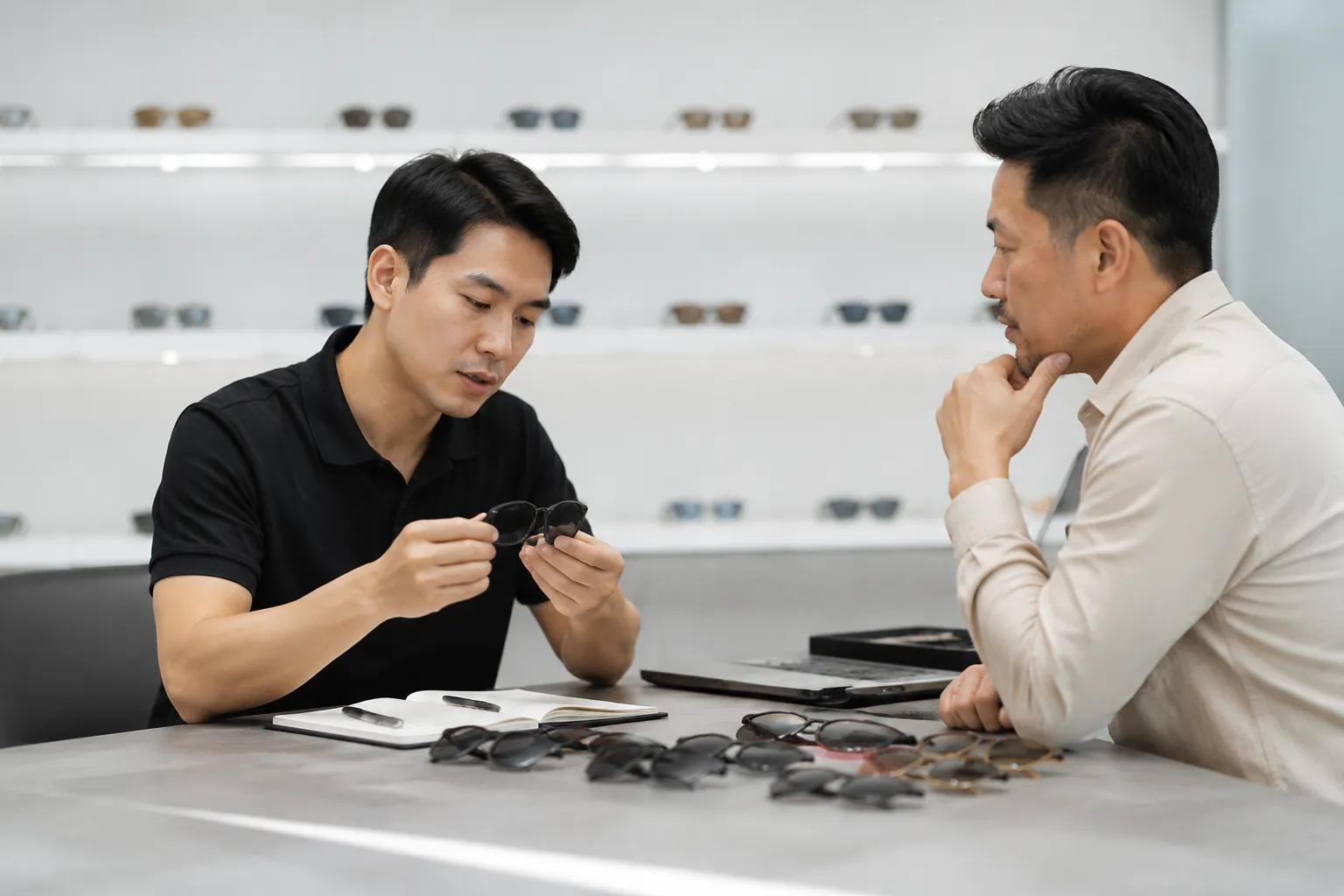
This guide is for brand owners, importers, distributors, and retailers buying custom sunglasses in volume. Do not start with the lowest quote. Start by confirming whether a supplier can make your product with consistent fit, lens quality, decoration, documentation, and compliance support. Price matters. Process control matters more. If key steps are outsourced, standards are vague, or the factory cannot support your target market, a cheap quote can become an expensive order. Benchmark the factory first. Then compare quotes with context.
Start with a capability map, not a price sheet
Many buyers ask for pricing before they understand how a factory makes the product. That order creates risk. Before RFQ, build a capability map for the exact sunglass program you want to buy, then check each supplier against it. The goal is simple: identify which steps the factory controls directly, which are handled by a related facility, and which are outsourced.
For sunglasses, the core checkpoints are frame production, lens processing or sourcing, decoration, assembly, inspection, and packing. If critical steps are split across several vendors, control gets weaker. Timing slips more easily. Rework takes longer. Sample-to-bulk variation becomes harder to contain.
Outsourcing is not automatically a deal breaker. But every handoff adds another failure point. Color mismatch, packaging errors, delayed corrections, and inconsistent finishing often appear at those handoffs.
Ask the supplier to explain its process in operational terms, not marketing language. A claim like "we make custom sunglasses" tells you very little. It does not tell you whether the supplier molds frames, buys semi-finished parts, fits stock lenses, or sends logos to an outside decorator. You need a process map. Not a catalog claim.
- Request a full process list: material preparation, molding or cutting, CNC work, polishing, lens sourcing or tinting, decoration, assembly, inspection, and packing.
- Mark each process clearly: in-house, related facility, or outsourced vendor.
- Flag high-risk handoffs: outsourced lens tinting, outsourced logo plates, and off-site packing usually need tighter scheduling and clearer ownership.
- Ask who owns the standard: if a defect appears, who decides acceptance, rework, and remake responsibility?
If the supplier cannot explain the chain clearly, treat that as a warning. You may be dealing with a coordinator or trader rather than a factory with direct process control.
Check frame production depth by material and process
Frame capability is not a yes-or-no question. Injection-molded plastic, acetate, metal, and mixed-material sunglasses require different equipment, tooling, and operator skill. Benchmark the factory against the construction you plan to source, not against a broad product catalog.
For injection styles, ask who owns the mold, where molding happens, and how part consistency is controlled after molding. Then go deeper. Ask how parts are trimmed, how deformation is checked, and how fronts and temples are stabilized before assembly. A supplier that really manages injection production should be able to describe the workflow in practical terms.
For acetate styles, ask about sheet sourcing, CNC routing, groove machining, polishing steps, wire core insertion where relevant, and final hand finishing. Acetate can look premium. It can also expose weak process control fast. Uneven machining, over-polishing, or poor alignment can change the shape, affect lens fit, and create visible symmetry issues.
For combination styles, ask when metal parts or trims are fitted, how they are fixed, and when the assembly is checked for gaps, scratches, and alignment. Mixed-material sunglasses often carry more cosmetic risk because more parts must match both visually and mechanically.
Do not accept vague claims like "good quality" or "strict tolerance." Ask which dimensions and cosmetic points the factory checks during production and before packing. A reliable supplier should be able to show control points for symmetry, hinge fit, lens seating, temple alignment, and surface finish.
Benchmark lens processing before you discuss color or price
Frames shape the look. Lenses often decide whether the product passes inspection and whether it is suitable for sale in the target market. Some suppliers buy finished lenses and only fit them into the frame. Others also manage tinting, coating coordination, or lens inspection. That difference matters. Lens problems can turn a strong quote into a claim very quickly.
Ask exactly what the supplier does with lenses. Does it source finished lenses from an outside vendor? Tint lenses in-house? Inspect visible defects before assembly? Keep incoming inspection records or batch records? These are basic questions, but the answers show how much control the supplier actually has.
Also ask about defect criteria in plain production language. Common checkpoints include scratches, bubbles, flow marks, optical distortion, edge chipping, and left-right shade mismatch. If the supplier cannot define what it rejects, it is not controlling the risk well enough for private-label work.
| Checkpoint | What to Ask | Practical Benchmark | Why It Matters |
|---|---|---|---|
| Lens tinting | In-house or outsourced, batch control method, match standard | Supplier can explain how left-right shade consistency is checked and recorded | Reduces remake risk and visible color mismatch |
| Visible light transmission | Target lens category and target market requirements | Lens category is confirmed before mass production and tied to the intended market | Keeps product design aligned with legal sale requirements |
| Lens defect control | Scratch, bubble, distortion, and edge-chip criteria | Inspection is carried out under a defined lighting and viewing method before assembly | Prevents complaint-heavy bulk shipments |
| Compliance support | CE EN ISO 12312-1, ANSI Z80.3, AS/NZS 1067, REACH, FDA registration | Current documents are available and can be matched to the relevant lens and frame construction | Confirms market readiness and importer documentation support |
Do not accept a line like "we can pass CE." Ask which standard, which test report, which lens material, and whether the report applies to the sunglass type you plan to buy. Compliance documents must match the product closely enough to be useful.
Compare decoration methods by failure mode, not sample photo
Decoration is a common failure point in private-label sunglass programs. A sample may look fine. Bulk goods may arrive with rubbed logos, crooked plates, inconsistent color, or obvious placement variation. Judge decoration by how it fails in production, not by the best sample on the table.
Common options include laser engraving, pad printing, and metal logo plates. Each has different control points and different risks.
- Laser engraving: repeatable when the base material and artwork fit the process, but final visibility depends on material contrast and engraving effect.
- Pad printing: flexible for color logos and small graphics, but results depend on surface preparation, ink compatibility, curing control, and abrasion resistance.
- Metal logo plates: can create a premium look, but placement accuracy, fixing method, and cosmetic consistency are critical.
Ask for a decoration control sheet or equivalent work standard. It should define measurable points such as logo position reference, acceptable alignment, color reference if applicable, adhesion or rub-check method, and cosmetic acceptance criteria. Without a written standard, approval disputes are far more likely during bulk production.
For metal logo plates, ask exactly how they are fixed: adhesive only, pin plus adhesive, or another mechanical method. For pad printing, ask whether the factory performs a rub test or tape check after curing and whether the surface is pretreated when needed. For laser marking, ask how the mark appears on the actual production material. The result can change by substrate.
One more check matters. Ask to inspect several decorated pieces from the same run. One selected sample tells you very little about consistency.
Audit the QC path from incoming parts to packed cartons
Do not ask whether the factory has QC. Almost every supplier will say yes. Ask how inspection is staged, what is recorded, and what happens when a batch fails. That is where the real answer sits.
A practical sunglasses QC system usually includes incoming inspection, in-process control, assembly inspection, and final inspection. The labels are not the point. The point is whether each stage has clear checkpoints, responsible staff, and traceable records.
- Incoming inspection: check frame parts, hinges, lenses, logo accessories, labels, and packaging components before production starts.
- In-process control: check part condition, machining or molding result, decoration position, lens appearance, and polishing quality during production.
- Assembly inspection: verify hinge function, screw fit, lens seating, symmetry, opening and closing feel, and obvious sharp-edge or cosmetic issues.
- Final inspection: confirm appearance, quantity, labeling, packaging accuracy, and carton condition before shipment release.
Ask how the supplier separates passed goods, rework goods, and rejected goods. Ask where rework is recorded, who approves it, and whether final inspection is tied to an approved sample. These details matter more than a broad claim of "100% inspection."
You should also ask who reviews nonconformities and how the factory decides whether to stop production, rework a batch, or replace parts. A supplier that can explain escalation clearly is usually easier to manage when problems show up. And they will.
Use MOQ, price breaks, and lead times to test factory fit
MOQ and lead time are not just sales terms. They show how the supplier is set up and whether its process depth matches your sourcing model. A factory may advertise low MOQ, fast samples, and short bulk lead times. Fine. Those numbers only matter if the production route behind them is realistic.
| Order Stage | Typical Volume | What to Benchmark | Commercial Logic | Buyer Risk |
|---|---|---|---|---|
| Market test | Low-volume trial order | Sample accuracy, logo execution, and consistency of manual finishing | Unit cost is often higher because setup and handling are spread over fewer pairs | Variation risk can be higher, but financial exposure is smaller |
| Standard launch | Mid-volume production order | Color repeatability, stable assembly, and packaging control | Pricing may improve if the supplier can schedule production more efficiently | Defects can affect multiple stores, channels, or launch dates |
| Program volume | Higher-volume repeat order | Material planning, production continuity, defect containment, and shipment scheduling | Lower pricing usually depends on stable yield, organized purchasing, and fewer interruptions | Delays and repeat defects become more expensive and harder to correct quickly |
Ask what changes operationally as order volume rises. Does the supplier change tooling setup, allocate dedicated line time, buy materials in larger lots, or tighten scheduling with outside vendors? If the price drops at higher volume, the supplier should be able to explain why in production terms.
Lead times also need to be unpacked. Ask what the sample lead time assumes: stock mold or new mold, standard lens or custom tint, standard packaging or custom box. Then ask the same about bulk lead time. If lenses, logo hardware, or gift packaging come from outside vendors, those dependencies should be stated clearly.
If a factory offers an unusually aggressive price, ask what is excluded. Clarify whether tooling, testing, packaging, logo charges, replacement parts, or remake responsibility are included in the quote or billed separately.
Verify compliance and management claims the practical way
Do not ask for a certification pitch. Ask for relevant documents and verify whether they match the product you are buying. Start by separating management-system claims from product-compliance claims.
ISO 9001 and BSCI relate to management systems or social compliance practices. They can be useful signs of process discipline or audit readiness. They do not prove that a sunglass model meets product-performance or chemical requirements for sale. Product-facing requirements are different. Depending on the market and product, buyers may need to review CE EN ISO 12312-1, ANSI Z80.3, AS/NZS 1067, REACH, and FDA registration documents where applicable.
- Request current copies: ask for complete documents, not screenshots or expired files.
- Check the scope: confirm the documents apply to sunglasses and not only to another eyewear category.
- Match the construction: review whether the lens material, tint, coating, and frame construction are consistent with the product you plan to buy.
- Separate paperwork from performance: FDA registration does not replace product testing to ANSI Z80.3 or other applicable performance standards.
Also ask who manages document control when the design changes. If the lens tint, coating, material, or overall construction changes, ask whether the supplier recommends updated testing or a new review with the lab. A supplier that answers this clearly is usually more reliable during product updates and repeat orders.
Run a pre-quote scorecard and cut weak suppliers early
Before RFQ, score each supplier against the same benchmark points. Keep it simple. Keep it evidence-based. The goal is not to build a heavy audit file. The goal is to cut weak suppliers before price distracts the team.
Use a 1-to-5 score for process control, frame capability, lens control, decoration reliability, QC structure, compliance readiness, MOQ fit, and lead-time credibility. Under each score, add one short note of evidence. For example: "Lens inspection criteria provided and tied to batch records," or "Logo plate supplier outsourced and fixing standard not defined." The note matters more than the number because it captures the operational risk.
Once the scorecard is complete, request the quote and compare it in context. At that point, you can judge what is included, what depends on outside vendors, what documentation is available, and where the main execution risks sit. That is how experienced buyers avoid false savings and choose a supplier that can support both launch and repeat orders.
Have a custom sunglasses project in mind?
Send us your styles, target market and quantities and we will return a detailed quote with MOQ, lead time and a sample plan.
Get a QuoteWhy source this from Wenzhou with LumiShades
Wenzhou in Zhejiang Province is widely regarded as China’s eyewear manufacturing capital, producing a large share of the world’s sunglasses. That concentration matters to buyers: a deep local supply chain for acetate sheet, hinges, lens blanks, plating and packaging means shorter component lead times, easier color and material matching, and a workforce with decades of eyewear-specific skill. LumiShades has manufactured in this ecosystem since 2009, and our vertical integration — in-house injection molding, acetate cutting, CNC milling, lens tinting, decoration and quality control — means no part of your order is quietly subcontracted to a workshop you cannot audit.
For international buyers, that vertical control translates into accountability. When a single factory owns every step, defects are traced and fixed at source rather than bounced between vendors, and your specifications survive intact from first sample to bulk. We back this with 15+ years of experience, shipments to 60+ countries, more than 5 million pairs produced per year and a 98.5% on-time delivery rate. Our certifications — CE EN ISO 12312-1, FDA registration, ANSI Z80.3, AS/NZS 1067, REACH, ISO 9001 and BSCI audit — mean the compliance documentation your market requires already exists. Explore our manufacturing capabilities and quality control process to see how this works in practice.
Frequently asked questions
What is the first document I should ask for before requesting a quote? Ask for a process capability summary that shows each production step for your program and identifies whether that step is in-house, handled by a related facility, or outsourced. It should cover frame production, lens sourcing or processing, decoration, assembly, inspection, and packing. If the supplier cannot provide a clear process map, ask for a written production flow plus sample photos or video of the relevant steps before moving to RFQ.
How do I compare two factories that both claim low MOQ? Compare the operating conditions behind the MOQ, not just the number. Ask each supplier what is included at that MOQ: logo method, packaging type, sample lead time, tooling assumptions, and whether the sample is production-representative. Then compare how each factory controls lens appearance, frame consistency, decoration quality, and repeat-order matching. A low MOQ only helps if the supplier can reproduce the approved sample in the next batch.
Does FDA registration mean the sunglasses meet US product standards? No. FDA registration is not the same as product-performance compliance. For the US market, ask separately for evidence related to ANSI Z80.3 where applicable, and make sure the documents are relevant to the sunglass type you plan to import. If the supplier only provides FDA registration, treat that as incomplete compliance support, not proof of product performance.
Why does in-house lens tinting matter for a buyer? It can give the supplier more direct control over shade development, left-right lens matching, batch consistency, and traceability. It can also make color adjustments faster during sampling. If tinting is outsourced, ask who performs it, how shade approval is controlled, how batches are identified, and who is responsible if bulk color differs from the approved sample.
What is a realistic way to test decoration quality before bulk production? Approve a production-representative sample, then ask for a written decoration standard that covers logo position reference, acceptable alignment, color reference where applicable, adhesion or rub-check method, and cosmetic acceptance criteria. For metal logo plates, confirm the fixing method in writing. Before approving bulk production, ask to review several pieces made in the same run so you can judge consistency, not just one display sample.
Ready to start?
Explore our sport wrap sunglasses or request a quote — our sales team replies within 12 hours.
Request a Quote