
Metal Logo Plates Without Production Delays
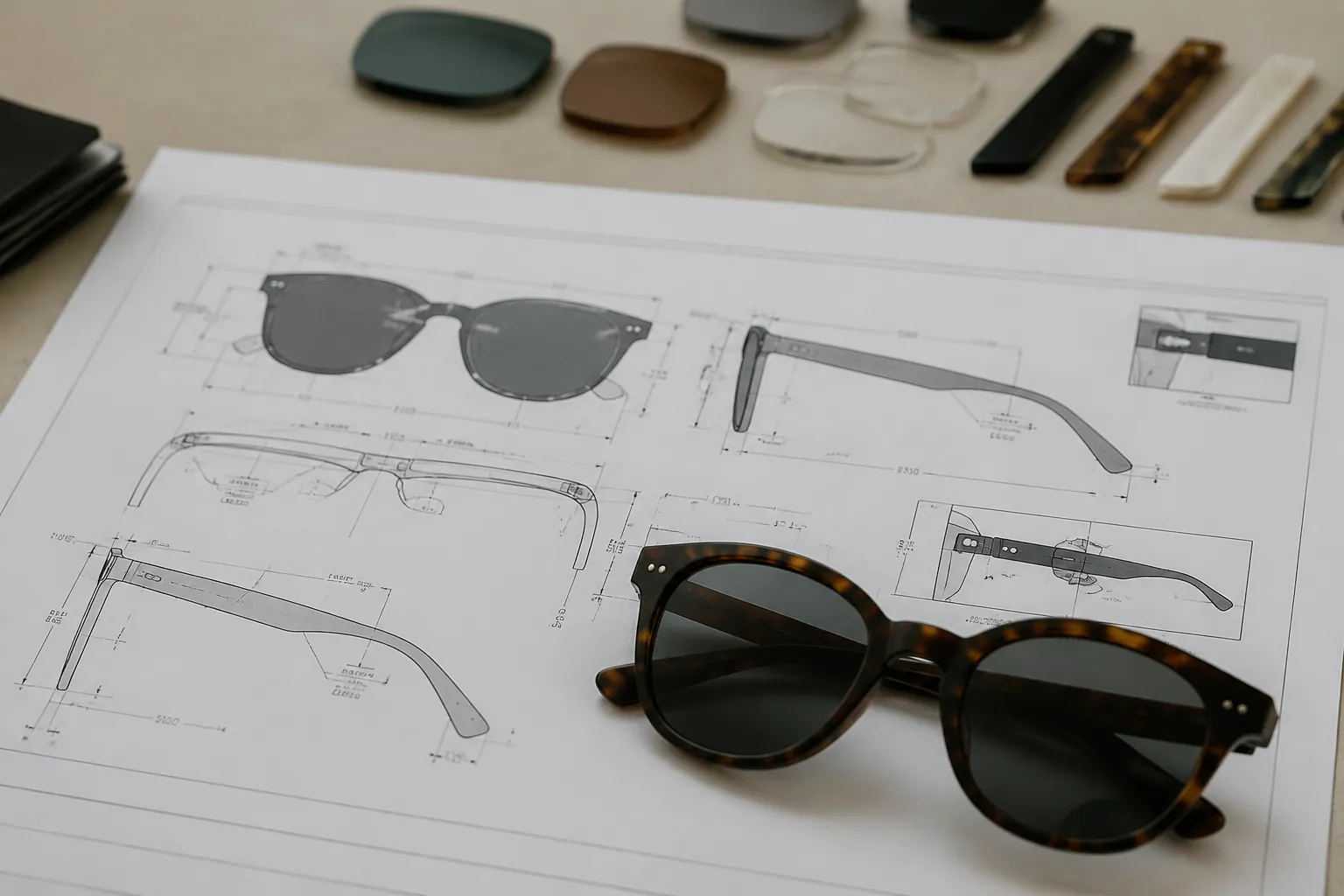
This guide is for brand owners, importers, distributors, and retailers sourcing custom sunglasses in volume. Metal logo plates can raise perceived value, but they also create avoidable delays when the spec is incomplete. The fix is simple: define the plate as an engineered component early. Lock the artwork, material, finish, attachment method, temple preparation, placement, and QC standard before sampling starts.
Start with the delay points, not the logo idea
Most delays tied to metal logo plates do not start with the logo artwork. They start with late decisions on plate size, attachment method, finish, and temple preparation. Buyers often approve the frame shape first and add hardware later, after mold design, CNC programming, polishing, or sample assembly planning is already underway. That creates rework.
The main risk points are predictable. A metal plate needs its own part drawing and may require stamping, laser cutting, CNC cutting, polishing, plating, brushing, or paint fill, depending on the design. The temple may need a flat bonding area, a milled pocket, drilled holes, or a screw seat. On acetate, machining order affects pocket edge quality and final polishing. On injection-molded plastic, wall thickness, local geometry, and resin behavior affect hole stability, sink risk, and usable bonding area.
In production terms, a logo plate is not just decoration. It changes how the temple is built. If the hardware spec is approved after acetate temples are already machined, the factory may need to revise the CNC program, change a fixture, or rework the polishing sequence. If the hardware is added after an injection mold design is frozen, the request may require a mold change, not a simple assembly update.
That is why buyers should lock logo hardware when they confirm frame material, temple thickness, hinge layout, and target price. Treat the plate as part of the product structure. Not a last-step branding detail.
Choose the attachment method before sampling starts
Different attachment methods create different risks in cost, lead time, assembly speed, and cosmetic control. There is no universal best option. The right choice depends on frame material, target price, plate size, logo detail, and expected wear conditions.
| Method | Typical Plate Size | Best Use | Main Risk | Sampling Impact | Bulk Impact |
|---|---|---|---|---|---|
| Adhesive plate on flat surface | 8-20 mm length, 0.4-0.8 mm thick | Entry to mid-tier private-label styles on injection or acetate | Edge lifting if surface is curved, oily, or over-polished | Low if size and finish are fixed early | Low to medium; needs bond-strength and position QC |
| Embedded plate in milled pocket | 12-30 mm length, 0.5-1.0 mm thick | Premium flush look with better tactile finish | Pocket tolerance too loose or too tight, visible gaps | Medium; requires stable CNC or mold prep | Low once fixture and depth are confirmed |
| Pinned or riveted plate | 15-35 mm length, 0.6-1.2 mm thick | Heavier-use styles, larger badges, stronger mechanical hold | Misaligned holes, whitening, cracking, or stress marks | Medium to high; hole position must be tested | Medium; slower manual alignment |
| Plate combined with screw fixing | 20-40 mm length, 0.8-1.5 mm thick | Oversized decorative hardware and fashion statement styles | More parts, loosening risk, higher reject rate | High; multiple components to validate | High; slowest assembly speed |
For many custom sunglasses programs, the lowest-risk starting points are a small adhesive plate on a designed flat area or a pocket-mounted plate with a simple rectangular or oval shape. Both are usually easier to control than multi-part hardware or heavily sculpted badges.
If you want a flush metal logo plate, ask for three dimensions on the approved drawing: plate thickness, pocket depth, and allowed flushness. Do not rely on phrases such as flush look or clean fit. The drawing should state whether the plate may sit proud, true flush, or slightly recessed, and by how much.
Also, do not approve a rendering alone. A rendering shows the intended appearance. It does not confirm how the part will be fixed, how the temple will be prepared, or what tolerance the factory can inspect against.
Lock three drawings: artwork, hardware, and placement
One common cause of delay is trying to use one approval file for three different jobs. Separate the approvals into artwork, hardware, and placement documents.
- Artwork file: confirm the final logo shape, line thickness, enclosed spaces, emboss or deboss detail, and finish direction if the surface will be brushed. If a logo contains very fine strokes or small enclosed areas, ask the supplier to confirm whether the process can reproduce them consistently after finishing.
- Hardware drawing: confirm plate length, width, thickness, corner radius, pin diameter if used, back-surface condition, and decoration method such as polished stainless steel, brushed aluminum, nickel-color finish, laser marking, enamel fill, or pad printing on metal.
- Placement drawing: confirm exact location from a defined reference point such as hinge center or temple front, orientation, left-right symmetry, curvature of the mounting area, and whether the temple needs a pocket, flat land, or drilled holes.
This is where tolerance must be stated in measurable terms. Instead of saying centered or aligned, specify the allowable placement tolerance, flushness condition, and hole-position tolerance where relevant. The correct tolerance depends on plate size, attachment method, material, and visible location, so buyer and supplier should agree it from the actual design and process capability.
State clearly whether the left and right temples mirror each other exactly and whether logo orientation changes on the opposite side. It sounds obvious. It still gets missed when a purchase order says only metal logo on temple without a drawing tied to the approved sample.
Match the plate spec to the frame material
Metal logo plates behave differently on injection frames and acetate frames. Do not assume the same badge design transfers directly across both constructions.
On injection-molded temples, the key issues are surface geometry, resin behavior, and local wall thickness. A plate bonded to a curved or textured area is more likely to show edge lift than a plate bonded to a defined flat area. If pins or rivets are used, the wall section around the hole needs enough material to reduce stress marks, cracking, or visible whitening, especially on high-gloss or transparent colors where defects show easily.
On acetate temples, the main variables are machining order and polishing control. A pocket milled too early can lose edge definition during tumbling or hand polishing. A pocket milled too late adds handling and machining steps after finishing. Ask when the pocket is cut, how the edge is protected during polishing, and whether the plate is installed before or after final surface finishing.
Plate material matters too. Stainless steel is common for thin, durable plates and suits small premium details. Aluminum is lightweight and can give a clear brushed look, but it dents more easily. Zinc alloy allows more sculpted or raised forms, but it is heavier and often needs a thicker section. Select the material together with temple thickness, target weight, and attachment method. Not on appearance alone.
Keep the price logic in view. More complex hardware usually means more process steps, more inspection points, and more assembly variation. Confirm early that the chosen hardware fits the intended price tier and order scale.
Use a cost and lead-time filter before approving premium hardware
Metal logo plates add both direct cost and process cost. Direct cost includes the metal part, finish, and assembly labor. Process cost includes artwork cleanup, trial fitting, fixture preparation, incoming inspection, and slower assembly during initial production if the part is hard to position or protect from scratches.
For a new project, review hardware against the following checkpoints before approval:
- MOQ fit: at low quantities, standard shapes and simple finishes are usually easier to justify than custom 3D hardware with multiple decoration steps.
- Price tier: ask for the hardware cost impact at sample quantity and at expected production quantities so you can compare the design with the business case.
- Tooling exposure: confirm whether the part needs stamping tooling, laser cutting, CNC edge cleanup, pocket fixtures, drilling jigs, or protective packing materials.
- Schedule effect: ask whether the plate can be produced within the sample schedule or whether it is likely to become the critical path.
- Finish complexity: polished, brushed, antique-tone, paint-filled, and dual-tone finishes do not carry the same cosmetic risk or lead-time requirement.
A capable supplier should explain the sequence clearly: artwork confirmation, part drawing approval, plate fabrication, finish treatment, trial fitting on the temple, surface cleaning, fixing, cure time if adhesive is used, in-process inspection, and final QC. If the process description is vague, the schedule risk is harder to control.
For bulk orders, line balance matters. If frames are ready but plates are still in finishing, or if incoming metal parts fail cosmetic inspection, a small trim detail can stop packing and shipment. Freeze hardware finish early. Avoid last-minute requests for brushed-direction changes, color-tone changes, or paint-fill revisions.
Build the sample in the same order planned for bulk
Many sample delays and later bulk problems happen because the first sample is built like a prototype, while bulk will be built like a production item. If a sample plate is hand-positioned without a fixture, but bulk will rely on a pocket, drilling jig, or alignment template, the approved sample may not represent repeatable production output.
Ask the factory to confirm the sample route in plain language. A realistic sequence might be: temple molding or machining, surface preparation, metal plate fabrication, cleaning, fixture positioning, bonding or pinning, cure or setting time if applicable, visual inspection, handling check, and packing. If any step is temporary for the sample only, that should be disclosed before approval.
It is usually better to spend extra time on one complete sample built with the intended attachment method than to approve a cosmetic-only sample and discover during pre-production that the pocket depth is wrong, the adhesive leaves visible edge lift, or the finish scratches too easily during assembly.
Photo review standards help. Before sample shipment, ask for front view, side view, macro close-up, and left-right pair comparison photos of the logo plate area. A macro image can reveal gap lines, raised edges, pin alignment issues, or finish inconsistency that a standard product photo will not show clearly.
For bulk, request first-article confirmation from the first assembled pairs, especially when the badge design or attachment method is new. This checkpoint helps catch repeatable placement or finish issues before the full lot is completed.
Put the right QC checks on the purchase order
If the purchase order only says metal logo on temple, the QC team does not have a measurable standard to inspect against. The PO or approved specification sheet should include specific checks tied to the final production version.
- Placement: define the location from a fixed reference point such as hinge center or temple end, plus the allowed tolerance.
- Flushness: state whether the plate must be flush, slightly proud, or slightly recessed, and specify the acceptable condition.
- Fixing check: define how the attachment will be verified, such as pull or peel verification for adhesive parts, or seating and alignment checks for pinned parts.
- Finish: define the plating tone or metal finish, brushed direction if applicable, paint-fill color if used, and the acceptable cosmetic standard for scratches or marks.
- Pair matching: left and right temples should match in angle, position, orientation, and visual level.
- Protection: state whether the metal parts need protective film or other scratch-prevention measures during packing and transport.
For compliance, metal logo plates do not replace the core frame and lens requirements. The finished sunglasses still need to meet the applicable standard for the destination market, such as CE EN ISO 12312-1, ANSI Z80.3, or AS/NZS 1067 where required. Materials and surface treatments should also remain aligned with REACH expectations for relevant markets. If the product is entering the US, buyers often request FDA registration information together with the applicable eyewear test file. Keep the compliance file tied to the final approved production specification, not an earlier version before hardware changes.
ISO 9001 and BSCI matter only if they support real process control. In practice, that means locked drawings, incoming metal-part inspection, in-process position checks, adhesive control where relevant, and final release criteria that match the approved purchase order and sample.
A practical decision framework for buyers
If you want premium logo hardware without slowing the project, make the decision in a strict sequence.
- Choose frame material first: injection and acetate require different temple preparation and may support different fixing methods.
- Choose attachment method second: adhesive, pocket, pin, or screw should be selected before final artwork approval.
- Approve three documents: artwork, metal-part drawing, and placement drawing should not be merged into one vague sign-off.
- Check MOQ and price logic: confirm whether the chosen hardware still makes sense at the expected order quantity and target sell-in price.
- Build the sample as bulk intends to build: do not approve temporary shortcuts that cannot be repeated in production.
- Write QC points into the PO: placement, finish, flushness, fixing method, and pair matching should all be measurable.
This is the mindset that prevents avoidable delays. Good hardware is manageable when it is specified early. Late hardware creates confusion, rework, and unstable lead times. If the supplier has a clear process for temple preparation, hardware approval, assembly, and QC, the project moves faster and with fewer approval loops. The key is simple: treat the metal logo plate as a controlled component from the start, with dimensions, tolerances, finish standards, and inspection criteria confirmed before sampling begins.
Have a custom sunglasses project in mind?
Send us your styles, target market and quantities and we will return a detailed quote with MOQ, lead time and a sample plan.
Get a QuoteWhy source this from Wenzhou with LumiShades
Wenzhou in Zhejiang Province is widely regarded as China’s eyewear manufacturing capital, producing a large share of the world’s sunglasses. That concentration matters to buyers: a deep local supply chain for acetate sheet, hinges, lens blanks, plating and packaging means shorter component lead times, easier color and material matching, and a workforce with decades of eyewear-specific skill. LumiShades has manufactured in this ecosystem since 2009, and our vertical integration — in-house injection molding, acetate cutting, CNC milling, lens tinting, decoration and quality control — means no part of your order is quietly subcontracted to a workshop you cannot audit.
For international buyers, that vertical control translates into accountability. When a single factory owns every step, defects are traced and fixed at source rather than bounced between vendors, and your specifications survive intact from first sample to bulk. We back this with 15+ years of experience, shipments to 60+ countries, more than 5 million pairs produced per year and a 98.5% on-time delivery rate. Our certifications — CE EN ISO 12312-1, FDA registration, ANSI Z80.3, AS/NZS 1067, REACH, ISO 9001 and BSCI audit — mean the compliance documentation your market requires already exists. Explore our manufacturing capabilities and quality control process to see how this works in practice.
Frequently asked questions
Will a metal logo plate always increase sample lead time? Not always. A metal logo plate can fit into the sample schedule if the artwork, size, finish, attachment method, and temple preparation are approved at the start. Ask the supplier one direct question before sampling begins: is the metal plate on the critical path, or can it be produced in parallel with frame sampling? Also ask whether the sample will use the same fixing method planned for bulk. If the answer is unclear, treat the hardware as a lead-time risk.
What is the safest attachment method for a first order? For many first orders, a small adhesive plate on a clearly defined flat area is the lowest-risk option because it usually needs less temple modification and fewer fixtures than pinned, screwed, or multi-part hardware. To make it workable, ask the supplier to confirm the bonding surface condition, adhesive type or bonding process, alignment method, and inspection standard for position and edge lifting. If you want a more premium flush appearance, a pocket-mounted plate is a common next step, but it needs tighter control of pocket depth and plate size.
Can I use the same logo plate design on both acetate and injection frames? Sometimes, but do not assume one hardware spec will transfer unchanged. The visible logo can stay consistent while the plate thickness, back structure, fixing method, or temple preparation changes between acetate and injection. Ask for separate placement and hardware drawings for each construction, even if the logo shape is identical. That review should confirm how the temple will be prepared, how the plate will be fixed, and what tolerance the factory can hold on each material.
How should I control quality for metal logo plates in bulk production? Put the control points into the approved drawing and purchase order, not just into email notes. At minimum, define the placement reference point, allowed position tolerance, flushness condition, finish requirement, attachment check, and left-right pair matching standard. Then request first-article confirmation from the first assembled pairs and ask for close-up photos of the logo area before the full lot is completed. If the hardware is new, ask the supplier to keep retain samples from the approved first-article run for comparison during final inspection.
Do metal logo plates affect compliance testing? They can affect the final product specification, so the final approved hardware should be reflected in the production file linked to compliance records. The sunglasses still need to meet the applicable market standard, such as CE EN ISO 12312-1, ANSI Z80.3, or AS/NZS 1067 where required, and relevant material controls should remain aligned with REACH expectations. For US shipments, buyers often request FDA registration information together with the applicable eyewear test documentation. The practical step is simple: make sure the compliance file, approved sample, purchase order, and final hardware drawing all describe the same finished product.
Ready to start?
Explore our rimless sunglasses or request a quote — our sales team replies within 12 hours.
Request a Quote