
Laser Engraving, Pad Printing, or Metal Plates?
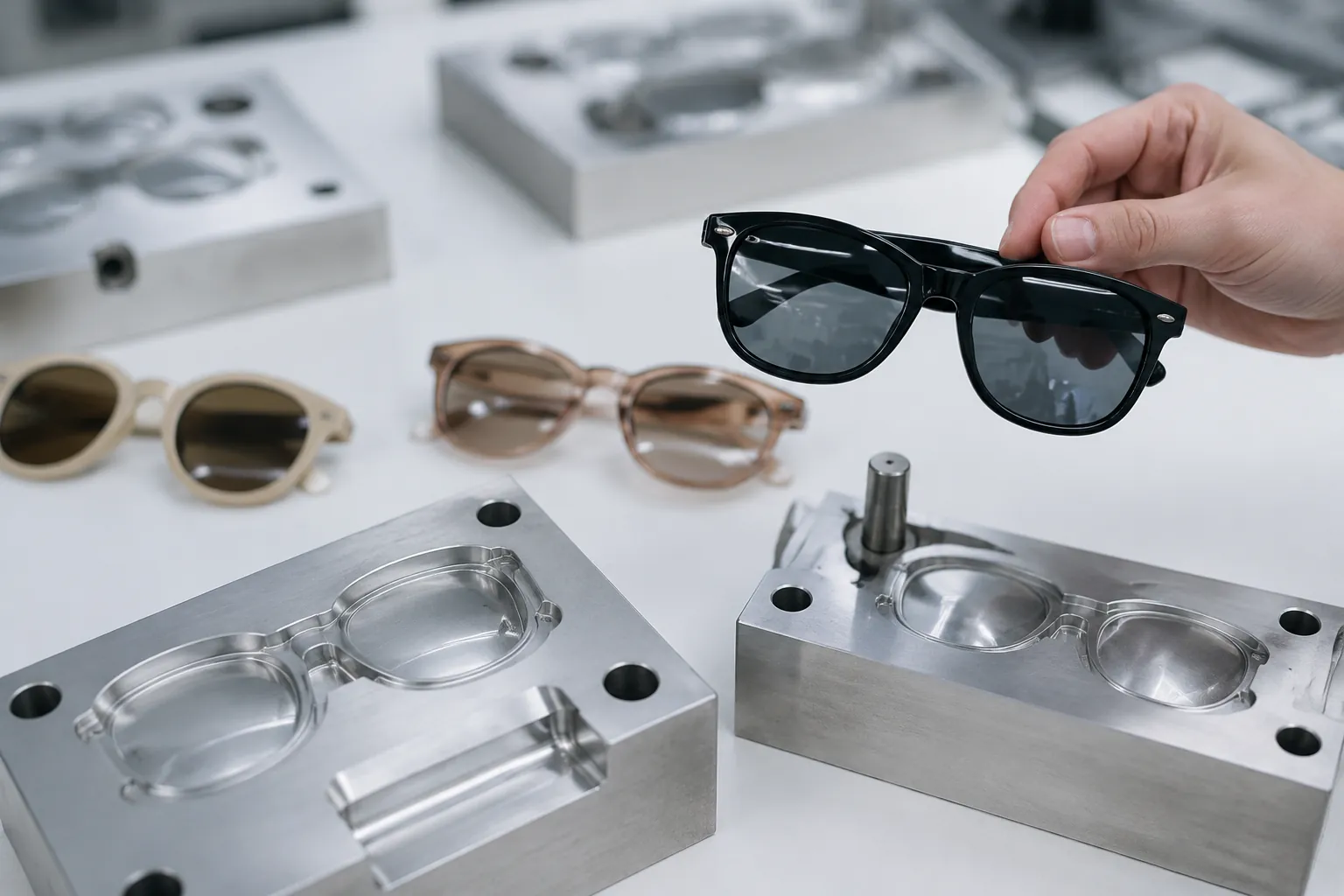
For volume buyers of custom sunglasses, branding is a production choice, not a cosmetic extra. The right logo method depends on frame material, surface geometry, price tier, wear conditions, and repeat-order consistency. This guide compares laser engraving, pad printing, and metal logo plates across one collection. It keeps the focus on manufacturability, inspection, and control across reorders. Written for brands, importers, distributors, and retailers that need clear specs and measurable QC.
Start with the collection logic
Most eyewear ranges mix materials, price points, and retail channels. One collection may include injection-molded sport frames, acetate lifestyle styles, and mixed-material premium models. If you force one branding method onto every SKU, something usually gives. The method will not suit the material, or the finish will miss the target tier.
Sort the range first. Entry. Core. Premium. Then match the logo method to material, geometry, and visual intent. In many cases, one branding language should cover most SKUs, with limited exceptions. For example, laser engraving can cover the range, while metal plates are reserved for selected acetate styles with enough temple width.
Make that decision during development. Not after bulk planning starts. Late changes trigger new artwork approval, new placement references, extra samples, and fresh QC rules. Branding belongs in the product spec. Period.
What each method does well
| Method | Best material and geometry | Typical control target | Cost and lead-time effect | Main risk |
|---|---|---|---|---|
| Laser engraving | Acetate, stainless steel, titanium, and some coated plastics on temples with enough usable width for clear marking | Placement tolerance should be defined on the drawing; minimum line width and engraving depth should be approved from production-like samples | Usually efficient once artwork, fixture, and settings are fixed | Low contrast on some dark or textured surfaces; excessive power can mark or haze sensitive materials |
| Pad printing | Flat or gently curved plastic or coated metal surfaces; best for one or two spot colors | Placement tolerance, color standard, and cure condition should be defined before approval | Setup and curing increase handling; each additional color adds alignment and process control requirements | Ink adhesion can fail on glossy, low-surface-energy, or high-rub areas if pretreatment and curing are not controlled |
| Metal logo plate | Acetate and thicker plastic temples with enough wall thickness and flat area for an insert, pin, or adhesive-mounted plate | Plate size, pocket fit, edge condition, and placement tolerance should all be specified on the sample approval sheet | Adds component sourcing, assembly, and inspection steps | Misalignment, edge lift, visible adhesive, sink marks, or poor fit if the temple structure is not designed for the plate |
Laser engraving is often the easiest to standardize once the artwork, location, and process settings are fixed. Pad printing is more sensitive to surface condition and curing control, so variation shows up faster if the process is loose. Metal plates create a stronger premium cue, but they are a component, not a simple decoration detail. Judge each method by repeatability. Not just by one good sample.
Match method to material and contact area
- Injection-molded frames: Laser can work for shallow marks, but contrast depends on resin color, texture, and finish. Pad printing is possible on suitable surfaces, but adhesion should be checked carefully on glossy, rubberized, or coated parts. Avoid aggressive engraving near thin temple sections or hinge stress areas.
- Acetate frames: Laser engraving is commonly used on inner or outer temples if the settings avoid whitening or uneven burn. Metal plates work only where the temple has enough flat width and local thickness for a clean pocket or secure attachment.
- Metal frames: Laser is often the cleanest option on stainless steel and titanium. Pad printing can work on painted or coated temple areas, but abrasion resistance and curing need to be checked on the actual finish.
- Mixed-material models: Two branding methods can live in one collection, but logo width, placement logic, and finish rules must stay controlled. Without that discipline, the range looks inconsistent even if each SKU passes on its own.
Material is only part of the call. Contact area matters too. Outer temple branding gets rubbed by hands, pouches, display handling, and daily wear. Weak ink or poorly seated plates fail there first. A logo that looks fine on a flat sample can behave differently on a curved sport temple, a polished acetate surface, or a narrow metal profile. Review the real geometry. Not a mock-up.
Set artwork and sample rules early
Brand consistency is usually lost in specification, not packing. Before first samples, issue one branding sheet per model with fixed coordinates, maximum logo size, finish notes, and any protected areas reserved for required markings.
- Measure logo position from a repeatable reference point such as the hinge center or temple start line.
- Keep logo width proportional to usable temple area so the mark does not crowd the edge, bend zone, or curved section.
- Define minimum clearance from top and bottom temple edges so placement can be checked consistently.
- Set a practical minimum text size and stroke weight based on the method, then verify legibility on an actual sample.
- For pad printing, define color with a Pantone reference. For metal plates, define finish and confirm the attachment method.
For laser engraving, ask for more than one setting if contrast or surface effect is uncertain. For pad printing, review a fully cured sample on the actual material and finish. For metal plates, inspect edge fit, alignment, and bond or fixing quality under normal handling. Do not approve from a photo alone. Check the sample in hand, under more than one light source, against the actual inspection reference.
Control cost with tiered branding
| Volume per design | Most practical branding choice | Typical added cost logic | Why it works |
|---|---|---|---|
| Low-volume trial orders | Laser engraving or one-color pad print | Usually the simplest way to avoid added components and reduce setup complexity | Suitable for testing artwork, placement, and market response with lower process risk |
| Mid-volume programs | Laser across most SKUs; pad print where brand color is important | Setup and approval effort can be spread across more units if the specifications stay stable | Balances visual branding with manageable production control |
| Higher-volume collections | Tiered mix, including metal plates on selected acetate hero styles | Additional hardware and assembly become easier to justify when used selectively rather than across the full range | Allows premium detailing where it adds clear value without overcomplicating every SKU |
| Repeat programs with stable specifications | Frozen artwork, fixed placement, and consistent decoration method by SKU | Process efficiency improves when approvals and fixtures do not need to be reworked each cycle | Best path for consistency, fewer avoidable errors, and smoother replenishment planning |
Cost control is less about the decoration method itself and more about variables. Every extra print color, plate finish, artwork revision, or placement change can trigger another setup, another approval, and another chance for error. If MOQ is tight, keep the system simple at first. Add complexity only where the material, volume, and retail position justify it.
Plan total lead time
Decoration sits inside the production schedule. It has to fit around material prep, frame processing, lens work, assembly, inspection, and packing. So the branding method should be reviewed as part of the critical path, especially for mixed-material orders or collections with multiple logo treatments.
Laser engraving is often easier to integrate once settings and fixtures are fixed. It does not need ink curing or separate component fitting. Pad printing usually takes more control around ink prep, alignment, and curing, so handling steps increase. Metal logo plates add a separate component plus fitting and inspection. Buyers should also account for plate approval, attachment quality, and visual alignment during final QC. If faster repeat orders matter, keep artwork, placement, finish, and packaging stable from one PO to the next.
Treat compliance and durability as part of the brief
Branding belongs in the product approval pack for the destination market. It is not just a visual choice. Depending on the market, buyers may need to consider CE EN ISO 12312-1, ANSI Z80.3, AS/NZS 1067, REACH, FDA registration, ISO 9001, and BSCI. Decoration must fit those requirements and any mandatory markings that must stay visible and legible.
Common problems are easy to avoid: a pad print covering required inner-temple information, a logo plate taking the area needed for legal markings, or an engraving setting that damages a coating. Before bulk approval, check the decorated sample for marking readability, plate edge smoothness, print adhesion, and surface stability after normal handling. Useful in-house checks include tape adhesion for printed areas, repeated dry-rub evaluation, hinge-area flexing where relevant, and a basic sweat- or solvent-resistance review on exposed finishes. These do not replace formal testing. They do screen out weak choices early.
Have a custom sunglasses project in mind?
Send us your styles, target market and quantities and we will return a detailed quote with MOQ, lead time and a sample plan.
Get a QuoteWhy source this from Wenzhou with LumiShades
Wenzhou in Zhejiang Province is widely regarded as China’s eyewear manufacturing capital, producing a large share of the world’s sunglasses. That concentration matters to buyers: a deep local supply chain for acetate sheet, hinges, lens blanks, plating and packaging means shorter component lead times, easier color and material matching, and a workforce with decades of eyewear-specific skill. LumiShades has manufactured in this ecosystem since 2009, and our vertical integration — in-house injection molding, acetate cutting, CNC milling, lens tinting, decoration and quality control — means no part of your order is quietly subcontracted to a workshop you cannot audit.
For international buyers, that vertical control translates into accountability. When a single factory owns every step, defects are traced and fixed at source rather than bounced between vendors, and your specifications survive intact from first sample to bulk. We back this with 15+ years of experience, shipments to 60+ countries, more than 5 million pairs produced per year and a 98.5% on-time delivery rate. Our certifications — CE EN ISO 12312-1, FDA registration, ANSI Z80.3, AS/NZS 1067, REACH, ISO 9001 and BSCI audit — mean the compliance documentation your market requires already exists. Explore our manufacturing capabilities and quality control process to see how this works in practice.
Frequently asked questions
Can I mix laser engraving and pad printing in the same collection? Yes, if the split follows a clear rule such as material family or price tier. Keep the logo position measured from the same reference point on every SKU, keep logo width visually consistent, and issue one branding sheet per model. During sampling, compare the full collection side by side so the mix looks deliberate, not random.
Which method is safest for small text? Laser engraving is usually the safer option for small text when the substrate gives enough contrast and the stroke width is adequate. Do not approve from artwork alone. Ask for a production-like sample on the actual material, then verify legibility at normal viewing distance and under store lighting. If the text is regulatory or traceability-related, make sure it does not interfere with required markings.
Will a metal logo plate work on every frame? No. It is usually better suited to acetate or thicker plastic temples with enough flat area and structural thickness for a pocket, pin, or adhesive-mounted plate. Before approving it, ask how the plate is attached, whether the temple was designed for that attachment method, and how alignment and edge condition will be checked in QC.
How do I keep branding costs down at low MOQ? Use one decoration method across most of the range, limit logo variants, and avoid extra colors or hardware unless they are commercially necessary. Ask for a quotation that separates tooling or setup from per-unit decoration cost so you can see what is driving the price. That makes simplification easier before the PO is placed.
Can decoration affect compliance? Yes. Decoration can cover required markings, reduce readability of legal text, or cause issues if it damages a coating or uses unsuitable materials. Include decoration in the approval pack for the destination market, confirm where required markings must appear, and review the final decorated sample against those requirements before bulk production starts.
Ready to start?
Explore our shield & oversized sunglasses or request a quote — our sales team replies within 12 hours.
Request a Quote