
MOQ by Eyewear Decoration Method
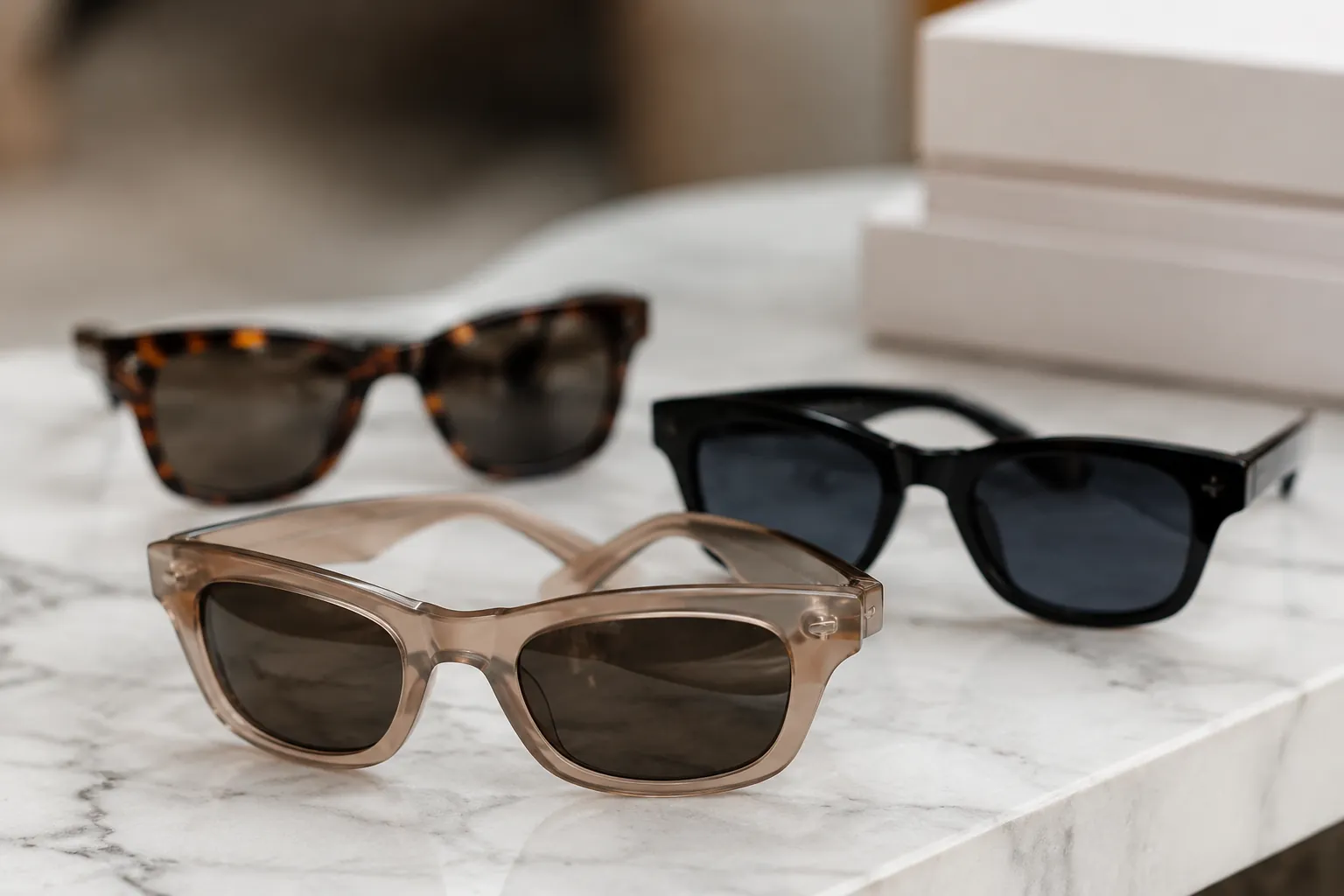
If you buy custom sunglasses for a brand, store chain, or distribution channel, MOQ is not just a factory rule. It changes with decoration method, setup time, scrap risk, material behavior, and the manual work on each pair. This guide compares the tradeoffs at 50, 300, and 1000 pairs so you can choose a branding method that fits your order size, frame material, and compliance needs before you commit.
Buyer checklist: pick the right MOQ and method
Use this to avoid wasted samples and extra setup work. The right choice usually becomes clear once you match the decoration method to the quantity, the frame material, and the required finish.
| If your order is... | Choose... | Why |
|---|---|---|
| 50 pairs | Laser engraving or simple one-color pad print | Lower setup burden, faster approval, and less risk if artwork changes |
| 300 pairs | Pad print, metal logo plate, or a simple mixed branding package | The fixed setup cost spreads out better, while repeatability is still manageable |
| 1000 pairs | Standardized branding package | Lower unit cost, easier replenishment, and more consistent production control |
- Send vector artwork, not a screenshot.
- State logo width in mm, not just "small."
- Confirm the exact frame material before choosing decoration.
- Ask for minimum line width, placement tolerance, and sample timing.
- Lock packaging early if it affects carton count, insert size, or logo placement.
Do not choose a decoration method only because it looks good in a mockup. Choose the method that can be produced at your target quantity without rework, extra handling, or avoidable reject risk.
What actually drives MOQ in eyewear decoration
MOQ is usually driven by the setup and handling needed before the first sellable pair is produced. More risk means more control. More control means more time.
The main drivers are artwork preparation, tooling or plate creation, operator time, curing or drying time, surface compatibility, and the number of quality checks needed before release. A method that works cleanly on one material may be inefficient or unstable on another.
Engraving is often practical on metal or hard-surface components because the mark is created directly in the material. Pad printing and screen printing depend more on ink transfer, surface prep, and drying control. Logo plates and packaging changes add separate components that may require their own minimums.
Laser engraving: best for small runs and durable marks
Laser engraving is often the most practical option when quantity is low and you want a durable, low-profile logo. It works well when the frame material accepts a clean mark without relying on ink or adhesive.
At 50 pairs, engraving is attractive because setup is limited and there is no ink color matching. The main risk is not the process itself. It is whether the logo size, surface shape, and material finish will reproduce legibly. Very fine details can disappear on textured or curved surfaces.
Use engraving when the brand wants a discreet mark and the frame material supports a stable result. Avoid it if the logo depends on strong color contrast or if the mark must stand out from a distance.
Pad print and screen print: flexible, but setup matters
Pad print is a common choice for eyewear because it can place a logo on curved or uneven surfaces with good efficiency. Screen print is usually better when the shape is flatter and the design is simple and repeatable.
These methods become more cost-effective as quantity rises because the same setup is reused across more pairs. At 50 pairs, a one-color print is usually the safest version because it limits registration issues and reduces the chance of rework. At 300 pairs and above, the setup cost is easier to absorb if the artwork is stable.
The key checks are ink compatibility, adhesion, curing time, and logo size. A print that looks correct on a sample can still fail if the substrate is too glossy, too flexible, or too hard to prepare consistently.
Metal logo plates and applied branding
Logo plates can work well when a buyer wants a more premium look or wants branding that is separate from the printed surface. They are often used when the order size is large enough to absorb the cost of the component and the attachment step.
At 300 pairs, a logo plate can be a practical middle ground if the design needs stronger visual impact than engraving but the buyer does not want a full custom mold or a more complex print workflow. The tradeoff is added handling, attachment control, and an extra component to inspect.
Check the actual frame material and placement area before approval. A plate that fits one frame shape may not sit cleanly on another. Verify the mounting method and thickness first.
Packaging changes: often overlooked, but cost and MOQ add up
Packaging can be a separate source of MOQ pressure because inserts, printed cartons, sleeves, and outer packaging often have their own setup needs. A simple logo change on the box may be easy, but a new insert size or custom tray can change the packing flow.
If packaging affects carton count, storage space, or the way pairs are packed for shipment, it can raise cost even when the decoration on the frame itself is simple. Confirm packaging early. Not after the branding method is fixed.
When the order is small, standard packaging is usually the easiest path. As volume increases, a branded packaging package can make sense if it supports the sales channel and does not create extra handling steps.
Compliance and quality control to verify before production
Decoration does not replace product compliance. The frame still needs to meet the relevant requirements for the market where it will be sold, and the chosen print, ink, adhesive, or plate must not compromise that result.
For sunglasses and eyewear, buyers commonly ask for evidence relevant to CE EN ISO 12312-1, ANSI Z80.3, AS/NZS 1067, REACH, and FDA registration where applicable. Factory management systems may also be supported by ISO 9001 or BSCI, but those are management or social compliance references, not product performance tests.
Before approval, confirm that the decoration method will not affect lens treatment, frame integrity, surface safety, or the legibility of required markings. Ask the supplier to show the actual material, placement, and artwork size that will be used in production.
Practical MOQ guidance by order size
At 50 pairs, prioritize the simplest method that gives acceptable brand visibility. At this level, the wrong decoration method can cost more in setup than the branding itself. Fewer colors and fewer steps are usually better.
At 300 pairs, you have enough volume to spread out setup work without committing to a fully standardized packaging or branding system. This is often the point where buyers can choose between durability, appearance, and cost with less pressure on unit economics.
At 1000 pairs, the focus should shift to repeatability and replenishment. Standard artwork, stable placement, and packaging that can be reordered without changes usually matter more than trying to optimize a single sample.
Have a custom sunglasses project in mind?
Send us your styles, target market and quantities and we will return a detailed quote with MOQ, lead time and a sample plan.
Get a QuoteWhy source this from Wenzhou with LumiShades
Wenzhou in Zhejiang Province is widely regarded as China’s eyewear manufacturing capital, producing a large share of the world’s sunglasses. That concentration matters to buyers: a deep local supply chain for acetate sheet, hinges, lens blanks, plating and packaging means shorter component lead times, easier color and material matching, and a workforce with decades of eyewear-specific skill. LumiShades has manufactured in this ecosystem since 2009, and our vertical integration — in-house injection molding, acetate cutting, CNC milling, lens tinting, decoration and quality control — means no part of your order is quietly subcontracted to a workshop you cannot audit.
For international buyers, that vertical control translates into accountability. When a single factory owns every step, defects are traced and fixed at source rather than bounced between vendors, and your specifications survive intact from first sample to bulk. We back this with 15+ years of experience, shipments to 60+ countries, more than 5 million pairs produced per year and a 98.5% on-time delivery rate. Our certifications — CE EN ISO 12312-1, FDA registration, ANSI Z80.3, AS/NZS 1067, REACH, ISO 9001 and BSCI audit — mean the compliance documentation your market requires already exists. Explore our manufacturing capabilities and quality control process to see how this works in practice.
Frequently asked questions
Can I order 50 pairs with my own logo? Yes, if the artwork is simple and the frame material supports the chosen method. For 50 pairs, laser engraving or a one-color pad print is usually the safest starting point. Keep the logo clean, avoid fine text, and confirm the logo width, placement, and surface finish before sampling.
Why is 300 pairs a common break point? Because fixed setup work becomes easier to absorb as the order gets larger. Below that point, sample preparation, color matching, and rework risk have a bigger impact on unit cost. Around 300 pairs, a buyer can usually compare methods on more balanced economics.
Which decoration method is cheapest at higher volume? Usually the simplest method that can be repeated with the least handling. For many eyewear jobs, that is one-color pad print or laser engraving, but the best option depends on the frame material, logo size, and whether the mark must be color-filled or highly visible.
Does decoration affect compliance? Yes, indirectly. The product still needs to meet the relevant standard for the market, including CE EN ISO 12312-1, ANSI Z80.3, AS/NZS 1067, REACH, and FDA registration where applicable. The decoration itself must also be compatible with the frame material and must not create adhesion, durability, or safety issues.
How long should I plan for samples and bulk production? Lead time depends on frame type, decoration method, and packaging complexity. Ask the supplier for a written sample schedule and bulk production schedule tied to your exact artwork, material, and packaging. A reliable quotation should separate sample approval time from mass-production time rather than giving one broad estimate.
What should I send to get an accurate quote? Send vector artwork, logo dimensions in millimeters, frame material, color requirements, decoration position, and packaging needs. If you have a target market, also share the compliance standard you need so the supplier can confirm whether the method is suitable before sampling.
Ready to start?
Explore our round sunglasses or request a quote — our sales team replies within 12 hours.
Request a Quote