
How to Source Polarized Sunglasses at Scale
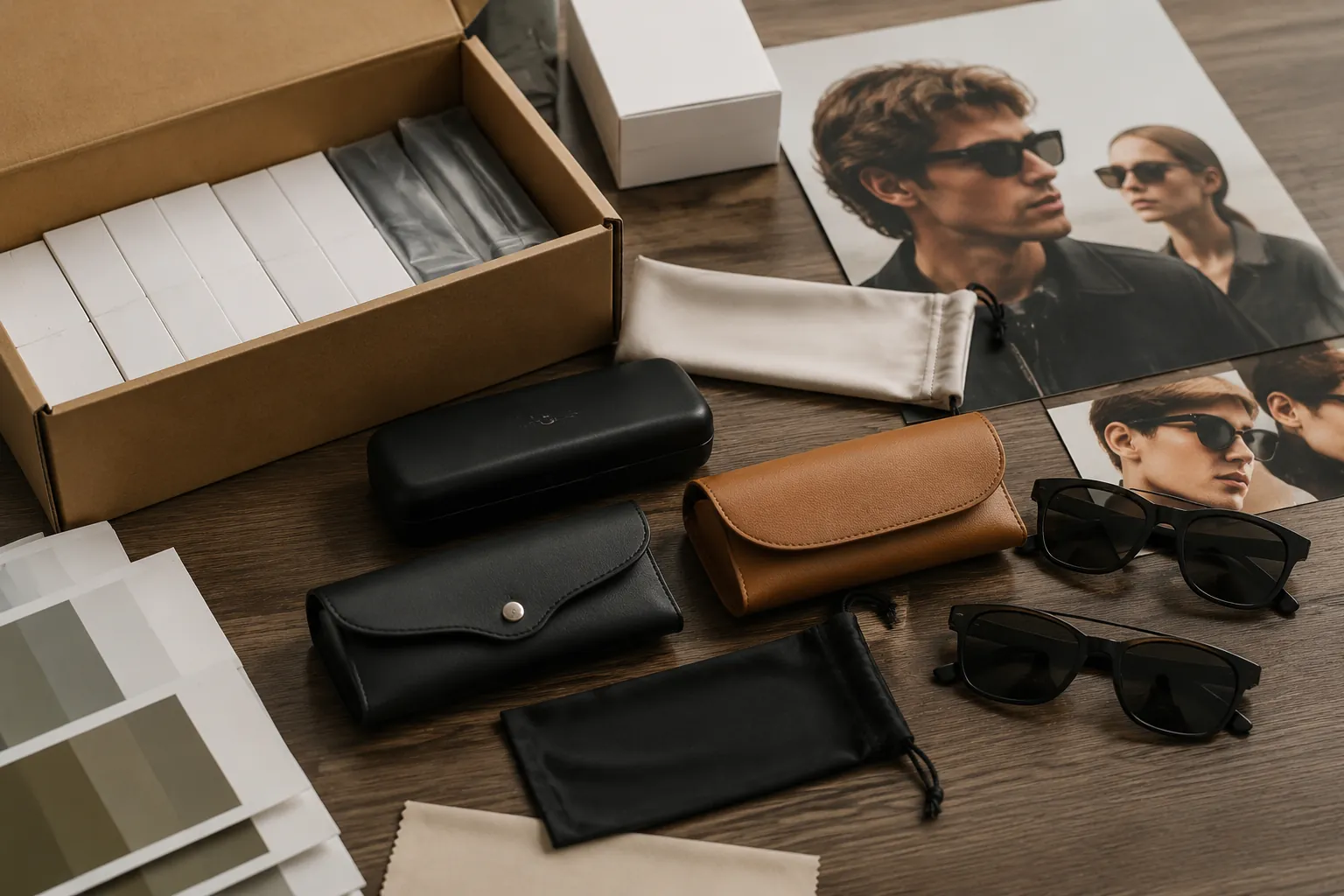
This guide is for brands, importers, distributors, and retailers buying polarized sunglasses in volume. The job is simple: choose the right lens spec, cut avoidable returns, and keep landed cost under control. If you are sourcing from China, details matter more than catalog photos. Small choices on lens construction, coating, tolerance, decoration, and QC can decide whether a program protects margin or burns it.
Start with the sell-through target
Most buyers start with frame style. That is backwards. Start with the channel, target retail price, sell-through window, and complaint rate you can live with.
A convenience-store impulse buy, a fashion program, and an outdoor specialty line do not need the same polarized spec. A low-price retail program may work with a basic TAC polarized lens, standard hard coat, and simple pad print. A premium line may need tighter cosmetic standards, better base-curve control, more consistent tint, and stricter paperwork. Miss that at the start, and you pay later in returns, markdowns, or dead stock.
Margin usually disappears in three places: over-specifying the lens, under-specifying the frame, or buying without a real QC plan. Know the target shelf price first. Then decide on lens color, visible light transmission, lens material, coating stack, and pack-out. Build the product around the retail environment. Not the other way around.
Rule of thumb: match the lens spec to the shelf, not to the loudest sample in the room.
At LumiShades, the starting point is not "Can you make it?" It is "What is the channel, target price, and annual volume?" With MOQ at 50 pairs per design, pricing that improves around 300, 1000, and 5000+ pairs, and bulk lead times of 25-35 days after approval, the commercial structure already tells you what is realistic. Spec follows the business case.
Choose the right polarized lens construction
Polarization is not one spec. Construction changes cost, clarity, impact resistance, thickness, and defect risk. Pick the wrong material and the product can feel cheap even if the optics are acceptable.
| Lens option | Typical buyer use | Common thickness | Cost behavior | Practical notes |
|---|---|---|---|---|
| TAC polarized | Mass retail, promo, entry fashion | About 0.8-1.0 mm | Lower | Lightweight and common on high-volume programs; a practical choice for price-sensitive channels. |
| PC polarized | Sport, youth, active use | About 1.2-1.5 mm | Mid | Used where impact resistance matters more, but it still needs controlled tint and coating application. |
| Nylon polarized | Premium outdoor, performance retail | About 1.1-1.3 mm | Higher | Often chosen when clarity, toughness, and perceived value matter more than the lowest landed cost. |
| Glass polarized | Specialty heritage or premium fashion | About 1.6-2.0 mm | Highest | Offers strong optics but adds weight and handling risk, which makes it harder to source efficiently in volume. |
TAC is the workhorse for cost-sensitive polarized programs. It is light, familiar to factories, and can deliver acceptable optics at a low price. PC fits better where impact resistance matters, especially in youth or outdoor channels. Nylon costs more, but buyers accept it when the shelf story can carry the price. Glass is niche in bulk sourcing because shipping weight and breakage risk make margin harder to protect.
There is no "best" material. There is only the right match for the channel. If the product is an impulse buy, a premium lens spec usually adds cost the customer will never notice. If the product sits in a performance category, the cheapest lens can trigger complaints about clarity, scratch resistance, or comfort in bright light.
Know the specs that move returns
Claims like "high definition" and "true color" are not enough. Buyers need measurable controls tied to the actual product and the actual market.
Start with the core lens controls. Check polarization axis alignment so the film is oriented correctly across the finished lens. A mis-rotated or poorly cut film can pass a quick visual check and still fail a simple function test. Match visible light transmission to the market: fashion lines may want darker tint, while driving or outdoor lines may need a tighter transmission range. Control lens thickness and edge finish because rough edges, burrs, and uneven polishing stand out on dark or mirrored lenses. Hold base curve consistency because mismatch can create fit problems or a warped look across batches. Watch hard coat performance because weak scratch resistance becomes a fast complaint.
The useful factory controls are plain:
- incoming lens film inspection for polarization orientation and cosmetic defects
- cutting tolerance control so left and right lenses stay matched
- lamination or assembly alignment checks before final fitting
- tint consistency checks against a master target under standard lighting
- final visual inspection under strong light for scratches, haze, and trapped dust
When buyers ask for tolerances, the supplier should give its own standard and explain where it applies. Frame width, temple length, and bridge measurements should sit within a defined production band. Lens shape mismatch needs tighter control because the eye catches asymmetry fast. The exact number depends on material and tooling. Do not demand a universal tolerance the factory cannot verify against the actual design.
Ask for a written defect definition before production starts. A tiny dust speck may be acceptable in one program and a rejection in another. Put that in writing. Include the limit for scratches, glue marks, logo misplacement, and lens haze.
Use MOQ and pricing tiers to protect margin
Volume pricing helps only if you understand the step-downs and how they affect landed cost. A common mistake is ordering just above MOQ, then paying nearly the same unit price as a larger run while still carrying the same setup burden.
For LumiShades, the structure is clear: MOQ starts at 50 pairs per design, then pricing improves around 300, 1000, and 5000+ pairs. At larger volume, cost can reach about $2.10 per pair depending on frame material, lens construction, decoration, and pack-out. That number matters only if the spec stays disciplined and the buyer keeps SKU count under control.
Every extra color, logo method, or lens tint adds changeover time and inspection burden. Split a design into too many small variants and the scale benefit disappears. Decoration is a good example. A one-color pad print may be enough for a promotional program. Laser engraving can look cleaner on metal parts and support a more premium finish, but it adds setup work. Metal logo plates, foil stamps, and custom temple inserts can lift perceived value, but only if the retail bracket can support the cost. Packaging works the same way. A custom insert, cleaning cloth, and printed box improve presentation. They do not fix a weak lens spec or poor frame finish.
- Set target landed cost first, including freight, duty, and packaging.
- Work backward from retail margin and markdown risk.
- Choose the lowest spec that still fits the buyer expectation.
- Concentrate volume into one or two colors rather than many tiny variants.
- Lock artwork early so you do not pay for resampling, new plates, or delayed approvals.
One design, one lens spec, and one clean production run is easier to buy, easier to repeat, and easier to defend on margin.
Check compliance before you approve art
Compliance is not a last-minute paperwork task. For polarized sunglasses, it needs to sit inside the buying process from the first spec sheet. The right documents support the right market, but they do not transfer automatically from one destination to another.
The relevant documents and standards here are CE EN ISO 12312-1, FDA registration, ANSI Z80.3, AS/NZS 1067, REACH, ISO 9001, and BSCI. They are not interchangeable. CE EN ISO 12312-1 is used for European market access. FDA registration supports U.S. regulatory requirements. ANSI Z80.3 is a recognized U.S. sunglasses standard. AS/NZS 1067 applies in Australia and New Zealand. REACH focuses on substances and material restrictions. ISO 9001 and BSCI speak to management systems and social compliance; they do not, by themselves, prove that a specific product complies with a market's eyewear requirements.
If you ship into Europe, the U.S., or Australia, ask for the exact test basis tied to the product version you are ordering. A polarized lens in a different tint, with a different coating, or in a different frame material may need a new validation set. Do not accept a generic file for a similar style and assume it covers the order. Ask for the report that matches the actual model.
Also ask how the supplier ties paperwork to production. If testing was done on one frame color and one lens color, later changes in plating, mirror coat, or frame resin may matter. REACH covers the material and substance side, while product standards address optical and safety expectations. A compliant factory should explain that split clearly.
Bluntly: if a supplier cannot say which document supports which market and which exact product version, stop there.
Build the production plan around the frame process
Polarized lenses are only half the job. The frame process often creates the real cost trouble because different materials behave differently in production, finishing, and assembly.
LumiShades handles injection molding, acetate cutting, CNC milling, lens tinting, decoration, and QC in-house. That matters because each frame material has a different failure pattern. Injection frames need stable mold control and repeatable dimensions. Acetate needs careful cutting, polishing, and heat control to avoid surface distortion and sharp edges. CNC-milled components need tight fixture control and a clean finishing step because tool marks and tolerance drift are easier to see.
For buyers, the key question is how the supplier builds around the frame material you want. A design that works in acetate may not run cleanly in injected plastic without a small change to bridge geometry, temple thickness, hinge area, or lens seating depth. A hinge that looks fine in a sample can become a problem if the process changes from one material to another. The factory should tell you where the process is sensitive instead of hiding behind "we can make anything."
| Process step | Buyer risk if weak | What to verify |
|---|---|---|
| Injection molding | Warping, fit drift, uneven finish | Mold control, dimensional checks, repeat sample consistency |
| Acetate cutting | Sharp edges, poor polish, size mismatch | Edge finish, left/right symmetry, batch repeatability |
| CNC milling | Visible tool marks, tolerance drift | Fixture precision, finish standard, hole alignment |
| Decoration | Logo wear, misprint, plating defects | Artwork approval, adhesion, placement tolerance |
If you are ordering several SKUs, keep the first round simple. One frame shape, one polarization spec, and one or two lens colors make it easier to control quality and easier for the factory to hold schedule. Complexity drives cost faster than most buyers expect, especially when one line has to manage multiple coatings, mirrored tints, and decoration methods in the same week.
Set sampling and QC gates early
Sampling is where many bad programs could have been saved. The sample should answer two questions: does the product look right, and can the factory repeat it at volume?
Use a clear timeline and a complete brief. A 7-10 day sample window and 25-35 day bulk window after approval are reasonable planning assumptions when the design is complete and the supplier is organized. Send final artwork, Pantone targets if relevant, lens color target, logo method, packaging instructions, and any required compliance language together. Do not drip-feed changes after sampling starts. Each change can alter tooling, decoration, or lead time.
A simple approval stack keeps the process clean:
- Appearance sample: confirm shape, tint, logo placement, polish, and finish.
- Functional check: verify polarization, hinge action, and wear fit.
- Pre-production confirmation: lock materials, artwork, coating, and packing.
- First-batch QC: inspect early output before the full run is released.
Ask for photos from the actual production lot, not only the sample room. Mixed tints, mixed hardware, and slight finish drift often show up only in real production. A supplier with in-house QC can catch this earlier, but only if the buyer defines the acceptance criteria. If you want 0.5 mm logo placement tolerance, say so. If you want no visible glue at the hinge or temple tip, say so. The more precise the brief, the lower the chance of a dispute later.
Require a pre-shipment checklist too: carton count, accessory count, lens wipe inclusion, outer carton marks, and random carton pulls for cosmetic review. That catches the classic miss where the master sample is good but the packed lot contains a different tint or looser temple action.
Spec for margin without making it look cheap
The best polarized sunglass programs are not the cheapest. They are the ones where the buyer spends on what the customer sees and saves on what the customer never notices. Clear lenses, good fit, clean finishing, and stable color matter more than unnecessary decoration or an overbuilt lens spec the channel cannot price in.
That means choosing one or two lens colors instead of many, avoiding excess packaging, and keeping decoration aligned with the retail tier. It also means paying attention to the small details that affect perceived quality: temple alignment, hinge smoothness, lens centering, and the absence of surface haze. A product that feels precise usually sells with more confidence, even if the bill of materials is restrained.
Use the commercial levers with intent. If the channel is promotional, spend less on premium lens materials and more on dependable bulk packaging and fast replenishment. If the channel is premium, invest in tighter finish control, better logo execution, and stricter cosmetic inspection. Either way, ask the supplier to show where the money goes: material, labor, coating, decoration, and packing. When you can see the cost stack, you can protect margin without guessing.
The strongest sourcing programs are boring in the right way. The spec is tight, the variants are limited, the QC rules are written down, and the factory understands the retail target. That is what keeps polarized sunglasses profitable at scale.
Have a custom sunglasses project in mind?
Send us your styles, target market and quantities and we will return a detailed quote with MOQ, lead time and a sample plan.
Get a QuoteWhy source this from Wenzhou with LumiShades
Wenzhou in Zhejiang Province is widely regarded as China’s eyewear manufacturing capital, producing a large share of the world’s sunglasses. That concentration matters to buyers: a deep local supply chain for acetate sheet, hinges, lens blanks, plating and packaging means shorter component lead times, easier color and material matching, and a workforce with decades of eyewear-specific skill. LumiShades has manufactured in this ecosystem since 2009, and our vertical integration — in-house injection molding, acetate cutting, CNC milling, lens tinting, decoration and quality control — means no part of your order is quietly subcontracted to a workshop you cannot audit.
For international buyers, that vertical control translates into accountability. When a single factory owns every step, defects are traced and fixed at source rather than bounced between vendors, and your specifications survive intact from first sample to bulk. We back this with 15+ years of experience, shipments to 60+ countries, more than 5 million pairs produced per year and a 98.5% on-time delivery rate. Our certifications — CE EN ISO 12312-1, FDA registration, ANSI Z80.3, AS/NZS 1067, REACH, ISO 9001 and BSCI audit — mean the compliance documentation your market requires already exists. Explore our manufacturing capabilities and quality control process to see how this works in practice.
Frequently asked questions
What is the cheapest polarized lens that still makes sense for retail? TAC polarized is usually the lowest-cost option that still makes sense for many retail programs. It fits price-sensitive channels and does not require higher impact resistance or a premium optical story. Before choosing it, confirm that the market can accept the look, thickness, and scratch performance of the finished product.
How many pairs should I order to get real price improvement? At LumiShades, pricing improves around 300, 1000, and 5000+ pairs. The actual benefit depends on frame material, lens type, decoration, and packaging. To make the volume break matter, keep the SKU count low and avoid splitting the run into too many colors or finishes.
Can one compliance file cover all markets? No. CE EN ISO 12312-1, FDA registration, ANSI Z80.3, AS/NZS 1067, and REACH serve different requirements. Match the document set to the destination market and to the exact product version, including lens color, coating, and frame material. Ask the supplier which report applies to the style you are ordering.
How long should polarized sunglasses take to sample and produce? A practical planning assumption is 7-10 days for samples and 25-35 days for bulk after approval. That timing depends on whether the design brief is complete, the materials are available, and no major changes are made after sampling starts. If artwork or compliance details are still moving, expect the schedule to extend.
What should I ask a supplier to prove polarization quality? Ask how they control polarization axis alignment, tint consistency, and final inspection. Also request the test basis for your target market and confirm the lens material, such as TAC, PC, nylon, or glass. If possible, ask for a functional check on the finished lens, not just a sales-sheet claim.
How do I protect margin without making the product look cheap? Keep the spec focused. Use one or two lens colors, avoid unnecessary decoration, hold tolerances on fit and finish, and spend on the features buyers notice first: clarity, alignment, smooth hinges, and clean detailing. It also helps to lock artwork early and limit late changes that trigger extra sampling or rework.
Ready to start?
Explore our wayfarer sunglasses or request a quote — our sales team replies within 12 hours.
Request a Quote