
Oversized Sunglasses: Prevent Hinge Failures in Production
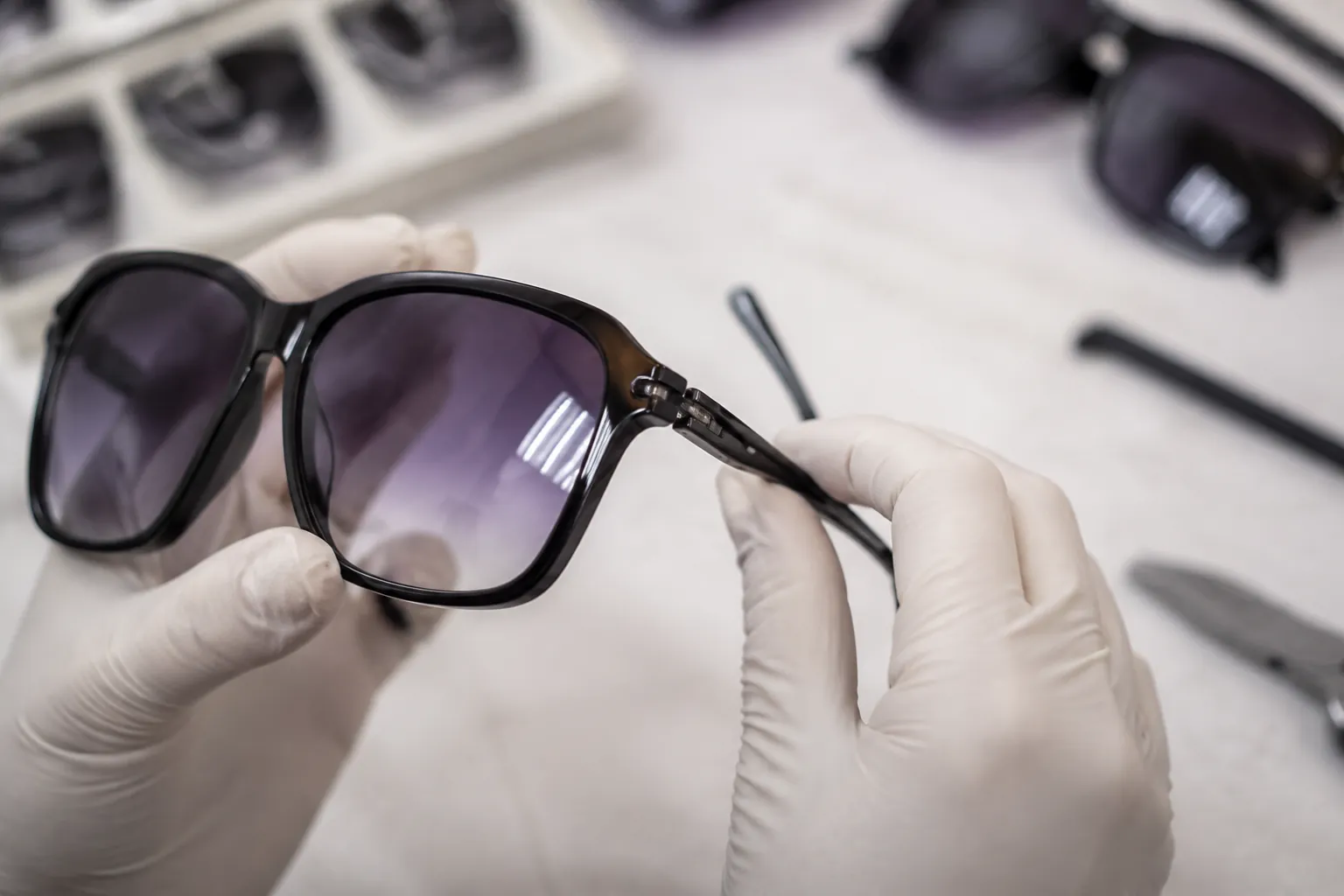
This guide is for brand owners, importers, distributors, and retail buyers sourcing oversized sunglasses at production scale. Large shapes sell. They also put more stress on the hinge area, temples, bridge, and lens rim. A frame that looks fine in CAD or on an early sample can loosen, warp, or crack in bulk if the structure, material, and assembly process are not defined tightly enough. The common failure modes are predictable: weak hinge zones, thin temple sections near the screw seat, material choices that do not suit the frame size, poor heat stability, and weak process control during hinge fitting and lens assembly. If you want oversized frames that hold up in bulk, the spec has to go beyond styling. It needs clear section targets, hinge hardware detail, tolerance limits, and inspection points the factory can run on the line.
Start With Failure Points, Not Styling
Oversized sunglasses push more leverage into a few small structural areas. Many buyers start with lens shape, color, and temple decoration. That is the wrong order for large frames. Start with the hinge block, the first section of the temple behind the hinge, the bridge, and the lens groove or rim edge.
As front size increases, the frame usually carries more mass and sees more torsion in normal wear. One-hand opening, pushing the frame up from one side, repeated folding, and heat exposure in storage or transit all load the hinge seat and temple root. If hinge embed is shallow, if the temple section drops too fast behind the hinge, or if the front is over-cut around the pocket, early loosening and cracking become more likely.
In production, repeat failures on oversized styles usually come from a short list:
- Front thickness looks heavy from the outside but is relieved too aggressively behind the hinge area.
- Temple profile is visually wide but too thin near the screw seat, so it twists or loses stability under load.
- Material choice does not match frame size, lens weight, or intended use.
- Lens fitting heat, storage heat, and transport heat were not considered when wall thickness and tolerances were set.
- Decoration was added after the structure was approved, removing material or adding weight in a high-stress zone.
Appearance matters. Structure comes first. On oversized frames, cosmetic approval without structural review is a common sourcing mistake.
Choose Material by Size, Load, and Price Band
For oversized sunglasses, material is not just a style choice. It affects rigidity, screw retention, warpage risk, finishing quality, decoration options, and how stable the frame stays after lens fitting and shipment.
| Material route | Typical MOQ fit | Best use | Main strength | Main oversized-frame risk |
|---|---|---|---|---|
| Injection molded plastic | Usually suited to medium and large-volume programs | Value and mid-market fashion programs | Lower unit cost, good repeatability, efficient scaling once tooling and process are stable | Warping, creep, or hinge stress if resin grade, wall thickness, and cooling control are not suitable for the frame size |
| Acetate | Often used for lower to mid-volume premium programs | Premium thick-profile oversized frames | Good perceived heft, strong finishing potential, and reliable screw retention when properly built | Higher material waste, more machining and polishing labor, and higher cost sensitivity as frame size increases |
| Injection front with metal-core temple | Common in custom programs where added temple stability is needed | Large fashion shapes needing better temple stability | Can reduce temple twisting and help shape retention | Poor core placement can create asymmetry, hard spots, or uneven bend behavior |
| CNC-milled acetate front and temples | Common in smaller-batch premium development | Higher-end private label with detailed geometry | Better shaping control around hinge blocks, bevels, and temple transitions | Longer development time and higher piece cost than standard molded routes |
Injection molding is often the commercial starting point for fashion programs, but performance depends on the resin, section design, and process control. On oversized fronts, the rim area may look adequate while the hinge zone still lacks local support. If the section is too thin, the front can flex too much and increase stress during lens insertion. If it is too thick without proper mold and cooling control, sink or distortion can show up.
Acetate is often chosen for thicker oversized styles because it lets the factory keep more material around the hinge block and temple root while still finishing outer surfaces cleanly. It also supports premium visual details well. The tradeoff is simple: more labor, slower throughput, higher cost.
A practical rule: if the frame is very wide, uses broad decorated temples, or carries heavier lenses, do not judge material on piece price alone. Large shapes expose weak material and weak section design fast.
Hinge Construction Decides Whether the Frame Lasts
Oversized sunglasses do not need exotic hardware. They need the right hinge, enough plate length, enough embed, and consistent installation. In many bulk failures, the hinge itself is not the real problem. The surrounding frame section is too weak, the pocket is poorly controlled, or the insert process is inconsistent.
Ask for the hinge specification, not just the phrase metal hinge. The technical pack should identify hinge type, barrel count, plate length, screw specification, insert method, and the minimum material section around the pocket. For many large fashion frames, buyers prefer a robust fixed hinge over a low-grade spring hinge. Less complexity. Fewer failure points.
As a working benchmark, buyers should confirm:
- Hinge plate size is appropriate to the frame size and temple load.
- Screw fit is stable and shows no visible wobble after assembly.
- Embed depth is sufficient to resist pull-out during repeated opening and closing.
- No whitening, cracking, sink, or local deformation appears around the hinge seat after fitting.
- Left-right opening resistance is reasonably consistent within the same pair.
For acetate, hinge embed and plate or rivet anchoring are especially important because oversized temples create more leverage in wear. For injection frames, pocket dimension control and insert setting are critical. A loose pocket allows hinge movement and poor screw retention. An over-tight pocket can create residual stress that appears later after heat exposure.
Routine factory checks should include open-close cycle checks on assembled samples, temple pull and twist checks by lot, screw retention checks, and visual inspection around the hinge seat after lens fitting. On oversized styles, these are baseline controls. Not extras.
Temple Geometry and Decoration Must Be Engineered Together
Most oversized temple failures do not come from temple length alone. They come from weak section design. A temple can look substantial because it is visually wide, yet still perform badly if it is too flat, too thin near the hinge, or over-milled on the inside.
On large fashion sunglasses, the first section behind the hinge does most of the structural work. That area usually benefits from a gradual thickness transition rather than a sharp step-down added only for visual effect. Sudden section changes create stress concentration. A broad temple may also need a metal core or added local support to control twisting.
Decoration has to be reviewed as part of the structure, not after it. A plain sample may look stable, then behave differently once a metal logo plate, deeper laser mark, or extra interior milling is added. Those changes affect balance, stiffness, and local stress.
| Decoration method | Typical use | Structural effect | What to control |
|---|---|---|---|
| Pad printing | Brand marks, pattern detail | Low structural risk | Surface preparation, adhesion, abrasion resistance |
| Laser engraving | Permanent branding on temple interior or exterior | Removes material depth on thin sections | Placement away from flex zones, controlled engraving depth |
| Metal logo plate | Premium branding | Adds weight and requires a local seat or cutout | Distance from hinge, seating stability, crack risk around the cutout |
| Hot foil or heat transfer | Decorative temple branding | Low structural effect but finish can be heat-sensitive | Temperature control, edge cleanliness, rubbing resistance |
Approve decoration only after the finished sample is opened, closed, and worn. Added weight can change how the frame sits. On oversized styles, that matters quickly.
The Spec Sheet Should Lock Down Real Numbers
If you want fewer failures, the purchase order cannot stop at color names and logo positions. Oversized sunglasses need a tighter technical pack than small basic frames. The supplier should be able to build and inspect against measurable requirements, not just a visual reference.
Your spec sheet should define:
- Front width, lens width, bridge, and temple length.
- Target front thickness and minimum section around hinge blocks and bridge transitions.
- Temple section at the hinge end, mid-section, and tip.
- Hinge model, barrel count, screw specification, and plate size.
- Lens material, base curve, nominal thickness, and polarization or tint requirement.
- Permitted warp tolerance, left-right symmetry tolerance, and logo placement tolerance.
- Decoration method and exact position from a fixed hinge or end-piece reference point.
For large sunglasses, buyers should also define what counts as unacceptable movement or distortion. If temple resistance differs noticeably from left to right, or if front twist appears after lens assembly, the pair should fail inspection even if the cosmetics look clean. On wide temples, logo drift is also more visible, so dimensioned references matter.
Compliance requirements should be confirmed at RFQ stage. Depending on the destination market and product category, buyers may need alignment with CE EN ISO 12312-1, ANSI Z80.3, or AS/NZS 1067. Material and chemical control requests are commonly supported through REACH. Some U.S. buyers also ask the supplier to confirm its FDA registration status where channel requirements call for it. At the factory level, buyers often review quality-system and social-compliance credentials such as ISO 9001 and BSCI. Verify these items directly with the supplier and match them to the actual sales market.
Do not separate durability from compliance. Lens retention, optical performance, material consistency, and heat behavior all affect return risk, even when the visible complaint starts at the hinge.
Cost, MOQ, and Lead Time: Where Durability Changes the Math
Stronger oversized construction does add cost, but buyers should weigh that against the cost of rework, replacement stock, chargebacks, and launch delay. In many cases, better hinge support, a stronger hinge plate, or a more stable temple section changes the math less than a return problem does.
MOQ, price, and lead time depend heavily on process route, customization level, hardware, lenses, and decoration. Injection programs usually make more sense once volume can absorb tooling and setup. Acetate and CNC routes are often easier to justify for smaller premium programs or for styles that need tighter shaping control. If the design is still open, ask suppliers to quote more than one construction route.
Commercially, the lowest unit price often applies only to simpler constructions at higher volume. Oversized frames with upgraded hinges, polarized lenses, acetate parts, or metal decoration should be expected to price above a basic entry-level frame. The real question is not whether the frame is cheap to make. It is whether the construction fits the retail program.
| Decision | Cost effect | Lead-time effect | Typical buyer impact |
|---|---|---|---|
| Increase hinge-area thickness | Usually low | Often limited once tooling is finalized | Can improve crack resistance with modest cost impact |
| Upgrade to stronger plate hinge | Low to moderate | Usually minor if hardware is available | Can reduce looseness and temple-related returns |
| Switch from injection to acetate | Moderate to high | Usually longer for sampling and production | Can improve premium feel and structural confidence on thick large frames |
| Add metal logo plates | Usually moderate | Adds decoration and inspection steps | Raises perceived value but can introduce balance and crack risk |
Lead times vary by factory, season, tooling status, and sample complexity. Treat every sample and production timeline as supplier-specific and confirm it in writing before placing the order. If hinge construction, temple geometry, lens thickness, or decoration seating is still changing after sample approval, the schedule will likely move. Those are structural revisions, not cosmetic edits.
A Practical Approval and QC Flow for Oversized Styles
Oversized sunglasses need a stricter approval path than basic fashion frames because small geometry errors scale badly in bulk. The cleanest process is to lock the structure before finalizing decorative details.
- Send a technical pack with target dimensions, material route, hinge preference, decoration plan, and market compliance requirements.
- Review the supplier drawing and ask specifically about hinge embed, temple section near the hinge, and reinforcement around the hinge block and bridge.
- Approve samples only after fit check, repeated opening check, front twist check after lens fitting, and heat exposure review appropriate to the material route.
- For larger orders, retain a sealed approval sample on both the buyer and factory side so production can be checked against a fixed reference.
- During bulk, request in-line QC on hinge alignment, screw retention, temple symmetry, front warp, lens fit, and logo placement.
- Before shipment, use standard AQL together with a focused durability review on the largest or heaviest variants, especially if different lens types, laminations, or dark transparent colors are involved.
Reject samples before bulk approval if any of these warning signs appear: temple resistance feels uneven left to right, visible whitening appears around the hinge pocket, the front rocks or twists on a flat surface after lens assembly, the temple opens too aggressively because of balance issues, or decorative hardware sits too close to a flex point.
One weak sample is usually not random. On oversized frames, it is often a process warning. Buyers who force correction during sampling usually cut downstream cost and delay.
Have a custom sunglasses project in mind?
Send us your styles, target market and quantities and we will return a detailed quote with MOQ, lead time and a sample plan.
Get a QuoteWhy source this from Wenzhou with LumiShades
Wenzhou in Zhejiang Province is widely regarded as China’s eyewear manufacturing capital, producing a large share of the world’s sunglasses. That concentration matters to buyers: a deep local supply chain for acetate sheet, hinges, lens blanks, plating and packaging means shorter component lead times, easier color and material matching, and a workforce with decades of eyewear-specific skill. LumiShades has manufactured in this ecosystem since 2009, and our vertical integration — in-house injection molding, acetate cutting, CNC milling, lens tinting, decoration and quality control — means no part of your order is quietly subcontracted to a workshop you cannot audit.
For international buyers, that vertical control translates into accountability. When a single factory owns every step, defects are traced and fixed at source rather than bounced between vendors, and your specifications survive intact from first sample to bulk. We back this with 15+ years of experience, shipments to 60+ countries, more than 5 million pairs produced per year and a 98.5% on-time delivery rate. Our certifications — CE EN ISO 12312-1, FDA registration, ANSI Z80.3, AS/NZS 1067, REACH, ISO 9001 and BSCI audit — mean the compliance documentation your market requires already exists. Explore our manufacturing capabilities and quality control process to see how this works in practice.
Frequently asked questions
Is acetate always better than injection molding for oversized sunglasses? No. Acetate is often chosen for premium oversized frames because it supports thick profiles, good finishing, and reliable screw retention when properly built. A well-engineered injection frame can also perform well, especially when resin selection, wall thickness, hinge support, and cooling control suit the frame size. To compare the two routes properly, ask the supplier for the exact material, hinge method, and section drawing for each option, then review assembled samples after lens fitting rather than comparing appearance alone.
Should I choose spring hinges for large fashion sunglasses? Not by default. Spring hinges can improve fit flexibility in some products, but they also add hardware complexity and another failure point. For many oversized fashion styles, a stable fixed hinge is easier to control in bulk and may be the more durable choice. Ask the factory to quote both options only if fit flexibility is a real requirement, and compare them using the same tests: opening consistency, screw retention, hinge stability, and sample performance after repeated opening and closing.
What should I ask a factory to test before I approve samples? Ask for a documented sample review that covers open-close cycle checking, temple pull and twist checks, screw retention checks, front warp inspection after lens fitting, and visual inspection for whitening or cracking around hinge pockets, bridge transitions, and rim areas. If the frame includes wide decorated temples, review the finished decorated sample rather than the plain sample. Also ask the supplier to confirm what they checked, how many samples were tested, and whether any structural adjustment was made after the first build.
How early should compliance requirements be discussed? At RFQ stage. If your target market requires alignment with CE EN ISO 12312-1, ANSI Z80.3, AS/NZS 1067, REACH, or supplier FDA registration status, the factory needs that information before sampling. These requirements can affect lens selection, markings, material choice, and documentation. A practical step is to list the destination markets in the RFQ and ask the supplier to confirm in writing which standards and documents they can support for that exact product.
What is a realistic timeline for custom oversized sunglasses? There is no single reliable timeline for every supplier or every construction route. Sampling and production time depend on tooling status, material route, decoration, lens type, order size, and whether structural revisions are still being made. The practical approach is to ask the factory for a written schedule covering sample build, sample revision, bulk production, and pre-shipment inspection, then confirm which steps would reset the clock. Changes to hinge hardware, temple geometry, lens construction, or decoration seating should be treated as timeline-sensitive because they affect structure, not just appearance.
Ready to start?
Explore our square sunglasses or request a quote — our sales team replies within 12 hours.
Request a Quote