
How to Source Promo Sunglasses for Beverage Campaigns
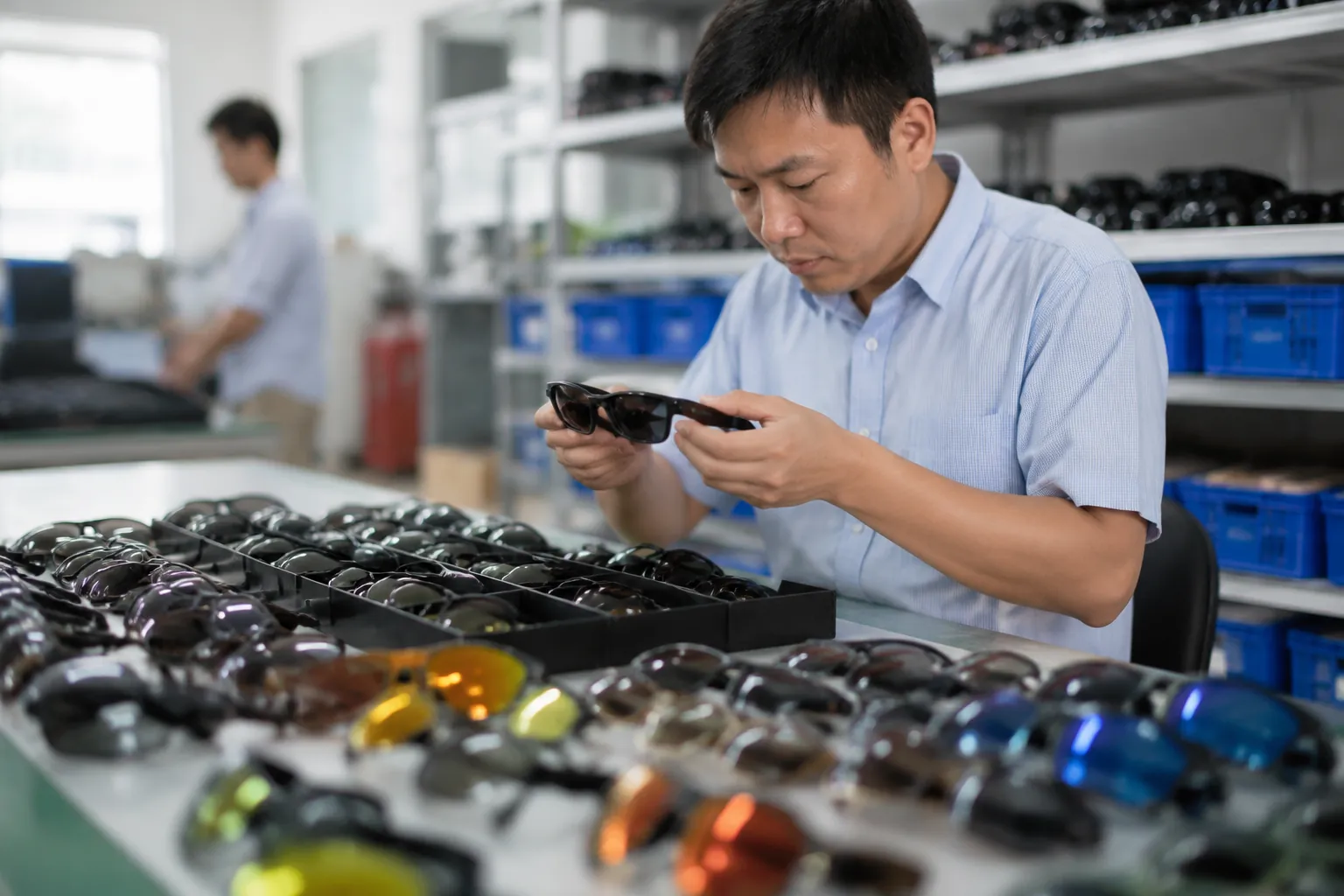
This guide is for beverage brands, licensed-product teams, importers, and retail buyers sourcing custom sunglasses for a launch, event, or seasonal promotion with a fixed deadline. Finding a factory is usually the easy part. The real job is lining up frame construction, branding method, packaging, compliance, and shipping timing with the sales channel and budget. A disciplined sourcing process helps buyers choose a product that shows the brand clearly, meets market requirements, packs efficiently, and lands in time for the campaign window.
Start With Campaign Math Before You Pick a Frame
Promotional sunglasses are deadline purchases. A summer RTD launch, beer garden activation, music festival sponsorship, convenience-store gift-with-purchase, or licensed merchandise drop usually has a fixed in-market date. Start with schedule, budget, and channel requirements before anyone falls in love with a frame shape.
Lock four commercial inputs first: target landed cost, required in-hands date, total quantity, and distribution channel. Those four variables drive most later decisions. A frame for a one-day event giveaway can use simpler packaging and accept broader cosmetic variation than a retail pack meant for a liquor chain, stadium store, or ecommerce bundle. If units will be handed out fast, visible branding at a controlled unit cost matters most. If they will stay on shelf, print placement, lens appearance, packaging copy, and barcode placement matter more.
Evaluate MOQ and timing together. Small custom runs are possible in some supply programs, but low volumes usually carry higher per-unit costs because tooling setup, print setup, sampling, and packaging approvals are spread across fewer pieces. Larger volumes often create room for better packaging, tighter color control, or upgraded construction. Ask for quotes at more than one quantity tier. The breakpoints matter.
Lead time also needs to be split into steps. A sample may take days or weeks depending on the construction and decoration method, and bulk production starts only after approval. Artwork confirmation, copy review, package labeling, and freight booking often take longer than first-time buyers expect. Build backward from the event date, allow for at least one revision round, and add margin for packing, pickup, customs, or a late artwork change.
- Good fit: event giveaways, regional distributor campaigns, licensed capsule runs, chain-store promotions, influencer seeding packs
- Bad fit: projects without locked artwork, a defined destination market, or an agreed packaging structure
- Best first step: confirm channel, quantity split, required ship date, and compliance destination before asking for a final quotation
- Best buffer: add extra time beyond the factory timeline for sample revisions, packaging approval, and freight or customs delays
Choose the Build for Use Time, Value, and Logo Space
Most campaign sunglasses fall into three practical build categories: injection-molded plastic, mixed-material frames, and acetate or CNC-finished retail styles. Each behaves differently in production, decoration, and packing. Pick for the job, not for the mood board.
| Build Type | Best Use | Typical Strength | Watch-Out | MOQ and Cost Logic |
|---|---|---|---|---|
| Injection molded plastic | Mass giveaway, festival, on-premise activation | Lower unit cost, repeatable color output, lighter shipping weight | Limited flat print area on some temples; glossy surfaces can show rub marks if packed without protection | Often the most practical starting point for cost-sensitive promotional runs |
| Injection front with metal details | Licensed merch, premium beverage promo, influencer kits | Stronger shelf appeal, more premium hinge feel, upgraded perceived value | More assembly steps and more parts to approve, which can increase cost and lead time | Usually considered when presentation matters as much as unit cost |
| Acetate or CNC-finished frame | Retail-ready capsule, brand-store item, margin-bearing merchandise | Heavier hand-feel, cleaner polish, stronger premium positioning | Higher material and finishing cost; natural variation in translucent colors may require tighter approval standards | Better suited to paid retail programs than basic giveaways |
Injection frames are common in beverage promotions because they are light, scalable, and usually more budget-friendly than acetate. They also give a stable base for one-color logo application when the temple surface is flat enough. Do not rely on a rendering. Ask for the actual printable area in millimeters. A temple that looks wide can have a much smaller usable zone once hinge clearance and edge curvature are factored in.
Material behavior matters in real distribution. High-gloss plastic can scuff if units are packed loose. Matte finishes can look more refined in lifestyle campaigns, but low-contrast branding methods such as laser marking may read weakly on some surfaces. Acetate often gives stronger perceived value, yet sheet variation can create visible differences in translucent tones from pair to pair. That may be fine for boutique retail. It can be a headache in a tightly standardized mass promotion.
If the item will be sold rather than given away, spend on the details the customer actually notices: hinge feel, temple finish, lens appearance, and pack presentation. A nicer box will not fix a weak frame.
Lock Decoration Early and Size Artwork to Real Print Space
Most promotional eyewear problems start with decoration, not frame shape. Buyers approve a flat mockup, then learn the logo prints too small, distorts on curvature, or gets expensive once the production method is fixed. Avoid that cycle. Choose the decoration method early and size artwork to the confirmed printable area.
Common branding methods for promo sunglasses include pad printing, laser engraving, and metal logo plates. Each has trade-offs in setup cost, visibility, durability, and assembly time.
| Method | Best For | Strength | Limit | Practical Cost Logic |
|---|---|---|---|---|
| Pad printing | Bold brand marks, slogans, high-volume giveaways | Economical, widely used, strong contrast on many plastic temples | Multi-color graphics add setup complexity; very small details may not reproduce cleanly | Often the most efficient choice for simple branding on promotional volumes |
| Laser engraving | Subtle branding, matte or coated surfaces | Durable mark without ink wear | Visibility depends heavily on the base material and color contrast | Useful when understated branding matters more than high contrast |
| Metal logo plate | Licensed product, retail packs, premium beverage gifting | Higher perceived value and distinct hardware look | Higher assembly cost and more approval points than print-only decoration | Usually best reserved for programs with retail or gifting budgets |
Ask for logo placement in millimeters, not just a digital rendering. On many promotional frames, the usable print zone is limited by hinge placement, temple taper, and surface curvature. Wrap styles may have an even shorter flat area. If artwork sits too close to the hinge, print loss or distortion becomes more likely. Too close to the temple tip, and the mark may disappear when worn or packed.
- Safest giveaway spec: one solid pad print on one temple, centered in the confirmed flat area
- Most common premium upgrade: branding on the pouch or box rather than adding multiple marks to the frame
- Main sampling check: confirm print size, print position tolerance, and contrast on the final frame color
- Common mistake: adding inside-arm copy, lens logos, and multi-color graphics to a low-volume project without confirming budget impact
The practical rule is simple: pay for clear visibility before paying for extra decoration points. One clean, readable mark usually works harder than several weak ones.
Match Compliance to the Market and Sales Path
Compliance is a market-access issue. Nothing more. If sunglasses will be sold, imported through formal channels, bundled with other goods, or kept for possible resale after a promotion, define the compliance route before bulk production starts. Asking for every document wastes time. Asking for the wrong one can delay the order just as easily.
Separate product-level compliance from supplier-level documentation. CE EN ISO 12312-1, ANSI Z80.3, and AS/NZS 1067 are product standards tied to sunglass performance in specific markets. REACH relates to chemical compliance for applicable materials and substances. ISO 9001 and BSCI can help assess factory systems and social compliance practices, but they do not replace product testing. FDA registration may appear in supplier paperwork, but buyers should verify whether it is relevant to their import and channel requirements rather than treating it as proof of sunglass performance compliance.
Free promotional product can still create risk. If leftover units may later be sold by a distributor, added to ecommerce bundles, or transferred into retail, build the packaging and labeling for that channel from the start. Reworking warnings, importer details, or barcode labels after bulk packing is slow and expensive.
- Confirm the destination market and final channel before sampling.
- Match lens category, labeling, and warnings to the applicable market requirement.
- Check whether the package needs a barcode, importer details, warning statement, or country-of-origin marking.
- Approve a pre-production sample using the final materials, print method, and packaging components.
- Keep test reports tied to the exact production specification, not to a similar-looking past model.
For beverage promotions, a slightly more retail-ready specification is often the safer choice when there is any chance the inventory will move across more than one channel. In many cases, that costs less than relabeling or splitting stock after arrival.
Use a Full Lead-Time Map, Not One Factory Number
A quoted bulk production window is only one piece of the schedule. Buyers need the full chain broken into approval gates so they can see where delay risk really sits. Often, the critical path is not molding or assembly. It is late artwork, revised box copy, untranslated warning text, or packaging materials arriving after the eyewear is finished.
| Stage | Typical Time | What Happens | Main Delay Risk |
|---|---|---|---|
| Artwork and specification lock | Varies by project | Frame choice, logo size, color callout, packaging format, channel confirmation | Multiple stakeholders approving different files or working from different assumptions |
| Sample making | Varies by construction and decoration method | Prototype with decoration, lens tint, and basic packaging review | Late vector files, unclear color targets, or incomplete placement instructions |
| Sample revision | Varies by requested changes | Adjustment to print scale, frame color, tint, or packaging details | Trying to solve too many variables in one revision round |
| Bulk production | Varies by order size and specification | Molding or machining, lens preparation, decoration, assembly, QC, and packing | Packaging items, labels, or approvals arriving after production has started |
Experienced buyers manage the order through gates: specification lock, sample approval, pre-production confirmation, bulk completion, and shipment release. That structure prevents a common campaign problem: the sunglasses are done, but the insert, barcode label, or warning copy is not, so the shipment cannot move.
Build extra time into any order tied to a public event. If transit is international, add the actual shipping mode timeline and a customs margin. One of the most useful buyer documents is a one-page brief listing SKU count, quantity by design, destination, packaging structure, shipping marks, barcode files, compliance requirements, and approved artwork references. That cuts clarification loops later.
Packaging Decides Whether the Item Feels Disposable or Retail-Ready
In beverage and lifestyle promotions, packaging is not a finishing touch. It changes how the product is handled, displayed, labeled, and resold. Frame specification may shift unit cost modestly. Packaging can reshape the whole downstream workflow.
Common formats include a simple polybag, a microfibre pouch, a printed paper box, or a retail set with insert card and UPC label. The right choice depends on who handles the product next. Event staff need fast distribution and low damage risk. Retailers need clean presentation, barcode visibility, and packs that are easy to replenish. Distributors need clear carton assortments and shipping marks.
- Polybag only: lowest-cost option, fast to pack, suitable for direct handout, weak for display and resale
- Pouch plus hangtag: stronger brand presentation, still compact for promotional fulfillment, useful middle ground for many programs
- Printed box: better suited to licensed goods, planned shelf placement, or ecommerce bundles
- Retail set with barcode and warnings: strongest option for multi-channel distribution or possible leftover resale
Packaging also affects damage rates and labor. Gloss frames packed without protection may scuff more easily. Individually protected units reduce marks but add handling time and material cost. Mixed cartons may trim freight waste in some cases, but they can also create expensive resorting work when a warehouse needs designs separated by customer or territory. If the order will be split across channels or regions, define inner-pack quantity, carton marks, and assortment ratios before production starts.
The real question is not which packaging is cheapest. It is which packaging fits the intended channel without rework. In many beverage campaigns, a simple branded pouch or a clearly labeled retail-ready pack beats an unbranded low-cost bag that creates problems later.
Match the Spec to Quantity Tiers
Promotional budgets are often set before the product is fully designed, so buyers should use quantity tiers to control complexity. Small runs can support custom branding, but every added process carries a bigger cost burden. As volume rises, buyers usually gain more room for packaging upgrades, process control, and logistics efficiency.
At lower volumes, the safest route is usually a simple specification: one frame material, one lens tint, one print color, and straightforward packaging. This keeps sample approval manageable and reduces the chance that setup-heavy features eat the budget. Added elements such as metal logo plates, multi-color temple graphics, or engineered retail boxes should be justified against the actual channel need.
At mid-range promotional volumes, buyers can often improve presentation with a branded pouch, better outer packaging, or tighter finish requirements. At larger scales, system optimization matters as much as the frame itself. Savings in packaging material, carton density, or manual assembly steps become more meaningful as order quantity grows. This is also where standardizing one approved frame across multiple markets and localizing only labels or inserts can simplify approvals and reduce timing risk.
Rule of thumb: at low quantity, simplify the product; at higher quantity, optimize the full system around it.
Before issuing a purchase order, confirm quantity by design, destination market, vector artwork, print size in millimeters, lens and frame finish, packaging structure, barcode or warning label requirements, carton assortment, and the required in-warehouse date rather than only the ex-works date. A complete brief protects a campaign timeline better than an ambitious specification with loose approvals.
Have a custom sunglasses project in mind?
Send us your styles, target market and quantities and we will return a detailed quote with MOQ, lead time and a sample plan.
Get a QuoteWhy source this from Wenzhou with LumiShades
Wenzhou in Zhejiang Province is widely regarded as China’s eyewear manufacturing capital, producing a large share of the world’s sunglasses. That concentration matters to buyers: a deep local supply chain for acetate sheet, hinges, lens blanks, plating and packaging means shorter component lead times, easier color and material matching, and a workforce with decades of eyewear-specific skill. LumiShades has manufactured in this ecosystem since 2009, and our vertical integration — in-house injection molding, acetate cutting, CNC milling, lens tinting, decoration and quality control — means no part of your order is quietly subcontracted to a workshop you cannot audit.
For international buyers, that vertical control translates into accountability. When a single factory owns every step, defects are traced and fixed at source rather than bounced between vendors, and your specifications survive intact from first sample to bulk. We back this with 15+ years of experience, shipments to 60+ countries, more than 5 million pairs produced per year and a 98.5% on-time delivery rate. Our certifications — CE EN ISO 12312-1, FDA registration, ANSI Z80.3, AS/NZS 1067, REACH, ISO 9001 and BSCI audit — mean the compliance documentation your market requires already exists. Explore our manufacturing capabilities and quality control process to see how this works in practice.
Frequently asked questions
What MOQ makes sense for a beverage promotion test run? For a test run, ask suppliers to quote more than one quantity level rather than relying on a single MOQ number. A very small run may be possible, but buyers should verify how sampling charges, print setup, packaging setup, and freight affect the real per-unit cost. The practical move is to request comparable quotations for a simple specification at low, mid, and campaign-scale volumes, then compare landed cost rather than factory price alone.
How much time should I allow before my event date? Start from the in-hands date and work backward through approval, production, freight, customs, and final delivery. Ask the supplier to break the schedule into specification lock, sample lead time, revision time if needed, bulk production, packing, and shipment handoff. Then add a buffer for artwork delays, packaging corrections, and transport disruption. Do not approve against one bulk-production number only. It hides the real schedule risk.
Which logo method is safest for large giveaway orders? For most large promotional runs, a single-color pad print on a confirmed flat temple area is the safest starting option because it is widely used, cost-efficient, and visually clear on many plastic frames. Before approving, ask for the printable area in millimeters, confirm the logo line weight suits the method, and review a physical sample on the final frame color. That reduces the risk of weak contrast or distorted placement.
Do free promotional sunglasses still need compliance planning? Yes. If the product is imported, distributed through formal channels, bundled in ecommerce, or may later be resold, compliance and labeling should be defined at the start. Buyers should confirm the destination market, ask which product standard applies, verify whether warning text or importer details are required on the product or package, and ensure any test report matches the final production specification. That is far easier than relabeling stock after arrival.
What certification documents should I ask for first? Ask first for the documents tied directly to your destination market and product specification: CE EN ISO 12312-1 for relevant European-market requirements, ANSI Z80.3 for the U.S., AS/NZS 1067 for Australia and New Zealand, and REACH documentation where chemical compliance is relevant. Then review supporting factory documents such as ISO 9001 and BSCI separately from product compliance. If a supplier provides FDA registration, confirm with your importer or compliance advisor whether it is relevant to your specific sales path rather than assuming it replaces sunglass performance testing.
Ready to start?
Explore our shield & oversized sunglasses or request a quote — our sales team replies within 12 hours.
Request a Quote