
Scale Custom Sunglasses from 50 to 5,000 Pairs
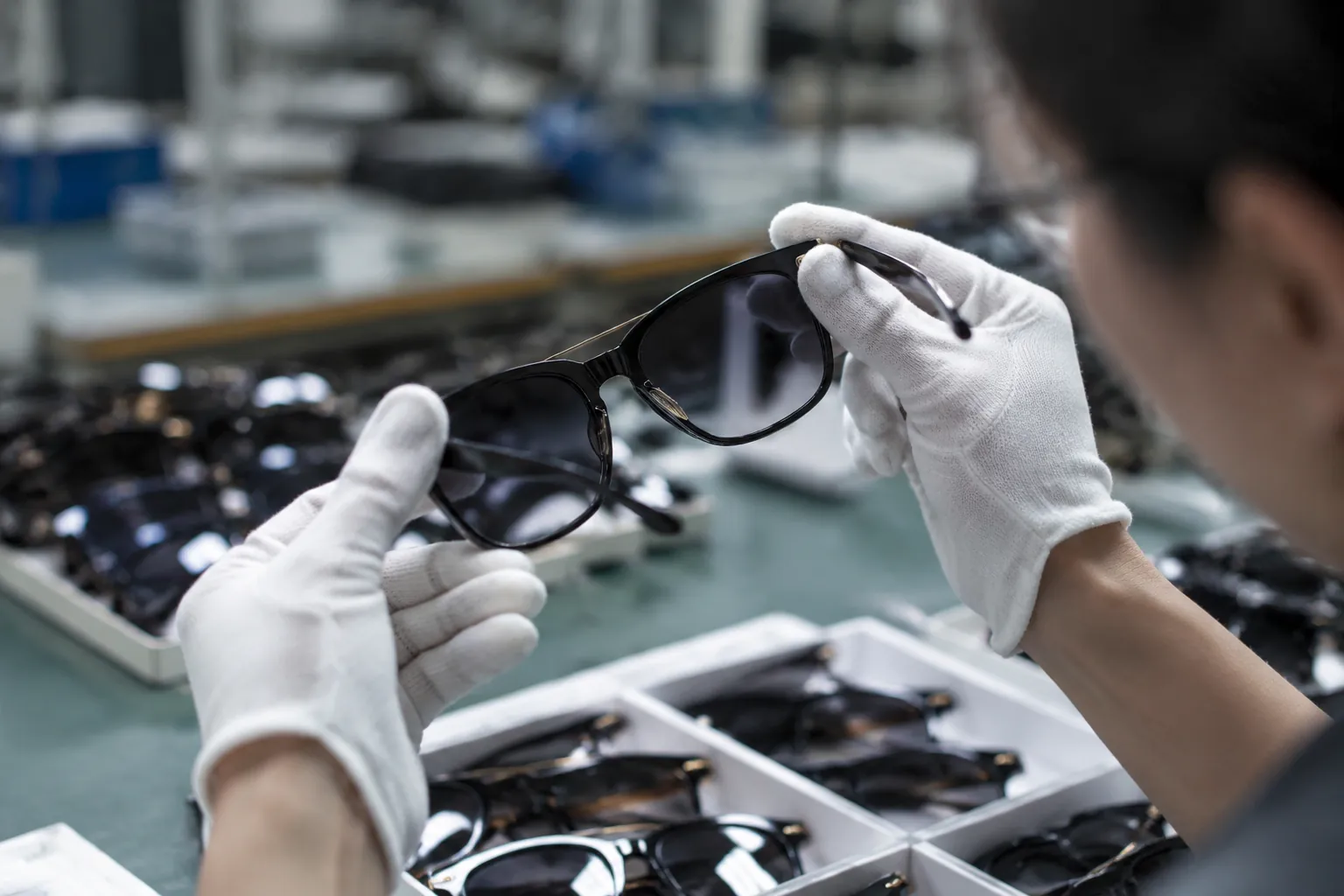
This guide is for brands, importers, distributors, and retailers testing custom sunglasses before a larger buy. A 50-pair trial is not just a small order. It is a risk check. Use it to verify frame fit, lens tint, decoration, packaging, compliance route, QC expectations, and reorder economics before moving to 300, 1,000, or 5,000 pairs. LumiShades' Wenzhou production setup is the reference point here: MOQ from 50 pairs per design, samples typically in 7–10 days after confirmed specifications, and bulk production typically in 25–35 days after approval, deposit, and material readiness. Capabilities include injection molding, acetate cutting, CNC milling, lens tinting, laser engraving, pad printing, metal logo assembly, packing, and QC. Compliance must be checked against the target market and the buyer's retailer or importer requirements before production starts.
Start with the reorder target, not the trial quantity
A 50-pair sunglasses order should not be treated as a miniature version of the final run. It has one job: reduce uncertainty before you buy more. Define success before placing the trial. Is the next step 300 pairs for a boutique drop, 1,000 pairs for a distributor launch, or 5,000 pairs for a seasonal program?
That answer changes the sourcing plan. A translucent PC frame may look fine across 50 pairs, but a larger reorder needs a fixed color formula and an approved physical swatch. A temple logo may pass on one sample, but mass production may need a dedicated jig if placement must be tight. A custom lens tint can be reviewed visually for the trial. For EU, U.S., Australia, or New Zealand sales, it also needs to connect to lens category, UV protection, and the right test or documentation plan.
For LumiShades, a clean path is: specification review and quotation, sample production, 50-pair trial, sales and fit feedback, then a 300/1,000/5,000-pair purchase order with locked specifications. Sample timing is typically 7–10 days after clear files and material choices are confirmed. Bulk production is typically 25–35 days after deposit and final approval, depending on material availability, capacity, packaging complexity, and inspection requirements.
Do not use the first 50 pairs to test ten unrelated styles. That creates noise. Choose one or two frames and test the variables that drive the next buying decision: fit, color, lens darkness, logo durability, packaging, compliance route, and landed cost.
What to lock at 50 pairs and what to keep flexible
The common mistake in low-MOQ eyewear sourcing is locking the wrong items too early. At 50 pairs, you need enough final detail to test the market. You do not need expensive commitments that only make sense after repeat demand is proven.
| Spec item | Lock at 50 pairs | Review before 300+ | Practical tolerance or decision point |
|---|---|---|---|
| Frame shape and fit | Yes | Only minor temple, nose-pad, or balance adjustments | Record front width, bridge, lens size, temple length, and approved sample reference. Agree on measurement points before bulk production. |
| Frame color | Usually | Confirm Pantone, masterbatch, color chip, or physical swatch | For 1,000+ pairs, use an approved physical standard or signed production sample, not only a screen image. |
| Lens tint and category | Yes | Confirm visible light transmission range and compliance route | Lens category and intended use affect CE EN ISO 12312-1, ANSI Z80.3, and AS/NZS 1067 planning. |
| Logo method | Yes | Adjust size, position, color, or jig if needed | Define logo size, location, artwork file, color, and acceptable placement tolerance in writing. |
| Retail packaging | Not always | Often upgraded at 300 or 1,000 pairs | Trial orders can use a pouch or standard box; final packaging should be checked for freight cost, carton loading, labeling, and damage risk. |
| Tooling or mold changes | No, unless essential | Decide after sales data and margin review | New tooling should be tied to repeat orders, unique product identity, IP strategy, or a clear commercial advantage. |
For the first 50 pairs, use the nearest existing mold or a frame that only needs color, lens, and branding changes if possible. LumiShades has in-house injection molding and acetate cutting, but that does not mean every project needs tooling. New tooling makes sense when the silhouette is the brand asset. Not before.
Use sampling to catch production problems early
The sample stage is where careful buyers prevent cost and delay. A 7–10 day sample is not just for photos. It should answer basic production questions. Does the frame sit correctly? Does the hinge feel stable? Is the logo readable? Is the lens tint right for the market? Will the packaging survive shipping?
- Confirm the frame material. PC is common for promotional and price-sensitive sunglasses because it molds efficiently and can support competitive unit costs at volume. TR90 is more flexible and resilient, which can suit sport and active-lifestyle frames. Acetate gives richer color depth and polish, but it requires cutting, tumbling, CNC shaping, and hand-finishing, so cost and lead time are usually higher. Metal frames require tighter control of plating or finishing, screws, hinges, and corrosion resistance.
- Check fit with numbers. Ask for lens width, bridge, temple length, front width, and pantoscopic angle where relevant. A size marking such as 52-20-145 mm is useful, but it does not replace a fit review. Check temple pressure, nose stability, frame balance, and whether the frame sits level.
- Approve decoration from the real process. Pad printing is economical for many one- or two-color temple logos, but adhesion should be checked with an agreed rub or tape test where appropriate. Laser engraving is durable, but visibility depends on material color and contrast. Metal logo plates add perceived value but require adhesive or mechanical fixing control.
- Review lens tint in daylight. Office lighting can hide differences between green, gray, brown, smoke, and gradient tints. Confirm UV400 requirement, lens category, polarized or non-polarized construction, mirror coating if used, and intended-use limits such as fashion, sport, or driving.
- Measure packaging before you scale. Cases, boxes, cleaning cloths, hang tags, barcode labels, and instruction cards all affect cost, carton size, shipping weight, and retail readiness. Heavy or oversized packaging can damage the landed-cost plan even when the sunglasses unit price looks good.
LumiShades handles lens tinting, CNC milling, laser engraving, pad printing, metal logo plates, packing, and QC in-house. That reduces handoff risk. It does not remove the buyer's approval role. Before bulk production starts, approve a physical sample or a documented sample set with photos, measurements, material notes, lens information, logo details, packaging details, and the specification version number.
What changes at 300, 1,000, and 5,000 pairs
MOQ is not only a factory rule. It reflects setup time, material purchasing, machine scheduling, logo alignment, QC, packing labor, and production changeover. At 50 pairs, those costs sit on a small batch. At 300 pairs, setup costs start to spread out. At 1,000 pairs, component planning is usually stronger. At 5,000 pairs, the factory can plan a longer run, reduce changeover waste, and organize inspection and packing with more consistency.
| Order size | Best use | Price behavior | Buyer focus |
|---|---|---|---|
| 50 pairs/design | Market test, influencer kit, buyer presentation | Highest unit cost because setup, logo alignment, and packing labor are spread over few units | Prove style, fit, tint, logo method, packaging direction, compliance route, and landed cost |
| 300 pairs/design | Small retail launch or distributor sample stock | Unit cost often improves if the specification is stable and packaging is not overly customized | Lock color standard, logo position, retail pack, barcode approach, and first sell-through data |
| 1,000 pairs/design | Core SKU launch | Better production efficiency and stronger planning for components, QC, and packing | Confirm compliance documents, inspection level, barcode labels, carton marks, and reorder timing |
| 5,000+ pairs/design | Seasonal program or wider distribution | Best opportunity for volume pricing when the design is simple, stable, and production-friendly | Finalize production calendar, carton loading, third-party inspection if required, freight method, and reorder forecast |
Do not assume every design can reach the same price level. A simple injected PC frame with standard non-polarized lenses and one-color pad printing has a different cost base than acetate with polarized lenses, metal trim, spring hinges, mirror coating, and premium packaging.
Use one clean quoting method: request 50, 300, 1,000, and 5,000-pair pricing from the same spec sheet. Then change one variable at a time: lens type, logo method, packaging, material, or hinge. That shows which choice is driving cost. Guesswork gets expensive fast.
Build a spec sheet production can follow
A vague spec sheet creates long email chains, inconsistent output, and arguments about what changed. Sunglasses specs do not need to be complicated. They need to be clear enough for purchasing, production, QC, packing, and compliance teams to work from the same version.
- Frame: model number or drawing, material, color reference, finish, size measurements, hinge type, screw color, spring hinge requirement, metal parts, and approved sample reference.
- Lens: material, tint, visible light transmission target or category if known, mirror or non-mirror finish, polarized or non-polarized construction, UV400 requirement, lens category, thickness, intended use, and applicable market standard.
- Branding: vector logo file, size, position, method, logo color, and placement tolerance. For small temple logos, visible drift can look careless in retail photos, so the acceptable range should be set before production.
- Packaging: pouch, cleaning cloth, case, hang tag, instruction card, barcode label, polybag, inner box, master carton dimensions, carton weight limit, carton marks, and any retailer routing or labeling rules.
- Compliance: target sales market and requested documentation, such as CE EN ISO 12312-1, ANSI Z80.3, AS/NZS 1067, REACH, FDA registration, ISO 9001, or BSCI where relevant to the product, factory, buyer, or sales channel.
- QC: inspection points, defect definitions, acceptable quality level if used, sample size, photo requirements, measurement checks, packaging checks, and pre-shipment approval steps.
Use version control. If the lens tint changes after sample approval, issue Spec V2. If packaging changes before 1,000 pairs, issue Spec V3. If the logo moves from the outside temple to the lens corner, create another revision. Factories run on drawings, samples, approved standards, and revision records. Not memory.
Plan compliance by sales market
Compliance cannot be bolted on after production. It affects lens choice, labeling, user information, claims, packaging, and sometimes import handling. The United States, European Union, Australia, and New Zealand do not use identical sunglasses requirements. Retailers may add their own rules on top.
For EU sales, buyers commonly plan around CE marking and EN ISO 12312-1 for sunglasses. For the U.S., ANSI Z80.3 is the relevant sunglasses performance standard, and FDA registration may be part of the importer or device-establishment discussion depending on the business role and product classification. For Australia and New Zealand, AS/NZS 1067 is the key reference. REACH matters for chemical restrictions in frame materials, coatings, inks, and accessories sold into the European market.
LumiShades can support projects that require CE EN ISO 12312-1, ANSI Z80.3, AS/NZS 1067, REACH, FDA registration, ISO 9001, and BSCI documentation or alignment where applicable. The buyer still needs to state the destination market, sales channel, and required document format before quotation or sample approval.
A very dark lens is not automatically safer or more compliant. Lens category, UV protection, traffic-signal recognition, transmittance, warnings, and intended use all matter. Fashion, sport, driving, children's, and promotional sunglasses may need different checks.
Ask for the document plan before paying the deposit on a large order. Not one week before shipment. If your retailer requires a specific test-report format, declaration wording, labeling statement, barcode style, instruction leaflet, or carton mark, share it at the quote stage. The product and the paperwork need to be built together.
Map the timeline from test order to 5,000 pairs
Scaling works best when the buyer treats the first order as phase one of a production program. Below is a practical schedule for a new custom sunglasses design using LumiShades' typical sample and bulk timing. Actual timing depends on file completeness, material availability, revision rounds, compliance testing, packaging approval, factory capacity, and shipping method.
| Phase | Typical timing | Factory work | Buyer decision |
|---|---|---|---|
| Spec and quote | Usually fastest when drawings, artwork, lens choice, and packaging needs are clear | Check frame, material, lens, logo method, packaging, compliance needs, and tier pricing | Request a 50/300/1,000/5,000 price ladder for the same specification |
| Sample | Typically 7–10 days after clear specification confirmation | Prepare frame, tint or fit lens, apply logo, check basic fit and finish | Approve, reject, or request one focused revision with written changes |
| 50-pair trial | Typically 25–35 days after approval, deposit, and material readiness | Produce small batch, inspect, pack, and prepare shipment | Test demand, fit feedback, product photos, packaging, compliance documents, and landed cost |
| 300-pair reorder | Typically 25–35 days after final approval, subject to capacity and materials | Run stable specification with improved setup efficiency | Confirm color standard, packaging, barcode labels, carton marks, and first sales data |
| 1,000–5,000 pairs | Typically 25–35 days after final approval, subject to capacity, materials, and inspection plan | Plan production slot, components, QC checkpoints, cartons, and inspection | Lock forecast, inspection plan, freight method, retailer requirements, and reorder calendar |
Do not wait until stock is gone to reorder. If sea freight, retailer delivery windows, or seasonal selling periods matter, place the next purchase order while the trial inventory is still selling. Production may be predictable, but freight, customs, holidays, test reports, artwork revisions, and buyer approvals can still add days or weeks.
Use decision rules before moving up a tier
Volume should be earned. Moving from 50 pairs to 300 is usually manageable if feedback is clean and the specification is stable. Jumping to 5,000 pairs only because the unit price looks attractive can create dead stock, compliance pressure, and cash-flow strain.
Simple rule: increase volume only after the design, compliance route, packaging, landed cost, inspection plan, and reorder timing are known.
Before moving from 50 to 300 pairs, confirm that complaints are not tied to fit, hinge feel, lens darkness, frame weight, nose comfort, or logo durability. Before moving from 300 to 1,000 pairs, confirm that packaging is final, barcodes scan correctly, cartons are labeled properly, and the sales channel accepts the compliance documents. Before moving from 1,000 to 5,000 pairs, confirm that the SKU has repeat demand. Launch excitement is not enough.
Check cash timing too. A lower unit price can still hurt working capital if the order arrives too early or if too many colors are ordered at once. For distributors, split colors carefully. Five colors at 1,000 pairs each may look balanced on a spreadsheet. In real inventory, one strong color and four slow colors create risk.
The value of a 50-pair MOQ is not only the smaller first purchase. It gives buyers a structured way to learn before scaling. Use the trial to make the 300, 1,000, and 5,000-pair orders cleaner, more repeatable, and more profitable.
Have a custom sunglasses project in mind?
Send us your styles, target market and quantities and we will return a detailed quote with MOQ, lead time and a sample plan.
Get a QuoteWhy source this from Wenzhou with LumiShades
Wenzhou in Zhejiang Province is widely regarded as China’s eyewear manufacturing capital, producing a large share of the world’s sunglasses. That concentration matters to buyers: a deep local supply chain for acetate sheet, hinges, lens blanks, plating and packaging means shorter component lead times, easier color and material matching, and a workforce with decades of eyewear-specific skill. LumiShades has manufactured in this ecosystem since 2009, and our vertical integration — in-house injection molding, acetate cutting, CNC milling, lens tinting, decoration and quality control — means no part of your order is quietly subcontracted to a workshop you cannot audit.
For international buyers, that vertical control translates into accountability. When a single factory owns every step, defects are traced and fixed at source rather than bounced between vendors, and your specifications survive intact from first sample to bulk. We back this with 15+ years of experience, shipments to 60+ countries, more than 5 million pairs produced per year and a 98.5% on-time delivery rate. Our certifications — CE EN ISO 12312-1, FDA registration, ANSI Z80.3, AS/NZS 1067, REACH, ISO 9001 and BSCI audit — mean the compliance documentation your market requires already exists. Explore our manufacturing capabilities and quality control process to see how this works in practice.
Frequently asked questions
Can I order 50 pairs with my logo and then reorder the same design at 1,000 pairs? Yes. Treat the 50-pair order as the approved baseline. Keep a controlled spec sheet with the frame model, material, color reference, lens type and category, UV400 requirement, logo artwork, logo position, packaging, carton marks, and QC points. Before placing the 1,000-pair reorder, ask the factory to confirm that the same materials and processes are available and whether any production sample or color chip needs reapproval.
Will the 50-pair trial match the 5,000-pair production exactly? It should match the approved standard, but only if the standard is clear. Use physical color swatches, approved samples, written lens specifications, logo placement tolerances, and packaging drawings. For larger runs, request a pre-production sample or first-article approval before full production, especially if color, lens tint, logo method, or packaging has changed since the trial.
Which logo method is safest for scaling? The safest method depends on frame material, logo size, color, and durability needs. Pad printing is cost-effective for many temple logos and scales well when artwork, ink color, placement, and jig setup are controlled. Laser engraving is durable but may be subtle on low-contrast materials. Metal logo plates can look premium but add assembly risk, so adhesion or fixing should be checked before volume production. Approve the logo from the actual production process, not only from a digital mockup.
What compliance documents should I ask for before selling sunglasses overseas? Start by naming the destination market and sales channel. For EU sales, ask about CE EN ISO 12312-1 and REACH where relevant. For the U.S., ask about ANSI Z80.3 and FDA registration considerations. For Australia and New Zealand, ask about AS/NZS 1067. Also ask your retailer or importer whether they require a specific test-report format, declaration wording, labeling, user information, barcode format, or carton mark. Share those requirements before sample approval so the product and paperwork follow the same plan.
How early should I place a reorder after the 50-pair test? If the test is selling well, start the 300 or 1,000-pair reorder before inventory is gone. Work backward from the required delivery date and include production time, sample or pre-production approval, compliance documentation, inspection, freight, customs clearance, and retailer receiving time. For seasonal programs or sea freight, the reorder decision usually needs to happen while trial inventory is still available, not after it sells out.
Ready to start?
Explore our round sunglasses or request a quote — our sales team replies within 12 hours.
Request a Quote