
How to Qualify Sunglasses Suppliers by Order Size
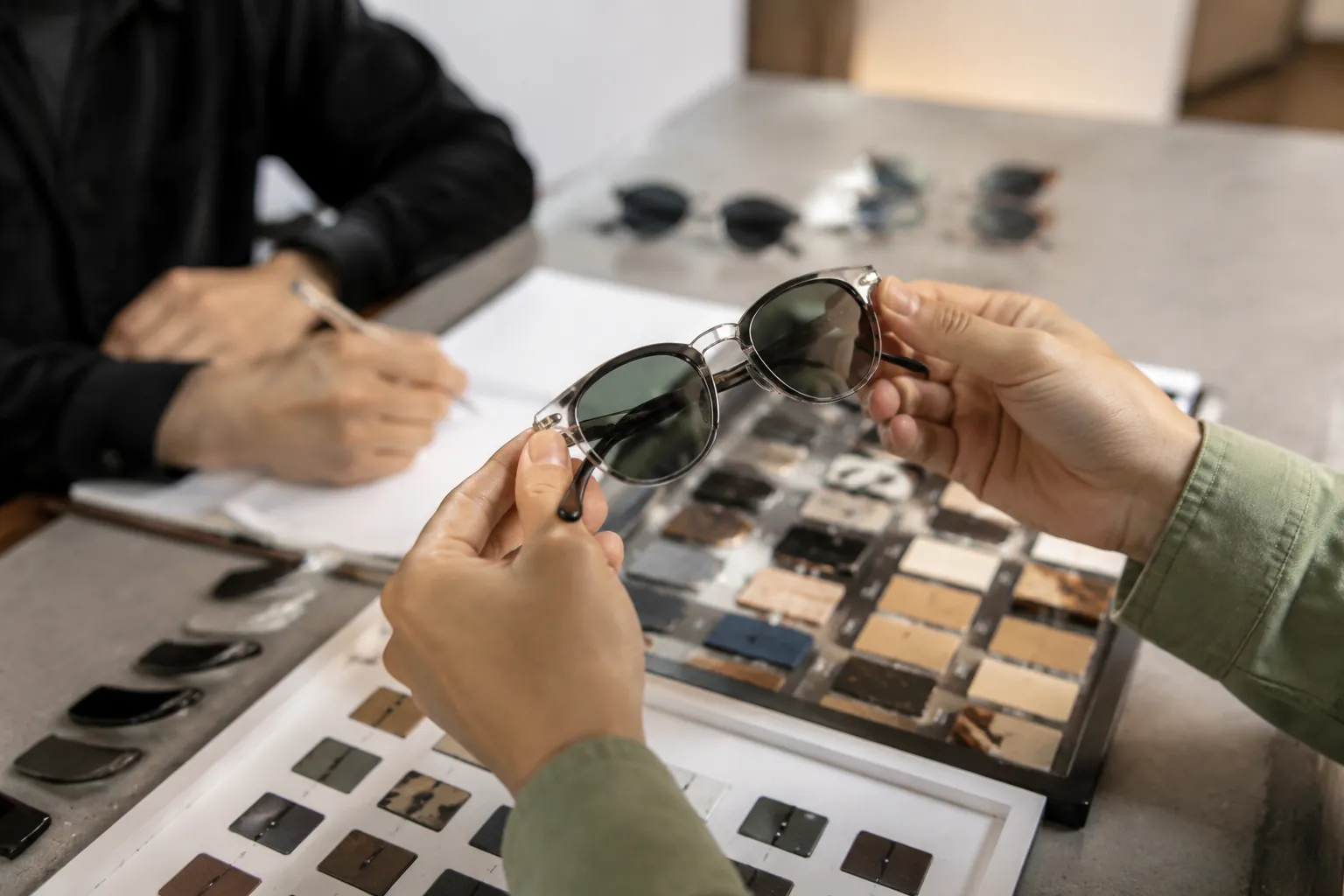
This guide is for overseas brands, importers, distributors, and retailers buying custom sunglasses in 50-, 300-, or 1000-pair batches. Supplier qualification should change with volume. A 50-pair order mainly tests communication, sample execution, and low-MOQ discipline. A 300-pair order starts to expose process control. A 1000-pair order should prove repeatability across color, lens quality, decoration placement, packing accuracy, and shipment timing. Use the framework below to match customization, cost expectations, lead time, compliance checks, and production control to the order size you are actually placing.
Match order size to the sourcing goal first
Start with one question: what should this order prove?
Many buyers over-spec small runs, then blame the supplier for cost or delay. That is backwards. A 50-pair order usually tests market response, frame fit, color direction, or influencer seeding. A 300-pair order tests whether the supplier can turn an approved sample into a small commercial batch. A 1000-pair order should prove the factory can follow the spec without constant buyer intervention.
Low MOQ does not mean every feature makes commercial sense. Small runs work best with a narrow brief: one stock mold, one or two standard frame colors, one lens color, one logo method, and simple packing. Add multiple temple finishes, mixed lens tints, rigid boxes, or split assortments, and handling cost rises fast. Often faster than the product value.
| Order size | Best sourcing goal | Reasonable specification level | Main risk |
|---|---|---|---|
| 50 pairs/design | Market test, event drop, influencer seeding | Stock mold, standard hinge, 1 logo position, pouch or polybag | Too many SKUs and packaging variants for a tiny run |
| 300 pairs/design | Brand launch, pilot retail batch | Controlled color standard, 1-2 decorations, barcode label, basic retail packing | Approving a loose sample with unclear measurements |
| 1000 pairs/design | Repeatable commercial order | Golden sample, BOM freeze, QC checkpoints, carton standard, compliance file | Production disputes caused by vague specs or artwork changes after deposit |
| 5000+ pairs/design | Seasonal program or distribution run | Formal planning, tighter tolerance control, possible tooling discussion | Late forecasts, split shipment pressure, line capacity conflicts |
Qualification should scale with financial exposure. Do not qualify a 50-pair test the same way you qualify a chain-store program.
What a 50-pair qualification should check
At 50 pairs, you are not testing full factory capacity. You are testing whether the supplier can handle a small custom order cleanly, communicate clearly, and avoid unnecessary complexity.
The safest 50-pair program uses an existing mold, standard frame color, standard lens option, and one decoration method such as pad print or laser marking.
A realistic brief is simple: black frame, smoke lens, one-color pad print on the left temple, logo width defined in millimeters, microfiber pouch, export carton. That is manageable. A weak brief looks like this: five frame colors, three lens tints, two logo positions, custom rigid box, metal logo plate, and mixed ratio packing. Too much setup. Too little volume.
- Ask for the stock mold sheet: eye size, bridge, temple length, base curve, material, available colors, and hinge type.
- Control logo placement by measurement: specify logo width and height plus the distance from the hinge in millimeters. Small shifts are obvious on sunglass temples.
- Request a real pre-production sample: not only a digital mockup. Mockups do not show print sharpness, scale, or fit on a curved surface.
- Confirm lens category and UV claim: fashion tint, UV400 claim, category 2, and category 3 are not the same buying decision. State the requirement clearly.
- Keep packing simple: pouch, polybag, swing tag, barcode sticker, or outer carton label. Rigid gift boxes are usually inefficient at 50 pairs.
For small runs, sample lead time matters more than factory size. The sample should answer three questions: does the logo look right, does the frame fit correctly, and does the lens tint match the selling concept? If the answer is unclear, do not move to bulk production.
At 300 pairs, process discipline starts to show
Three hundred pairs is where weak process control becomes visible. Setup cost is spread more efficiently, so buyers can expect better unit economics and cleaner execution. But the main value is not just a lower unit price. The real test is whether the supplier can follow a written production spec and hold the result across the batch.
This is also where buyers create future problems by approving a sample as "close enough." In eyewear, "close enough" often becomes the production standard. If the temple print sits too low, the lens tint is lighter than planned, or the pouch fits too tightly, document the issue and correct it before bulk approval. Do not assume the factory will interpret your intent.
At 300 pairs, ask for a formal spec sheet. It should cover frame material, frame color, lens color, logo artwork, decoration method, pack-out, and carton details. For color-sensitive programs, use a Pantone number or physical chip as a reference. But be practical. Molded plastic, acetate, coatings, and printed paper do not match paper standards perfectly. A retained physical control sample is often more useful than a color code alone.
Also ask which steps are in-house for the exact model being quoted. A stock injection-molded frame and a laminated acetate frame follow different production routes. They carry different defect risks. Qualify the supplier against the construction you are buying, not the catalog photo.
What 1000 pairs should prove before you scale
A 1000-pair order is not large by factory standards. It is large enough, though, to require real production control.
At this stage, the target is repeatability. The question is no longer whether the supplier can make one acceptable sample. The question is whether the whole shipment can match that sample within agreed tolerances.
For injection-molded frames, watch for flash at parting lines, sink or shrink marks near stress points, temple opening tension, and lens seating pressure. Inconsistent lens cutting causes trouble: one lens may sit too tight, another too loose. For acetate frames, watch laminate color variation, polishing consistency, hinge security, and left-right temple alignment after heating and adjustment. Acetate relies more on manual finishing. Operator control matters.
- Lock a golden sample: one signed sample held by the buyer and one by the supplier. Photos are not enough.
- Freeze the bill of materials: frame material, hinge, screw, lens material, packaging items, labels, and carton specification.
- Set inspection points: incoming lens check, frame-form check, decoration check, assembly check, and final packing check.
- Define defect categories: scratched lenses, loose hinges, cracked frames, print loss, color mismatch, and packing errors should be judged against written criteria.
- Confirm carton data: units per carton, carton dimensions, gross and net weight, barcode position, and shipping marks.
Discuss lead time by complexity, not just quantity. A 1000-pair order in one frame color with one print method is easier to schedule and inspect than a 1000-pair order split across multiple colors, decoration methods, and custom retail boxes. More variables mean more setup, more checking, and more packing control.
Cost logic by MOQ: why the same frame prices differently
Buyers often ask why they cannot get the 1000-pair or 5000-pair price on a 50-pair order. The reason is simple: setup cost does not shrink in line with quantity.
Artwork review, print plate preparation, fixture setup, lens selection, line scheduling, QC, and export documentation still happen whether the order is 50 pairs or 5000 pairs.
Compare quotes spec-for-spec. A basic stock frame with a standard lens, one logo print, and pouch packing has a very different cost structure from an acetate style with metal logo plates, custom lens tint, and retail-ready box packing. Unit price differences often reflect process burden, not just material cost.
| Cost driver | 50 pairs | 300 pairs | 1000 pairs |
|---|---|---|---|
| Frame mold/tooling | Use stock mold almost always | Stock mold still preferred | Tooling discussion becomes more realistic if repeat orders are likely |
| Decoration setup | High per-unit burden; best with 1 print position | More acceptable per-unit spread | Efficient if artwork and fixture positions are frozen |
| Lens color | Standard smoke, brown, or green is most practical | Custom tint can be considered with an approval sample | Custom tint is more viable if a control sample is signed |
| Packaging | Pouch, polybag, simple label | Barcode, insert card, basic retail box possible | Retail-ready packing and carton plan should be formalized |
| QC effort | Basic final inspection | Batch and packing checks | Incoming, in-process, and final checks expected |
The cleanest quote comparison is line by line. If one supplier includes logo printing, lens testing support, pouch, carton label, and export packing while another quotes only bare glasses, the lower quote may not be lower in landed cost.
Compliance and testing documents to request before payment
Compliance is not just paperwork. It affects customs clearance, retailer acceptance, product labeling, and liability.
The documents you need depend on the destination market, lens category, and claims made in sales materials or packaging. A credible supplier should be able to explain what standards the product is intended to meet and what support documents are available for that product.
Relevant documents may include CE-related support for EN ISO 12312-1, ANSI Z80.3 support for the US market, AS/NZS 1067 support for Australia or New Zealand, REACH-related material information, FDA registration details where applicable, and management-system or social-compliance documents such as ISO 9001 and BSCI. Request only what applies to the market and product claim. A pile of unrelated certificates does not reduce risk.
- European Union: request documentation that supports EN ISO 12312-1 performance and ask for REACH-related material information for restricted substances.
- United States: ask how ANSI Z80.3 applies to the sunglasses being quoted and request clarification on the supplier's FDA registration status where relevant to the program.
- Australia/New Zealand: request AS/NZS 1067 support if that market is planned.
- Retail or importer review: ISO 9001 can support quality-system review and BSCI can support social-compliance review.
Claims must match evidence. If the sunglasses are sold as UV400, polarized, category 3, or suitable for a specific use case, the test basis and labeling should support that claim. Check polarization during QC. Lens category labeling should reflect the actual visible light transmission range, not a marketing preference.
Production-control questions that expose weak suppliers
A trader can still be useful. But you need to know who controls production.
Qualification should go beyond catalog images and broad promises. Strong suppliers answer process questions with steps, checkpoints, fixture details, and defect-handling methods. Weak suppliers say "no problem" and give no control logic.
For a typical injection-frame program, production may include material preparation, molding, trimming, hinge or temple assembly, lens fitting, decoration, cleaning, final adjustment, inspection, and packing. For acetate, the route is usually longer: sheet cutting, CNC shaping, beveling, tumbling, polishing, hinge insertion, manual fitting, lens assembly, adjustment, and final polishing. Each step adds a chance for variation.
- Ask where lens tinting is done: in-house tinting can improve schedule control, while outsourced tinting adds handoff risk.
- Ask how logo position is fixed: fixtures, jigs, and print stops are more reliable than verbal instructions.
- Ask what tolerance is accepted: a measurable answer is more useful than "we control it well."
- Ask what happens if lens scratches exceed the limit: the answer should include segregation, replacement, reinspection, and trace-back.
- Ask who signs the final inspection report: a named QC role or department is better than a vague assurance.
Practical rule: if the supplier cannot explain how your lens tint, decoration position, and pack-out are controlled on the line, do not jump from a 50-pair test to a 1000-pair order.
Use a staged path from test order to repeat program
The safest sourcing path is staged. Start narrow. Measure performance. Add complexity only after the supplier proves control.
This can feel slower than placing a mixed large order right away. It usually lowers the risk of remakes, delays, and compliance problems.
For a new supplier, begin with one frame, one lens, one logo position, and one basic packing method at 50 pairs. Review sample accuracy, logo sharpness, lens appearance, fit, communication speed, and whether bulk matches the approved sample. If the result is clean, move to 300 pairs and add only one controlled variable, such as a second frame color or upgraded retail packaging.
At 1000 pairs, require a frozen spec sheet, signed golden sample, written QC plan, carton standard, and market-relevant compliance documents.
Three buying rules prevent many disputes. First, do not change artwork after deposit unless you accept delay and possible remake cost. Second, do not approve production from a low-resolution mockup when logo scale and placement matter. Third, do not split one 1000-pair order into many tiny SKUs and expect the same unit price as one SKU. Each SKU creates its own setup, handling, and inspection burden.
Even a capable supplier needs a disciplined brief. The factory controls execution. The buyer controls specification clarity.
Have a custom sunglasses project in mind?
Send us your styles, target market and quantities and we will return a detailed quote with MOQ, lead time and a sample plan.
Get a QuoteWhy source this from Wenzhou with LumiShades
Wenzhou in Zhejiang Province is widely regarded as China’s eyewear manufacturing capital, producing a large share of the world’s sunglasses. That concentration matters to buyers: a deep local supply chain for acetate sheet, hinges, lens blanks, plating and packaging means shorter component lead times, easier color and material matching, and a workforce with decades of eyewear-specific skill. LumiShades has manufactured in this ecosystem since 2009, and our vertical integration — in-house injection molding, acetate cutting, CNC milling, lens tinting, decoration and quality control — means no part of your order is quietly subcontracted to a workshop you cannot audit.
For international buyers, that vertical control translates into accountability. When a single factory owns every step, defects are traced and fixed at source rather than bounced between vendors, and your specifications survive intact from first sample to bulk. We back this with 15+ years of experience, shipments to 60+ countries, more than 5 million pairs produced per year and a 98.5% on-time delivery rate. Our certifications — CE EN ISO 12312-1, FDA registration, ANSI Z80.3, AS/NZS 1067, REACH, ISO 9001 and BSCI audit — mean the compliance documentation your market requires already exists. Explore our manufacturing capabilities and quality control process to see how this works in practice.
Frequently asked questions
Should I start with 50 pairs or go straight to 300 pairs? Start with 50 pairs if the frame shape, lens tint, logo scale, or market response is still unproven. Use that run to approve a physical sample, confirm fit, and verify decoration placement in millimeters. Move to 300 pairs only after you have a written spec sheet covering frame material, lens color, logo artwork, packing method, and carton details.
Can I use custom lens colors at 50 pairs? Sometimes, but standard tints such as smoke, brown, or green are usually safer at 50 pairs because they are easier to source and easier to match consistently. If you want a custom tint at low MOQ, ask for a physical lens approval sample first and confirm whether the supplier can hold the color without increasing lead time or minimum quantity. For most buyers, custom tint control becomes more practical at 300 pairs or above.
What documents should I request for selling sunglasses in the EU? Request documentation that supports EN ISO 12312-1 performance for the sunglasses being purchased and ask for REACH-related material information for restricted substances. Also check that product labeling matches the actual lens category and any UV400 or polarization claim. Before payment, ask the supplier to identify exactly which test report, declaration, or technical file supports the model you are buying. Do not rely only on general company certificates.
How long should I plan for samples and bulk production? Do not rely on a generic lead-time promise. Ask for two separate timelines: sample lead time and bulk lead time after sample approval and deposit. Then ask what could extend the schedule, such as custom lens tint, multiple frame colors, outsourced packaging, holiday shutdowns, or revised artwork. The useful question is not only "how many days?" It is also "what assumptions make that schedule valid?"
What is the biggest mistake buyers make at 1000 pairs? They approve vague specifications. At 1000 pairs, you should have a signed golden sample, frozen bill of materials, measured decoration positions, defined lens and frame color references, packing plan, carton marks, and written inspection criteria for critical, major, and minor defects. If any of those items is still open, resolve it before production starts rather than during final inspection.
Why does the unit price drop at 300, 1000, and 5000 pairs? Because setup and control costs are spread across more units. Artwork handling, print setup, fixtures, line changeover, inspection, and export processing all take time whether the order is small or large. To compare prices fairly, ask each supplier to break out what is included: frame, lens, logo method, packaging, labels, testing support, and export carton. A lower number is not a better price if key items are excluded.
Ready to start?
Explore our shield & oversized sunglasses or request a quote — our sales team replies within 12 hours.
Request a Quote