
Custom Temple Tips for Private Label Sunglasses
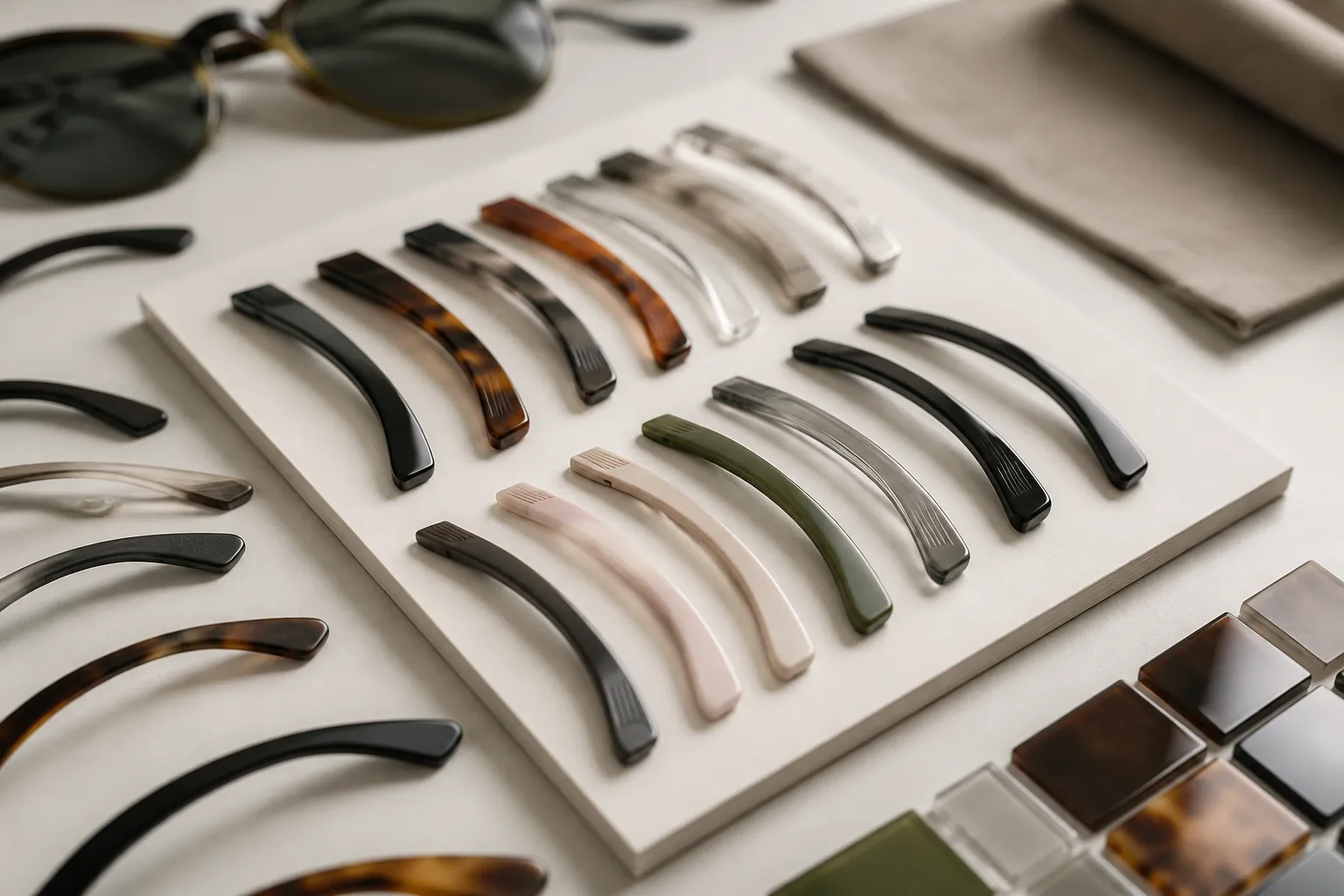
This guide is for brand owners, importers, distributors, and retailers sourcing private label sunglasses at volume. If you want a collection to feel related without opening new front tooling for every SKU, temple tips are one of the most practical branding zones to assess. A consistent temple-end detail can carry across acetate, metal, and injected styles with less development risk than redesigning the full frame front. Done well, it creates a repeatable visual cue, keeps development under control, and avoids custom details that look good in samples but fail in bulk production.
Why Temple Tips Matter More Than Buyers Think
Most private label programs start with front shape, lens color, and logo placement. Fair enough. But that often produces a line where each SKU works alone while the collection lacks a clear brand cue. One square frame, one cat-eye, one aviator, and one wrap can all sell. They still may not read as one family on shelf or in product photos.
Temple tips help fix that. They sit in a repeatable position, stay visible in side view, and can often be customized without changing the front mold. That matters. It lets buyers focus development on a smaller component instead of reopening the most expensive and complicated area of the frame.
The value comes from repetition. Use one recognizable temple-end detail across several styles and the line starts to look intentional, not random.
Useful temple-tip signatures include:
- a distinctive end silhouette, such as a paddle, coin end, tapered spear, or stepped block
- a controlled surface feature, such as a groove, chamfer, bevel, or textured section
- a fixed color cue, including a solid accent, laminated acetate edge, or contrast end cap
- a small hardware element, such as a flush metal plate, rivet cap, or branded insert
- a tactile cue that can be recognized by touch as well as sight
For many buyers, temple-end development is the practical middle ground between stock frames and full-custom eyewear. Visible enough to matter. Simple enough to scale.
Start With Volume, Not Sketches
Do not start with drawings alone. Start with your SKU plan and expected order volume. The same idea behaves very differently in a test order than in a repeat program.
- Map the frame families: separate injected plastic, acetate, metal, and mixed-material styles. A detail that works on acetate may need different thickness, tooling, or assembly on metal.
- Decide what stays constant: usually one or two signals only. For example, hold the same end silhouette and logo position, or the same groove pattern and color cue. More variables mean more QC risk.
- Define the signature zone: in many programs, the final section of the temple is enough. Extend the feature too far forward and you may affect comfort, balance, and consistency.
- Match complexity to MOQ: at lower volumes, an existing tip geometry with custom color or print is usually the lowest-risk route. At higher volumes, modified shapes or dedicated parts become easier to justify.
- Check wearer comfort early: a sharp tail, oversized block, or metal cap may look strong in CAD and still create pressure behind the ear. Skin-contact parts need wear testing. Not just visual approval.
- Review compliance exposure: the tip itself does not determine optical certification, but inks, coatings, adhesives, and plated inserts still need to sit inside your documentation and compliance process.
A simple rule helps: if one temple-end language can run across multiple SKUs in one season or carry into repeat orders, it is usually worth developing. If it works on only one style, the return drops fast unless volume is secure or the style is strategically important.
Which Temple-Tip Routes Make Sense
There are four common ways to build a signature temple end. They are not equal. Tooling demand, lead time, and production stability vary a lot.
| Route | Best Use | Typical Cost Impact | Lead-Time Impact | Main Trade-Off |
|---|---|---|---|---|
| Standard tip with custom color or print | Low-MOQ launches, pilot programs, retailer exclusives | Lowest relative cost because the base part already exists | Usually the smallest impact if the factory already runs the component | Easy to copy and often less distinctive over time |
| Modified existing tip shape | Brands that want a repeatable silhouette without rebuilding the full temple | Low to moderate depending on the process and amount of rework required | Often manageable within standard sample timing if the base structure is proven | Design freedom is limited by the original temple section and attachment method |
| Fully custom injected tip insert or end piece | Programs that can share one branded component across several compatible styles | Higher upfront development because dedicated tooling or part development is needed | Adds time for tooling, fit check, and first-article approval | Needs enough volume or repeat use to justify dedicated components |
| Acetate custom end profiling with metal detail | Higher-end acetate collections and premium retail programs | Moderate to high because material yield, hand finishing, and QC become more demanding | Usually longer due to polishing, matching, and insert fitting control | More variation can appear if process discipline is weak |
For many B2B buyers, the second and third routes are the most realistic balance. Distinctive enough to support branding. Controlled enough to manufacture repeatedly.
Supplier capability matters. A lot. Temple-end projects often break down at the handoff points: one supplier machines the part, another decorates it, another assembles it, and final QC is left dealing with tolerance drift. Confirm who owns molding or machining, decoration, assembly, and final inspection before development starts.
What Raises Cost and What Usually Does Not
Buyers often assume any custom part will drive cost up sharply. Not always. Temple-end customization can be one of the more controlled ways to add visible brand language if it stays close to an existing temple structure and avoids unnecessary assembly risk.
At lower volumes, the least disruptive route is usually the most economical. Color changes, laser marks, or pad-printed accents generally need less development than new molds or complex inserts. As volume rises and the same detail is used across multiple SKUs, shape changes or dedicated end components become easier to justify because the cost spreads across more units and more seasons.
Changes that usually add limited cost:
- switching tip color within an existing material system
- adding a one-position laser mark where substrate contrast is stable
- using pad print on a flat area with enough usable width for consistent registration
- adding a basic bevel or shallow groove if the base machining or molding process already supports it
Changes that often cost more than buyers expect:
- left-right mirrored metal inserts that require tight cavity fit and orientation control
- very sharp geometry that needs extra hand finishing to meet comfort and safety expectations
- multi-layer acetate builds used only at the temple end, which increase scrap and color-matching complexity
- rubberized or soft-touch coatings that look good in samples but may create wear or tackiness problems later
Ask the right question. Not whether the tip is custom. Ask whether the detail fits the target price band, repeats cleanly in bulk, and can be reused across future SKUs without fresh redevelopment.
Development Steps That Hold Up in Production
This is where many concepts fail. A temple tip can look good in a render and still turn into a bad production part if geometry, finish, and decoration limits are not defined on the drawing.
- Define the visible signature zone: state exactly which section of the temple end carries the brand cue so the factory knows what must stay consistent.
- Set section thickness by material: injected parts can hold repeatable form, but very fine edges may soften in molding; acetate can show crisp edge character, but it needs polishing allowance. Avoid unsupported thin points unless the supplier has already proven the structure.
- Lock the assembly method: overmolded, inserted, pinned, glued, or cut from one acetate temple. Each route has different failure points. Decide early.
- Specify measurable tolerances: end length, logo offset, insert depth, and edge radius should all appear on the drawing. If a detail is judged only by eye, it will drift.
- Prototype for wear, not only appearance: samples should be worn for extended periods, especially if the target market also uses helmets, hats, or tied-back hair. Pressure points often show up only after use.
- Check decoration after final finishing: polishing, tumbling, or edge correction can change how close a logo or groove appears to the edge. Base approval on final-finish samples.
- Freeze a control sample: production QC should inspect against an approved physical sample and signed drawing, not only artwork or a 3D render.
Lead time depends on the route and on the supplier's existing part library. If the concept uses an existing structure, development is usually faster than building a fully new component. A new injected part, custom metal cap, or more complex acetate construction usually adds time for tooling, fit validation, and first-article approval before mass production begins.
Material, Decoration, and Compliance Limits
Temple tips are small parts. They still sit inside the product compliance chain. Treat them as functional components, not decorative extras.
For finished sunglasses, the main standards usually apply at the lens and complete-product level, including CE EN ISO 12312-1, ANSI Z80.3, and AS/NZS 1067 where relevant to the market and product category. A temple tip does not replace those requirements and does not certify the product on its own. But materials and surface treatments at the temple end can still create compliance, durability, or claims issues if they are not documented and controlled.
REACH matters for substance control, especially where paints, inks, coatings, adhesives, soft-touch layers, and plated metal parts are involved. Buyers also often request supplier-level documents such as FDA registration, ISO 9001, or BSCI, but those are factory or system indicators. They are not substitutes for product testing, bill-of-materials control, or market-specific compliance review.
| Material / Finish | Strengths | Common Limits | What Buyers Should Check |
|---|---|---|---|
| Acetate | Rich edge color, good polishing depth, strong premium feel | Batch color variation, more hand finishing, possible left-right mismatch | Color lot control, polishing consistency, dimensional symmetry |
| Injected plastic | High repeatability, efficient cost, good for shared branded parts | Very fine details can soften; some textures may not reproduce sharply | Tooling quality, gate marks, shrink behavior, texture fidelity |
| Metal end cap or insert | Premium appearance, strong tactile identity, good logo surface | Fit tolerance, plating risk, adhesion failure if fixed poorly | Cavity fit, plating specification, sweat exposure durability, pull-off resistance |
| Rubberized or soft-touch coating | Comfortable hand feel and immediate perceived value | Can wear, become sticky, or discolor over time | Abrasion performance, chemical resistance, long-term tackiness risk |
Decoration choice matters too. Pad print is flexible and widely used but needs a stable print zone. Laser marking can be clean and durable where contrast is reliable. Foil, inlay, or plated details may look stronger on shelf but require tighter process control. Request the full bill of materials for any custom temple-end build, including inks, coatings, adhesives, inserts, and plating specifications.
Failure Modes That Cause Rework and Claims
Temple-tip customization stays efficient only if it runs cleanly in production. Most failures are predictable. Most are preventable.
- Decoration drift: logos or line patterns are placed too close to the edge, then polishing changes the visible spacing.
- Left-right mismatch: one temple tip ends up slightly longer, steeper, or fuller than the other, especially on hand-finished acetate parts.
- Edge bite: CAD geometry looks crisp, but the real part feels sharp on skin and leads to comfort complaints.
- Color inconsistency: inserts, paints, or acetate lots vary because approval was based on photos rather than physical standards.
- Loose plates or caps: insert cavity control or adhesive control is weak, and the part lifts after heat or sweat exposure.
- Balance shift: heavy end pieces make the frame feel tail-heavy and change perceived fit quality.
The fix is straightforward. Put measurable checkpoints on the drawing and QC sheet. Tip length, width, logo offset, insert depth, and edge condition should all be defined clearly enough for inspection. Even a simple go/no-go reference for the temple end can reduce avoidable disputes at final inspection.
Also confirm how quality responsibility is assigned. If molding, machining, decoration, and assembly are split across multiple suppliers, each handoff creates more room for disagreement. Clear ownership reduces delays.
How to Build a Family Look Without Over-Engineering It
If the goal is brand recognition without opening new full-frame tooling for every style, build a temple-tip system rather than a one-off feature. Repeatability matters more than novelty.
- Choose one signature end silhouette that can translate across multiple SKUs.
- Limit the first rollout to a manageable number of frame constructions so QC does not fragment too early.
- Keep one constant cue, such as a fixed accent color, identical groove geometry, or the same metal insert language.
- Use one logo size and placement rule across the range to reduce visual inconsistency.
- Review sell-through, return feedback, and comfort comments before expanding the system further.
This approach can make a collection look related even if one style is acetate, one is injected, and one is metal with fitted end sleeves. It also gives the factory a more repeatable component logic, which can help future sampling and reduce development confusion.
For many private label buyers, the most practical route is to start from an existing frame platform, modify or develop a signature temple end, validate it in physical samples, and then carry that detail into future styles. Lower risk. Easier to scale. More realistic than pushing every new style into full custom front tooling from day one.
Strong eyewear branding does not need more parts. It needs one detail that production can hold consistently.
Have a custom sunglasses project in mind?
Send us your styles, target market and quantities and we will return a detailed quote with MOQ, lead time and a sample plan.
Get a QuoteWhy source this from Wenzhou with LumiShades
Wenzhou in Zhejiang Province is widely regarded as China’s eyewear manufacturing capital, producing a large share of the world’s sunglasses. That concentration matters to buyers: a deep local supply chain for acetate sheet, hinges, lens blanks, plating and packaging means shorter component lead times, easier color and material matching, and a workforce with decades of eyewear-specific skill. LumiShades has manufactured in this ecosystem since 2009, and our vertical integration — in-house injection molding, acetate cutting, CNC milling, lens tinting, decoration and quality control — means no part of your order is quietly subcontracted to a workshop you cannot audit.
For international buyers, that vertical control translates into accountability. When a single factory owns every step, defects are traced and fixed at source rather than bounced between vendors, and your specifications survive intact from first sample to bulk. We back this with 15+ years of experience, shipments to 60+ countries, more than 5 million pairs produced per year and a 98.5% on-time delivery rate. Our certifications — CE EN ISO 12312-1, FDA registration, ANSI Z80.3, AS/NZS 1067, REACH, ISO 9001 and BSCI audit — mean the compliance documentation your market requires already exists. Explore our manufacturing capabilities and quality control process to see how this works in practice.
Frequently asked questions
Can I use one custom temple-tip design across acetate and metal frames? Yes, but usually as a shared design language rather than an identical part. First define what must stay constant: silhouette, groove pattern, accent color, insert shape, or logo position. Then have the supplier adapt the construction for each material. For acetate, confirm polishing allowance and left-right symmetry control. For metal, confirm how the end piece is attached, what tolerance the sleeve or cap can hold, and whether the finish holds up under wear. Request side-view drawings and physical samples for each construction before approving bulk use across the line.
At what order volume does a custom temple tip usually make financial sense? There is no fixed breakpoint because the answer depends on whether you are modifying an existing part or creating a new one. A custom color, pad print, or laser mark on a standard tip can make sense at relatively low volume because development is limited. A modified shape or dedicated injected component becomes more practical when the same design will be shared across several SKUs or repeated in future orders. Ask the supplier for two quotations: one using a standard tip with decoration, and one using the custom route. Then compare unit price, tooling, sample cost, lead time, and whether the part can be reused on future styles.
Will a custom temple tip affect compliance for CE EN ISO 12312-1 or ANSI Z80.3? Usually not at the optical-performance level, because CE EN ISO 12312-1, ANSI Z80.3, and AS/NZS 1067 apply to the finished sunglasses and the relevant lens or product performance requirements. But a custom temple tip can still affect your compliance file if it adds new coatings, inks, adhesives, plated inserts, or substrate materials. For REACH-sensitive markets, ask for material declarations or supporting chemical documentation for those added components. In practice, review the full bill of materials whenever the temple-end build changes, even if the lens and frame front stay the same.
How much extra lead time should I expect for signature temple-end development? It depends on whether the design uses an existing structure or requires a new component. If the supplier is changing color, print, or a minor shape detail on an established part, the lead-time effect is usually limited. If the design needs new injection tooling, a new metal insert, or more complex acetate shaping, expect extra time for development, first samples, fit confirmation, and first-article approval before bulk production starts. The practical way to manage timing is to ask the supplier to break the schedule into stages: drawing approval, prototype sample, revised sample if needed, tooling completion if applicable, pre-production sample, and bulk production.
What is the most common mistake buyers make with temple-tip branding? They approve the concept for appearance only and do not control comfort, finishing drift, and inspection criteria. The temple end touches the wearer directly and is often inspected closely, so small defects are easier to notice than many buyers expect. Reduce risk by approving a final-finish sample rather than a pre-polish prototype, defining measurable checkpoints on the drawing, and asking how left-right matching will be inspected. If the design includes metal caps, coatings, or inserts, also ask how attachment strength and wear durability will be checked before shipment.
Ready to start?
Explore our rimless sunglasses or request a quote — our sales team replies within 12 hours.
Request a Quote