
Packaging Mistakes That Delay Sunglass Shipments
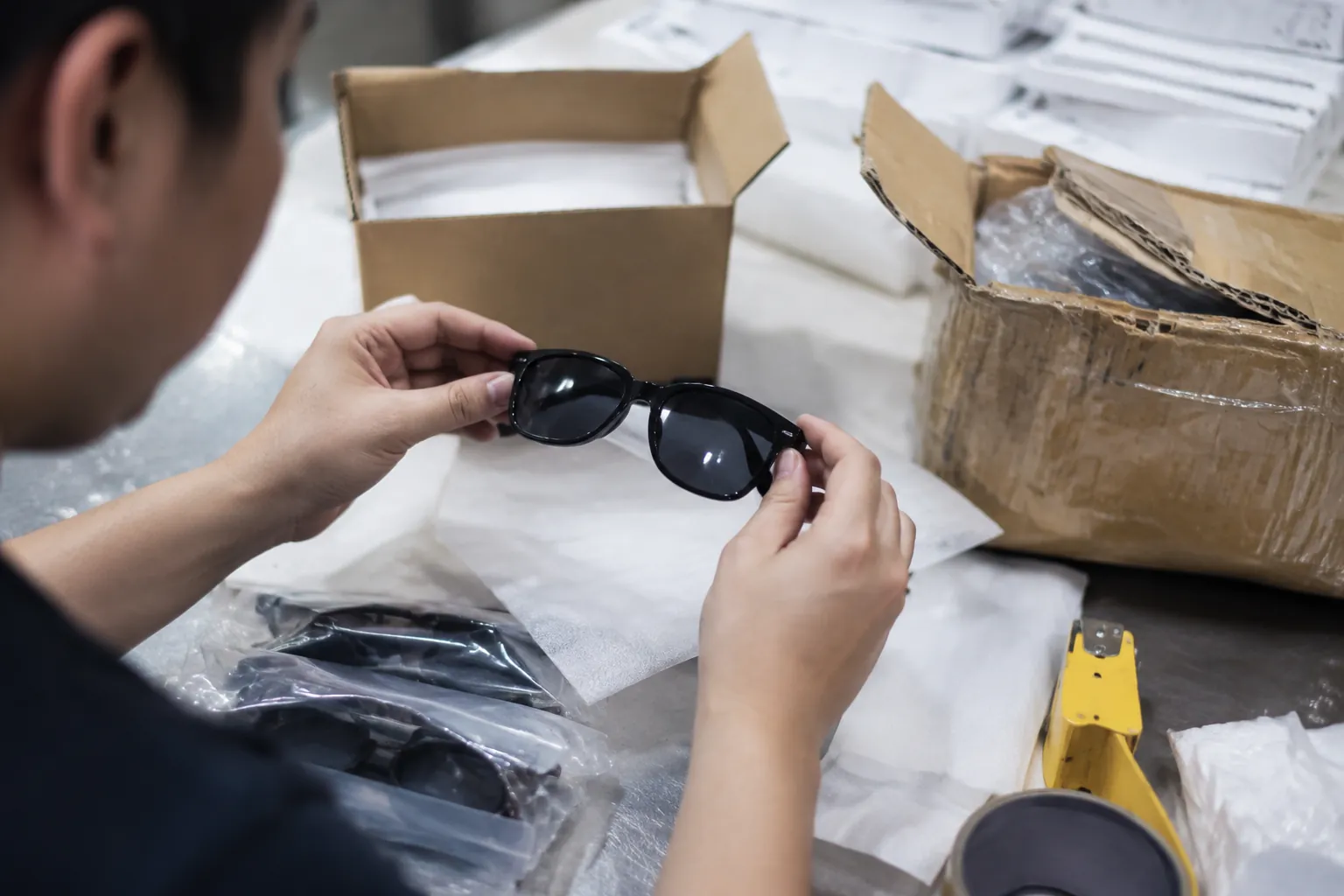
This article is for brand owners, importers, distributors, and retailers sourcing custom sunglasses in volume. Delays often do not start with the frame. They start with the branded parts around it: insert cards, hangtags, barcode labels, microfiber pouches, polybags, warning labels, and carton marks. Each one needs artwork approval, purchasing, incoming inspection, and correct setup on the packing line. Miss one step and finished goods sit. Define these items early, approve them at actual size, and check them in one fully packed sample before bulk packout.
Where shipment delays usually start
Late packaging delays usually begin much earlier. Frames may be molded or machined, lenses tinted, logos applied, hinges fitted, and final assembly completed, yet the order still cannot ship. The insert file is not approved. The UPC list does not match the SKU sheet. The retail label does not scan.
For custom sunglasses, the repeat problem items are paper insert cards, folded leaflets, microfiber pouches, hangtags, UPC or EAN stickers, polybags, carton shipping marks, country-of-origin labels, and retailer-specific pack-ins. None is especially complex on its own. The trouble is coordination. Each item depends on three controls at once: correct artwork, correct purchasing, and correct execution on the packing line.
The real issue is sequence control. A packaging item cannot be packed correctly if the artwork is still changing, if the purchased part does not match the approved file, or if the line is working from an outdated SKU-to-label list. Once finished sunglasses are waiting at final packout, any packaging error gets slower and more expensive to fix. Goods may need to be held, reopened, relabeled, or repacked.
Even factories that manage frame production and lens processing well still need disciplined control of packaging accessories, especially paper goods, printed labels, and pouches sourced separately. Packaging is not a last-minute graphics task. Treat it that way and shipment risk goes up fast.
Buyer checklist before bulk starts
Before bulk release, lock the packing method and define every branded accessory as a controlled item. That means dimensions, material, print method, attachment, data content, and placement are fixed before the line starts closing units.
- Lock the packing method: each pair in polybag or not, pouch included or not, insert orientation, hangtag position, inner pack count, and master carton quantity.
- Confirm barcode ownership: who issues UPC or EAN numbers, who verifies them, and whether each colorway, lens category, or retail pack version needs a separate code.
- Approve final print files at production size. A file reviewed only on screen may miss trim risk, fold alignment, or crowded text.
- Define label content exactly: SKU, style code, color code, lens category, country of origin, importer or distributor details, warning text, and market-specific wording.
- Choose the attachment method: cotton string, elastic loop, plastic fastener, removable label, or no attachment. The wrong method can scratch lenses or mark frame surfaces in transit.
- Approve one fully packed sample, not only loose components. This is where many errors first show up.
- Freeze carton marks before mass packing. Reworking outer cartons late wastes labor and increases picking risk.
Write even basic details in measurable language. Instead of saying standard insert card, specify something like: 60 x 90 mm, 350 gsm C1S card, matte lamination one side, 4C front and 1C back, trim tolerance +/-0.5 mm, packed flat 500 pcs per bundle. That gives the supplier something concrete to buy, inspect, and run.
One missing detail can hold a finished order. The goods are assembled. They are still not ready to ship in the approved retail or export configuration.
Which accessories carry the most risk
| Item | Main risk | Typical lead-time impact | What buyers should confirm |
|---|---|---|---|
| Paper insert card | Wrong size, language error, trim shift, missing legal text, warped stock after lamination | Delay if reprint is required before packout | Final dimensions, paper weight 250-400 gsm, print side, fold direction, finish, and required text by market |
| Hangtag | Wrong hole position, weak string knot, hard eyelet or fastener scratching frame or lens | Delay if tags must be remade or attachment method changed | Tag size, hole diameter, string length, attachment point, and whether any hard part touches the lens |
| UPC or EAN label | Poor scan grade, wrong SKU mapping, quiet zone too small, label placed on curved or textured area | Delay if relabeling is needed | Barcode type, final size, quiet zone, adhesive grade, human-readable text, and data list by style and color |
| Microfiber pouch with print | Logo drift, ink rub-off, incorrect pouch size, drawstring imbalance, color mismatch | Delay if rejected lots must be remade | Pouch dimensions, fabric weight, print method, logo position tolerance, fabric color, and drawstring specification |
| Master carton shipping mark | Wrong PO number, destination, assortment, carton count, or gross weight format | Delay if cartons must be re-marked or resorted | Marking layout, carton quantity, gross/net weight format, destination code, and outer carton size |
Barcode labels create a specific risk because they look simple. They are not. Scan performance depends on correct data, correct sizing, adequate quiet zones, print quality, and placement on a flat enough surface. If a label wraps over a curved temple, crosses a seam, or sits on a textured area, scan reliability drops. Buyers should provide a clean barcode data sheet, specify final label size and placement, and require a sample scan check before bulk labeling starts.
Paper inserts cause another common delay. On a small card, minor trim variation can cut into warning text or make a centered layout look visibly off. Lamination can also change stiffness or create curl, which matters if the insert must slide into a pouch or sit neatly inside a retail pack.
Printed microfiber pouches need clear controls too. Logo position, rub resistance, pouch dimensions, and drawstring balance affect both presentation and line efficiency. If the pouch is wrong, packing slows down or the lot gets rejected.
How approvals should fit the production calendar
If prototype sampling and bulk production follow separate milestones, packaging files should not wait until bulk is underway. Packaging procurement needs to move in parallel with frame and lens production. Otherwise packout becomes the last bottleneck.
A practical schedule looks like this:
- Freeze sunglass specs, colorways, logo decoration method, and the packaging bill of materials.
- Submit artwork for insert cards, hangtags, pouches, UPC labels, warning labels, and carton marks.
- Review a pre-production sample, ideally showing the intended packed presentation even if some final printed pieces are still pending.
- Before bulk material release, freeze all printable files, barcode mapping, market text, and carton assortment logic.
- During bulk, inspect the first printed packaging lot and the first packed carton, not only the first finished sunglasses.
This sequence matters. A factory may keep moving on frames, lenses, and logo application while packaging accessories are still in progress, but the final packout station cannot run correctly if inserts, labels, or carton marks keep changing. Once finished sunglasses reach final assembly, the remaining options are usually bad ones: wait or pack twice.
Packing twice adds labor, handling, and more chances to mix SKUs or mark the product. Order size also changes the control burden. Smaller runs can become disproportionately slow if they carry too many retail packaging variants. Larger runs justify tighter planning because carton configuration, barcode mapping, and market versions directly affect warehouse receiving and shipment accuracy.
Specification details that prevent rework
Good packaging specifications are exact. A useful insert or hangtag specification should define dimensions in millimeters, material, paper weight or thickness, print colors, finish, hole position if tagged, fold direction if folded, and the final packing method.
For barcode labels, the instruction should include exact data content and placement. Example: 38 x 25 mm matte white label, removable or permanent adhesive as specified, black print, UPC-A code, human-readable digits below, minimum quiet zone as required by the barcode format, applied to outer polybag front lower-right corner, square to edge within +/-2 mm. That is a production instruction. Saying add barcode sticker is not.
For labels applied directly to sunglasses, be careful. Adhesive residue on lenses is a common complaint, especially on mirrored, flash-coated, or hard-coated surfaces. If a label must touch the product, specify removable adhesive and require a removal test after storage under normal room conditions and after agreed heat-exposure simulation. In many programs, labeling the polybag, pouch, or swing tag is lower risk than labeling the lens.
Attachment details matter too. A hard plastic fastener or metal eyelet can abrade a lens during transit. Depending on frame geometry and packing method, the safest hangtag point may be the hinge area, bridge, or another non-critical location that avoids repeated contact with the lens surface.
Decoration method also affects packaging behavior. Screen-printed pouches, heat-transfer pouches, laminated cards, and hot-stamped tags behave differently during folding, stacking, and insertion. Small detail. Real consequence.
Compliance text and labeling mistakes buyers still make
The sunglasses may meet the required standard, yet the accessory text can still create import or retail acceptance problems. Buyers should separate product compliance from packaging claims. Packaging should reflect the approved product configuration and the destination market, not a generic file reused from an older program.
Where relevant to the product and market, buyers may need packaging text or supporting documentation aligned with CE EN ISO 12312-1, ANSI Z80.3, AS/NZS 1067, REACH, FDA registration, ISO 9001, or BSCI. Use those references only where they actually apply. Printing a standard reference, warning statement, or compliance claim on an insert or hangtag without confirming applicability creates unnecessary risk.
Typical mistakes include:
- Printing compliance logos or statements that do not match the approved lens category or tested configuration.
- Using one insert for all markets even though language, importer address, or warning wording differs.
- Forgetting country-of-origin or distributor information where the retailer or destination authority requires it.
- Changing UV wording or lens category text on artwork without matching the approved product specification.
Buyers should maintain one controlled artwork file per SKU family and market version. If the same frame ships to the EU and Australia with different insert text, treat those as separate controlled items with separate revision history. Packing-line staff should not be expected to choose the correct insert from memory or verbal instruction.
One wrong line of print can stop shipment because cartons may need to be reopened, resorted, and checked again before release.
Packing-line failure modes inside the factory
Many packing errors happen at the end of the order, when finished sunglasses and multiple packaging variants are staged together. At that point, control needs to be physical and documented. Verbal instruction is not enough.
A workable packing control plan for custom eyewear should include line clearance before each new SKU starts, a sample board or approved golden sample at the station, barcode scan checks, count verification by inner pack and master carton, and random QC audits on completed packs. If one style uses the same frame in multiple lens colors, visual separation alone is weak control. Use separate bins, separate line labels, and a packing sequence that limits adjacent look-alike SKUs.
Incoming inspection of accessories matters too. Paper insert shortages, mixed hangtags, weak pouch stitching, or mislabeled barcode rolls will not be caught by frame or lens inspection. They need their own receiving checks before final packout starts. For printed items, check the first lot for dimensions, print content, color consistency against the approved proof, and barcode readability where applicable.
Even if frame QC, lens coating checks, hinge function checks, and logo inspection are solid, accessory control still needs separate checkpoints. A correct sunglass unit can still ship incorrectly if it is packed with the wrong pouch, the wrong UPC, or the wrong carton mark.
Buyers should request at least one packed sample approval and first-carton photos from bulk. Those checks catch a large share of preventable packing errors before the shipment is sealed and staged for dispatch.
What to send your supplier so the order closes cleanly
If you want fewer revision loops and fewer late changes, send one controlled packaging pack instead of scattering instructions across chat messages, marked-up PDFs, and spreadsheet edits. One person on the buyer side should own the revision level so the supplier is not comparing multiple versions of the same insert or barcode list.
A workable document pack usually contains:
- SKU list by style, frame color, lens color, and barcode number
- AI or print-ready PDF artwork files in actual size
- Color references such as Pantone codes where relevant
- Insert and tag dimensions with tolerances
- Pouch or case dimensions, material weight, and logo position
- Single packed sample photo showing item order inside the pack
- Master carton assortment, outer carton size, and shipping marks
For smaller runs, simpler packaging is usually easier to control. Every extra variant adds handling time, count risk, and more chances of mixing components. For larger programs, more detailed labeling and carton logic are often justified because warehouse scanning, retail receiving, and market segregation are more sensitive to error.
The commercial point is straightforward. Inserts, hangtags, UPC labels, and carton marks are small items with outsized impact on ship dates, labor cost, and claim risk. Treat them as controlled production parts. That is how orders close cleanly.
Have a custom sunglasses project in mind?
Send us your styles, target market and quantities and we will return a detailed quote with MOQ, lead time and a sample plan.
Get a QuoteWhy source this from Wenzhou with LumiShades
Wenzhou in Zhejiang Province is widely regarded as China’s eyewear manufacturing capital, producing a large share of the world’s sunglasses. That concentration matters to buyers: a deep local supply chain for acetate sheet, hinges, lens blanks, plating and packaging means shorter component lead times, easier color and material matching, and a workforce with decades of eyewear-specific skill. LumiShades has manufactured in this ecosystem since 2009, and our vertical integration — in-house injection molding, acetate cutting, CNC milling, lens tinting, decoration and quality control — means no part of your order is quietly subcontracted to a workshop you cannot audit.
For international buyers, that vertical control translates into accountability. When a single factory owns every step, defects are traced and fixed at source rather than bounced between vendors, and your specifications survive intact from first sample to bulk. We back this with 15+ years of experience, shipments to 60+ countries, more than 5 million pairs produced per year and a 98.5% on-time delivery rate. Our certifications — CE EN ISO 12312-1, FDA registration, ANSI Z80.3, AS/NZS 1067, REACH, ISO 9001 and BSCI audit — mean the compliance documentation your market requires already exists. Explore our manufacturing capabilities and quality control process to see how this works in practice.
Frequently asked questions
Should I approve packaging from a digital mockup only? No. Use the digital mockup for artwork review, but do not stop there. Approve the print-ready file at actual size, then review at least one physical packed sample showing the real sunglasses, real accessory placement, and final attachment method. Check trim, fold direction, barcode placement, string length, pouch fit, and whether any hard component can touch the lens or frame during transit.
When should UPC labels be finalized for a bulk sunglasses order? Finalize them before bulk material release and before any packaging accessories are printed or applied. The buyer should send a controlled barcode list tied to the exact SKU, colorway, and market version, then require the supplier to confirm data mapping and sample scan results. If barcode data changes after labels are printed or applied, relabeling can affect polybags, pouches, cartons, and packed units.
Is it safe to put stickers directly on sunglass lenses? Usually not, unless a retail program specifically requires it and the label has been tested for that surface. Adhesive can leave residue or mark mirrored, flash-coated, polarized, or hard-coated lenses, especially after storage and heat exposure. The lower-risk option is to label the polybag, pouch, or hangtag. If direct lens labeling is mandatory, specify removable adhesive and require a documented removal test on the actual lens finish.
Can one insert card cover EU, US, and Australia shipments together? Only if the wording, importer details, warnings, product claims, and any referenced standards are valid for all destination markets and for the actual approved product configuration. In practice, buyers should verify this market by market against their compliance and import requirements, then keep separate controlled artwork versions whenever the text does not fully align.
What is the minimum packaging information I should send with my PO? At minimum, send the SKU list, barcode list, actual-size artwork files, dimensions, material specifications, packing method, and carton marks. To make that usable on the factory side, include revision numbers, market version identification, attachment method, and one packed sample photo or packing diagram. Without those controls, late approvals, reprints, packing errors, and shipment holds become much more likely.
Ready to start?
Explore our round sunglasses or request a quote — our sales team replies within 12 hours.
Request a Quote