
Custom Sunglasses Packaging That Protects Profit
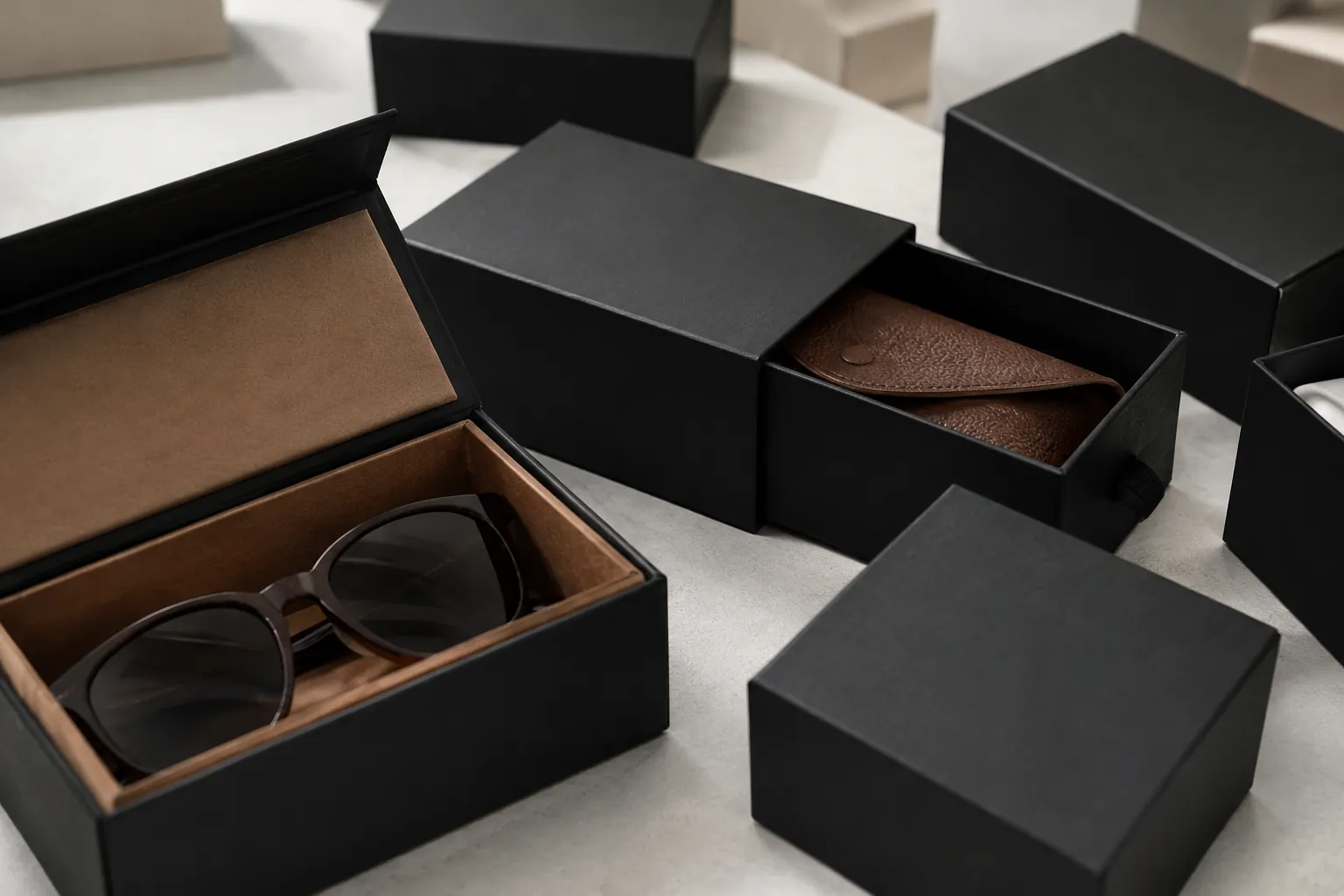
This guide is for brand owners, importers, distributors, and retailers buying custom sunglasses in volume. Packaging is not a photo sample decision. It is a cost, handling, and risk-control decision. In eyewear programs, the real impact comes from specifics: packed dimensions, material specs, assembly steps, carton yield, label accuracy, and damage risk by frame type. If you are sourcing from China or another offshore base, approve those details before bulk packing starts. Late packaging changes spill into print files, inserts, labels, carton counts, and shipment timing.
Start with the commercial case, not the mockup
Many buyers review sunglass packaging by appearance first. That is backwards. Packaging affects presentation, but it also affects material cost, assembly time, carton efficiency, storage density, and transit damage risk. A package that looks premium in a sample meeting can still create avoidable freight cost or slow pack-out on the factory floor.
Start with three questions. Where will the product sell: retail shelf, e-commerce, promotional distribution, or wholesale replenishment? Does the unit pack need to provide most of the protection, or will the inner and master carton do most of that work? What packaging cost is acceptable relative to product value and channel requirements? Those answers narrow the right format fast.
MOQ logic matters too. Frame pricing and packaging pricing do not always scale together. A frame program may improve at one volume level while a custom box, insert, or case stays expensive because tooling, print setup, or manual assembly still drives the cost. Treat packaging as its own sourcing line item, with its own breakpoints and lead-time implications.
At quotation stage, request product price, unit packaging price, any separate assembly charge, packed dimensions, units per inner carton if used, units per master carton, and master-carton dimensions. Without that data, a packaging mockup is not a buying decision yet.
Choose the pack format by channel
Different channels punish different mistakes. Retail shelves punish weak presentation, poor print quality, and packaging that does not communicate clearly. E-commerce punishes oversize dimensions, weak protection, and structures that crush easily. Distributor and wholesale programs punish slow packing, unclear SKU marking, and mixed-carton errors.
| Pack format | Best use case | Typical unit cost effect | Main advantages | Main risks |
|---|---|---|---|---|
| Microfiber pouch | Promotional, value retail, bulk wholesale | Usually the lowest-cost option | Low cube, simple packing, can also serve as a cleaning pouch | Limited crush protection; frame parts can contact lenses if the fit is loose |
| Drawstring pouch plus folding carton | Mid-range retail, private label launches | Moderate increase versus pouch only | Compact footprint, better presentation, clear surface for branding and labeling | Weak board or poor lamination can deform during humid storage or long transit |
| EVA zip case | Travel, sport, higher break-risk styles | Higher than pouch or carton formats | Better shape retention and impact resistance | Larger cube, higher freight burden, quality can vary by shell, zipper, and lining |
| Rigid setup box with insert | Gift sets, premium retail display | Usually the highest-cost option | Strong presentation, stable structure, broad decoration options | Higher freight burden, more assembly steps, easy to overspecify for the channel |
If sunglasses are going into chain retail with hang display or shelf presentation, question every millimeter of unnecessary depth or empty space. A well-specified folding carton with an insert can be more efficient than a rigid box because it uses less cube and is often easier to store and assemble. If the product ships one order at a time, parcel-size efficiency matters even more. Small increases in package depth or width can materially raise dimensional shipping cost.
Frame construction should also drive the decision. Lightweight injection-molded styles may work with a pouch-based system if the lenses are protected from contact and the frame stays stable in transit. Heavier acetate or metal styles often need firmer containment. More weight means more movement. Exposed hardware, hinge geometry, or adjustable nose pads can make that worse.
Where packaging damage usually starts
Most sunglass packaging failures are predictable. Temple tips press against lenses. Hinges create pressure points. Inserts let the bridge shift. Paperboard softens in humidity. Cartons are packed too loosely or too tightly. None of this is unusual. It just needs to be checked on purpose.
In development, check these details closely:
- Insert fit tolerance: The frame should sit securely with no obvious free movement inside the insert or cavity. If the product rattles during handling, the fit is too loose.
- Temple control: Thick temples, exposed hinge parts, and sharp edges can create lens contact points. This matters especially for mirrored, dark-tint, or cosmetic-coated lenses where rub marks show easily.
- Board behavior: Folding cartons that look acceptable in a sample room may soften or deform after long transit or storage if the board grade or lamination is not suitable.
- Wrapped-box bonding: Rigid boxes can fail at corners or edges if gluing and wrap application are inconsistent.
- Master-carton loading: Even good unit packaging can fail if outer cartons are underfilled, crushed, or stacked beyond their practical strength.
At factory level, damage checks should happen before bulk packing starts. Use actual production frames in the final approved unit packaging. Place those units into the intended inner and master cartons. Move them through normal handling, then reopen and inspect under direct light. For higher-risk programs, request carton-level drop testing or added transit simulation suited to the shipping method. The goal is simple: catch movement, compression, abrasion, or labeling failure before the same issue repeats across the full order.
Problems last longer when product and packaging are sourced through separate workflows. Insert fit, barcode placement, and handling instructions get reviewed too late. Final frame dimensions and final packaging approval should be checked together.
Price freight and labor, not just the unit pack
Do not compare packaging options on unit price alone. Ask for packed unit dimensions, packed weight, assembly sequence, units per inner carton if used, units per master carton, and master-carton dimensions. That is the minimum data needed to compare freight impact, storage density, and factory labor with any confidence.
| Option | Typical cost effect | Pack-out labor effect | Freight effect | Damage control |
|---|---|---|---|---|
| Pouch only | Lowest packaging spend | Usually the simplest pack-out flow | Best carton efficiency | Low to moderate, depending on frame shape and carton control |
| Pouch plus folding box | Moderate increase | Additional folding, insertion, and labeling steps | Manageable cube increase | Moderate protection |
| EVA case | Higher unit packaging cost | Often simple if undecorated; more steps if sleeves, labels, or inserts are added | Noticeably higher cube | Strong protection |
| Rigid box with insert | Highest packaging spend | Usually the most manual handling | Highest freight burden | Good if the insert fit is correct and the box is not oversized |
The hidden cost is often carton efficiency. A presentation box may look fine as a sample but cut units per master carton enough to raise freight, warehousing, and handling cost across the order. That gets worse when the added size does not improve actual product protection.
A better process is to request two scenarios during quotation: one presentation-led option and one efficiency-led option. Put both into the same landed-cost worksheet with product cost, packaging cost, assembly assumptions, carton counts, and freight assumptions. That changes the discussion. Preference becomes math.
Design details that stop cost later
Small packaging decisions can create large production problems. A one-piece folding carton is easier to assemble and control than a multi-part gift box. A standard insert material is usually easier to source and hold consistently than a decorative structure chosen mainly for appearance. More steps mean more chances for rework, delay, and labeling error.
Use practical design rules:
- Keep outside dimensions close to the folded frame size, while leaving enough clearance that hinges and temples are not forced during packing.
- Control the bridge and both temples, not only the front frame shape. Good inserts manage movement at multiple contact points.
- For mirrored, gradient, or dark-tinted lenses, add a protective separation layer if any hard component could touch the lens during handling or transit.
- Place barcode, color, and size identifiers where warehouse staff can scan or read them without opening the package.
- Use premium decoration only where it serves a clear commercial purpose for the channel.
Material choice should follow performance requirements. EVA cases generally offer better shape retention and crush resistance, but they consume more space. Microfiber pouches reduce cost and cube, but provide limited structural protection. Folding cartons are often the middle ground if the board grade, insert design, and carton loading method are specified correctly.
Decoration method also affects lead time and reject risk. On pouches, screen print and heat transfer are common. On cartons, offset printing with standard lamination is widely used. Foil stamping, embossing, and other premium finishes may fit some retail programs, but they require tighter process control. Approve them because the channel needs them, not because the option exists.
Build packaging approval into the timeline
Late packaging decisions cause avoidable delays. Even if sunglass production is on schedule, shipment can still stall because artwork is unresolved, inserts are unapproved, labels are wrong, shipping marks are missing, or pack-out instructions are incomplete. Packaging is not the last cosmetic step. It is part of production control.
A practical sequence looks like this:
- Approve the sunglass specification first: frame material, lens color, hinge type, logo method, compliance target, and folded size.
- Choose packaging concepts based on channel, budget, and damage risk.
- Request the dieline, packed dimensions, material specification, and assembly method, not only a visual render.
- Approve a physical packaging sample with the actual frame packed inside.
- Confirm carton quantity, barcode placement, and shipping marks before bulk packing starts.
- Inspect both the product and the final packed goods before shipment release.
Lead-time logic should be explicit in the quotation and order confirmation. A plain pouch is usually simpler than a printed carton. A rigid setup box with custom inserts or extra decoration adds process steps and more failure points. If box dimensions, insert geometry, or barcode content change after mass production starts, rework may hit artwork, labels, assembly instructions, and carton planning.
Ask suppliers to identify the packaging approval deadline that still protects the shipment date. Put that date into the production schedule. Do not leave it buried in email.
Compliance, labeling, and the final release check
Packaging does not replace product compliance, but it does need to support compliance claims accurately. Any printed statement should match the documentation for the approved product and target market. Relevant references may include CE EN ISO 12312-1, ANSI Z80.3, AS/NZS 1067, REACH-related declarations, FDA registration where relevant, ISO 9001, and BSCI. Do not print claims, logos, or regulatory language the supplier cannot document for that exact product and market.
Check the following before bulk release:
- Country-of-origin marking is correct for the destination market and packaging configuration.
- Style number, color code, and barcode match the approved production record.
- Lens category, warning text, or care information is included where required or expected for the target market.
- Importer or responsible-party details are printed where legally required.
- Lot code, barcode label, and print durability have been checked for handling and scanning.
- Outer-carton strength is appropriate for the shipment mode and expected storage conditions.
- Both the pre-production sample and the final packed sample have been approved.
- Bulk lead time includes packaging print, assembly, and inspection steps, not only frame manufacturing.
Also request one packed sample taken from the actual production line, not only from the packaging vendor. That confirms the real assembly method, labeling sequence, and handling quality under factory conditions. Good packaging protects the product. Tight packaging control protects delivery performance, compliance accuracy, and margin.
Have a custom sunglasses project in mind?
Send us your styles, target market and quantities and we will return a detailed quote with MOQ, lead time and a sample plan.
Get a QuoteWhy source this from Wenzhou with LumiShades
Wenzhou in Zhejiang Province is widely regarded as China’s eyewear manufacturing capital, producing a large share of the world’s sunglasses. That concentration matters to buyers: a deep local supply chain for acetate sheet, hinges, lens blanks, plating and packaging means shorter component lead times, easier color and material matching, and a workforce with decades of eyewear-specific skill. LumiShades has manufactured in this ecosystem since 2009, and our vertical integration — in-house injection molding, acetate cutting, CNC milling, lens tinting, decoration and quality control — means no part of your order is quietly subcontracted to a workshop you cannot audit.
For international buyers, that vertical control translates into accountability. When a single factory owns every step, defects are traced and fixed at source rather than bounced between vendors, and your specifications survive intact from first sample to bulk. We back this with 15+ years of experience, shipments to 60+ countries, more than 5 million pairs produced per year and a 98.5% on-time delivery rate. Our certifications — CE EN ISO 12312-1, FDA registration, ANSI Z80.3, AS/NZS 1067, REACH, ISO 9001 and BSCI audit — mean the compliance documentation your market requires already exists. Explore our manufacturing capabilities and quality control process to see how this works in practice.
Frequently asked questions
Should I use a hard case for every sunglass order to reduce damage? No. Start with frame construction, sales channel, and shipping method. Hard cases often make sense for heavier acetate styles, metal frames, sport styles, or programs exposed to rough parcel handling, but they add cube and cost. For lighter injection-molded styles, a microfiber pouch or pouch-plus-carton format may be enough if the frame is stable, the lenses are protected from contact, and the master carton is packed correctly. Ask the supplier to test the actual frame in the proposed packaging and provide packed dimensions and carton yield before you decide.
What packaging information should I request at quotation stage? Request the unit packaging type, packed unit dimensions, packed weight, material specification, insert type, assembly method, units per inner carton if used, units per master carton, and master-carton dimensions. Also ask whether tooling, artwork setup, labels, or manual pack-out are quoted separately. With that information, you can compare landed cost, freight impact, and handling complexity across options instead of judging only the visible sample.
Can packaging delay my bulk order even if the sunglasses are finished on time? Yes. Common causes include late artwork approval, incorrect barcode content, insert-fit changes, missing shipping marks, or packaging materials arriving after the frames are ready. To reduce that risk, set a packaging approval deadline in the production schedule, approve a physical sample with the real frame inside, and confirm final labels and carton markings before bulk packing starts.
How do I balance premium presentation with freight cost? Work backward from the sales channel. If the sunglasses will sell on shelf, prioritize visible branding, print quality, and clean presentation. If they will move through wholesale distribution or e-commerce, prioritize compact dimensions, straightforward assembly, and reliable protection. In many programs, a well-designed folding carton gives a better commercial balance than a rigid gift box because it provides branded presentation without adding as much cube, storage burden, or manual handling.
What compliance claims are safe to print on the package? Only print claims supported by documentation for the exact approved product and destination market. Depending on the program, that may include CE EN ISO 12312-1, ANSI Z80.3, AS/NZS 1067, REACH-related declarations, FDA registration where relevant, ISO 9001, and BSCI. Before artwork approval, ask the supplier for current supporting documents and confirm which statements belong on the product, the package, or the shipping carton. Do not add regulatory language, icons, or chemical claims based on a previous style or a generic template.
Ready to start?
Explore our wayfarer sunglasses or request a quote — our sales team replies within 12 hours.
Request a Quote