
Create Exclusive Sunglass SKUs Without New Tooling
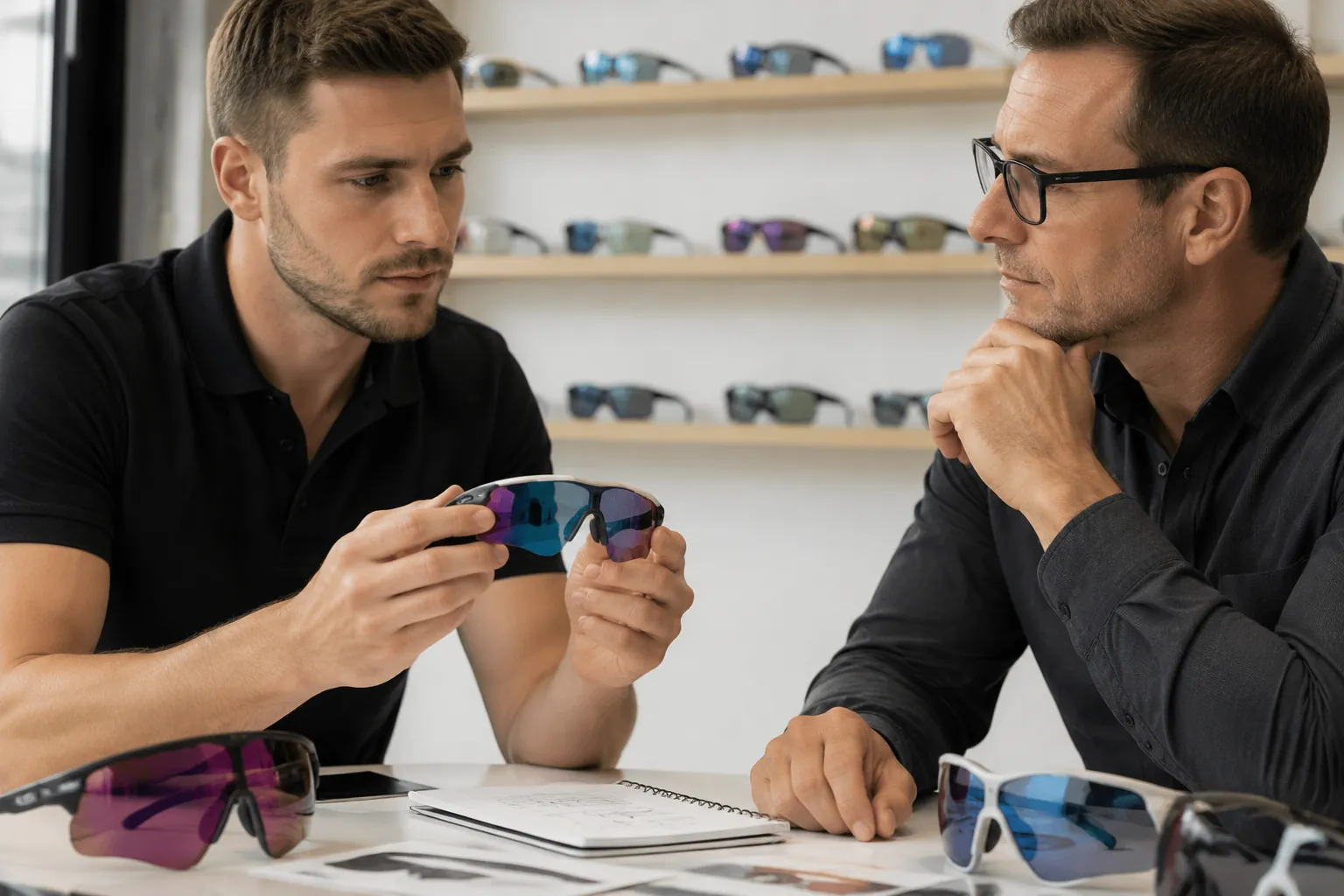
If you buy sunglasses for a brand, chain, or distribution program, you do not need a new mold for every exclusive style. You need a controlled mix of frame color, lens tint, hardware, logo placement, and packaging that changes the shelf read without changing the base tool. This keeps SKU variety under control while protecting tooling spend, MOQ, and lead time.
Start with one frame platform
The lowest-cost way to build exclusive SKUs is to choose one approved frame family and use it as a platform. Keep the front shape, temple geometry, hinge position, and lens curve fixed. That limits tooling risk and avoids repeated fit revisions.
Once the base construction is approved, you can create new-looking variants by changing only the visible parts. For a first program, three base frames are usually enough: one injected frame, one acetate frame, and one metal or mixed-material frame. Keep it tight. More bases mean more cost and more confusion.
What should stay fixed:
- Front dimensions and lens shape
- Temple length and fit
- Hinge type and hinge position
- Base tooling and mold cavity
What can usually change without new tooling:
- Frame color and surface finish
- Lens tint and mirror layer
- Temple tips and inserts
- Logo plates or engraving
- Pad print position and ink color
- Packaging, cloth, and case
If you change fit-critical dimensions, recessed logo areas, or structural attachment points, stop. That is a tooling discussion, not a cosmetic tweak.
Use color to separate SKUs
Color is the fastest way to make a small assortment look like a real program. It is also one of the safest changes because it usually does not affect fit or function.
For injected frames, solid colors, translucent colors, and matte finishes can each create a different retail impression. On acetate, layered sheet color and polish level matter too. The same frame shape can read core, fashion, premium, or seasonal depending on the color system.
A practical method is to assign colors by channel or customer segment. One neutral color can support core replenishment. One fashion color can support seasonal demand. One premium finish can support higher-priced doors. Do not send the exact same frame color to every channel if you want the SKU to feel exclusive.
Watch shade drift. It is common. Ask for a physical color standard, a written color reference, and an approved bulk target before production starts. For translucent frames, review samples under daylight and indoor light. The same material can read differently. Very differently.
- Pick one neutral base color for repeat orders.
- Add one seasonal color that can be retired without affecting the line.
- Reserve one premium finish, such as matte paint or layered acetate.
- Match lens tint to the frame family so the product looks intentional.
Lens changes do more than most buyers think
Lenses carry a large part of the perceived value. Two frames can be identical, but a different tint, mirror tone, or coating can make them read as separate SKUs at retail.
Common options include gray, brown, and green tints, plus fashion tints such as pink, blue, or yellow. Mirror coatings add another layer of difference. A light silver mirror usually reads more classic, while gold or blue mirror often reads more fashion-driven. Gradient tint can also change the shelf look, especially on larger shapes.
Lens changes are not only cosmetic. They can affect light transmission, labeling, and market acceptance. Before bulk, confirm the final lens spec against the target market requirements and the intended use of the product.
Verify the exact test report or declaration that applies to your SKU and destination market. Relevant references may include CE EN ISO 12312-1, ANSI Z80.3, AS/NZS 1067, REACH, FDA registration, ISO 9001, and BSCI, depending on the product and supplier scope.
| Variant change | What it changes | Cost impact | Buyer risk |
|---|---|---|---|
| Plain tint change | Color impression, light feel | Low | Low |
| Mirror coat addition | Premium look, stronger shelf contrast | Low to medium | Medium if specs are not fixed |
| Gradient tint | Fashion positioning | Low to medium | Medium due to visual consistency |
| Polarized lens swap | Function and price tier | Medium | Medium to high if test plan is weak |
For volume programs, define lens specs in writing: base color, target transmittance range where applicable, mirror side, lens thickness, and any marking requirements. Vague orders create rework. Rework costs money.
Treat hardware and trim as part of the SKU
Most buyers focus on frame shape first. That is not enough. Small metal parts can change perceived quality quickly, and they usually do not require a new mold if the structure stays the same.
Think in layers: hinge finish, screw finish, temple core pattern, logo plate, rivet shape, nose pad style, and temple tip insert. A brushed gunmetal hinge on one run and polished silver on another will make the products look different even if the base frame is identical.
Decoration methods such as laser engraving, pad printing, and metal logo plates can move the brand mark without changing the core tool. Useful. One SKU can use a temple print, another a metal logo on the temple, and another a laser mark where allowed by the design and substrate.
Before sample approval, confirm these points:
- Hardware finish code and whether the plating tone is stable between batches
- Logo size in millimeters, not just a general description
- Pad print adhesion on glossy versus matte surfaces
- Whether metal logo plates sit flush or stand proud
- Whether temple tips can accept a different insert color without loosening
Hardware changes are only safe when they remain cosmetic. If a logo plate requires a new recess or a different insert geometry, that may affect tooling.
Use packaging to make each SKU feel separate
Packaging does more than protect the product. It helps make an otherwise identical frame look like a separate retail offer. That is useful for private label, distributor, and chain programs.
Use packaging to support the position of each SKU. A black carton with silver print can support a core style. A kraft box can support an eco position. A rigid box can support a premium door. A soft pouch can support a value or promo set. Same sunglasses. Different read.
Packaging also helps with channel control. If your wholesale and retail programs share the same frame, do not give them identical packaging. Packaging is one of the easiest ways to reduce direct shelf comparison.
Keep the packaging spec specific:
- Box dimensions
- Paper weight or carton grade
- Print method and ink color
- Insert material
- Cloth size and weave
- Case closure type
Do not overcomplicate the pack-out. Every added component creates another sourcing and QC item. Two or three meaningful packaging upgrades are usually enough to change the retail read.
Build a SKU matrix that controls MOQ
Exclusive assortment planning gets messy when every version is treated as a one-off. Better to build a SKU matrix: one base frame, a few colorways, two or three lens options, and one or two logo treatments. That creates choice without splitting demand into tiny pieces.
The right MOQ strategy depends on your supplier and the complexity of the spec. Ask for the actual minimum order by design, colorway, and lens option before you commit. If you split demand across too many weak variants, unit cost rises and replenishment gets harder.
Use this logic:
- Test a small number of variants first if you need market proof.
- Keep only the best performers for replenishment.
- Concentrate volume into the strongest SKUs instead of spreading orders thinly.
- Use the platform approach to support repeat orders once the market shows what sells.
The goal is not maximum variety. The goal is controlled variety with stable economics. If the variant count rises faster than demand, the program gets expensive fast.
Sample approval should catch the expensive mistakes
Most bad SKU programs fail during sample approval, not in production. The buyer approves too quickly, then the bulk order arrives with a different color, different lens tone, wrong print placement, or a hardware finish that does not match the sample.
A practical sample workflow is simple. The first sample should confirm fit and shape. The second sample should confirm the visual spec: frame color, lens color, logo placement, hardware finish, and packaging. If you are running more than one SKU, approve each variant against a written spec sheet. Do not rely on memory. Memory is weak.
Request the following before bulk release:
- Signed color standard
- Final artwork file with placement dimensions
- Lens specification by tint and coating
- Packaging proof or physical pre-production carton
- QC checkpoint list covering appearance and function
Review the product against measurable references wherever possible. Approve with rulers, samples, and written specs instead of general impressions.
A simple way to build exclusivity without new molds
The formula is basic: keep the frame geometry fixed, vary the visible surfaces, and package each version as a separate story. That gives you a product family instead of disconnected samples.
Example program for one base frame:
- SKU 1: matte black frame, gray lens, laser logo, standard carton
- SKU 2: translucent smoke frame, brown lens, metal logo plate, premium box
- SKU 3: tortoise acetate, gradient lens, pad print, pouch and cloth set
- SKU 4: matte olive frame, blue mirror lens, temple engraving, eco carton
That is enough variation for many buyers. You do not need a new mold for every style. You need a clear platform, disciplined spec control, and a strong approval process.
For overseas buyers sourcing from Wenzhou, this approach fits normal factory behavior: it stays inside standard lead times, avoids unnecessary tooling spend, and supports repeat orders once the market shows which SKU deserves volume. If the line performs, you can revisit full custom tooling later. First prove the assortment.
Rule of thumb: pay for new tooling only after the variant mix proves demand. Until then, spend on visible differentiation, not hidden engineering.
Have a custom sunglasses project in mind?
Send us your styles, target market and quantities and we will return a detailed quote with MOQ, lead time and a sample plan.
Get a QuoteWhy source this from Wenzhou with LumiShades
Wenzhou in Zhejiang Province is widely regarded as China’s eyewear manufacturing capital, producing a large share of the world’s sunglasses. That concentration matters to buyers: a deep local supply chain for acetate sheet, hinges, lens blanks, plating and packaging means shorter component lead times, easier color and material matching, and a workforce with decades of eyewear-specific skill. LumiShades has manufactured in this ecosystem since 2009, and our vertical integration — in-house injection molding, acetate cutting, CNC milling, lens tinting, decoration and quality control — means no part of your order is quietly subcontracted to a workshop you cannot audit.
For international buyers, that vertical control translates into accountability. When a single factory owns every step, defects are traced and fixed at source rather than bounced between vendors, and your specifications survive intact from first sample to bulk. We back this with 15+ years of experience, shipments to 60+ countries, more than 5 million pairs produced per year and a 98.5% on-time delivery rate. Our certifications — CE EN ISO 12312-1, FDA registration, ANSI Z80.3, AS/NZS 1067, REACH, ISO 9001 and BSCI audit — mean the compliance documentation your market requires already exists. Explore our manufacturing capabilities and quality control process to see how this works in practice.
Frequently asked questions
How many exclusive SKUs can I build from one base frame? Usually 4 to 8 workable SKUs if you vary color, lens, hardware, logo, and packaging in a controlled way. The exact number depends on your MOQ, target market, and how different each variant needs to look at retail. If demand is limited, fewer SKUs are safer.
What changes usually do not require new tooling? Frame color, surface finish, lens tint, mirror coating, pad print, laser engraving, metal logo plates, temple tip inserts, and packaging usually do not require new molds if the frame structure stays the same. Confirm with the supplier before sample approval, because structural changes can affect tooling.
What changes can force new tooling? Changes to frame geometry, lens shape, temple shape, hinge position, or recessed logo areas can require new tooling or tool modification. If a change affects fit, assembly, or the mold cavity, ask the factory to quote it as an engineering revision instead of assuming it is cosmetic.
How should I handle compliance for different lens options? Confirm the final SKU against the destination market requirement before bulk. Ask for the relevant documentation for the exact lens and frame combination, and request the applicable test report or declaration for your market. Relevant references may include CE EN ISO 12312-1, ANSI Z80.3, AS/NZS 1067, REACH, FDA registration, ISO 9001, and BSCI, depending on the product and supplier scope.
What is the safest MOQ strategy for a new collection? Start with a small number of variants so you can test the market without splitting volume too thinly. Then concentrate repeat orders on the winning SKUs. Before you place an order, ask the supplier to confirm the MOQ by design, colorway, lens option, and packaging so you know the cost breaks.
Ready to start?
Explore our square sunglasses or request a quote — our sales team replies within 12 hours.
Request a Quote