
Sunglasses Order Tiers: 50, 300, and 1,000 Pairs
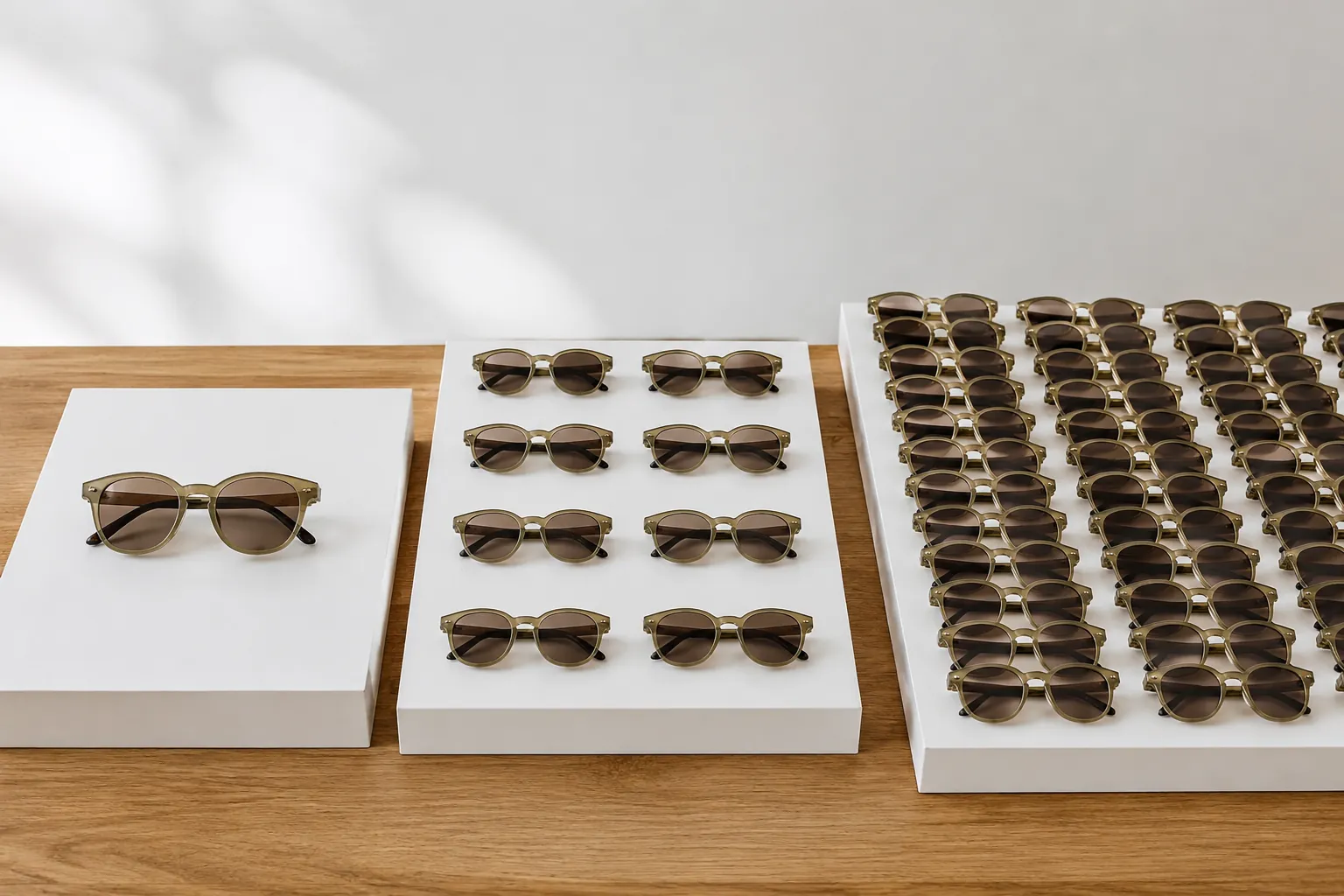
If you buy sunglasses for a brand, chain, import business, or distribution program, order size matters as much as frame design. A 50-pair order is not the same decision as a 300- or 1,000-pair run. This guide shows how to use those tiers to plan margin, reduce SKU risk, define quality checks, and decide when to test, scale, or reorder. It is written for practical sourcing decisions, not sales copy.
Give Each Tier a Job
Do not treat every MOQ the same. A 50-pair run is a validation exercise. A 300-pair run is a controlled launch. A 1,000-pair run is a replenishment order. Different job. Different risk.
At a sunglasses factory, pricing usually drops by quantity tier. One quote at 50 pairs, a better one at 300, better again at 1,000, and more savings at higher volume. Sample turnaround and bulk lead times also vary by factory, frame construction, decoration, and season. Confirm them in writing. Timing affects learning speed, cash tied up in stock, and how much room you have for freight, duty, and packaging before margin slips.
Do not chase the lowest ex-factory price by itself. Buy the right amount of proof. At 50 pairs, you are buying signal. At 300, you are buying a launch set with enough depth for retail accounts and content. At 1,000, you are buying consistency, better landed cost, and a real base for reorders.
As volume rises, the program should get tighter. Fewer design changes. Clearer QC standards. Less guessing about packaging or decoration. If the design is still moving, keep the order small. If demand is stable, lean into volume and protect repeatable specs.
Use this simple rule: the smaller the order, the more you should pay for information; the larger the order, the more you should pay for control. If a factory cannot state the same spec twice, the tier is too large.
What 50 Pairs Buys You
A 50-pair order is a learning tool, not a scale tool. Use it when the shape is unproven, the channel is new, or you need stock for photos, seeding, and early sales without overcommitting. At this level, test the variables that break first: fit, lens tint preference, color mix, packaging response, and finish quality.
Keep it narrow. One frame, one lens category, and one or two colorways is usually enough. Split 50 pairs across too many SKUs and the data gets noisy. You will not learn much. Two-color testing is often better than three-color testing for that reason.
This is also the cheapest place to catch process issues. On acetate, inspect edge polish, lens groove consistency, temple symmetry, and color swirl uniformity. On injection frames, check gate marks, parting lines, hinge seating, and whether the arms return evenly after opening. On metal or mixed-material styles, watch solder points, nose-pad alignment, and coating coverage. If you are ordering printed logos, check registration and ink density under bright light. A logo that looks fine in a sample photo can fail on shelf.
Ask for real tolerances, not vague quality language. Define what matters: lens centering, temple alignment, hinge feel, surface finish, logo placement, packing cleanliness. Factories may express tolerances differently. That is not the point. Agree on the acceptance standard before production starts.
For 50 pairs, ask for:
- Approved pre-production sample photos
- Lens tint reference or physical swatch
- Logo placement proof with measurements
- Packing mockup or carton layout
- Defect tolerance and rejection rules
Best use: launch tests, new channels, influencer seeding, proof of concept, and first-buy negotiations with retailers.
How 300 Pairs Supports Margin
At 300 pairs, the economics start to matter. This is where many buyers move from "can it sell?" to "can it support a retail price after freight, duty, packaging, and margin?" Unit cost usually improves. More important, landed cost becomes easier to forecast because setup costs are spread across more units. That helps with retail pricing, marketplace planning, and DTC margin models.
A 300-pair program should widen the assortment a little, but not so much that inventory gets scattered. Three to four SKUs is often a workable range. One shape in three colors. Or two shapes with one main color each and a backup color behind the winner. Enough variation to learn. Not enough to confuse replenishment.
Decoration starts to matter more here because branding carries more of the selling load. Laser engraving is a strong option when you want durable, precise marks on acetate or metal components. Pad printing works well for logos on temples or lenses, but validate adhesion and wear resistance. Metal logo plates can feel more premium, but they add a part, another assembly step, and more placement variation. If the base frame is already strong, better logo application may improve sell-through more than a more expensive frame material.
Use process discipline. Ask for first-article confirmation. If the order is large enough, ask for a mid-run sample check. Confirm lens tint with a physical reference, not a color name alone. If the program uses UV protection or polarization, confirm the exact specification and verify the run matches it. In a 300-pair order, one bad lens batch can hurt a launch faster than a slightly higher price would.
Cost control gets more specific at this tier. Ask whether the quote includes:
- Logo setup and print plates
- Lens cut and tint matching
- Individual polybags or cleaning cloths
- Master carton count and drop-test packaging
- Replacement allowance for defects
Practical rule: if the 50-pair test sold cleanly, move the winning SKU to 300 and cut deadweight. Do not scale every idea.
Why 1,000 Pairs Changes the Work
At 1,000 pairs, you are no longer testing in the same way. You are planning replenishment. The factory can usually stabilize production better. The per-unit price improves more noticeably. You can also justify tighter color and component control because the program now has enough scale to support it. The line starts to function like a supply program, not a one-off order.
The lead-time logic changes too. If production takes several weeks after approval and shipping adds more time depending on mode and destination, your reorder trigger has to happen well before the shelf is empty. Buyers often keep safety stock for their strongest styles. That keeps a late reorder from turning into a stockout.
SKU depth matters more as well. A 1,000-pair order should be concentrated enough that each SKU has real inventory behind it. That may mean two core colors carrying most of the volume, with a smaller share assigned to a seasonal or fashion color. Color consistency becomes serious at this point. Black should stay black across batches. Tortoise should stay within an acceptable swirl range. Transparent colors should not drift in clarity or tone from lot to lot.
Quality control should also be explicit. Ask for defined inspection points such as lens tint consistency, polarization verification where relevant, hinge torque, temple opening force, logo durability, carton count accuracy, and packing cleanliness. If the order is large enough, request AQL-based inspection or an equivalent factory QC process with photo evidence of defects and pass/fail thresholds. Small defects get expensive when they repeat across 1,000 pairs.
At 1,000 pairs, also lock down change control:
- Freeze frame mold, lens spec, and coating type before mass production.
- Approve one master color standard for each frame color.
- Confirm packaging artwork and carton marks before booking freight.
- Require written sign-off for any line-side substitution.
Best use: core program orders, retail replenishment, distributor stock, and seasonal lines with a defined repeat plan.
A Simple Tier Comparison
Use the table below as a working model. Exact pricing depends on frame structure, lens type, decoration, and packaging, but the logic stays the same: more units usually means better cost, more stability, and more responsibility for forecast accuracy.
| Tier | Primary goal | Typical SKU count | Price position | Lead time use | Buyer risk |
|---|---|---|---|---|---|
| 50 pairs | Test demand, fit, and finish | 1-2 | Highest unit cost | Sample or pilot run | Low cash risk, high learning value |
| 300 pairs | Build a launch set with sellable margin | 3-4 | Mid-tier pricing improvement | Launch stock | Moderate inventory risk |
| 1,000 pairs | Support repeat orders and margin | 2-5 | Better landed cost | Core replenishment | Higher cash tied up, lower cost per pair |
| 5,000+ pairs | Lock in program economics and supply stability | 1-6 | Best volume pricing | Seasonal or annual planning | Forecast risk, but strongest scale leverage |
The exact breakpoints vary by frame construction and decoration. The planning logic does not. If you need proof, buy 50. If you need a launch, buy 300. If you need a working supply program, buy 1,000. If you need deeper program economics, move into larger volume only once demand is repeatable.
Use the table with one more lens: what you are risking if the style misses. A 50-pair miss usually costs time. A 300-pair miss costs margin and shelf space. A 1,000-pair miss ties up cash and complicates planning. That is why the tier has to match the job.
Cost Drivers You Should Watch
Frame construction changes the pricing ladder more than many buyers expect. Injection molding is efficient for repeatability and usually supports strong cost control at volume. It fits well when you want consistent shapes and can commit to a mold-based process. Acetate usually costs more in labor because it needs cutting, tumbling, polishing, fitting, and more hands-on finishing. The tradeoff is a richer feel, deeper color options, and a more premium retail look.
CNC milling can support sharper geometry and a more engineered look, but it is rarely the cheapest entry point. If your customer values design detail and edge definition, it may be worth the added cost. For budget-sensitive programs, it can be too much. Metal and mixed-material constructions bring their own issues: solder integrity, coating durability, and visible inconsistency at joints and welds.
Lenses are a separate cost and performance decision. Basic tint lenses cost less than polarized lenses or more controlled optical packages. UV protection should be stated clearly. Do not assume a lens is compliant just because it is dark. If polarization is required, ask how the factory verifies it. If you need mirrored lenses or gradient effects, confirm whether the coating is in-film, surface-applied, or part of the lens base. That affects durability and reject rates.
Decoration has real cost consequences. Laser engraving is usually one of the most durable and precise branding methods for premium programs. Pad printing is flexible and cost-effective, but it needs cure and abrasion checks. Heat-transfer or foil applications can look good on launch models, but they may not hold up as well in repeat programs. Metal plates and custom temple tips add perceived value, but they also add parts, assembly time, and alignment risk. Match decoration to the tier: simple and stable for 50 pairs, strong enough to sell at 300, and repeatable enough to scale at 1,000.
Packaging and logistics also move the number. Rigid cases, microfiber cloths, hangtags, barcode stickers, and retail-ready cartons can change landed cost more than buyers expect. If the business depends on a target margin, ask for packaging as a separate line item, not a bundled surprise.
One useful rule: every new material or decoration layer should earn its place by improving retail price, brand perception, or durability. If it does none of those things, it is just cost.
Ask for Compliance Early
For overseas buyers, compliance is not a sidebar. It is part of the buying decision. Ask for documentation that matches the market you sell into and the exact product configuration you are buying. Common references include CE EN ISO 12312-1, FDA registration, ANSI Z80.3, AS/NZS 1067, REACH, ISO 9001, and BSCI.
- CE EN ISO 12312-1 is relevant for sunglasses sold into many European markets.
- ANSI Z80.3 is the U.S. sunglass standard buyers often request for optical and impact-related requirements.
- AS/NZS 1067 applies to sunglasses sold in Australia and New Zealand.
- REACH matters when you need material compliance on chemicals and restricted substances.
- ISO 9001 and BSCI support system and social compliance expectations, but they do not replace product testing.
Ask for the documents that match your actual sales market. Do not assume one certificate covers every country or every channel. If you sell into retail, expect buyers to ask for test reports, factory audit records, and carton or label compliance. If you sell DTC, you still need the same product discipline even if the paperwork is lighter.
Ask for document dates and scope, not just logos. A current report tied to the exact product category is more useful than a general claim. If the frame material, lens type, coating, or construction changes, the compliance picture may need to be checked again.
Before production starts, confirm the compliance package in writing:
- Product standard and market destination
- Test report date and lab name
- Frame, lens, and coating scope
- Labeling, warnings, and packaging text
- Replacement plan if specs change
Build Reorders Around Reality
The smartest buyers map reorder timing backward from the shelf, not forward from the factory. If samples and approvals take time and bulk production takes several weeks after approval, you already know the production clock. Add freight, customs clearance, warehouse receiving, and any labeling work on top. That means your reorder trigger should come before you feel low on stock, especially for the styles that generate most of your revenue.
- Use the 50-pair run to validate shape, comfort, visual appeal, and sell-through signal.
- Move winners into a 300-pair order to improve price and test broader distribution.
- Scale proven styles to 1,000 pairs once demand is stable and return rates are acceptable.
- Keep reorders on the same base specs where possible to protect lead time and color consistency.
- Review defect patterns after every shipment so recurring issues are corrected at the source.
Use a simple reorder trigger based on forward cover. If a style sells in steady weekly quantities, production should start while you still have enough inventory to bridge the build window plus transit. If you wait until the last case is gone, you are already late. Reorder from the most repeatable spec set: same frame mold, same lens tint, same logo method, same carton format. Every extra change adds uncertainty and can raise delivery risk.
One blunt point: if you change the frame, tint, logo method, and packaging at the same time, you will not know what improved or broke. Change one thing at a time when you can, especially once the program moves from testing to scale.
For forecasting, track these inputs after each shipment:
- Sell-through by week
- Return rate by color or size
- Defects per 100 pairs
- Gross margin after landed cost
- Days of cover remaining at reorder
Document Every Order
Good sourcing programs are built on repeatable records. For every order tier, keep the same core documentation so you can compare one run to the next. Record the approved sample, the frame and lens specification, the decoration method, the carton configuration, the agreed tolerance standard, and the inspection result. If a problem appears later, those records show whether the issue came from the design, the material, or the production run.
Compare landed cost, not just unit price. A low ex-factory quote can still be a weak business decision if packaging, freight, duty, rework, and replacement stock push the real cost too high. Evaluate the full program: product, compliance, packaging, logistics, and expected sell-through. That is how the 50-, 300-, and 1,000-pair tiers become a sourcing system instead of isolated orders.
Keep a simple order file for each run:
- Approved sample images and date
- Spec sheet with frame, lens, and coating details
- Logo artwork and placement callout
- Packing list, carton count, and carton marks
- Inspection result and defect notes
- Freight mode, ETA, and receiving date
If you are building a long-term sunglasses line, the goal is consistency. Use the small tier to learn. Use the medium tier to prove margin. Use the large tier to protect supply. That sequence keeps the business disciplined and still leaves room for better pricing and stronger retail execution.
Have a custom sunglasses project in mind?
Send us your styles, target market and quantities and we will return a detailed quote with MOQ, lead time and a sample plan.
Get a QuoteWhy source this from Wenzhou with LumiShades
Wenzhou in Zhejiang Province is widely regarded as China’s eyewear manufacturing capital, producing a large share of the world’s sunglasses. That concentration matters to buyers: a deep local supply chain for acetate sheet, hinges, lens blanks, plating and packaging means shorter component lead times, easier color and material matching, and a workforce with decades of eyewear-specific skill. LumiShades has manufactured in this ecosystem since 2009, and our vertical integration — in-house injection molding, acetate cutting, CNC milling, lens tinting, decoration and quality control — means no part of your order is quietly subcontracted to a workshop you cannot audit.
For international buyers, that vertical control translates into accountability. When a single factory owns every step, defects are traced and fixed at source rather than bounced between vendors, and your specifications survive intact from first sample to bulk. For procurement review, buyers can request process records, approved samples, quality checkpoints and project-specific compliance files before placing a bulk order. Required testing and documentation are confirmed against the destination market and product specification rather than assumed from a generic certificate list. Explore our manufacturing capabilities and quality control process to see how this works in practice.
Frequently asked questions
Should I start with 50 pairs or go straight to 300? Start with 50 pairs if the design, fit, or channel is still unproven. Move to 300 pairs only after the first run gives you clear sell-through or feedback that supports a larger launch. If the style already has demand history, 300 can be the first commercial order, but it should still be backed by a confirmed spec and sample approval.
How many SKUs should I put in a 300-pair order? Usually 3 to 4 SKUs is the right range. That gives you enough assortment to compare demand without splitting inventory so thinly that nothing gets meaningful depth. If one color is clearly dominant, keep the mix concentrated on the likely winner.
What is a realistic price target at 1,000 pairs? There is no universal target because price depends on frame construction, lens type, decoration, packaging, and the market you are buying for. Ask the factory for the full landed-cost picture, not just ex-factory price, and compare that against your target retail margin. If a supplier gives one number without confirming spec, packaging, and compliance scope, it is not enough to plan on.
How fast can I get samples and bulk production? Timing varies by factory and product complexity, so confirm it in writing before you place the order. Many buyers work with sample approval first and then a multi-week bulk production window, plus additional time for shipping and receiving. The important part is not the exact number but the total schedule from approved sample to shelf.
Which compliance documents should I ask for first? Start with the documents that match your sales market and product spec: CE EN ISO 12312-1 for many European markets, ANSI Z80.3 for the U.S., AS/NZS 1067 for Australia and New Zealand, REACH for chemical compliance, and FDA registration where relevant to your supply chain. Also request ISO 9001 and BSCI if your buyer file or retailer requires factory system and social compliance records. Always ask for the current report date and the exact product scope covered.
Ready to start?
Explore our cat-eye sunglasses or request a quote — our sales team replies within 12 hours.
Request a Quote