
OEM Sunglasses Tech Pack for Accurate Factory Quotes
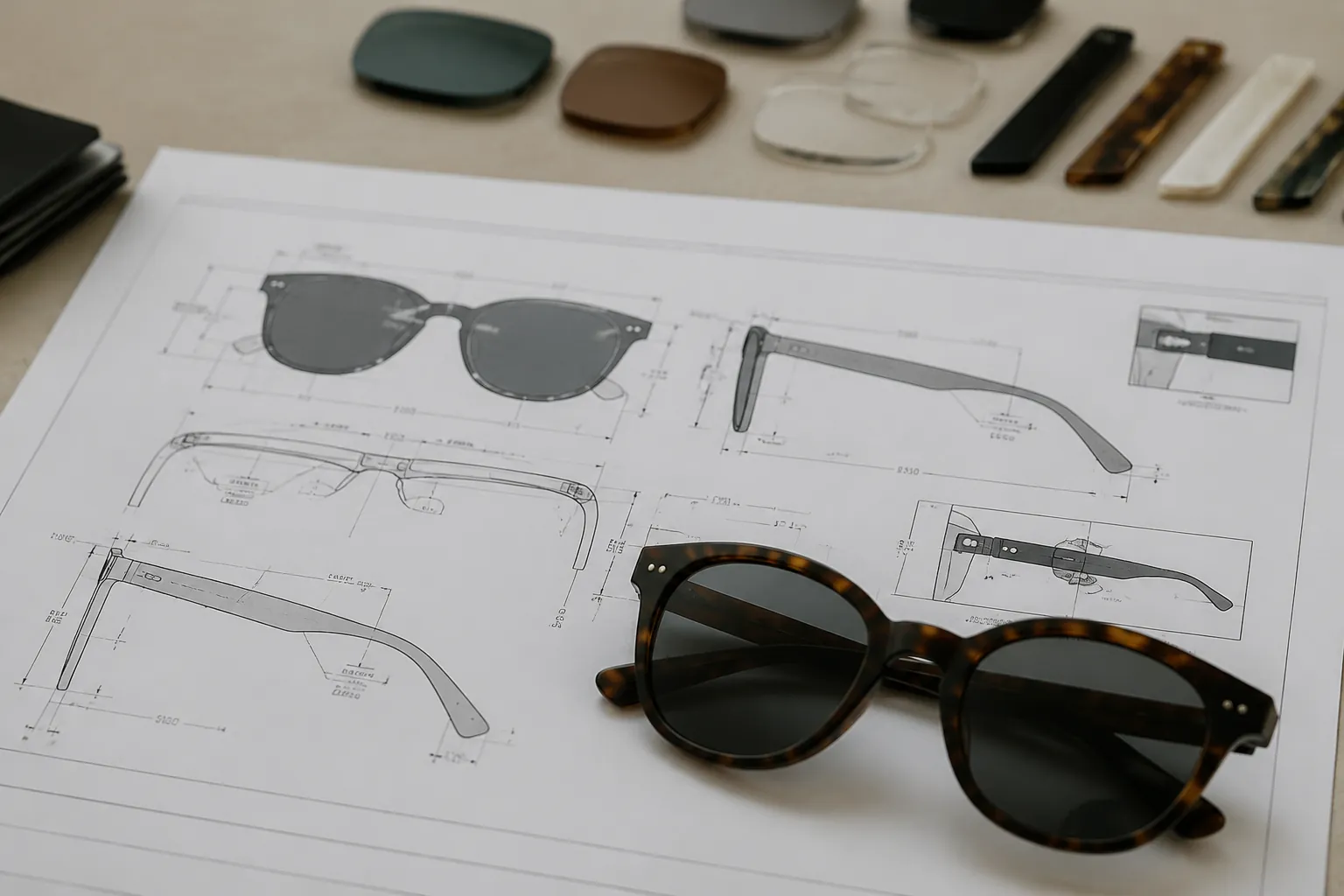
This guide is for overseas brands, importers, distributors, and retailers preparing to request an OEM sunglasses quote. A strong tech pack gives the factory verified detail, not room to guess. It helps the supplier price the product you plan to sell, not a cheaper version built on assumptions. It also exposes tooling, sampling, compliance, packaging, inspection, MOQ, and lead-time issues before production starts.
Start With the Quote Decision Sheet
Open the tech pack with a one-page decision sheet. The factory needs the commercial frame before it checks engineering detail: order size, target market, launch date, packaging level, incoterms, and quotation currency. Quantity is not just a buying number. It can affect mold choice, material purchasing, color matching, decoration setup, QC workload, carton planning, and production scheduling.
Do not assume one price covers every version of the product. Ask the supplier to quote the exact specification at practical quantity tiers. If you are weighing a launch order and a scale order, show both. If you want an existing mold first and possible custom tooling later, separate those requests. Do not let the factory blend the assumptions.
- Project type: OEM from buyer drawings, private label on an existing factory shape, or modification of an available model.
- Quantity tiers: request prices at your launch quantity and realistic reorder quantities, with MOQ stated per design, color, and lens option.
- Lead-time target: define whether the date means sample approval, factory completion, China port departure, or warehouse arrival.
- Sales market: state EU, US, UK, Australia/New Zealand, or other markets because markings, testing, and importer obligations differ.
- Quote breakdown: ask for eyewear unit price, tooling, sample cost, packaging, testing, inspection, freight, and lead time as separate lines.
Lead time needs trigger points. Ask when the clock starts: after artwork approval, deposit receipt, material confirmation, sample approval, test approval, or packaging proof approval. If any material, lens, plating, packaging, or third-party test is not confirmed, require the factory to list it as an open assumption.
Drawings Must Show the Product in 3D
A front rendering is not a tech pack. Sunglasses are three-dimensional products with lens curve, bridge geometry, hinge movement, temple drop, nose fit, and logo placement. Miss those details and the first sample becomes an interpretation. The quote may be wrong too.
Include front, side, top, inner temple, and exploded views. For acetate frames, show sheet thickness, lamination direction if relevant, core wire position, rivet type, and finish. For injection frames, show visible parting lines, gate preferences where known, texture areas, and any two-color or overmolded zones. For metal frames, show rim construction, bridge type, solder joints, nose pad arm, plating color, and screw size.
| Drawing item | Factory decision it controls | Common quoting risk |
|---|---|---|
| Front view with lens shape | Lens cutting, frame width, bridge width, visual balance | Factory estimates dimensions from a lifestyle photo |
| Side view with temple curve | Temple pressure, ear bend, wearing comfort | End-tip bend is corrected only after a failed sample |
| Top view with base curve | Wrap angle, lens base curve, hinge alignment | Buyer expects a wrapped style but the drawing shows a flat front |
| Inner temple layout | Size mark, origin mark, SKU, compliance text | Marks are placed on a high-rub area and wear off |
| Decoration callout | Laser, pad print, metal plate, foil, or embedded logo | Quote changes after the logo method is chosen |
Send logo and artwork files as AI, PDF, SVG, or EPS with fonts outlined. PNG or JPG files are useful for visual reference, not production artwork. If the design is based on a physical sample, provide measured caliper data. State whether the sample is a fit reference, a style reference, or a part that must be matched dimensionally.
Measurements That Prevent Fit Problems
Use millimeters. Define tolerances by dimension group. A size line such as 52-20-145 helps, but it is not enough for production. Include lens width, lens height, bridge width, front width, hinge-to-hinge width, temple length, temple drop, frame thickness, lens groove depth, nose opening, pantoscopic angle, and base curve.
Do not paste generic tolerances into every project. The right tolerance depends on material, process, frame shape, lens fit, and inspection method. Ask the factory to confirm what it can hold after sample approval. Then identify the dimensions that are critical to function. Lens fit, hinge alignment, screw engagement, nose fit, and temple symmetry usually need tighter control than decorative surfaces.
- Define the size code, then list full engineering measurements.
- Mark critical dimensions that cannot change after sample approval.
- State tolerances for lens fit, frame width, temple length, logo position, and packaging separately.
- Provide a physical reference sample if wearing fit matters more than exact drawing match.
- Specify adult, junior, low-bridge, Asian-fit, or other regional fit requirements where relevant.
Fit issues often start small: a narrow bridge, tight temple angle, high nose opening, incorrect pantoscopic angle, or wrong lens base curve. For injection-molded frames, ask the factory to confirm shrinkage allowance before tooling. PC, TR90, nylon-based materials, and other polymers do not mold the same way.
Frame Material Choices and Quote Impact
Never write only "plastic frame." It is too vague. Material and process affect weight, finish, durability, tooling cost, color control, and lead time. The same shape made in PC injection, TR90, acetate, metal, or mixed materials can carry very different prices.
| Frame option | Best use | Quote impact | Process notes |
|---|---|---|---|
| PC injection | Promotional sunglasses, simple fashion frames | Often cost-efficient at volume | Good impact resistance; surface feel, polish, and coating quality depend on tooling and finishing |
| TR90 | Flexible sports and lightweight daily frames | Usually higher than basic PC injection | Comfortable and flexible; color, paint adhesion, and deformation control should be checked |
| Acetate | Premium fashion frames with depth and polish | Higher material and labor cost | CNC cutting, tumbling, polishing, and heat adjustment add process time |
| Metal | Aviators, thin rims, rimless or semi-rimless styles | Depends on soldering, plating, nose pad system, and component quality | Ask about plating specification, nickel release where relevant, screw quality, and corrosion checks |
| Mixed material | Acetate front with metal temple, plastic with metal logo parts | Higher assembly and QC complexity | More risk points: screws, adhesive, plating color, part alignment, and galvanic or coating issues |
For color, provide Pantone references and, where possible, a physical swatch or approved master sample. Pantone is a guide, not a guarantee across translucent acetate, matte coatings, rubberized paint, tinted TR90, or plated metal. For acetate, request a cutting from the actual sheet when color is critical. For injection, confirm whether the color is compounded resin, paint, plating, or surface coating. If the frame is painted or coated, define the adhesion, abrasion, sweat, and alcohol-wipe checks required by your sales channel.
Lens Specs Need Performance Targets
"UV400" is not a complete lens specification. The factory needs lens material, color, lens category, visible light transmission, base curve, thickness, coating, polarization requirement, and target standard. These details affect price, labeling, markings, test reports, and market suitability.
Specify PC, TAC, nylon, acrylic, glass, or another approved material. PC is common where impact resistance and cost matter. TAC is widely used for polarized lenses. Nylon is often used for higher-performance eyewear, but it usually costs more. Define lens category, VLT range, UV requirement, mirror coating, gradient tint, anti-scratch coating, polarization efficiency, and any impact-related checks required by your market or retailer.
For Europe, reference CE EN ISO 12312-1 for non-prescription sunglasses where applicable. For the United States, reference ANSI Z80.3 and confirm FDA registration and device listing obligations with the importer, brand owner, or regulatory adviser. For Australia and New Zealand, reference AS/NZS 1067. For EU chemical restrictions, include REACH where materials or components fall within scope. Do not request every standard by default. Testing costs money, and the report must match the actual product, materials, lens category, markings, and shipment.
Lens category must also match packaging and product-page language. Category 0 is very light tint. Category 1 gives limited sun-glare reduction. Category 2 is medium tint. Category 3 is for strong sunlight. Category 4 is very dark and generally not suitable for driving. If the product uses polarized TAC lenses, ask the factory to confirm polarization axis, lens orientation, heat-resistance expectations, delamination risk, and whether mirror coating is applied before or after forming.
Branding Must Be Production-Ready
Branding is a manufacturing specification. Treat it that way. A logo that looks clean in a render may fail on a curved temple, textured coating, thin acetate section, or flexible TR90 part. Define method, size, position, color, finish, and durability requirement before requesting a final quote.
Common decoration methods include laser engraving, pad printing, hot stamping, foil, inlaid metal logos, and attached metal plates. Each method has different setup costs, durability limits, and inspection points. Laser engraving is durable but can be low contrast on some black or translucent materials. Pad printing is economical for small logos, but ink adhesion must match the substrate and coating. Metal plates can look premium, but they add tooling, plating, edge finishing, fixing control, and inspection.
- Laser engraving: provide vector artwork, mark depth or contrast target, and an approved sample photo.
- Pad printing: specify Pantone color, logo size, position tolerance, and rub-test requirement.
- Metal plate: define metal color, surface finish, thickness, fixing method, edge radius, and plating requirement.
- Inner temple text: include size code, lens category, CE or other required marks, origin mark, SKU, and batch code where required.
- Artwork control: send vector files with outlined fonts and one approved revision number.
Keep decoration away from hinges, high-flex temple zones, nose contact points, and heavy abrasion areas unless the method has been validated there. For curved or textured temples, request a decoration trial before approving mass production. Ask the supplier to confirm a realistic logo-position tolerance based on the actual surface and process.
Packaging, Barcodes, and Carton Rules
Packaging can change landed cost and compliance risk as much as the eyewear itself. A quote for one pair in a polybag is not comparable to a quote with a microfiber pouch, printed retail box, cleaning cloth, instruction leaflet, barcode label, and export carton marks. Put packaging into the first RFQ.
Define unit packaging, retail packaging, master carton quantity, barcode type, label size, label placement, language requirements, and carton marks. If selling to retailers, include hangtag hole position, warning text, importer details, country of origin, price-label rules, and carton sorting by SKU. If selling online, drop-test performance and scuff protection may matter more than shelf presentation.
A quotable packaging spec might read: one pair in recycled polybag, one microfiber pouch with one-color logo print, one cleaning cloth, one folded instruction card, 12 pairs per inner box, 300 pairs per export carton, carton mark on two sides, EAN-13 barcode on retail box and outer carton. "Nice retail packaging" is not quotable. It does not define materials, print method, dimensions, quantity per carton, or label rules.
Ask the factory to quote packaging separately from eyewear. This lets you compare the real frame and lens cost and adjust packaging without reopening the whole quotation. Printed pouches, boxes, and instruction cards may need dielines, artwork proofing, color approval, barcode verification, and retailer approval before production.
Final RFQ Checklist Before Sending
Before sending the RFQ, ask one hard question: could a production engineer build these sunglasses without calling you? If not, the quotation will contain assumptions. Those assumptions often come back as price changes, extra sample rounds, missed lead times, or compliance gaps.
Send one controlled file with a revision number and date. Include drawings, dimensions, tolerances, frame material, lens specification, decoration files, packaging, compliance targets, quantity tiers, incoterms, and approval standard. Ask the factory to state exclusions clearly, especially tooling, third-party testing, special packaging molds, inspection, freight, duties, and taxes.
- Control revisions: use one file name, one date, and one approved sample reference.
- Quote tiers: request prices for your launch quantity and realistic reorder quantities, with MOQ by design, color, and lens.
- Separate costs: list eyewear, tooling, samples, packaging, testing, inspection, and freight separately.
- Confirm timing: count lead time from sample approval, deposit receipt, material confirmation, and packaging artwork approval.
- Request evidence: ask for CE EN ISO 12312-1, ANSI Z80.3, AS/NZS 1067, REACH, FDA registration, ISO 9001, or BSCI only where relevant.
- Define approval: state whether the approved sample, signed drawing, test report, or all three control bulk production.
A capable sunglasses factory still needs a precise brief. A strong tech pack gives molding, cutting, lens tinting, decoration, packing, and QC teams the same target. That is how you get a quote you can compare, approve, and produce against.
Have a custom sunglasses project in mind?
Send us your styles, target market and quantities and we will return a detailed quote with MOQ, lead time and a sample plan.
Get a QuoteWhy source this from Wenzhou with LumiShades
Wenzhou in Zhejiang Province is widely regarded as China’s eyewear manufacturing capital, producing a large share of the world’s sunglasses. That concentration matters to buyers: a deep local supply chain for acetate sheet, hinges, lens blanks, plating and packaging means shorter component lead times, easier color and material matching, and a workforce with decades of eyewear-specific skill. LumiShades has manufactured in this ecosystem since 2009, and our vertical integration — in-house injection molding, acetate cutting, CNC milling, lens tinting, decoration and quality control — means no part of your order is quietly subcontracted to a workshop you cannot audit.
For international buyers, that vertical control translates into accountability. When a single factory owns every step, defects are traced and fixed at source rather than bounced between vendors, and your specifications survive intact from first sample to bulk. For procurement review, buyers can request process records, approved samples, quality checkpoints and project-specific compliance files before placing a bulk order. Required testing and documentation are confirmed against the destination market and product specification rather than assumed from a generic certificate list. Explore our manufacturing capabilities and quality control process to see how this works in practice.
Frequently asked questions
Can I request a quote with only reference photos? Yes, but treat it as a rough estimate only. Reference photos do not define dimensions, material, lens category, hinge structure, coating, logo method, packaging, or compliance requirements. For an actionable quote, send drawings or measured samples, full dimensions, frame and lens specs, decoration files, packaging details, sales market, quantity tiers, and required standards.
What MOQ should I put in the tech pack? State the quantity you want to buy now and the quantities you may reorder later. Ask the factory to confirm MOQ separately for each design, frame color, lens color, logo method, and packaging version. MOQ can change if the product needs custom tooling, custom acetate sheet, special lens color, plated metal parts, or printed packaging.
Which sunglasses compliance standards should I request? Match the standard to the sales market and product type. For Europe, ask about CE EN ISO 12312-1 for non-prescription sunglasses and REACH where material restrictions apply. For the US, discuss ANSI Z80.3 and confirm FDA registration or listing obligations with the responsible importer or regulatory adviser. For Australia/New Zealand, reference AS/NZS 1067. Request reports that match the final materials, lens category, markings, and shipment.
Do I need a new mold for custom sunglasses? Not always. Existing molds can support private label, color changes, lens changes, and some decoration changes. New tooling is usually needed for a unique frame shape, proprietary dimensions, special hinge structure, unusual lens curve, or major front and temple changes. Ask the factory to quote existing-mold and new-tooling options separately, including tooling ownership and maintenance terms.
How should I control sampling and bulk production timing? Ask the supplier to give lead time with clear trigger points. Sampling may depend on available materials, tooling, lens color, decoration trials, and packaging proofing. Bulk production should be counted from agreed events such as sample approval, deposit receipt, final artwork approval, material confirmation, and test approval. Do not accept a lead time unless exclusions and pending approvals are listed.
What is the most common reason factory quotes change later? The most common reason is an incomplete first RFQ. Price can change when the buyer later adds a lens category, polarized lens, different material, new logo method, retail packaging, third-party testing, custom tooling, tighter tolerance, or lower quantity. Prevent this by requiring the factory to list every assumption and exclusion in the quotation.
Ready to start?
Explore our sport wrap sunglasses or request a quote — our sales team replies within 12 hours.
Request a Quote