
Plan Seasonal Sunglasses Colorways That Sell
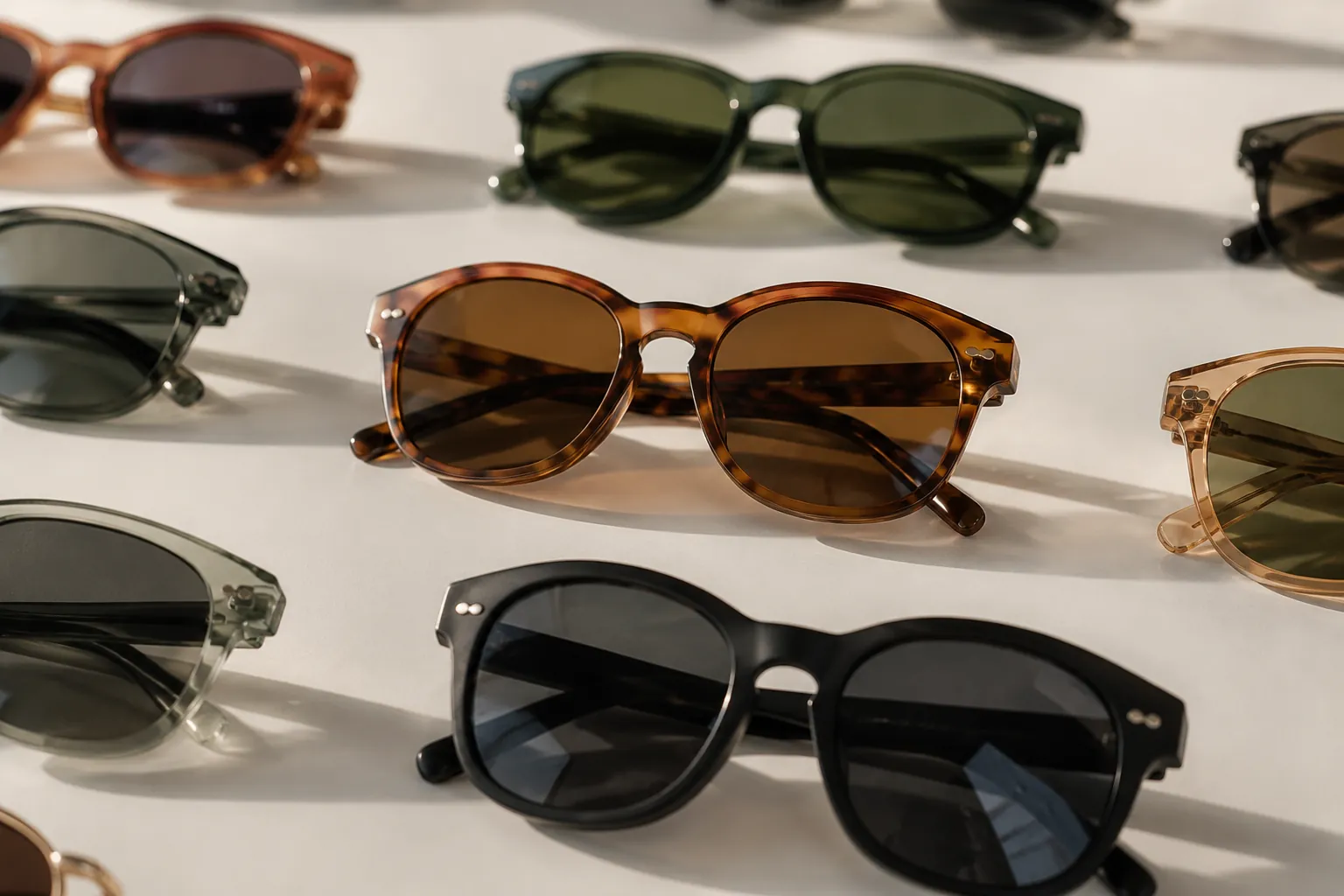
This guide is for brands, importers, distributors, and retailers buying custom sunglasses in volume. The goal is not to launch more colors. It is to build a colorway plan that supports sell-through, protects reorder options, and avoids unnecessary setup, sampling, and dead-stock cost. The most reliable approach is controlled: a small core range, a limited seasonal layer, and a factory plan built around MOQ thresholds, lens compliance, material behavior, decoration limits, and realistic lead times. Get those factors aligned, and seasonal newness becomes easier to manage.
Start with a 3-bucket colorway framework
Many sunglass programs create SKU sprawl because every new color is treated as a new product. Often, it is not. A better approach is to divide each frame shape into three buckets: core carryover, seasonal accents, and test colors.
- Core carryover: frame-lens combinations intended to stay in the line across multiple selling periods. Typical examples are black frame with grey lens, dark tortoise with brown lens, or crystal smoke with green lens.
- Seasonal accents: combinations introduced for a season, campaign, or account window. Examples might include translucent tea with brown gradient lens, crystal olive with smoke lens, or matte sand with light brown tint.
- Test colors: limited runs used to answer one commercial question before scaling. These are useful for retailer trials, DTC capsules, or account feedback, but they still need a clear purpose.
For one proven sunglass shape, a practical assortment is usually a small set of clearly different colorways, not a wide spread of near-duplicates. As colorway count rises, demand fragments. Reorders get harder to plan. That gets worse when volume is split across channels, regions, or account allocations.
Use shape stability and color variety together. If one shape already sells, changing color is usually lower risk than changing tooling. New molds, revised temple parts, or different acetate machining paths can add time and cost without enough payoff for one seasonal shade.
- Core colors should be chosen for broad acceptance and reorder confidence.
- Seasonal colors should create urgency without forcing a full material reset.
- Test colors should answer one direct question: is demand strong enough to support a larger reorder?
Choose the core first, then add seasonal contrast
Your core colors should be the combinations you would reorder without hesitation. Seasonal colors should give buyers a reason to act now. Reverse that order, and you often get strong samples but weak repeat business.
Start with frame bases that already work in your target channels. In many markets, black and dark tortoise remain reliable. They work across men's, women's, and unisex assortments, hide wear better than very pale colors, and pair easily with standard lens tints. A useful method is simple: lock core neutrals first, add one lower-risk fashion color, then test one seasonal accent.
Seasonal contrast does not always require a different frame color. Often, the lower-risk move is to keep the frame constant and vary lens tint, finish, or branding detail. For example, a matte black frame with grey lens may be a core carryover, while the same frame with a mirror lens or alternate logo treatment becomes a seasonal refresh.
That matters at the factory. If frame material, geometry, and hinge stay fixed and only lens tint or decoration changes, production scheduling is easier and QC is easier to control.
| Colorway role | Typical combination | Expected share of style volume | Inventory risk | Best use |
|---|---|---|---|---|
| Core carryover | Black frame + grey lens | Primary volume driver | Low | Main volume, repeat orders, key accounts |
| Core carryover | Dark tortoise + brown lens | Secondary volume driver | Low | Lifestyle and fashion channels |
| Core fashion | Crystal smoke + green lens | Moderate share | Medium-low | Broaden assortment without major risk |
| Seasonal accent | Crystal olive + smoke lens | Limited seasonal share | Medium | Seasonal refresh |
| Test color | Clear grey + flash mirror lens | Trial quantity only | High | Limited run, market validation before scaling |
If a seasonal option does not clearly earn space in the range, cut it. The line should stay easy for sales teams to explain and for buyers to reorder.
Build around manufacturing common parts
A strong colorway plan is also a common-parts plan. Buyers who track what stays fixed and what changes usually control MOQ efficiency, sample cost, and bulk complexity better.
Break each sunglass SKU into five decision points: frame material, frame color, lens specification, decoration, and packaging. Change all five at once, and setup cost rises fast. Repeatability drops.
- Keep frame geometry fixed: same front, temples, hinge position, and fit.
- Limit base material options: for one style, stay within one resin family or one acetate family plus a small set of approved colors.
- Reuse lens curve and size: this reduces fitting issues and simplifies replacement planning.
- Change decoration last: pad print, laser engraving, hot foil, or metal logo plates can create visible difference with less BOM disruption than changing core components.
Injection-molded frames usually offer the cleanest economics for larger colorway programs because color matching can be more repeatable and unit cost generally improves with volume. Acetate can give more depth, translucency, and premium pattern effects, but seasonal acetate colors may be harder to reproduce exactly if sheet supply, pattern yield, or finishing response shifts between lots.
Decoration method affects repeatability too. Pad print is cost-efficient and suitable for simple logos, but fine detail may soften on textured or highly curved surfaces. Laser engraving is durable and precise for subtle branding, especially on metal parts or coated surfaces. Metal logo plates can add a premium feel, but they also add component sourcing, assembly, and tolerance control. On lower-volume seasonal runs, the simplest visible change is often the easiest one to scale.
For many controlled-volume programs, a practical formula is this: keep one proven frame mold, one hinge type, one packaging format, and one lens curve, then rotate lens tint plus one finish or decoration detail. That keeps the product fresh without turning purchasing into redevelopment.
Match colors to compliance and wearability
Not every attractive lens color is commercially sensible. Buyers need to balance appearance, wearability, claim language, and market compliance.
If the item is sold as sunglasses, lens performance must match both destination market requirements and the claims printed on packaging, hangtags, and product detail pages. Common references buyers may need to review include CE EN ISO 12312-1, ANSI Z80.3, AS/NZS 1067, REACH, FDA registration, ISO 9001, and BSCI. The real issue is not whether a supplier can name these standards. It is whether the exact lens construction, tint, coating, and finished product being shipped match the tested or documented specification behind the market claim.
Dark grey, brown, and green lenses are often safer core choices because buyers know how to place them across channels. Pale fashion tints, heavy mirrors, and gradient lenses can work, but they need closer review. A light cosmetic tint may look strong in a campaign image and still disappoint in outdoor use if the customer expects standard sunglass performance.
Ask these questions before approving a seasonal lens:
- Visible light transmission: is the tint category appropriate for sale as sunglasses in the target market?
- Labeling accuracy: do packaging, hangtags, and PDP copy describe the lens honestly?
- Coating durability: if using mirror or flash coatings, is abrasion performance acceptable for the intended price point and use case?
- Material compatibility: does the tint or coating behave consistently on TAC, PC, nylon, or CR-39, depending on the construction?
Material behavior matters. Polycarbonate lenses are common in impact-focused and value-driven programs, but weak mirror coatings can scratch easily. TAC polarized lenses can improve perceived value and wearer comfort, but they add cost and require lamination control. Nylon can offer strong optical performance for technical product, but it does not fit every price structure.
Also check chemical restrictions for the destination market, especially where REACH or similar substance requirements apply to coatings, colorants, and surface treatments. Fashion color is easy to sample. Keeping product claims and compliance support aligned in bulk production is harder.
Use MOQ, price breaks, and sampling logic to avoid dead stock
Colorway planning is volume planning. MOQ, price breaks, and setup cost determine whether a colorway makes commercial sense. Lower-volume test runs provide flexibility but usually carry a higher unit cost. Larger runs can improve pricing, but only if demand is proven or replenishment is likely.
A practical rule is to put core colors into the strongest quantity bracket you can support with realistic reorder expectations, then keep seasonal colors closer to controlled-volume levels unless pre-orders or account commitments justify more.
| Order approach | Typical quantity | Typical cost logic | Best use | Main risk |
|---|---|---|---|---|
| MOQ test run | Supplier minimum | Highest unit cost, maximum flexibility | One seasonal color check, retailer sample sell-in | Limited backup stock if demand exceeds plan |
| Small launch | Low-volume production | Some cost improvement over MOQ | DTC drop, capsule launch, limited wholesale | Too many colorways split sell-through |
| Core program | Mid-volume production | Better absorption of setup and decoration cost | Best-seller colors with planned replenishment | Forecast error if the wrong colors are treated as core |
| Volume production | High-volume production | Lowest unit cost, strongest margin potential | Proven carryover SKUs | Capital tied up if demand softens |
Sampling should follow the same discipline. Do not sample six seasonal colors if the launch can realistically support one or two. A tighter sample round might include core carryovers, one safer fashion option, and one or two seasonal bets. If two options look too similar in daylight or on face, remove one early. Every extra option adds artwork review, packaging variation, carton labeling complexity, and reorder noise later.
A common buying mistake is spreading an order too evenly across too many colors before demand is proven. Usually, deeper buys in fewer core colors plus a small seasonal test position are easier to sell through and easier to replenish.
Plan the calendar backward from sample and bulk timing
Seasonal colorways often fail on timing, not concept. Sample lead time, approval time, and bulk production time all need to be planned backward from the launch date.
A simple B2B process works well:
- Week 1: lock frame shape, target market, lens type, and required compliance standard.
- Week 1-2: choose core colorways and a limited set of seasonal options for sampling. Freeze logo positions and packaging format at the same time where possible.
- Week 2-3: review physical samples under indoor light, outdoor light, and on-face wear. Check lens appearance, frame consistency, logo readability, and packaging match.
- Week 3: eliminate weak options quickly. If a colorway only works in a stylized render or one photo angle, it is usually not strong enough.
- Week 4 onward: release bulk only after colorway approval, artwork sign-off, packaging confirmation, and document requirements are aligned.
Build in real review buffers. Seasonal colors create more debate than core colors because they are more trend-sensitive. If the program includes custom logo plates, mirror coatings, or retailer-exclusive packaging, allow extra time for review and confirmation.
For repeat shapes, create a reference library: approved frame chips, approved lens samples, and final decoration standards. Physical retainers are usually a more reliable basis for color matching than edited images or screen-based references.
Approve colorways with a failure check, not just a mood board
Many teams still approve colorways from renderings, retouched photos, or trend boards. Those tools help with direction. They are not enough for production sign-off. Final approval should include a short failure check based on how the sunglasses will actually be sold, worn, and reordered.
- Under natural light: does the frame read as intended, or does the tone shift unexpectedly?
- On face: does the lens still look commercial when worn, not only when held in hand?
- Across parts: do front, temples, logos, and other visible parts match closely enough for the promised quality level?
- After handling: does the finish show fingerprints, rub marks, or coating weakness too quickly?
- In assortment: is this colorway clearly different from the others, or is it duplicating an existing option under a different name?
- For repeatability: can the supplier reproduce this result again within the expected reorder window?
This is where supplier feedback matters. Ask direct questions about color stability, coating risk, and likely variation between sample and bulk. A seasonal colorway is not strong enough unless it is attractive, sellable, and repeatable at the volume you actually intend to buy.
Useful buyer question: Which of these seasonal colors is the most repeatable in bulk without visible change in frame tone, lens appearance, or decoration?
Keep your line fresh without multiplying SKUs
The cleanest seasonal strategy is not more colors. It is more controlled change. A line stays fresh when customers recognize the shape, trust the fit, and still notice something new.
For most brands, one frame shape should generate most of its volume through stable colors, with a smaller share coming from carefully chosen accents. As a working structure for each proven sunglass style, use core neutrals, one lower-risk fashion color, one seasonal drop color, and only a retailer-exclusive color when account volume clearly supports the added complexity.
That structure keeps the line easier for sales teams to present, easier for operations teams to manage, and easier to replenish. It also fits factory economics better: test cautiously, scale winning colors into larger brackets, and reserve the deepest commitments for true carryover winners. If a seasonal color cannot justify its own complexity in sampling, carton marking, QC attention, and stock risk, it probably should not launch.
Freshness matters. Discipline matters more. The strongest programs usually have a clear core, a small number of well-timed seasonal bets, and a sourcing plan that makes reorders, compliance, and margin easier instead of harder.
Have a custom sunglasses project in mind?
Send us your styles, target market and quantities and we will return a detailed quote with MOQ, lead time and a sample plan.
Get a QuoteWhy source this from Wenzhou with LumiShades
Wenzhou in Zhejiang Province is widely regarded as China’s eyewear manufacturing capital, producing a large share of the world’s sunglasses. That concentration matters to buyers: a deep local supply chain for acetate sheet, hinges, lens blanks, plating and packaging means shorter component lead times, easier color and material matching, and a workforce with decades of eyewear-specific skill. LumiShades has manufactured in this ecosystem since 2009, and our vertical integration — in-house injection molding, acetate cutting, CNC milling, lens tinting, decoration and quality control — means no part of your order is quietly subcontracted to a workshop you cannot audit.
For international buyers, that vertical control translates into accountability. When a single factory owns every step, defects are traced and fixed at source rather than bounced between vendors, and your specifications survive intact from first sample to bulk. We back this with 15+ years of experience, shipments to 60+ countries, more than 5 million pairs produced per year and a 98.5% on-time delivery rate. Our certifications — CE EN ISO 12312-1, FDA registration, ANSI Z80.3, AS/NZS 1067, REACH, ISO 9001 and BSCI audit — mean the compliance documentation your market requires already exists. Explore our manufacturing capabilities and quality control process to see how this works in practice.
Frequently asked questions
How many colorways should I launch for one sunglass shape? For most B2B programs, start with a controlled range, not a broad assortment. A practical structure is 2 core neutrals, 1 lower-risk fashion color, and 1 seasonal option. Add a second seasonal option only if you have enough order volume, account segmentation, or pre-commitment to keep each SKU commercially meaningful. Before approving any colorway, ask three questions: who is it for, what quantity will it launch at, and is it likely to be reordered?
Should I test a new seasonal color at the MOQ? Yes, if the run is a true market test and you define the decision criteria in advance. Use MOQ-level production for one of three purposes: retailer trial, limited DTC drop, or internal demand validation. Before placing the order, decide what result would justify scaling the color later, such as sell-through speed, reorder requests, or account feedback. Also confirm that the supplier can reproduce the same colorway consistently if you need a larger follow-up order.
What is the safest way to add seasonal freshness without creating a new SKU problem? Keep the frame shape, hinge, lens curve, and packaging unchanged, then vary one or two visible elements such as lens tint, frame finish, or logo treatment. This reduces BOM disruption, limits tooling or fitting risk, and makes bulk production easier to manage. When reviewing options, prioritize changes that are visually clear to the customer but operationally simple for the factory to repeat.
Do seasonal lens colors create compliance issues? They can. Before approving a seasonal lens, confirm that the exact lens construction and finished product support the intended market claim and destination requirements. Ask the supplier which standard applies to the target market, such as CE EN ISO 12312-1, ANSI Z80.3, or AS/NZS 1067, and verify that labeling, visible light transmission category, and lens description are consistent. If the lens includes mirror, gradient, or very light cosmetic tint effects, request extra review because appearance-led lenses can create claim or wearability problems if they are not specified carefully.
How far ahead should I lock seasonal colorways? Lock them as early as your launch calendar allows, and build backward from the ship date rather than forward from concept approval. At minimum, account for sampling time, internal review time, and bulk production time, then add buffer for packaging approval and any compliance-document review. Seasonal colors usually take longer to approve than core colors because they attract more debate, so do not leave final sign-off until the same point in the calendar you would use for a straightforward carryover reorder.
Ready to start?
Explore our sport wrap sunglasses or request a quote — our sales team replies within 12 hours.
Request a Quote