
How to Verify Sunglass Lens Scratch Resistance
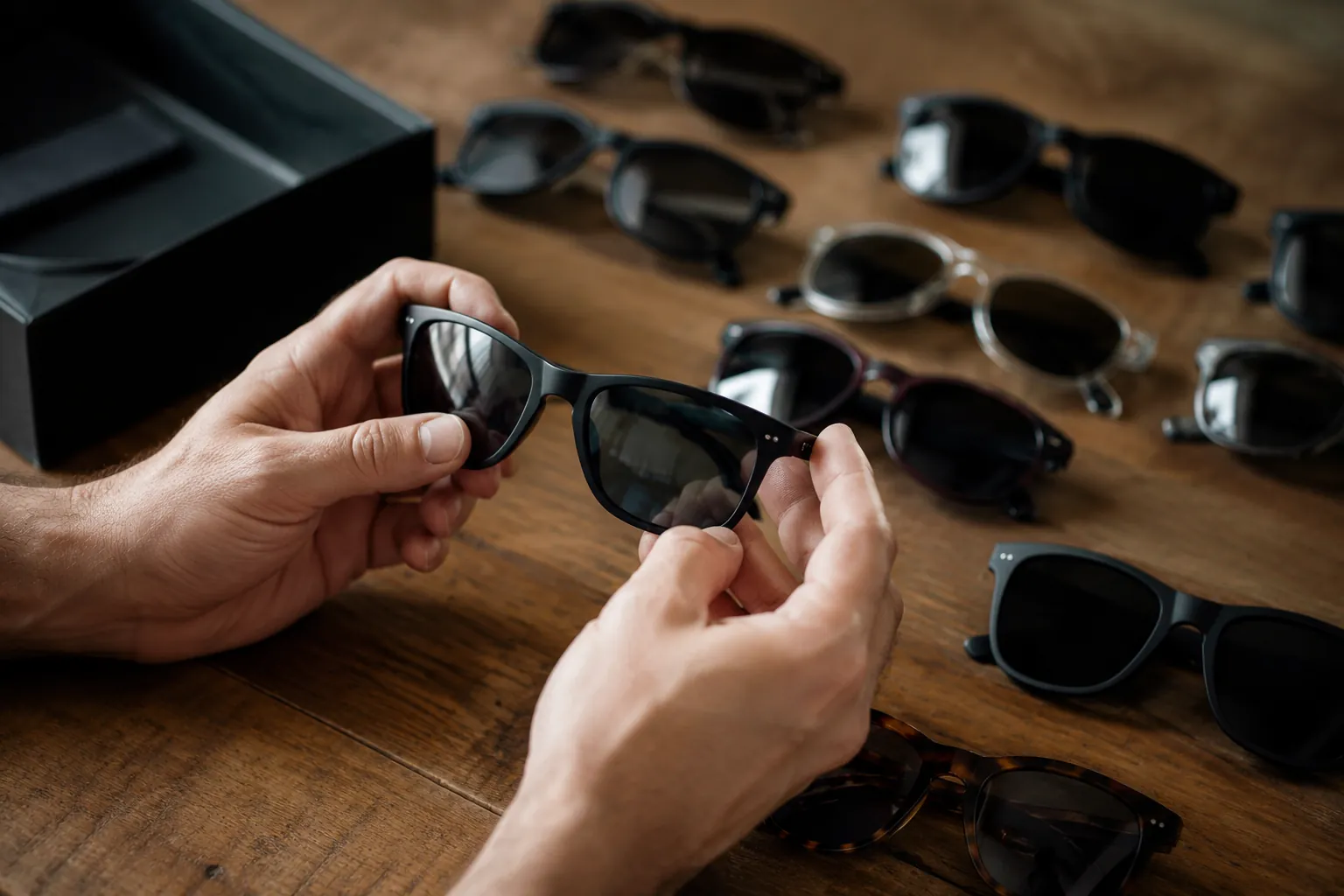
This guide is for brand owners, importers, distributors, and retail buyers sourcing sunglasses in volume. The aim is simple: verify scratch-resistance claims before you place a purchase order. Do not accept vague phrases like durable lens or anti-scratch coating. Ask for facts you can compare: lens substrate, coating method, curing control, abrasion test setup, defect criteria, and packaging protection. That gives you a usable specification. It also makes quotations easier to compare, sample approval more reliable, and post-shipment disputes easier to avoid.
Set the right expectation: scratch-resistant is not scratch-proof
The first mistake is obvious but common: treating scratch resistant as if it means scratch proof. It does not. No sunglass lens used in normal retail or consumer handling is immune to abrasion. Pocket contact, carton dust, rough display surfaces, poor cleaning cloths, and repeated dry wiping will mark most plastic lenses over time.
For B2B buyers, the real question is not Will it scratch? It is How easily will it scratch under the expected handling conditions, and is that level acceptable for the channel and price point? Open-rack retail, sports use, e-commerce fulfillment, and promotional distribution do not create the same risk.
Material matters before coating. Polycarbonate is widely used because it is light and impact resistant, but the surface is relatively soft and usually depends on a competent hard coat. Acrylic is common in lower-cost fashion and promotional sunglasses; it can look fine, but abrasion performance is often weaker. CR-39 style plastic can offer good optics and reasonable abrasion behavior with the right coating, though it is less common in lower-cost OEM sunglasses. Nylon is common in sports styles and can perform well, but it usually costs more and needs tighter processing control.
Ask the supplier to define the lens build clearly: substrate, tint method, hard-coat chemistry or coating type if they will disclose it, curing method, mirror layer if any, and topcoat if any. If the answer is only anti-scratch lens, you do not yet have a real specification.
| Lens material | Typical use | Surface behavior | Buyer note |
|---|---|---|---|
| Polycarbonate | Sports, kids, mass retail, promotional | High impact resistance, scratches easily without good hard coat | Common OEM choice; coating quality is critical |
| Acrylic | Low-cost fashion, event giveaway | Lower cost, often weaker abrasion durability | Use only when complaint risk is acceptable |
| CR-39 style plastic | Better optical programs, some private label | Good optics, moderate abrasion performance with coating | Less common at entry price tiers |
| Nylon | Sports and wrap styles | Tough, flexible, can perform well with higher-spec coating | Higher material and processing cost |
Ask for evidence before you approve a sample
If a supplier claims strong scratch resistance, ask for proof in a format your QC team can check later. A one-line claim on a quotation or sample card is not enough. It cannot be compared across factories. It is also hard to enforce in a dispute.
- Confirm the exact lens material: polycarbonate, acrylic, TAC polarized structure, nylon, or another specified substrate.
- Ask whether the hard coat is applied in-house or sourced from a coated-lens supplier, and whether the application method is dip coating, spin coating, spray coating, or another controlled process.
- Request the target coating thickness or the supplier's stated control range if they will share it.
- Ask for curing details: thermal cure, UV cure, or a combined process, and whether the factory records oven temperature, cure time, or UV lamp condition by batch.
- Request the internal abrasion test method, applied load, cycle count, pass rule, and batch sampling frequency.
- Ask for before-and-after photos or haze readings on the same lens color, mirror finish, and decoration you intend to buy.
- Confirm whether mirrored, gradient, flash-coated, polarized, or logo-decorated lenses are tested separately when the finish changes.
- Check that the finished lens still meets the target-market requirement, such as CE EN ISO 12312-1, ANSI Z80.3, or AS/NZS 1067, where applicable.
Then ask where scratch risk appears in the production flow. Many scratch problems are introduced after the hard coat is applied, not during coating itself. Typical risk points include transfer trays, assembly fixtures, logo application stations, cleaning steps, and final packing. If the supplier cannot identify those points, process control is probably weak.
Keep one distinction clear. Regulatory compliance is not the same as abrasion performance. CE EN ISO 12312-1, ANSI Z80.3, and AS/NZS 1067 matter, but they do not tell you whether one supplier's hard coat will hold up better than another's in daily handling.
How factories usually test hard-coat performance
Most factories rely on internal abrasion tests because production decisions need fast feedback. The label of the test is not enough. Setup detail matters. Without it, one passed scratch test cannot be compared with another.
Common factory-side methods include weighted rubbing with abrasive media, repeated wipe tests using controlled cloth contact, pencil-hardness-style surface checks, and haze comparison before and after abrasion. Better-equipped suppliers may use a motorized rub tester with a fixed load and cycle count. Some suppliers rely only on visual inspection after abrasion. Others also record haze increase with an instrument.
Ask for four essentials every time: method, load, cycles, and pass standard. Good reporting should also state lens type, color, coating batch, test date, and whether the result is visual, numerical, or both. If a factory says only passed anti-scratch test, you still do not have a buying standard.
Sampling frequency matters too. Repeat orders in one stable lens specification may justify lighter routine checks than new lens colors, mirrored finishes, or new decorative treatments. Any change in substrate, mirror stack, tint, coating source, or curing setting can affect abrasion behavior. The test plan should reflect that.
Useful rule: if the supplier cannot describe the abrasion test in a way your QC team or a third-party inspector could repeat, the scratch-resistance claim is not commercially reliable yet.
What performance usually looks like by price tier
Scratch resistance often improves as process control improves, but buyers should not treat price alone as proof. Better coatings usually require cleaner application conditions, tighter viscosity or process control, more stable curing, and better handling after cure. That adds cost. Still, a higher quotation means little without test evidence and production discipline.
| Price tier | Typical FOB logic | Likely lens/coating level | Commercial implication |
|---|---|---|---|
| Entry level | Price-led program focused on minimum landed cost | Basic PC or acrylic lens, limited coating upgrade | Suitable for promotional or short-life fashion programs; complaint risk should be evaluated carefully |
| Mid tier | Balanced cost and retail durability target | Better-controlled hard coat and more stable handling process | Common private-label retail range if QC is defined clearly |
| Upper commercial tier | Higher-cost program with stronger durability expectations | Higher-spec coating, tighter inspection rules, stronger packaging protection | Lower complaint risk is possible, but only if the supplier can document process control |
MOQ also affects what is realistic. A factory may accept small runs, but process stability is often easier to maintain on repeat production with a fixed lens source and established handling routine. That does not mean small orders must perform badly. It means buyers should verify more aggressively when the program is new, low-volume, or highly customized.
Ask the supplier to quote lens options separately. You need visibility into the cost difference between a basic lens and an upgraded hard coat, between non-polarized and TAC polarized, and between plain tint and mirror finish. If the lens specification disappears inside one bottom-line price, substitution risk goes up.
Where scratch claims usually fail in production
Most scratch failures are cumulative, not dramatic. A coating can look acceptable in isolation, then lose real-world performance through weak curing control, poor handling, or abrasive contact later in the process.
- Under-cured hard coat: the lens may pass casual appearance inspection, but surface hardness is not fully developed.
- Dirty coating area: dust or fibers trapped before cure can create visible defects or weak points.
- Excess tray contact: loose stacking or poor separation lets lenses or finished glasses rub during transfer.
- Decoration damage: printing fixtures, hot-stamping nests, laser-marking supports, or logo-installation tools can contact the lens surface or edge.
- Rework abrasion: removing ink, adhesive residue, or handling marks after assembly can damage the lens if tools or cloths are contaminated.
- Packing friction: inadequate bagging, poor compartment control, or loose carton packing can create transit rubbing before the goods reach the customer.
That is why process detail matters. Ask blunt questions. Are lenses protected with removable film before assembly? Are soft-contact fixtures used? Are gloves or finger cots required after coating? Are scratch defects logged by station and lot number, or buried under general appearance defects? A factory that can trace scratch defects is in a better position to fix them.
In-house operations can help when tinting, decoration, assembly, and final QC sit under one roof, because feedback moves faster. But vertical integration by itself proves nothing. The control still has to be real.
Match sample approval to bulk-order reality
Many buyers approve a clean development sample and assume bulk production will match. That is a weak assumption. A hand-finished sample is often handled more carefully than a production run moving through multiple stations.
Start with sample type. On a new project, ask for both a presentation sample and a production-representative sample made through normal line handling. If the order includes mirrored lenses, printed logos, or metal decorations, those same operations should appear on the sample you approve.
Next, keep a retention sample. Hold one sealed approval sample linked to the PO, color code, lens specification, and packaging specification. That retained sample becomes the reference for pre-shipment inspection and later complaint review.
Then define inspection criteria in writing. For larger orders, use an AQL-based inspection plan and state what counts as a major or minor lens scratch. The standard should define viewing distance, viewing angle, light source, and inspection time so the result is repeatable. Informal checking under mixed warehouse lighting is not a standard.
Use lead time to reduce risk. Do not just wait for shipment. Ask for in-line photos, pre-shipment QC records, and packaging confirmation before goods leave the factory. If the sales channel is open-rack value retail, specify stronger lens protection and tighter packing controls than you would for an e-commerce order packed in a pouch and carton.
Compliance and chemical checks: useful, but limited
Serious buyers should still verify compliance and system documents. For sunglasses, that usually means checking the applicable file for the destination market, such as CE EN ISO 12312-1, ANSI Z80.3, or AS/NZS 1067. Depending on the program, buyers may also review REACH restricted-substance compliance, FDA registration where relevant to the supplier or importer setup, ISO 9001 process management, and BSCI or similar social compliance records if required by the customer.
But keep the boundary clear. A valid compliance file does not prove superior scratch resistance. It shows that a product or management system meets a defined regulatory or operational requirement. Different issue. Different evidence.
For procurement, use stacked evidence:
- Compliance evidence for market-entry and safety requirements
- Internal abrasion-test evidence for comparing hard-coat performance
- Production QC records showing the same standard was maintained through the batch
- Packaging specification that reduces post-production rubbing in transit
When a supplier can provide all four clearly, the scratch-resistance claim becomes commercially useful instead of sales language.
A practical PO framework for buyers
Before you release a bulk order, reduce the decision to a short list of measurable checks. That makes supplier comparison easier and gives you a clearer basis for enforcement later.
- Define the end market clearly: promotional giveaway, fast-fashion retail, sports program, or repeat chain-store program.
- Match the lens substrate to that use case instead of defaulting to the lowest-cost option.
- Specify whether the lens is plain tint, gradient, polarized, mirrored, or logo-decorated, because each can change abrasion risk and handling requirements.
- Request the supplier's internal abrasion-test details and compare factories using the same reporting fields.
- Approve one production-representative sample, not only a showroom sample.
- Write scratch inspection criteria into the PO or quality agreement, including defect definitions and inspection conditions.
- Confirm the packaging method: individual bag, pouch, partition, protective film if used, inner box, and master-carton arrangement.
- For repeat orders, compare each new batch against the retained approval sample and confirm whether the lens source, coating source, or curing process changed.
If the factory cannot answer clearly on test method, curing control, batch sampling, and handling protection, treat the scratch-resistance claim as weak. If they can provide specific process detail and the performance matches your commercial target, you have a specification you can actually buy against.
The goal is simple. Buy a durability level that fits the channel, margin, and complaint risk, backed by evidence you can check before and after shipment.
Have a custom sunglasses project in mind?
Send us your styles, target market and quantities and we will return a detailed quote with MOQ, lead time and a sample plan.
Get a QuoteWhy source this from Wenzhou with LumiShades
Wenzhou in Zhejiang Province is widely regarded as China’s eyewear manufacturing capital, producing a large share of the world’s sunglasses. That concentration matters to buyers: a deep local supply chain for acetate sheet, hinges, lens blanks, plating and packaging means shorter component lead times, easier color and material matching, and a workforce with decades of eyewear-specific skill. LumiShades has manufactured in this ecosystem since 2009, and our vertical integration — in-house injection molding, acetate cutting, CNC milling, lens tinting, decoration and quality control — means no part of your order is quietly subcontracted to a workshop you cannot audit.
For international buyers, that vertical control translates into accountability. When a single factory owns every step, defects are traced and fixed at source rather than bounced between vendors, and your specifications survive intact from first sample to bulk. We back this with 15+ years of experience, shipments to 60+ countries, more than 5 million pairs produced per year and a 98.5% on-time delivery rate. Our certifications — CE EN ISO 12312-1, FDA registration, ANSI Z80.3, AS/NZS 1067, REACH, ISO 9001 and BSCI audit — mean the compliance documentation your market requires already exists. Explore our manufacturing capabilities and quality control process to see how this works in practice.
Frequently asked questions
What should I ask a supplier to prove scratch resistance on sunglass lenses? Ask for six items in writing: the lens substrate, the coating method, the curing method, the internal abrasion-test setup, the pass/fail criteria, and the batch test frequency. Then ask for evidence on the exact lens configuration you plan to order, including color, mirror finish, polarization, and logo decoration if applicable. The minimum useful record is a test description with load, cycle count, and result, plus before-and-after photos or haze data. If the supplier cannot tie the test result to the actual lens specification on your PO, the claim is weak.
Does CE EN ISO 12312-1 prove a lens has a good hard coat? No. CE EN ISO 12312-1 is an important sunglass standard, but it does not rank one supplier's hard coat against another's for scratch resistance in commercial use. Treat it as a market-access and product-performance requirement, not as proof of superior abrasion durability. To assess scratch resistance, ask separately for the factory's abrasion-test method, acceptance standard, and batch QC records.
Are polycarbonate lenses always more scratch resistant than acrylic lenses? No. Polycarbonate is usually chosen for impact resistance, not because its bare surface is harder. In practice, both polycarbonate and acrylic lens performance depends heavily on hard-coat quality, curing control, and post-coating handling. Do not compare materials by name alone. Ask for the same abrasion-test report format on each option and review the finished lens, not just the substrate description.
How many samples should I check before a bulk sunglass order? For a new program, review at least two samples: one presentation sample and one production-representative sample made through normal line handling. If the order includes mirrored lenses, printing, or metal decorations, those operations should be present on the production-representative sample. After approval, retain one sealed reference sample linked to the PO, lens specification, and packaging specification so your inspector has a fixed comparison standard during pre-shipment inspection.
Can very low MOQ orders have the same scratch resistance as large volume orders? They can, but buyers should verify more carefully. Low-MOQ orders may use the same nominal lens specification, yet consistency can be harder to control when the run is new, highly customized, or not part of a stable repeat program. Protect yourself by writing the exact lens material, coating requirement, test method, and packaging standard into the quotation and PO. Then ask for batch-specific QC evidence instead of relying on a previous sample alone.
Ready to start?
Explore our shield & oversized sunglasses or request a quote — our sales team replies within 12 hours.
Request a Quote