
Mirror Lens Specs Buyers Should Require
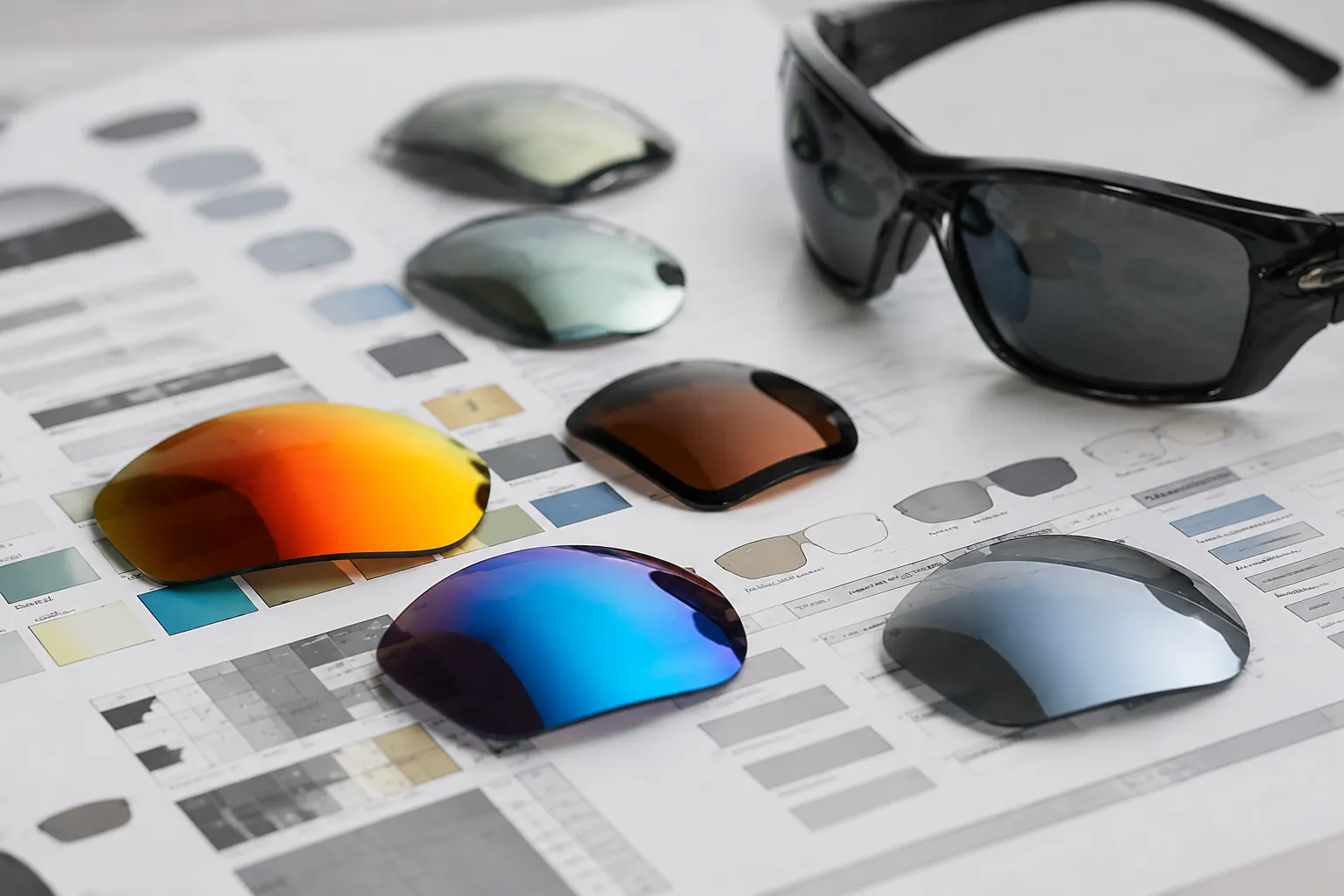
This article is for buyers sourcing private-label, promotional, or retail sunglasses in volume and dealing with mirror lenses that scratch, haze, rub, or peel too early. In most cases, the problem is not the mirror color by itself. It is the lens system as a whole, plus what happens during coating, curing, edging, insertion, wiping, packing, and inspection. If you set the right specifications before bulk production, you can protect shelf appearance, reduce avoidable claims, and avoid approving showroom samples that will not hold up in shipment or store handling.
Why Cheap Mirror Lenses Fail So Often
Mirror lenses often look acceptable at sample stage and still fail quickly after shipment. Buyers commonly approve mirror programs on appearance alone: mirror color, reflectivity, and whether the sample matches the intended look. That leaves the main durability risks undefined.
A mirror lens is usually a layered construction. A common build is: lens substrate, hard coat, mirror layer, and sometimes a clear protective top coat. If one layer is applied unevenly, under-cured, contaminated, or omitted, the lens may pass a basic outgoing visual check and still fail later in transit, retail display, or normal cleaning.
Reflective finishes also make surface damage easier to see than standard tints. A light wipe mark that barely shows on a smoke or brown lens can be obvious on silver, blue, green, gold, or multicolor mirror. The problem is not always that the surface is much weaker. It is often that any disruption is more visible.
Common root causes include:
- Thin or inconsistent lens builds: lenses with poor thickness control are harder to coat evenly and more vulnerable at the edge during fitting.
- Weak hard-coat curing: an under-cured hard coat may look normal at final QC, then mark more easily after heat exposure, wiping, or carton movement.
- No protective top coat: a decorative mirror-only build is cheaper, but the front surface is usually easier to scratch during packing, transport, and retail try-on.
- Dirty process conditions: dust, oil, fingerprints, or poor handling before coating can reduce adhesion and create visible defects under strong light.
- Poor edging or insertion: rough lens edges, tight grooves, or forced assembly can start flaking at the rim area even when the coating line is acceptable.
- Weak unit packing: if the lens front touches a polybag, pouch fold, tissue, zipper pull, or another lens, visible rub marks can appear before the carton reaches the customer.
The field complaints are usually predictable: fine scratches from cleaning, reflectivity variation near the edge, cloudy spots linked to coating or chemical exposure, rainbowing after heat, and flaking after assembly stress. On polycarbonate lenses, weak adhesion often appears first at the edge because that is where insertion stress is highest.
For buyers, the lesson is simple: mirror failure is usually a process-control problem, not a color-selection problem. If the RFQ only defines mirror shade, UV level, and price, the supplier is left to make durability decisions for you.
The Failure Modes to Check Before You Place Bulk
Most mirror-lens failures fall into a short list of repeatable problems. Each points to a different production weakness. Ask questions that isolate the root cause. Do not accept a general promise of better QC.
- Poor adhesion between layers: the mirror layer does not bond reliably to the coated lens surface. Signs include edge lift, flaking after tape testing, damage after normal wiping, or failure around the bevel after assembly. Typical causes are contamination, unstable coating parameters, or poor compatibility between substrate, hard coat, and mirror system.
- Low scratch resistance on the front surface: the lens has the correct mirror appearance but no durable protective top coat, or the top coat is weakly cured. It looks fine at approval stage, then picks up marks during pouch packing, carton movement, or consumer handling.
- Uneven coating deposition: reflectivity shifts from center to edge because fixtures are overloaded, part orientation is inconsistent, vacuum deposition is not uniform, or process windows are poorly controlled. Buyers then see color variation within the same lot or from lot to lot.
- Heat or humidity sensitivity: weakly cured systems can develop haze, rainbowing, dull patches, or micro-cracking after storage, container shipment, or warehouse exposure, especially when units are packed under pressure.
- Assembly damage after coating: tight frame grooves, poor bevel control, rough insertion tools, or careless hand fitting can chip the edge or mark the front surface before final packing.
- Chemical contact damage: some mirror surfaces are affected by alcohol wipes, aggressive cleaners, sunscreen transfer, adhesive residue, or low-grade pouch materials. If the end use includes retail cleaning or promotional distribution, this risk matters.
- Packing abrasion: the lens survives production but fails in the last step because the front surface contacts rough bag film, pouch seams, rivets, metal trims, or neighboring frames in a carton.
That last group of failures matters because mirror coatings are often damaged after coating, not during coating. Lens quality, frame fit, post-assembly wiping, unit packing, and carton packing need to be controlled as one process. If the supplier treats them as separate departments with separate standards, the buyer usually absorbs the return cost.
A useful review method is to ask where each defect can start:
- Before coating: substrate quality, washing, contamination.
- During coating: layer application, curing, deposition uniformity.
- After coating: edging, insertion, wiping, handling.
- At packing: bag contact, pouch contact, carton compression, vibration.
This structure forces the factory to explain control points instead of describing the lens as simply "blue mirror" or "scratch resistant."
What to Specify Instead of Just 'Blue Mirror Lens'
If your purchase order states only mirror color, UV requirement, and lens category, the highest-risk variables are still open. Mirror lenses need a short but precise specification. Appearance, durability, and handling all need to be defined.
A practical buyer specification should include the following items:
- Lens material: PC, nylon, TAC polarized, or other stated substrate.
- Nominal center thickness and tolerance: for example, 1.8 mm ±0.1 mm or another agreed target based on product design.
- Base curve: such as base 6 or base 8, since coating and fitting conditions can differ by shape.
- Lens tint and target VLT range: define the approved optical range, not just "category 3."
- Destination-market standard: CE EN ISO 12312-1, ANSI Z80.3, or AS/NZS 1067 where applicable.
- Mirror color approval method: against a sealed physical sample or approved retained panel, not a photo on a phone.
- Coating stack: hard coat + mirror + clear protective top coat, if required.
- Adhesion test requirement: identify method, timing, and pass/fail rule.
- Wipe or rub test requirement: define cloth type, pressure, cycle count, and reject criteria.
- Cosmetic standard: define acceptable and rejectable levels for scratches, pinholes, streaks, haze, edge lift, and color variation.
- Assembly control: confirm edge inspection before insertion and post-assembly lens check.
- Unit packing protection: require front-surface protection so the lens does not contact abrasive materials.
Material still matters. Process control matters more. Polycarbonate is widely used and commercially practical, but it is sensitive to coating adhesion and assembly stress. Nylon is often positioned as a more premium option and can offer better toughness in use, but buyers still need to verify coating compatibility and process control. TAC polarized lenses introduce another variable because lamination quality affects heat stability and consistency.
For B2B orders, specify a protected mirror system, not mirror appearance alone. Ask the supplier to state clearly whether the quoted build includes a hard coat, mirror layer, and protective top coat, and whether those layers are standard in the quoted price. This makes factory comparisons more meaningful and reduces the risk of approving a sample built differently from bulk.
The same logic applies to MOQ and price. Small runs can be harder to standardize because setup, color control, and packing routines may be less stable. Larger runs often give the factory more reason to formalize fixture loading, inspection checkpoints, and unit protection. Quantity does not guarantee quality. Process does.
Spec Options That Change Durability
| Spec Item | Low-Cost Version | Better B2B Version | What Changes in Real Use |
|---|---|---|---|
| Lens substrate | Thin or inconsistent PC build | Controlled-thickness PC or nylon where budget and design allow | Better coating consistency, lower edge stress, fewer insertion marks |
| Hard coat | Minimal or unstable curing | Verified hard coat with controlled curing parameters | Lower risk of wipe marks, haze, and poor mirror adhesion |
| Mirror construction | Decorative mirror only | Hard coat + mirror + protective top coat | Better resistance to cleaning marks, pouch rub, and retail handling |
| Color approval | Phone photo or digital image only | Sealed physical sample with retained approval standard | Less lot-to-lot variation and fewer disputes on shade |
| Edge finishing | Fast edging with limited bevel control | Defined bevel and edge inspection before insertion | Fewer chips, flake starts, and rim-area failures |
| Assembly method | Fast manual fitting with little process control | Defined insertion SOP with post-assembly lens inspection | Lower chance of stress marks and coating damage during fitting |
| Unit wiping | Random cloth, no control of pressure or cleanliness | Clean designated cloths and controlled wiping steps | Fewer pre-shipment micro-scratches and smear complaints |
| Individual packing | Loose polybag or direct lens contact with pouch | Lens-facing protection, non-abrasive separation, controlled pouch fold position | Fewer front-surface rub marks after shipment and unpacking |
| Carton packing | Loose loading with movement inside carton | Partitioned or stabilized packing layout | Reduced vibration damage and lower cosmetic rejection at arrival |
| QC evidence | General claim of inspection | Lot-linked photos, records, and retained sample check | Better accountability if defects appear after delivery |
This is where claims are often won or lost. Buyers may negotiate frame material, hinge type, branding, and decoration closely, then leave lens handling vague. With mirror styles, vague handling instructions become expensive very quickly.
If the product will sit in mass retail, gift channels, e-commerce fulfillment, or promotional distribution, the lens has to survive more than sample-room inspection. It has to withstand carton movement, unpacking, shelf contact, casual try-on, and in some cases return handling. That is why packing belongs in the lens specification itself, not at the end of the discussion.
The Tests Serious Buyers Should Ask to See
You do not need the same level of documentation for every order, but you do need evidence that the supplier checked the real risks tied to mirror-lens failure. Ask what is tested in-house, what is checked by lot, what is checked after assembly, and what standard applies to the destination market.
For finished sunglasses, compliance may need to align with CE EN ISO 12312-1, ANSI Z80.3, or AS/NZS 1067 depending on where the product will be sold. Those standards cover optical performance, UV protection, and related safety requirements. They do not replace durability control, but they are baseline requirements where applicable.
For coating durability and appearance retention, buyers should ask for practical checks tied to the exact lens build being purchased:
- Adhesion check: cross-hatch or tape test on coated sample lenses from the production lot after full curing.
- Rub or wipe test: a defined cloth, defined pressure, defined cycle count, and a written pass/fail standard for visible damage.
- Strong-light visual inspection: a repeatable light source and viewing method for checking pinholes, streaks, haze, rainbowing, edge defects, and reflectivity inconsistency.
- Heat or storage check: review for haze, color shift, or coating instability after agreed temperature exposure if shipment conditions make this relevant.
- Packing simulation: finished units packed as shipped and then checked for front-surface rubbing after handling, vibration, or carton movement.
- Post-assembly inspection: confirmation that lenses are checked after insertion into the frame, not only as loose lenses.
- Lot traceability: records linking incoming material, process date, in-process checks, and outgoing QC to the shipment lot.
Ask the factory to describe each control point in plain terms:
- When is the adhesion test done?
- How many pieces per lot are checked?
- Is the wipe test done on loose lenses or finished sunglasses?
- Who approves color against the retained master sample?
- Are lenses rechecked after cleaning and packing?
- What photos or records can be shared before final payment?
The key move is to connect certificates to order-specific control. A supplier may have REACH documentation, ISO 9001 certification, BSCI audit records, or market-compliance files for eyewear. That does not prove that your mirror lens build was checked after coating, insertion, and packing. Ask what was tested on your order, when it was tested, and whether sample and bulk used the same build.
Where Lead Time, MOQ, and Pricing Affect Lens Quality
Mirror coatings are more vulnerable on rushed orders because coating, curing, assembly, and packing all depend on stable process control. Compress the timeline too far and visual defects rise while final inspection catches less.
Sample lead time and bulk lead time vary by supplier, lens type, frame construction, and decoration complexity. The important question is not the quoted number of days by itself. It is whether the approved sample was made with the same coating stack, fitting method, and packing method planned for bulk production. A hand-finished sample can look very good and still fail to represent line production.
MOQ also changes how much process discipline is practical. Very small runs may involve more manual setup, less stable color control, and less standardized packing. Larger runs often justify tighter fixture control, clearer inspection checkpoints, and retained approval samples. Ask how the supplier handles mirror-lens approval at the exact order size being quoted.
Read price the same way. If a quotation is unusually low, ask what has been simplified or removed:
- Was the protective top coat removed?
- Was lens thickness reduced?
- Was edge finishing simplified?
- Was individual lens protection downgraded?
- Was inspection time reduced?
- Was the approved sample built differently from the quoted bulk plan?
A very low-cost mirror sunglass may still be suitable for a short-life promotional program or a one-time event giveaway. It should not be bought under the assumption that it will perform like a protected retail-grade build. Buyers should match the lens system to the use case: event distribution, e-commerce, chain retail, outdoor sport, or gift-with-purchase each place different stress on the surface.
Lead time pressure can also affect the last steps the most. When factories are behind schedule, the first corners often cut are extra curing time, gentle wiping, and careful unit packing. That is exactly where mirror-lens appearance is won or lost.
A Practical RFQ Checklist for Mirror Styles
Use the points below in your RFQ or purchase order. They force the supplier to answer the durability question directly instead of treating mirror approval as a color-only decision.
- State lens material, nominal thickness, base curve, tint, and target VLT range.
- Specify destination-market compliance: CE EN ISO 12312-1, ANSI Z80.3, or AS/NZS 1067 as applicable.
- Define mirror color against a sealed physical sample, not a messaging-app photo.
- Require hard coat + mirror + protective top coat if retail handling matters.
- Set cosmetic criteria for scratches, pinholes, streaks, haze, edge lift, and visible color variation.
- Ask how the factory protects lenses during edging, insertion, wiping, and unit packing.
- Request confirmation that post-assembly inspection is done after lens insertion.
- Request lot-level QC records, dated inspection photos, or retained-sample comparison before balance payment.
- Confirm carton packing method so lenses do not rub against bags, pouches, or each other.
- Confirm whether sample and bulk use the same coating stack and same packing method.
One of the most effective corrections in mirror-lens programs is often better packing. A low-abrasion liner, soft separation material, cleaner polybag interior, or revised pouch-fold position can prevent the cosmetic damage that leads to retailer rejection. These details sound small until a shipment arrives with widespread front-surface rub.
A short buyer checklist can also be used during sample approval:
- Compare sample color against intended retained standard under consistent lighting.
- Inspect mirror surface under strong front light for pinholes, streaks, and wipe marks.
- Inspect the rim area for chips, lifting, or coating weakness at the edge.
- Check whether the sample arrives with front-surface protection in its actual selling pack.
- Ask whether the same lens build is standard or was specially prepared for sample approval.
The rule is simple. Specify the coating stack. Specify the handling method. Verify both before shipment. Otherwise, you are paying for appearance without controlling the conditions that keep that appearance intact.
Have a custom sunglasses project in mind?
Send us your styles, target market and quantities and we will return a detailed quote with MOQ, lead time and a sample plan.
Get a QuoteWhy source this from Wenzhou with LumiShades
Wenzhou in Zhejiang Province is widely regarded as China’s eyewear manufacturing capital, producing a large share of the world’s sunglasses. That concentration matters to buyers: a deep local supply chain for acetate sheet, hinges, lens blanks, plating and packaging means shorter component lead times, easier color and material matching, and a workforce with decades of eyewear-specific skill. LumiShades has manufactured in this ecosystem since 2009, and our vertical integration — in-house injection molding, acetate cutting, CNC milling, lens tinting, decoration and quality control — means no part of your order is quietly subcontracted to a workshop you cannot audit.
For international buyers, that vertical control translates into accountability. When a single factory owns every step, defects are traced and fixed at source rather than bounced between vendors, and your specifications survive intact from first sample to bulk. We back this with 15+ years of experience, shipments to 60+ countries, more than 5 million pairs produced per year and a 98.5% on-time delivery rate. Our certifications — CE EN ISO 12312-1, FDA registration, ANSI Z80.3, AS/NZS 1067, REACH, ISO 9001 and BSCI audit — mean the compliance documentation your market requires already exists. Explore our manufacturing capabilities and quality control process to see how this works in practice.
Frequently asked questions
Do mirror coatings always scratch more easily than plain tinted lenses? Not always in absolute terms, but they usually show damage more clearly. A light surface mark that is hard to notice on a non-mirrored lens can stand out immediately on a reflective lens. For sourcing decisions, the better question is whether the supplier is offering a protected build. Ask whether the quoted lens includes a hard coat, the mirror layer, and a clear protective top coat, and ask to see the supplier's wipe or rub test method for that exact build.
Is polycarbonate a bad choice for mirrored sunglasses? No. Polycarbonate is a standard commercial choice for mirrored sunglasses. The main risk comes from poor coating adhesion, weak curing, rough lens edging, and inadequate packing, not from the material name alone. If the supplier quotes PC, ask for the nominal lens thickness, the full coating stack, how adhesion is checked after curing, and how the lens is protected during insertion and packing. That tells you more than a generic claim that one material is better.
What should I ask for if the sunglasses will go through mass retail handling? Ask for a protected mirror construction, a written cosmetic standard, and a packing method designed to prevent front-surface contact. In practice, that means specifying hard coat + mirror + protective top coat, approving color against a sealed physical sample, defining rejectable defects such as scratches, pinholes, haze, and edge damage, and confirming how lenses are separated in the individual pack and carton. Also ask whether post-assembly inspection is done after lens insertion, not only after coating.
Can a supplier prove mirror durability without full third-party testing on every order? Yes, but the proof needs to be lot-specific and process-specific. Ask for in-house adhesion checks, defined wipe or rub tests, strong-light visual inspection records, and evidence that packed finished goods were checked for rubbing risk. For market access, confirm the relevant compliance file for CE EN ISO 12312-1, ANSI Z80.3, or AS/NZS 1067 where required. For supplier controls, REACH, ISO 9001, or BSCI documentation can be useful background, but they do not replace order-level evidence for your mirror lens build.
Does low MOQ make mirror-lens quality worse? Not by itself, but low MOQ can make control harder because setup may be more manual and less standardized. Buyers should treat small runs as higher risk unless the supplier can show that sample and bulk use the same coating stack, fitting process, and packing method. The practical step is to ask how mirror-lens color approval, assembly checks, and unit packing will be handled at your exact order quantity, and to request pre-shipment photos or QC records tied to that lot.
Ready to start?
Explore our sport wrap sunglasses or request a quote — our sales team replies within 12 hours.
Request a Quote