
Wholesale Sunglasses for Resorts, Cruises and Tourist Shops
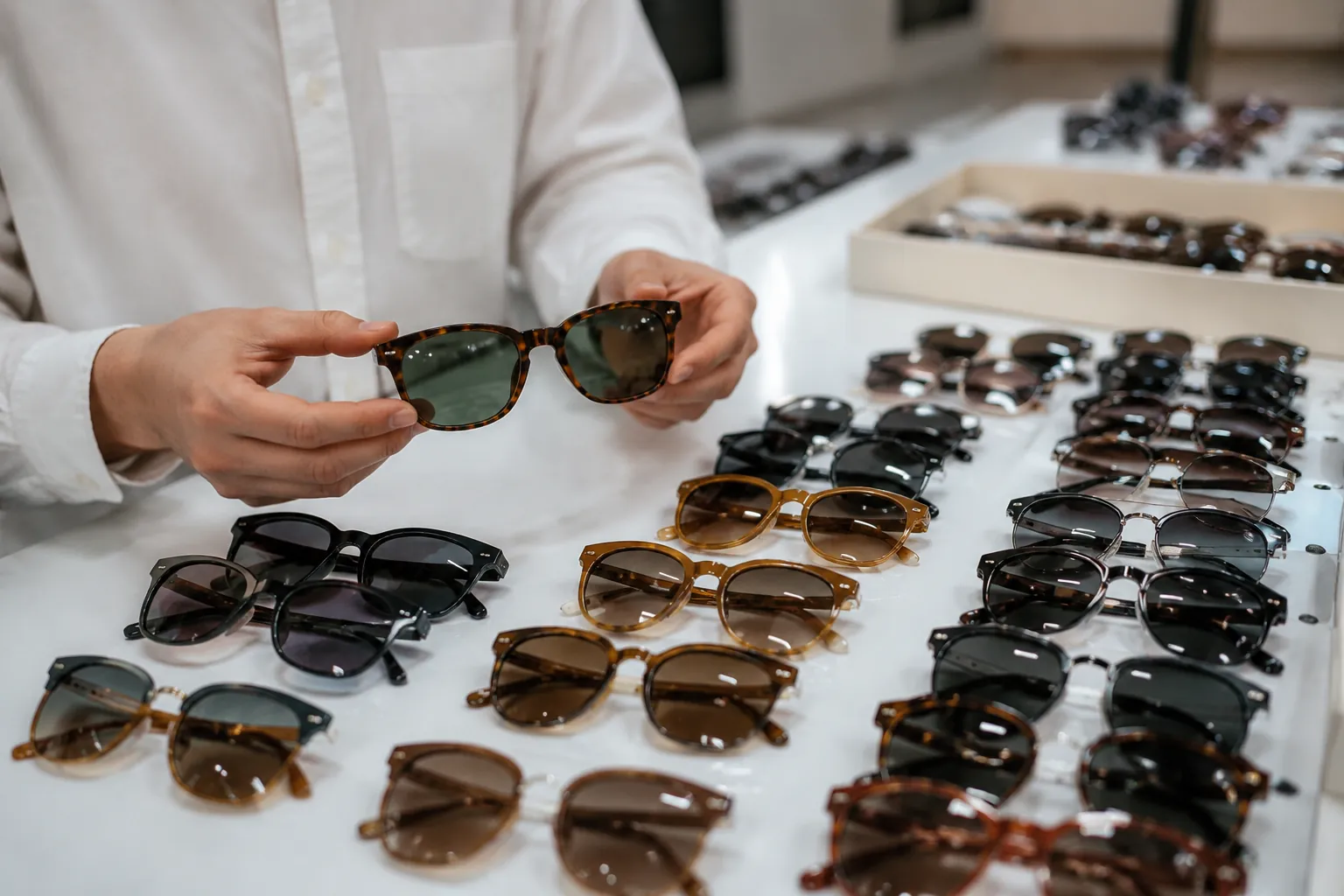
This guide is for resort retail buyers, cruise merchandisers, distributors and tourist shop owners who need sunglasses that sell fast, survive heavy handling and reorder cleanly. It shows how to brief a supplier with clear, checkable details: frame material, lens category, tint, polarization, logo method, packaging, compliance documents, inspection points, lead-time assumptions and replenishment rules. The aim is simple: fewer weak SKUs, cleaner quotes, fewer avoidable returns and better seasonal stock control.
Start With the Selling Environment
Resort, cruise and tourist-shop sunglasses are not bought like optical-chain eyewear. Many customers are replacing a forgotten pair. Some want a souvenir. Others need sun protection before a beach, pool or boat activity. The product has to communicate value fast: UV protection, fit, price, destination branding and whether the lens is polarized.
That should shape the sourcing brief. A frame may look good in a catalog, then twist on a hot display, scratch on a spinner rack or lose its logo after contact with sunscreen. That is not a reliable travel-retail frame. Define the selling environment first. Choose frame shapes after that.
- Beach resorts: prioritize lenses suited to bright sunlight, corrosion-resistant screws, durable hinges and darker smoke, brown or green tints.
- Cruise shops: need compact display quantities, stable SKUs and barcodes, cartons that tolerate repeated handling and mid-price styles that fit many face widths.
- Tourist shops: benefit from local logo printing, fast color rotation and replenishment plans that protect proven seasonal sellers.
- Pool and water parks: need impact-resistant frame materials such as PC or TR90, simple hinges and low-risk designs without fragile nose-pad assemblies.
Build the first assortment around retail roles, not random shapes: glare protection, everyday unisex, fashion souvenir, kids and emergency value pair. This makes reorders easier. The buyer can see which role is missing instead of only reacting to sold-out SKUs.
Build an Assortment That Can Reorder
Many first orders carry too many small variations. Twelve lens colors, five temple logos and six frame colors may look thorough on a spreadsheet. On the rack, they often become slow movers. In high-turn travel retail, depth in proven roles usually beats scattered variety.
A practical launch assortment can run 8 to 12 SKUs. Assign quantity by expected traffic, display capacity and replenishment lead time. Before ordering, ask the supplier to confirm MOQ per design, MOQ per color, MOQ per lens option and MOQ per logo or packaging version. These limits matter. One frame shape with three colors, two lens types and two logo versions may count as several production variants.
Ask suppliers to quote the same technical specification at each quantity break. Do not compare price unless the frame material, lens category, tint, polarization, coating, logo method, pouch or box, barcode labeling and inspection requirement are the same. A lower unit price may mean a thinner frame, non-polarized lens, simpler packaging or looser QC. That is not better value.
| Retail Role | Suggested Share | Frame Direction | Buying Detail |
|---|---|---|---|
| Core unisex | 30-40% | Wayfarer, square, soft rectangle | Use black, tortoise, smoke and matte navy; keep lens category and barcode consistent. |
| Polarized glare | 20-30% | Wrap, sport square, aviator-inspired | Best near beaches, marinas and cruise decks; test POS screens and staff devices before going fully polarized. |
| Fashion souvenir | 15-25% | Cat-eye, round, oversized | Use local color stories, but avoid splitting demand across too many low-volume variants. |
| Kids and teens | 10-15% | Flexible TR90, small PC frame | Check age suitability, hinge strength, temple-end smoothness and required warning labels. |
| Emergency value | 5-10% | Simple PC injection frame | Keep decoration minimal and price sharp for forgotten-sunglasses purchases. |
Use the table as inventory control, not a fixed fashion rule. If a dive pier drives most sales, increase polarized depth. If the resort is adult-only, reduce kids and add another core unisex or premium fashion SKU.
Choose Materials for Heat, Salt and Handling
Travel retail is hard on sunglasses. Frames sit near windows. Wet or sunscreen-covered hands handle them all day. They fall onto tile. They live in beach bags. Material choice matters more than a catalog photo.
PC injection frames are cost-efficient and work well for value souvenirs and emergency pairs. They hold color consistently and support repeat production. But very thin temples can feel weak or distort under heat. For PC frames, review actual sample weight, hinge reinforcement, bridge structure and temple stiffness before approving bulk production.
TR90 is more flexible. It is often a better choice for sport, kids and pool-shop programs. It usually costs more than basic PC, but it can reduce breakage complaints because temples bend rather than snap. Acetate gives better color depth, weight and perceived value for boutique resort shops, but it requires cutting, tumbling, polishing and more hand assembly. Metal frames can sell well in adult travel retail. Still, plating, screws, solder points and nose pads need tighter inspection because salt air and humidity expose weak finishes quickly.
- PC: best for value programs, large color runs and repeatable injection-frame production.
- TR90: best for kids, sport, pool and active travel retail where flexibility matters.
- Acetate: best for premium resort boutiques and branded capsule collections where finish and color depth matter.
- Metal: best for adult fashion shelves, but only with documented checks on plating, solder points, screws and nose pads.
Set practical tolerances in the purchase order. Temples should open evenly. Lenses should sit without visible rim gaps. Hinge screws should not protrude. Frame fronts should not rock noticeably on a flat surface. Finished surfaces should be free from sharp edges, glue overflow and obvious polishing marks. Approve a physical sample before bulk production, and require written approval for any material or component substitution.
Specify Lenses and Compliance Clearly
Do not write "UV400 lens" and stop. That is too vague. A complete lens specification should include lens category, tint color, visible light transmission target, polarization, coating, labeling and the compliance standard for the selling market.
For beach and cruise retail, Category 3 sunglass lenses are common because they are intended for bright sunlight. Category 2 can suit fashion-led or mixed-light destinations. Category 4 is very dark, is not suitable for driving and requires clear warnings. Polarized lenses reduce glare from water, decks and sand, but they can make some LCD screens harder to read. Test before committing. Cruise and resort buyers should check POS screens, cabin-key readers, rental kiosks and staff devices before making the full range polarized.
Compliance must match the market where the sunglasses are sold. For the European Union, request CE documentation against EN ISO 12312-1 and confirm REACH material control where applicable. For the United States, ANSI Z80.3 is commonly used for non-prescription sunglasses, and FDA registration may be relevant for suppliers placing eyewear products into the U.S. market. For Australia and New Zealand, AS/NZS 1067 is the reference standard. Keep documents tied to the actual model, lens color, coating and production batch wherever possible.
Factory note: changing lens tint, lens supplier, mirror coating or polarization film after approval can affect test results. Treat these as specification changes, not cosmetic edits.
QC should include UV transmittance, visible light transmission, lens surface inspection, polarization verification and fit testing. A scratch near the center field is serious. The customer sees it immediately when trying the product on.
Brand Without Creating Production Problems
Resort and cruise buyers often want destination branding. Poor decoration can make sunglasses look like giveaways instead of retail products. Keep it restrained. The safest branding zones are temples, small lens-corner marks, pouch tags, hangtags and display cards. Large lens logos reduce wearability and increase rejection risk.
Decoration methods behave differently in production. Pad printing is economical for temple logos and destination names, but artwork should be simplified and ink adhesion tested against sunscreen, sweat and saltwater exposure. Laser engraving is clean on metal plates and some temple surfaces, but contrast can be low on dark or translucent materials. Metal logo plates feel premium, though they add tooling, glue or pin assembly and placement checks. Heat-transfer or sticker-style decoration should be avoided for humid beach retail unless the supplier can provide testing evidence and approved samples.
| Branding Method | Best Use | Production Risk | Factory Check |
|---|---|---|---|
| Pad printing | Temple logos, icons, destination names | Ink rub-off from sunscreen, sweat or saltwater | Run adhesion, rub and tape tests before bulk. |
| Laser engraving | Metal temples, logo plates, selected acetate designs | Low contrast or uneven depth | Confirm readability after polishing and cleaning. |
| Metal logo plate | Higher-priced resort retail | Loose plate, glue overflow or misalignment | Check pull strength and placement tolerance. |
| Hangtag and pouch | Seasonal campaigns and multi-location programs | Barcode, SKU or language-version mixing | Match tag, pouch, inner bag and carton label. |
For a first program, use one consistent temple logo plus a strong hangtag or pouch. Keep logo size modest. Confirm exact artwork placement on a physical decorated sample, then require written approval before production begins.
Plan Cost, MOQ and Lead Time Early
Low unit price is not the full cost story. Tooling, decoration setup, lens upgrades, retail packaging, inspection, freight method and reorder timing all affect landed cost. Ask suppliers to quote the same specification at each quantity break. Otherwise, the cheaper quote may simply use thinner frames, non-polarized lenses or weaker packaging.
Clarify MOQ at the level that affects production: per model, per color, per lens type, per logo, per packaging version and per shipment. A supplier may accept a small total order but require higher quantities for a custom color, mirror lens, metal logo plate or printed pouch. For test orders, use fewer variants with enough stock per SKU to measure sell-through. For seasonal orders, protect core styles that can be reordered without changing the approved specification.
Confirm lead time in writing. It varies by material, decoration, sample approval, factory capacity and inspection schedule. Do not treat air freight as a rescue plan for late approvals. It shortens transit time, not sample making or bulk production.
- Artwork and specification approval: confirm logo files, Pantone references, lens details, warning text and packaging copy before sampling.
- Pre-production samples: require physical samples for custom lens, logo, color or packaging decisions before bulk production.
- Bulk production: confirm the production calendar after sample approval, deposit or PO release and final component confirmation.
- Injection repeats: usually move faster when mold, frame color, lens reference and packaging are unchanged.
- Acetate or decoration-heavy orders: allow more time for cutting, polishing, logo placement, sorting and final inspection.
For seasonal travel retail, build the purchase schedule backward from the required in-store date. Include internal approval time, sample review, bulk production, inspection, export paperwork, freight, customs clearance, local distribution and shelf setup. Many margin problems start with a late internal approval that forces premium freight.
Control Replenishment and Final Inspection
High-turn tourist retail often fails quietly. Best sellers disappear. Staff fill the rack with slow movers. The buyer sees flat sales without realizing the core product was out of stock. Replenishment should be planned before the rack looks empty.
Track sell-through by retail role as well as SKU. If several black polarized square styles sell out across shops, that is a glare-protection signal. Reorder the role and adjust color depth. If a pink round frame works at one resort but not another, keep the local winner. Do not force it into every location.
- Set weekly sell-through reporting by location, vessel or store group.
- Flag any SKU that reaches the agreed reorder point before mid-season.
- Reorder core styles deeper and cut slow fashion colors.
- Keep barcode, pouch, carton mark and lens category stable across reorders.
- Approve any material, lens, component or logo substitution in writing before production.
Write final inspection into the purchase order. Pull samples across cartons, not only from the top of one box. Check frame finish, hinge action, lens seating, center-field scratches, logo position, barcode accuracy, warning text, model number, lens category and carton marks. For polarized styles, verify the effect with a polarization checker, not just a sticker.
The safest PO states model number, frame material, lens category, tint, polarization, coating, logo method, packaging, barcode, carton quantity, inspection standard, required compliance documents and shipment date. Vague POs create vague results, especially when reorders are placed under time pressure.
Have a custom sunglasses project in mind?
Send us your styles, target market and quantities and we will return a detailed quote with MOQ, lead time and a sample plan.
Get a QuoteWhy source this from Wenzhou with LumiShades
Wenzhou in Zhejiang Province is widely regarded as China’s eyewear manufacturing capital, producing a large share of the world’s sunglasses. That concentration matters to buyers: a deep local supply chain for acetate sheet, hinges, lens blanks, plating and packaging means shorter component lead times, easier color and material matching, and a workforce with decades of eyewear-specific skill. LumiShades has manufactured in this ecosystem since 2009, and our vertical integration — in-house injection molding, acetate cutting, CNC milling, lens tinting, decoration and quality control — means no part of your order is quietly subcontracted to a workshop you cannot audit.
For international buyers, that vertical control translates into accountability. When a single factory owns every step, defects are traced and fixed at source rather than bounced between vendors, and your specifications survive intact from first sample to bulk. For procurement review, buyers can request process records, approved samples, quality checkpoints and project-specific compliance files before placing a bulk order. Required testing and documentation are confirmed against the destination market and product specification rather than assumed from a generic certificate list. Explore our manufacturing capabilities and quality control process to see how this works in practice.
Frequently asked questions
What MOQ should a resort buyer use for a first sunglasses order? Ask the supplier to confirm MOQ per model, color, lens type, logo method and packaging version. For a first order, choose fewer SKUs with enough units per SKU to measure sell-through. Do not spread the budget across many low-volume variants that cannot be reordered or judged properly.
Are polarized sunglasses worth adding for beach and cruise retail? Yes. Polarized lenses are useful near beaches, marinas, pool decks and cruise decks because they reduce glare from water, sand and reflective surfaces. Test before making every style polarized. Some POS screens, cabin-key readers, rental kiosks and staff devices can be harder to read through polarized lenses.
How long should custom resort sunglasses production take? Lead time depends on material, decoration, sample approval, factory capacity and inspection requirements. Build the schedule backward from the in-store date and include artwork approval, pre-production samples, bulk production, inspection, export paperwork, freight, customs clearance and local distribution. Air freight can shorten transit, but it does not replace sample approval or production time.
Which compliance documents should overseas buyers request? Match documents to the selling market and exact product specification. For the EU, request CE documentation against EN ISO 12312-1 and confirm REACH controls where applicable. For the United States, ask about ANSI Z80.3 and FDA registration where relevant. For Australia and New Zealand, request AS/NZS 1067 documentation. Keep documents linked to the actual model, lens color, coating and batch.
What branding method is safest for tourist shop sunglasses? A modest temple logo plus a branded hangtag or pouch is usually the safest starting point. Pad printing can work well for simple logos if adhesion is tested. Laser engraving is cleaner on suitable metal or plate surfaces. Avoid large lens logos or untested stickers in humid beach environments because they can reduce wearability and increase defect risk.
How can buyers reduce returns from resort sunglass programs? Write the technical specification into the PO: frame material, lens category, tint, polarization, hinge type, logo position, packaging text, barcode and inspection checks. Approve a physical sample before bulk production, test printed logos for rub resistance and require written approval for any material, lens, component or packaging substitution.
Ready to start?
Explore our square sunglasses or request a quote — our sales team replies within 12 hours.
Request a Quote