
Metal Hinge Upgrades for Sunglass Buyers
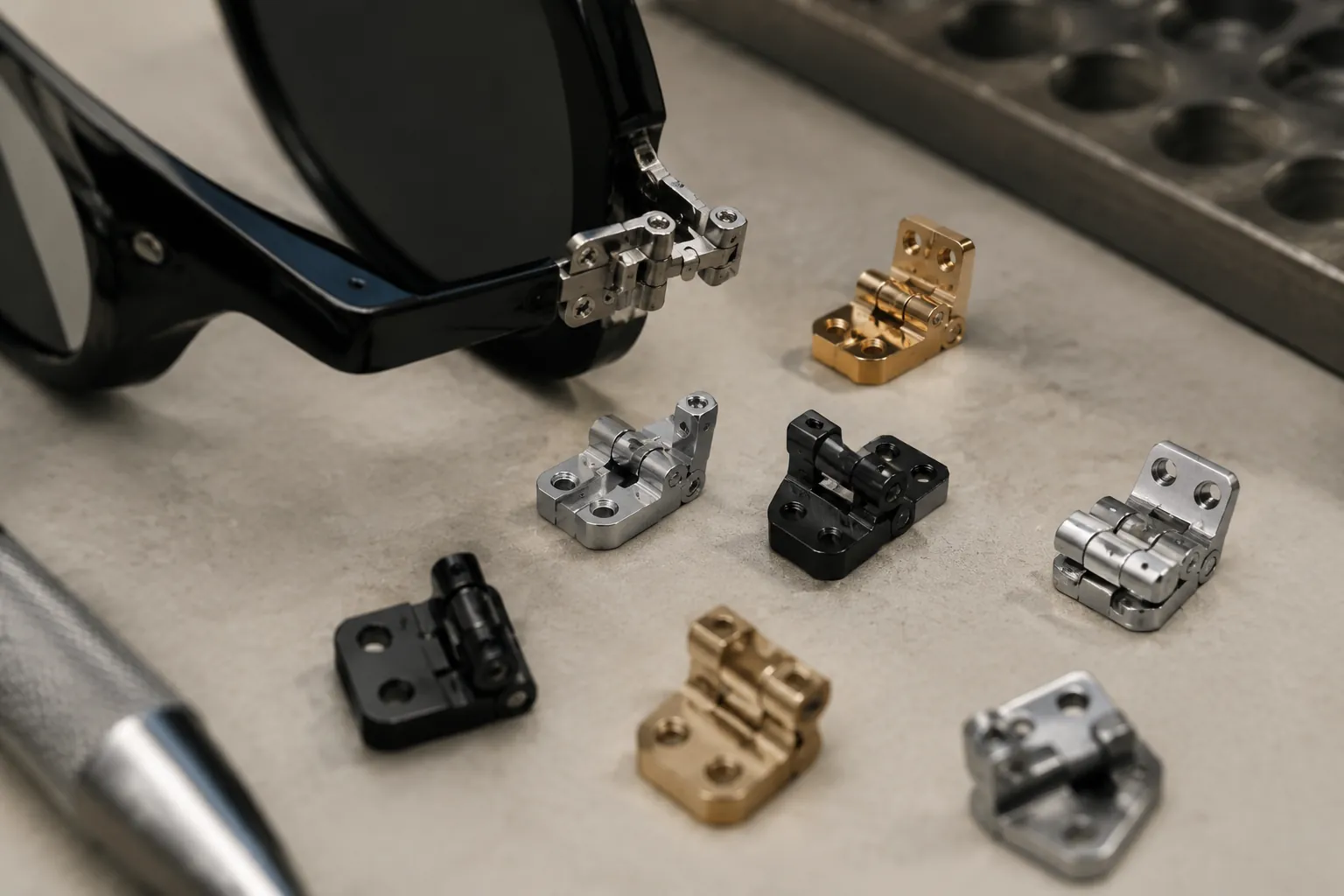
If you buy sunglasses for brands, importers, distributors, or retail programs, hinge choice is not a small detail. It affects return risk, opening feel, packaging stability, shelf impression, and the price a frame can support at retail. This guide explains the hinge options that matter, how to evaluate them in production, and how to choose the right construction for premium and mid-tier collections.
Why the hinge affects more than durability
Many buyers treat hinges as a hardware line item. That misses how much the hinge shapes the first impression. It is one of the first parts a buyer or end customer touches. If the temple opens unevenly, feels loose, or closes with uneven resistance, the frame reads as low quality even when the front shape is strong.
Hinge problems usually show up in a few predictable ways. Screws loosen when thread engagement is poor or assembly torque is inconsistent. Temples drift out of alignment after packing, shipping, or repeated try-on. The hinge area can crack or deform if the front or temple geometry is too thin for the load. The visible problem may look like a hinge failure. The root cause is usually design, material choice, or assembly control.
That is why hinge upgrades often deliver more value than cosmetic changes. A cleaner hinge, smoother swing, and more consistent closure can support stronger pricing than surface decoration alone. In mid-range and premium eyewear, hardware is part of the value story because it affects feel, durability, and shelf presentation at the same time.
Channel behavior matters too. Self-serve retail, optical counters, fashion stores, and travel retail all stress the product differently. Frequent try-on, repeated opening and closing, and tight display packing expose weak hinge construction quickly. Buyers should judge the hinge as part of the whole retail experience, not as hidden structure.
The main hinge constructions buyers should compare
When sourcing sunglasses, buyers usually compare standard metal hinges, spring hinges, embedded metal hinges for molded frames, and decorative upgraded hinges with custom plating or visible hardware. Each construction has trade-offs in cost, feel, durability, and production control.
| Hinge type | Typical use | Buyer upside | Main risk |
|---|---|---|---|
| Standard metal hinge | Core mid-tier acetate or injection frames | Cost-efficient, easy to service, and stable when screw fit and alignment are controlled | Can feel basic if plating, barrel finish, or temple closure is inconsistent |
| Spring hinge | Higher-comfort mid-tier and premium programs | Better flex tolerance, stronger perceived quality, and more forgiving fit during try-on | More parts, more assembly time, and tighter QC on symmetry and torque |
| Embedded metal hinge | Injected or mixed-material frames | Cleaner appearance and strong interface when insert position is accurate | Insert shift, sink, or mold variation can misalign the temples permanently |
| Decorative upgraded hinge | Fashion-led premium collections | Visible metal detail supports brand storytelling and retail positioning | Cost rises quickly when custom shapes, logo work, and special plating are added |
The practical question is not which hinge is most advanced. It is which hinge fits the channel and still feels intentional in hand. For many mid-tier collections, a well-finished standard metal hinge with good screw retention is the most efficient option. For comfort-led premium programs, a spring hinge is worth considering only when the market or retailer can support the higher cost.
Material and finish matter as well. Zinc alloy is common when cost control and die-cast flexibility are priorities. Stainless steel can offer stronger corrosion resistance and a more premium feel, but it may be harder to form and finish consistently. Nickel plating gives a bright, familiar appearance, but the final result still depends on base polishing and corrosion control. Dark finishes such as black coating or PVD-style looks can create a matte premium effect, but the buyer should verify abrasion resistance, edge coverage, and consistency across the hinge barrel.
What good hinge engineering looks like in production
Good hinge performance starts before assembly. Front thickness, temple thickness, barrel length, screw boss depth, and metal geometry all need to work together. If the hinge barrel is too large for the temple wall, screw engagement suffers. If the screw is too short, the joint can wobble. If it is too long, it can bottom out and create uneven clamping force or thread damage.
For acetate frames, the hinge pocket should be cut consistently so left and right sides match. Buyers should ask for dimensional control at the hinge area, not just overall frame dimensions. A useful sourcing spec should define how much left/right temple alignment variation is acceptable when the frame is closed, what torque range is expected during assembly, and what gap variation is allowed before packing.
For injection or mixed-material frames, insert location and molding conditions are critical because the hinge insert becomes part of the finished geometry. If the insert shifts during molding, the temple angle can be wrong from the start. That kind of error usually cannot be corrected later by polishing or final assembly. Fixture design, cooling time, and insert placement all matter.
At factory level, the controls are simple but unforgiving: hole position, hinge alignment, torque consistency, and cycle testing. Buyers should ask for the test basis in writing instead of accepting a general promise of good quality. A serious program should define sample size, cycle count, pass/fail criteria, and how failures are handled if one side loosens before the others. The number of cycles should match the intended use case and market expectations.
Repeatability matters most. If one sample feels tight and the next feels loose, the issue is not only hinge style. It is process control. Buyers should request the same hinge finish, screw specification, and assembly method on all approval samples so the test reflects the shipped product.
For a serious buyer, ask for the following on every hinge upgrade:
- Temple swing test target and sample size
- Recommended screw type, length, and thread engagement depth
- Any thread-lock method, such as pre-applied patch or controlled adhesive
- Plating thickness or finish standard, plus corrosion expectations
- Left/right closure tolerance and acceptable visible gap range
- Cycle-test basis and whether results are measured before or after packing
Cost impact and margin logic by volume
Hinge upgrades are one of the more efficient ways to move a frame up-market without redesigning the entire product. They do add cost. Not just the metal itself. Extra assembly time, tighter inspection, tooling changes, and a higher reject rate during sample development can all land on the quote.
The right question is whether the hinge supports the intended retail position. A spring hinge or a better-finished metal hinge can make sense if the product is sold in a channel that values comfort, repeat try-on, or visible hardware quality. If the channel does not reward those features, the upgrade may not return enough value.
Decoration also drives cost. A plain polished metal hinge may be efficient, while laser engraving, custom embossing, logo plates, or multi-step plating can increase cost and lead time. Buyers often underestimate the labor side. A tighter hinge may require slower assembly, more torque checks, or more rework during first-pass production. That is part of the cost structure even if it does not appear as a separate hardware line item.
| Program level | Hinge recommendation | Why it fits | Commercial note |
|---|---|---|---|
| 50-300 pairs | Standard metal hinge or light upgrade | Lower tooling risk, simpler sample approval, and limited rework exposure | Helps protect cash and avoids over-specifying early runs |
| 300-1000 pairs | Better-finished metal hinge or selective spring hinge | Enough volume to absorb a higher hardware cost and test market response | Useful stage for retailer feedback and repeat-order validation |
| 1000-5000+ pairs | Spring hinge or custom metal detail where brand positioning supports it | Supports a stronger margin story and higher perceived value | Best point for premiumization and custom branding |
Do not upgrade hinges just because a catalog page looks better. Upgrade them because the channel needs the improvement. A buyer should be able to explain the reason in one sentence: comfort, durability, premium feel, or lower after-sales risk.
Where hinge upgrades help retail pricing
Retail buyers notice hardware quickly. If the hinge looks thin, rough, or uneven, the frame loses authority on the shelf. That matters especially in the lower- to mid-priced range, where customers compare touch and finish as much as styling. A smooth hinge with controlled resistance often creates a stronger first impression than decorative detail that does not improve handling.
A better hinge can support higher pricing in three ways. First, it improves opening feel, which makes the frame seem more controlled and more expensive. Second, it reduces the chance of temple looseness in-store, which helps display quality and staff confidence. Third, it can make a higher retail price easier to justify when the frame is otherwise simple and clean. Buyers often treat hinge quality as part of the threshold for whether a product feels worth trying.
That said, hardware alone does not carry the program. If the lens tint is poor, the surface finish is inconsistent, or the fit around the nose bridge is off, no hinge will save the product. Buyers should treat hinge upgrades as one part of the spec, not as the whole story. The strongest results usually come when hinge quality, plating, polishing, and packaging are aligned.
Match the hinge to the shopping environment. If the product is sold in a self-serve channel, durability and repeat closing matter more than decorative complexity. If it is sold through a premium display or optical counter, the opening feel and visual finish may justify a higher hardware spend. The hinge should support the retail story, not fight it.
Buyer rule: if the frame needs heavy ornament to look premium, the hinge upgrade probably belongs in the same budget discussion as plating, polishing, and QC, not as a standalone fix.
Quality checks that catch hinge problems early
Hinge issues often pass initial visual inspection. They show up after cycling, shipping, or store handling. That means QC needs both visual and mechanical checkpoints. A frame that looks aligned on the bench can still fail after packing pressure, repeated try-on, or a short period on display.
Start with the basics. Left and right temple closure should be checked before packing. The hinge should open smoothly without grinding, and both sides should stop at the same point. Torque consistency matters because a screw that is too loose can drift, while one that is over-tightened can strip the thread or bind the hinge.
Open-close cycling should be done on sample frames from each lot. The test method should be documented and repeatable. Inspect for visible burrs, sharp edges, plating wear, exposed base metal, and spring-back if the hinge is designed to flex. If the frame is packed in a hard case or bulk carton, check whether alignment changes after packing and basic transit simulation. A hinge that shifts under packing pressure is still a problem.
For export programs, compliance sits alongside mechanics. The following standards and registrations are commonly relevant depending on the target market: CE EN ISO 12312-1, ANSI Z80.3, AS/NZS 1067, REACH, FDA registration, ISO 9001, and BSCI. These do not replace hinge testing. They support market access and manufacturing controls, but buyers still need clear sampling records, revision control, and approval samples that match the shipped build.
If you are buying for multiple regions, ask for the same hinge build across markets unless there is a documented reason to change it. Fragmented specs create confusion in production and make after-sales handling harder. A consistent hinge architecture also makes spare-parts planning more predictable because screw length, barrel style, and temple fit stay stable.
A practical sourcing path for premium and mid-tier lines
The safest way to source a hinge upgrade is to treat it as a staged decision, not a late-stage styling request. Start with the retail target, then define the mechanical requirement, then lock the appearance. If the order is reversed, the buyer often pays for unnecessary decoration or under-specced hardware.
Use this order:
- Set the target shelf price and expected channel.
- Choose the hinge family that matches that channel and customer behavior.
- Define temple thickness, screw spec, finish standard, and acceptable tolerances.
- Request sample pairs in the same frame color and lens tint you plan to sell.
- Approve only after fit, swing, closing behavior, and packing stability are consistent across samples.
For premium programs, a spring hinge or visibly stronger metal hinge can be worth the extra cost if the frame will be tried on frequently. For mid-tier collections, a clean standard metal hinge with better alignment is often the better use of budget. That is usually where the margin sits: enough hardware quality to feel deliberate, without paying for features the channel will not reward.
Sample timing also matters. If you receive samples early enough, you can compare hinge options before final production decisions are locked. That gives room to refine screw choice, polishing, plating, or pocket depth before mass production starts. Early comparison is especially useful when the frame shape is strong but the first hinge choice does not feel right in hand.
Compare two samples side by side: one with the baseline hinge and one with the upgraded hinge. That makes it easier to judge whether the added cost is visible in the hand, not just on paper. Buyers often find that a modest improvement in swing quality is enough, while a more complex spring system is unnecessary.
What to put in your RFQ before you ask for samples
A vague RFQ usually produces vague hardware. A good RFQ saves time and reduces extra sample rounds. Include hinge details up front, even if you are still deciding between two options. The more the supplier knows about material, finish, channel, and target price, the closer the first prototype will be to the final target.
At minimum, specify the frame material, target market, and whether the program is price-led or premium-led. Then define the hinge preference and acceptable alternatives. If the style direction is already defined, include finish instructions such as matte, polished, plated, painted, or dark-coated. If decoration is part of the concept, note whether you want laser engraving, pad print, embossing, or a metal logo plate. That helps the factory decide whether the hinge should be plain, branded, or intentionally visible.
For better quoting, include volume logic instead of a single number. A factory can make better decisions when it knows whether the order is a small test, a pilot run, or a repeat program. If your reorder pattern is quarterly or seasonal, say so. If you have a landed-cost ceiling or ex-factory target, include that as well. It helps the supplier choose the right hinge architecture instead of defaulting to the cheapest option.
- Frame material: acetate, injection, mixed material, or metal
- Target market and compliance needs
- Hinge type preference and acceptable alternatives
- Finish: matte, polished, plated, painted, or dark-coated
- Decoration methods: laser engraving, pad print, embossing, or metal logo plate
- Annual volume range and expected reorder pattern
- Target landed cost or ex-factory ceiling
That level of detail helps a factory quote the right hinge architecture instead of guessing. It also makes sample feedback faster because the first prototype is closer to the final target. In eyewear sourcing, that saves time and reduces the chance that the hardware decision gets reopened late in development.
If the collection needs to feel more expensive, start with hinge construction, not styling alone. It is one of the few changes that buyers, wearers, and warehouse teams all notice.
Have a custom sunglasses project in mind?
Send us your styles, target market and quantities and we will return a detailed quote with MOQ, lead time and a sample plan.
Get a QuoteWhy source this from Wenzhou with LumiShades
Wenzhou in Zhejiang Province is widely regarded as China’s eyewear manufacturing capital, producing a large share of the world’s sunglasses. That concentration matters to buyers: a deep local supply chain for acetate sheet, hinges, lens blanks, plating and packaging means shorter component lead times, easier color and material matching, and a workforce with decades of eyewear-specific skill. LumiShades has manufactured in this ecosystem since 2009, and our vertical integration — in-house injection molding, acetate cutting, CNC milling, lens tinting, decoration and quality control — means no part of your order is quietly subcontracted to a workshop you cannot audit.
For international buyers, that vertical control translates into accountability. When a single factory owns every step, defects are traced and fixed at source rather than bounced between vendors, and your specifications survive intact from first sample to bulk. For procurement review, buyers can request process records, approved samples, quality checkpoints and project-specific compliance files before placing a bulk order. Required testing and documentation are confirmed against the destination market and product specification rather than assumed from a generic certificate list. Explore our manufacturing capabilities and quality control process to see how this works in practice.
Frequently asked questions
Should I choose a spring hinge for every premium sunglasses line? No. Use a spring hinge only when the added flexibility supports the product's purpose. It makes sense for frequent try-on, comfort-led retail, or frames that need extra tolerance in handling. If the frame is light, the fit is already stable, and the channel does not reward complex hardware, a well-finished standard metal hinge is often the better choice. The buyer should compare both options in hand before deciding.
What hinge defect causes the most returns? Loose or uneven temple action is one of the most common reasons buyers reject or return frames. In most cases, the root cause is not the hinge style itself but poor alignment, weak screw retention, or inconsistent assembly torque. To reduce risk, ask for torque control, left/right symmetry checks, and a small cycle test on approval samples before mass production.
Can I upgrade hinges without changing the whole frame design? Sometimes yes, but only if the temple thickness, barrel size, screw geometry, and hinge pocket still support the new construction. A supplier may be able to move from a basic hinge to a better-finished hinge within the same frame family. You still need new samples, because even a small hinge change can alter closure feel, alignment, and packing behavior.
What should I test on samples before approval? Check opening feel, left/right symmetry, screw retention, visible burrs, plating quality, and fit after packing. If the frame is for a regulated market, also confirm the relevant compliance documents for that market. The most useful buyer check is a side-by-side comparison of the baseline hinge and the upgraded hinge after a short cycle test, because that shows whether the improvement is real in hand.
What is a realistic MOQ for a hinge-upgraded sunglass design? MOQ depends on the factory, the frame material, the hinge type, and the decoration level. A small pilot order is usually the safest way to test an upgraded hinge before committing to a larger run. For commercial planning, ask your supplier to quote by volume tier and to show how the hinge choice changes cost, lead time, and sample approval risk at each tier.
Ready to start?
Explore our shield & oversized sunglasses or request a quote — our sales team replies within 12 hours.
Request a Quote