
Sunglasses Tooling by Order Size: Stock, Inserts, Custom
The wrong frame construction path can trap cash, slow launch, and leave you with a product that does not fit your sales stage. This guide is for brand owners, importers, distributors, and private-label buyers choosing between stock molds, modified mold inserts, and full custom tooling. The aim is simple: match the tooling decision to order size, differentiation, compliance risk, and likely reorders before production starts.
Start Here: Match Tooling to Order Size
Frame construction should follow the commercial facts: how many units you can sell, how different the product must look, and how much launch risk you can carry. The table below gives practical industry ranges. Exact numbers vary by supplier, material, hinge, decoration, lens specification, packaging, and factory capacity. Treat them as quote-checking benchmarks, not fixed prices.
| Factor | Stock Mold Existing Cavity | Modified Mold Insert Change | New Tooling Full Custom |
|---|---|---|---|
| Typical MOQ per design | 50-300 pairs, supplier-dependent | 300-500 pairs | 1,000-3,000 pairs, sometimes negotiable |
| Tooling cost to buyer | Usually $0 for the frame mold | Often $300-$900 per insert or insert set | Often $1,800-$5,000+ depending on complexity, steel, cavities, and mechanism |
| Unit price direction | Lowest upfront risk; not always lowest unit cost at scale | Slightly higher than stock because of setup and custom detail | Can be lower at higher volumes once tooling is amortized |
| Sampling lead time | Often 5-10 days if colors, lenses, and decoration are standard | Often 10-20 days depending on insert machining and fitting | Often 3-6 weeks to first approved samples, depending on mold complexity and revisions |
| Bulk lead time | Often 20-35 days after approval | Often 25-40 days after approval | Often 35-60 days for a first run after tooling approval |
| Design ownership and exclusivity | Shared geometry; no frame-shape exclusivity unless separately contracted and enforceable | Shared base geometry; custom modified details may be exclusive by agreement | Custom geometry can be exclusive if ownership and use restrictions are written into the tooling contract |
| Best for | Market tests, promotional runs, first orders, color or lens validation | Budget-conscious differentiation, repeat orders, second collection development | Core SKU, premium positioning, confirmed reorder demand, proprietary fit or silhouette |
The real comparison is total cost over expected sales, not the first invoice. A stock frame can be the right call for 100 pairs. The same frame may be the wrong call after 10,000 pairs if custom tooling would lower unit cost or protect the design.
Stock Mold: Low Risk, Limited Control
A stock mold is an existing production tool owned or controlled by the supplier. The shape already exists. You pay for materials, labor, lenses, decoration, packaging, overhead, and margin. You usually do not pay for the frame mold.
The limit is geometry. In most cases, you cannot change the lens shape, bridge width, frame front silhouette, temple length, hinge position, or wrap angle without modifying or replacing tooling. That is the trade. Fast and lower risk, but not yours alone.
You can often change these items without a new frame mold:
- Color and surface finish: Solid, translucent, matte, gloss, soft-touch, or painted finishes may be available depending on resin and coating system. Check adhesion, rub resistance, and chemical compliance.
- Lens specification: UV400, tinted, gradient, mirror-coated, polarized TAC, PC, or other lenses may fit the same frame if the lens shape and groove stay unchanged. Optical category and labeling must match the destination market.
- Brand decoration: Pad printing, laser marking, hot stamping, metal logos, plaques, or lens logos can brand the product without changing the mold. Ask for tape, rub, or alcohol wipe testing where decoration durability matters.
- Hardware choices: Some suppliers can offer hinge finish, screw color, or nose-pad options if the parts are compatible with the existing construction.
- Packaging: Pouches, cases, cleaning cloths, retail boxes, barcode labels, hangtags, and instruction leaflets can be customized separately from frame tooling.
Stock molds work best when demand is still unproven. Use them to test a shape, audience, color range, price point, or sales channel. They also give you real product for photography, sales samples, trade shows, and small wholesale trials.
The weakness is defensibility. Another buyer may order the same base shape from the same supplier, or a similar shape elsewhere. Your protection comes from brand, distribution, decoration, packaging, speed, and customer relationships. For promotional eyewear and early validation, that may be enough. For a long-term hero SKU, it usually is not.
Modified Mold: A Middle Path
A modified mold starts with an existing frame tool and changes a defined area, often by machining or replacing an insert. The base shape stays mostly the same. A visible or functional detail changes. Simple idea. Practical limits.
Whether it can be done depends on the original mold. Not every stock mold has replaceable inserts where you want them. Ask before you design around an assumption.
Common buyer-requested modifications include:
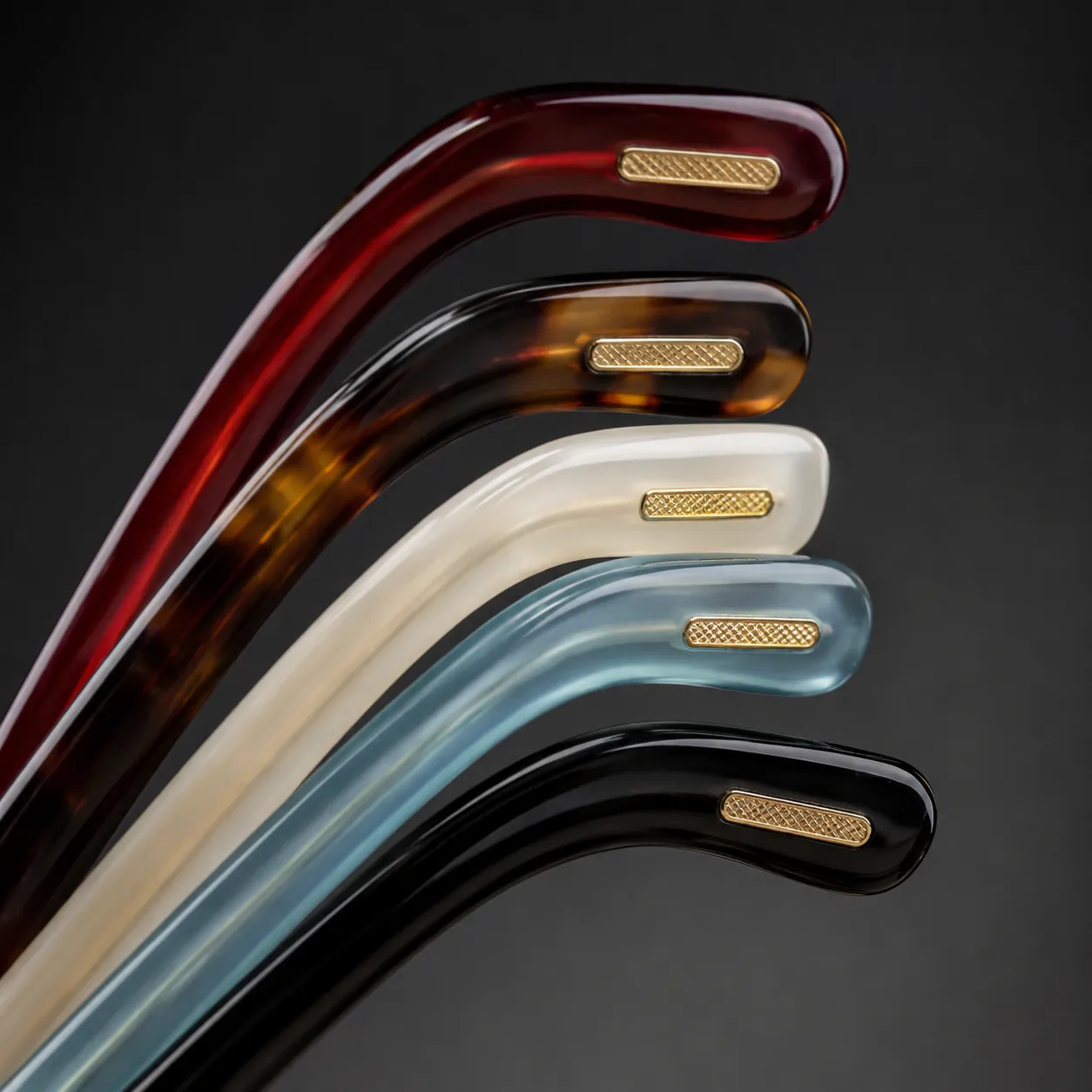
- Temple logo recess or plaque seat: A shallow recess can hold a metal logo, injected logo block, or printed brand panel. Confirm remaining wall thickness, plaque tolerance, adhesive method, and stress risk near the hinge.
- Raised or recessed brand detail: A molded mark on the temple or bridge can look more integrated than surface printing. The supplier should confirm draft angle, polishing method, and clean release from the mold.
- Temple tip adjustment: Some temple-end details can be changed for fit or styling. Bigger changes to curvature, drop, hinge angle, or length may require a new temple tool.
- Texture or surface pattern: Molded texture can separate the product from stock items, but fine details need sample validation. Polishing, coating, and resin flow can soften them.
- Cosmetic front detail: Small brow, rivet, or pin-style features may be possible if they do not affect lens retention, bridge strength, or ejection from the mold.
Modified tooling suits buyers with some demand signal but not enough confidence for full tooling. It gives the product a clearer signature while keeping development risk lower. It is useful for repeat orders, distributor exclusives, capsule collections, and private-label programs that need visible branding without changing fit.
Put the scope in writing. The purchase order or tooling agreement should define the changed part, insert ownership, exclusivity, sample timing, revision rounds, and what happens if the modified part fails fit or durability checks.
Do not assume exclusivity. The unmodified base frame may still be shared. If exclusivity matters, define the territory, term, buyer name, style number, modified component, and remedies for unauthorized use.
New Tooling: Build It Only When It Matters
New tooling means the supplier cuts production tooling for your frame instead of using an existing cavity. Choose this path when the silhouette, fit, lens shape, bridge, temple design, hinge architecture, or brand language must be proprietary.
The process usually starts with a STEP or IGES file, a technical drawing, or a physical reference sample for reverse engineering. Before steel is cut, the supplier should confirm material, shrinkage allowance, parting line, gate location, ejection method, hinge construction, lens groove, screw specification, and surface finish.
Key variables that affect cost and lead time include:
- Frame material: PC, TR90-type polyamide, and other injected plastics have different shrinkage, flow, drying, and processing needs. A mold designed for one material may not run another correctly without engineering changes.
- Cavity count: A single-cavity tool costs less but produces more slowly. Multi-cavity tooling raises output, tooling cost, and balancing complexity.
- Hinge design: Standard barrel hinges are simpler than spring hinges, flex hinges, or metal insert reinforcement. Complex hinges may need extra fixtures or operations.
- Undercuts and side actions: Features that cannot release straight from the mold may require sliders or lifters. These increase mold cost, maintenance, and sampling risk.
- Surface finish: High-gloss, matte, textured, painted, plated, or rubberized surfaces each require different mold finishing and process validation.
- Lens retention: The lens groove and frame front stiffness must be checked with actual production lenses. A frame that drops lenses is not ready, no matter how good it looks.
Use a controlled approval sequence. At minimum: design confirmation, tooling quote, tooling ownership terms, first samples, revision comments, corrected samples if needed, pre-production samples, and written approval before bulk production. Ask for measurements against agreed critical dimensions, not just photos.
Tool ownership must be explicit. State who paid for the tool, who owns it, whether it can be used for any other buyer, how it will be stored and maintained, how long the supplier must keep it, and how it can be released or transferred. If transfer may matter later, request mold size, injection machine requirements, and special setup information before production begins.
Run the Reorder Math First
Start with a sales forecast and a reorder assumption. A custom tool can make sense if the product will repeat. It can waste money if you only need one small batch.
A practical decision sequence:
- If you expect fewer than 300 units across all colorways: Start with stock molds. Cash exposure stays lower, and you can test shape, lens color, packaging, and channel response before investing in tooling.
- If you expect 300-1,000 units and need a brand detail: Consider a modified insert. Ask for the base stock quote and modified quote side by side, including insert cost, MOQ, sample time, and unit price impact.
- If you have sold a similar shape and expect repeat orders: Evaluate new tooling. Compare the first-run cost including tooling with the reorder unit cost after tooling is paid. The project needs convincing volume math.
- If the frame is premium or proprietary: New tooling may be necessary even at lower volume. Generic geometry can weaken positioning. Treat tooling as part of brand investment, but still document ownership and compliance requirements.
Use a simple first-run formula: landed unit cost equals product unit cost, plus tooling divided by units, plus testing, packaging setup, sample freight, duty, freight, and inspection divided by units. For reorders, remove one-time tooling and setup costs unless the supplier charges for replacement inserts, revised packaging, or new testing.
Ask every supplier for cost comparisons at 500, 1,000, 2,000, 5,000, and 10,000 units. The quote should separate frame unit price, lens upgrade, decoration, packaging, tooling, testing, and freight assumptions. If everything is blended into one number, you cannot see what changes with volume or specification.
Compliance: Test the Actual SKU
Sunglasses are regulated products. The construction path does not remove compliance obligations. A stock frame may already have test reports, but you still need to confirm that the tested product matches your actual material, lens, coating, decoration, and batch. A new frame needs fresh validation before shipment.
Core standards and regulatory items buyers should understand:
- CE and EN ISO 12312-1 for the EU and UK: Sunglasses sold in these markets are commonly assessed against EN ISO 12312-1 for general-use sunglasses. Requirements cover optical properties, UV protection, luminous transmittance category, robustness, labeling, and user information. The product also needs appropriate conformity documentation for the market.
- ANSI Z80.3 for the United States: ANSI Z80.3 is the main US consensus standard for nonprescription sunglasses and fashion eyewear. It covers optical quality, transmittance, impact resistance, and related requirements. Confirm the applicable edition with your test lab or compliance adviser.
- AS/NZS 1067 for Australia and New Zealand: This standard covers sunglasses and fashion spectacles, including lens categories, transmittance, labeling, and warnings. Category and driving-use claims must be accurate.
- REACH for the EU: REACH is a chemical regulation, not a performance test. Materials, coatings, paints, plastics, metals, and packaging components may need restricted-substance review. Watch phthalates, PAHs, nickel release for metal skin-contact parts, and substances of very high concern where applicable.
- FDA requirements for the United States: Nonprescription sunglasses are generally treated as medical devices because of impact-resistant lens requirements under 21 CFR 801.410. US importers should confirm current registration, listing, labeling, and impact-resistance obligations with the supplier, broker, or regulatory adviser before shipment.
- Factory-level certifications: ISO 9001 can indicate a quality management system. BSCI can indicate a social compliance audit framework. These documents help screen suppliers, but they do not replace product testing.
For stock molds, ask for recent test reports and confirm that the report style number, material, lens type, coating, and category match your order. For modified molds, decide whether the change affects mechanical stability, lens retention, or chemical exposure. For new tooling, plan product testing before bulk shipment. Do not rely on reports from a frame that only looks similar.
Keep a compliance file for each SKU. Include supplier declarations, material declarations, lens specifications, test reports, labeling artwork, packaging artwork, bill of materials, purchase order, production photos if available, inspection report, and shipment documents. This file helps you answer quickly if a marketplace, customs authority, retailer, or distributor asks for proof.
Material and Process Limits
Tooling choices depend on material and process. A quote is not comparable unless the material, production method, lens type, hinge, coating, packaging, and compliance scope are the same.
Common material and process distinctions:
- Polycarbonate PC frames: PC is commonly injection-molded. It is impact resistant and widely used in eyewear components, but drying, shrinkage, processing, and coating adhesion must be controlled. Do not assume a PC stock mold is suitable for another resin without engineering review.
- TR90 and similar polyamide frames: TR90-type materials are commonly injection-molded and valued for flexibility and low weight. They have different processing temperatures, shrinkage behavior, and gate requirements from PC. Confirm the exact material grade. Do not accept TR90 as a vague label.
- Acetate frames: Cellulose acetate frames are generally cut and shaped from sheet, then tumbled, polished, assembled, and adjusted. They are not produced through the same injection mold process as PC or TR90 frames. Tooling may involve CNC fixtures, cutting programs, lens patterns, and assembly jigs rather than injection cavities.
- Metal frames: Stainless steel, monel, titanium, and other metal frames use stamping, bending, milling, welding, soldering, plating, and assembly processes. Customization may require bending jigs, stamping dies, welding fixtures, or plating development instead of plastic injection tooling.
- Lenses: Lens material and coating affect compliance and cost as much as the frame does. Confirm UV protection, impact requirements, optical quality, lens category, polarization, mirror coating, abrasion resistance, and labeling before production approval.
If one quote is much cheaper than the others, check the material first. Ask for a material declaration, resin or sheet supplier information where available, and a physical sample. For larger or regulated programs, use third-party testing. Verbal assurances are not enough.
Hidden Costs After Tooling Approval
Many buyers budget for the frame mold and unit price, then run into extra costs during sampling, compliance, packaging, or shipment. These costs are normal. They should not be a surprise.
Common cost items to ask about:
- Tooling revisions: Clarify whether the tooling price includes one or more rounds of adjustment after first samples. Changes caused by supplier error should be treated differently from buyer-requested design changes.
- Lens edging patterns: A custom lens shape may require a new edging pattern or digital cutting setup. Confirm whether this is included in the frame tooling quote.
- Decoration setup: Pad-printing plates, hot-stamping dies, laser fixtures, metal logo tooling, and color-matching fees may be charged separately.
- Packaging setup: Custom boxes, inserts, molded cases, foam, labels, and barcodes may require dies, plates, sample rounds, or MOQ commitments.
- Testing and compliance documentation: EN ISO 12312-1, ANSI Z80.3, AS/NZS 1067, REACH-related chemical testing, and other market-specific checks may need separate lab quotes. Cost depends on scope, lab, urgency, and number of variants.
- Inspection: Pre-shipment inspection, AQL inspection, lab sample pulling, or retailer-specific inspection can add cost but may prevent larger losses.
- Sample freight: Multiple sample rounds, test samples, packaging samples, and approval sets can add meaningful courier cost before bulk production begins.
- Mold storage or transfer: If you own custom tooling, confirm storage, maintenance, release, crating, and transfer costs before you need them.
Ask for these items as separate quote lines. A clear quote lets you compare suppliers fairly and keeps a low unit price from hiding unavoidable setup costs.
Have a custom sunglasses project in mind?
Send us your styles, target market and quantities and we will return a detailed quote with MOQ, lead time and a sample plan.
Get a QuoteWhy source this from Wenzhou with LumiShades
Wenzhou in Zhejiang Province is widely regarded as China’s eyewear manufacturing capital, producing a large share of the world’s sunglasses. That concentration matters to buyers: a deep local supply chain for acetate sheet, hinges, lens blanks, plating and packaging means shorter component lead times, easier color and material matching, and a workforce with decades of eyewear-specific skill. LumiShades has manufactured in this ecosystem since 2009, and our vertical integration — in-house injection molding, acetate cutting, CNC milling, lens tinting, decoration and quality control — means no part of your order is quietly subcontracted to a workshop you cannot audit.
For international buyers, that vertical control translates into accountability. When a single factory owns every step, defects are traced and fixed at source rather than bounced between vendors, and your specifications survive intact from first sample to bulk. We back this with 15+ years of experience, shipments to 60+ countries, more than 5 million pairs produced per year and a 98.5% on-time delivery rate. Our certifications — CE EN ISO 12312-1, FDA registration, ANSI Z80.3, AS/NZS 1067, REACH, ISO 9001 and BSCI audit — mean the compliance documentation your market requires already exists. Explore our manufacturing capabilities and quality control process to see how this works in practice.
Frequently asked questions
Can I start with a stock mold and switch to modified or custom tooling later? Yes. This is often the most sensible path for an unproven style. Use a stock mold to test shape, color, lens, packaging, and channel demand with limited upfront risk. If sales are strong, ask the supplier whether that exact mold can accept a modified insert for a temple logo, bridge detail, texture, or plaque recess. Get the answer in writing because not every stock mold is designed for insert changes. If you later want a different lens shape, bridge width, frame size, wrap, or overall silhouette, that usually means new tooling.
How do I compare the real cost of stock mold versus new tooling? Compare total cost at the volume you realistically expect to sell, not only the first order. Use this structure: total project cost equals unit price multiplied by quantity, plus tooling, decoration setup, packaging setup, testing, inspection, sample freight, bulk freight, duty, and any financing or warehousing cost. Then divide by units. Run the calculation for the first order and reorders separately. New tooling often looks expensive on the first run because tooling is spread across fewer units. It can become cheaper over multiple reorders if the custom unit price is lower or the product earns a higher selling price because the design is proprietary.
What should be included in a custom tooling agreement? The agreement should identify the tool by product name, style number, component, material, and drawing or 3D file revision. It should state who owns the tool, who may use it, whether it is exclusive, where it will be stored, how it will be maintained, what revision rounds are included, how damage or wear is handled, and how the tool can be released or transferred. It should also state that the supplier cannot use the tool or the resulting frame geometry for other buyers without written permission. If you may transfer the tool later, request mold dimensions and machine requirements before production starts.
How do I verify that a modified insert was actually made for my order? Ask for process evidence before production approval: CAD or technical drawing of the modified area, photos or video of machining where practical, photos of the insert installed in the mold, and first samples showing the modified detail. During sample review, compare the part against the agreed drawing and measure critical dimensions such as recess depth, logo position, wall thickness where accessible, and plaque or decoration fit. For higher-value programs, include insert ownership and exclusivity terms in the purchase order so the issue is contractual, not only visual.
Do I need new compliance testing if I only change a temple insert? It depends on what the change affects. If the modification is purely cosmetic and does not affect lens retention, hinge attachment, frame strength, material, coating, or skin-contact chemistry, a full repeat of every optical test may not be necessary. Still, ask a qualified lab or compliance adviser whether mechanical checks are needed, especially for temple fatigue, hinge strength, and robustness. If you change the lens, lens coating, frame front, lens groove, bridge, material, coating, or labeling category, assume fresh testing or at least a documented compliance review is needed.
What documents should I request before paying a tooling deposit? Request the tooling quotation, product specification sheet, material specification, 2D drawing or 3D file confirmation, tooling schedule, sample approval process, tooling ownership terms, exclusivity terms if needed, payment schedule, expected MOQ, and a list of costs not included in the quote. For regulated markets, also ask what existing test reports the supplier has and whether your final SKU will need new testing for EN ISO 12312-1, ANSI Z80.3, AS/NZS 1067, REACH-related chemical checks, or US FDA-related documentation.
What happens to my custom mold if I switch suppliers? If you own the mold, the supplier should release it according to the written tooling agreement. In practice, transfer can still be difficult. The mold may be designed for a specific injection machine, platen size, tie-bar spacing, ejector layout, runner system, or production setup. Before commissioning tooling, ask for machine compatibility information and keep the final drawings, approved samples, and mold records. If transfer becomes necessary, the receiving factory should inspect the mold before promising production. Budget for crating, freight, inspection, cleaning, possible repair, and process revalidation.
Are ISO 9001 or BSCI certificates enough to prove the sunglasses are compliant? No. ISO 9001 relates to quality management systems, and BSCI relates to social compliance auditing. They can help you screen a supplier, but they do not prove that a specific sunglass SKU meets EN ISO 12312-1, ANSI Z80.3, AS/NZS 1067, REACH obligations, or US FDA-related requirements. You still need product-specific specifications, test reports, labeling review, and shipment documentation for the market where the sunglasses will be sold.
Ready to start?
Explore our round sunglasses or request a quote — our sales team replies within 12 hours.
Request a Quote