
Wholesale Sunglasses Supplier Scorecard
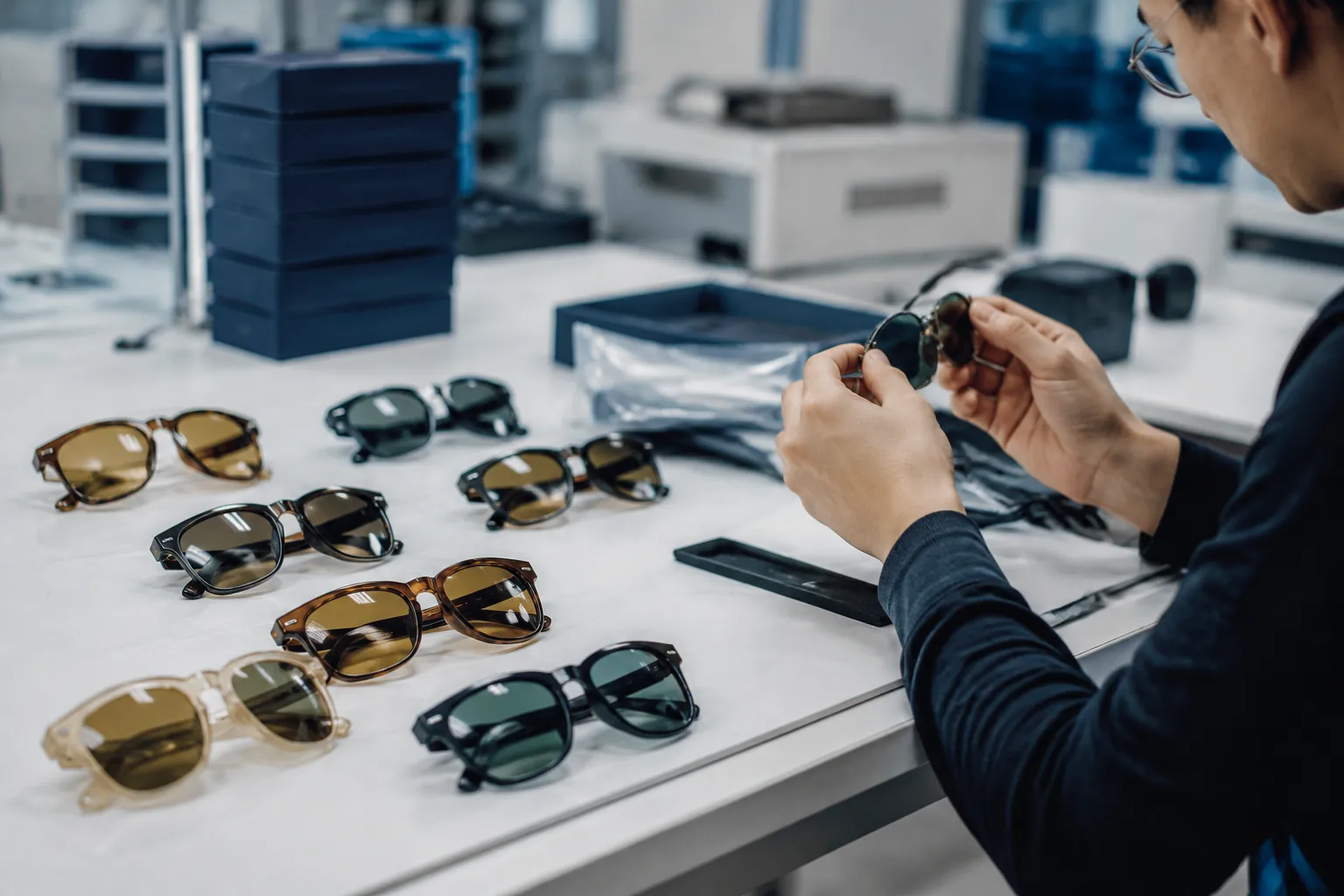
This guide is for distributors, importers, retail chains, and private label brands comparing OEM and ODM sunglasses factories. It gives you a practical scorecard for ranking suppliers by cost structure, reorder control, compliance readiness, production capability, QC discipline, and delivery reliability. Use it before a trial order. Use it again before adding any factory to your core supplier list.
Start With A Weighted Supplier Scorecard
A cheap quote is not a supplier scorecard. Distributors need a factory that can repeat color, lens quality, packaging, compliance files, and delivery windows across multiple purchase orders. The scorecard should focus on risks that become expensive after deposit: late production, unstable lens tint, weak hinge control, packaging errors, loose QC standards, and missing market documents.
Unit price matters. It should not decide the order alone. A supplier that saves a few cents per pair but misses a retail launch can create bigger costs through air freight, markdowns, retailer penalties, or lost shelf space. Score the factory against the way you sell: low-MOQ test drops, replenishment basics, promotional programs, private label retail lines, or multi-country seasonal campaigns.
| Score Area | Suggested Weight | What To Verify | Strong Pass Signal |
|---|---|---|---|
| MOQ and pricing tiers | 20% | 50/300/1000/5000+ pair breaks, tooling, decoration, lens, case, carton | Written price ladder with assumptions for material, lens category, decoration, and packaging |
| Reorder control | 20% | Master samples, mold numbers, color chips, lens tint records, packing files | Factory can repeat the last PO from controlled files, not chat history |
| Compliance readiness | 20% | CE EN ISO 12312-1, ANSI Z80.3, AS/NZS 1067, REACH, FDA registration, ISO 9001, BSCI | Documents match destination market, lens type, product category, and current company details |
| Production capability | 20% | Injection, acetate cutting, CNC, lens tinting, printing, laser, metal logo, QC | Key processes are documented with inspection records at defined control points |
| Seasonal delivery | 20% | Sample time, bulk lead time, capacity booking, inspection window, freight cutoff | Supplier confirms timing by SKU count, color split, packaging, and approval date |
LumiShades can be assessed with this scorecard as a Wenzhou, Zhejiang eyewear manufacturer offering custom sunglasses production and related in-house processes. That is a useful starting point. It is not proof. Ask for current documents, retained samples, inspection records, and written production assumptions before approval.
Price The Program, Not One Frame
Many distributors ask for one price on one style and use that number to judge the supplier. That is too thin. Sunglasses cost changes with frame material, hinge type, lens category, UV claim, coating, decoration method, packing, order split, and color count. A 50-pair MOQ can be useful for testing. It is rarely the stable commercial cost.
LumiShades offers custom orders from 50 pairs per design. That can work for sales samples, retail buyer presentations, influencer drops, and small market tests. Larger quantities may improve cost because setup, material purchasing, packing labor, and QC sampling are spread across more units. Ask for the price ladder in writing. Require the supplier to state what is included: lens type, pouch or case, logo method, insert card, barcode label, carton mark, and inspection standard.
- 50 pairs per design: Use for validation only; setup, artwork handling, and packing labor are spread across too few units.
- 300 pairs: A practical first commercial tier for simple PC or TR90 frames, standard lenses, and limited color splits.
- 1000 pairs: Better for distributor stock lines because component buying, carton packing, and QC sampling become more predictable.
- 5000+ pairs: Best for repeat SKUs, retail promotions, and seasonal programs where packaging and compliance files are already locked.
Do not compare injection molded PC, TR90, and handmade acetate as if they are the same product. PC can be economical, but it may feel stiff and show cosmetic defects if molding is poorly controlled. TR90 is valued for light weight and flexibility, but drying, molding temperature, and frame recovery must be controlled to reduce warpage. Acetate has higher perceived value, but cutting, CNC shaping, tumbling, hand polishing, and hinge insertion add labor and QC risk. A metal logo plate can look premium, but it adds alignment tolerance, plating consistency, adhesive strength, and corrosion checks.
A clean RFQ should include frame material, lens material, lens category, UV400 claim, polarization if required, hinge type, logo size, decoration position, packaging, barcode format, carton mark, inspection level, target country, and required test standard. If the factory quotes without clarifying these points, treat the price as preliminary. Not production-ready.
Compare Materials And Decoration Methods
Material and decoration choices decide both cost and defect risk. A simple pad-printed logo on a PC temple is not the same challenge as a recessed metal emblem on acetate or laser engraving on a curved TR90 temple. Ask where tolerances are controlled. Ask how each decoration process is inspected.
| Choice | Typical Use | Process Risk | Buyer Control Point |
|---|---|---|---|
| PC injection frame | Promotional and value wholesale sunglasses | Flow lines, brittle feel, sink marks, color shift between batches | Approve material grade, mold number, color chip, and fit standard |
| TR90 injection frame | Lightweight sports or lifestyle sunglasses | Warped temples, uneven bridge recovery, lens groove tolerance | Check temple opening, frame balance, lens fit, and heat-aging sample results if required |
| Acetate frame | Premium private label and fashion programs | Polishing inconsistency, sheet color variation, hinge alignment | Record sheet code, thickness, lamination direction, and approved polishing sample |
| Pad printing | Low-cost logos on temples or lenses | Ink rub-off, print offset, poor adhesion on coated surfaces | Define rub test, logo position tolerance, ink system, and approval sample |
| Laser engraving or metal plate | Higher-end branding | Burn depth variation, crooked plates, adhesive failure, plating defects | Approve fixture, depth, alignment tolerance, and tape or pull test where relevant |
For distributor programs, logo position tolerance should be defined in millimeters, not described as "centered." A practical tolerance may be ±0.5 mm for small temple logos and ±1.0 mm for larger artwork, depending on the frame curve, logo size, and fixture. Lens fit should be tight enough to prevent popping during handling, but not so tight that stress marks appear around the groove. Hinge screws should open smoothly without wobble. If torque is not measured, require retained samples and in-process checks during assembly.
Check Reorder Reliability Before The First PO
Reorders expose weak suppliers. The first shipment may get extra management attention. Later shipments depend on the normal production system. Review reorder control before approving the first PO.
Ask how the factory controls master samples, color chips, lens tint standards, hinge torque, logo fixtures, and packaging files. For injection frames, the mold number, cavity, resin grade, drying conditions, and color masterbatch should be recorded. For acetate frames, the factory should keep the sheet supplier, sheet code, thickness, lamination direction, CNC file, tumbling time, and approved hand-polish finish. For lenses, it should keep tint density, coating details, polarization direction if applicable, UV category, and lens curve.
A distributor should never approve a sample without also approving the control file used to repeat it.
LumiShades lists in-house capabilities including injection molding, acetate cutting, CNC milling, lens tinting, laser engraving, pad printing, metal logo plate application, and QC. Verify which processes will be used for your SKU. Also check which steps, if any, are outsourced. In-house production can reduce handoff risk, but only when the factory maintains controlled specifications, retained samples, and inspection records.
- Request two retained samples: one for your office and one sealed at the factory.
- Confirm Pantone, RAL, or physical color-chip references for frame, lens, and logo.
- Define allowed defects: scratches, bubbles, flow marks, print offset, lens spots, hinge looseness.
- Record packaging structure, barcode placement, polybag warning text, insert card, and carton marks.
- Require the last PO number, approved sample date, and version number on every reorder worksheet.
For replenishment SKUs, check component stock and purchasing lead time. A factory may mold frames quickly but still wait for hinges, polarized lenses, hard cases, microfiber pouches, barcode labels, or printed inserts. Small components can cause large delays.
Score Certification Readiness By Market
Compliance is not decoration for a sales deck. It affects customs clearance, retailer acceptance, product labeling, and importer risk. For sunglasses, the right documentation depends on destination market, lens claim, user category, and material. Avoid suppliers that send unrelated certificates, expired reports, or reports for a different product type.
For LumiShades, relevant documents to request may include CE EN ISO 12312-1, ANSI Z80.3, AS/NZS 1067, REACH, FDA registration, ISO 9001, and BSCI. Ask for current copies. Check whether they apply to the product type you are ordering: adult sunglasses, kids sunglasses, polarized lenses, tinted lenses, mirror-coated lenses, or specific material restrictions. A report for one black smoke lens does not automatically cover a new mirror lens, children's frame, or different material.
| Market | Common Requirement | Buyer Check | Risk If Missed |
|---|---|---|---|
| European Union | CE EN ISO 12312-1 and REACH | Confirm lens category, UV claim, restricted substances, labeling, and Declaration of Conformity | Retail rejection, relabeling, customs questions, or delayed launch |
| United States | FDA registration and ANSI Z80.3 | Check optical quality, impact-related expectations, labeling, and importer records | Compliance hold, retailer rejection, or customer claim exposure |
| Australia/New Zealand | AS/NZS 1067 | Confirm sunglare filter category, UV claim, and required marking | Retailer refusal or forced repacking |
| Multi-market program | Combined report package | Match SKU, lens, material, label, and destination requirements | One market passes while another blocks the shipment |
Ask for compliance documents before deposit on a new market program. Testing after production can verify a batch, but it is too late for efficient design correction. Review UV400 claims, category marking, nickel release on metal parts, phthalates, heavy metals, and restricted substances before materials are purchased.
Audit Production Capability And QC Metrics
Many trading companies call themselves factories. Some real factories own one process and outsource the rest. For distributors, the issue is control. Sunglasses production has many points where a small error can become a shipment-level problem.
Injection molding requires correct pellet drying, stable barrel temperature, clean molds, and controlled cooling time. Poor drying can create bubbles or brittle frames. Uneven cooling can twist temples or distort the lens groove. Acetate production requires accurate cutting, CNC shaping, barrel polishing, hand polishing, hinge insertion, and final adjustment. Lens tinting requires batch control, especially for gradient, mirror, polarized, or category-specific lenses. Decoration requires fixtures so logos sit straight on curved temples. QC must catch defects operators may stop noticing after handling thousands of pieces.
- Injection molding: Check sink marks, flow lines, weak bridge areas, gate trimming, color variation, and temple symmetry.
- Acetate cutting: Check edge smoothness, lens groove consistency, hinge alignment, polishing, and sheet color match.
- CNC milling: Check groove accuracy, bridge shape, lens fit, temple thickness, and left-right balance.
- Lens tinting: Check UV performance, tint category, optical distortion, polarization direction, and batch consistency.
- Decoration: Check laser depth, pad print adhesion, metal plate alignment, plating finish, and logo position tolerance.
- Final QC: Check AQL level, barcode scan, carton condition, packing quantity, labeling, and retained sample match.
Use critical, major, and minor defect definitions. Critical defects include unsafe lens performance, sharp edges, broken hinges, wrong compliance marking, or lenses that fail required UV performance. Major defects include visible lens scratches, wrong logo, severe color mismatch, loose screws, wrong lens category, and incorrect packaging. Minor defects include small cosmetic marks outside the main viewing area or slight carton scuffing. Final inspection alone is too late. Require in-process QC at molding, lens fitting, decoration, and packing.
Build Lead Times Around The Retail Calendar
Bulk lead time is not just factory production days. It includes artwork confirmation, sample making, sample shipping, buyer approval, deposit, material purchasing, production, inspection, export booking, documents, and freight. If the shelf date is fixed, work backward from the retail launch. Do not ask the factory to absorb every delay at the end.
LumiShades lists sample production at about 7-10 days and bulk production at about 25-35 days after approval, depending on SKU complexity, order quantity, material availability, packaging, and compliance requirements. Those timings can work for many distributor programs only when the buyer is fast on approvals. A five-day delay approving a logo position is still a five-day delay. Factories cannot reliably hold open capacity for late feedback during peak sunglass season.
| Stage | Typical Timing | Buyer Control Point | Common Delay |
|---|---|---|---|
| RFQ and spec lock | 2-5 days | Send artwork, lens spec, packing, target market, and quantity split | Incomplete logo files or vague material request |
| Sample production | 7-10 days | Approve frame, lens, logo, packaging, and barcode layout | Changing color or logo size after first sample |
| Material purchase | 3-10 days | Freeze PO quantity, color split, lens type, and case selection | Waiting for special lenses, hinges, pouches, or labels |
| Bulk production | 25-35 days | Monitor in-process QC and confirm inspection booking | Late carton mark, barcode, or compliance label change |
| Inspection and shipment | 3-7 days before dispatch | Approve final inspection, documents, and export booking | Missed vessel cutoff, incomplete documents, or courier delay |
Seasonal pressure matters. Orders placed before spring and summer campaigns compete for molding machines, lens tinting capacity, packing labor, and freight space. For proven repeat SKUs, reserve capacity early. For new designs, reduce risk by testing small quantities first. Move winners to larger production only after sell-through, packaging, and compliance files are confirmed.
Turn The Score Into A Buying Decision
After scoring, classify suppliers by role. Do not force one factory to do every job. A low-MOQ supplier may be right for new distributor styles. A high-capacity factory with stable processes may be better for repeat seasonal programs. A factory with strong compliance files should handle regulated retail accounts only after the documents are checked against your actual SKU and destination market.
For LumiShades, the profile fits distributors that need custom sunglasses from 50 pairs per design for testing and larger wholesale runs after validation. The Wenzhou base, in-house process range, MOQ option, and listed compliance documents are relevant strengths to verify. Connect those strengths to your SKU plan, inspection standard, and retail calendar.
- Use 50 pairs for design validation, buyer samples, influencer drops, and small retail tests.
- Move proven colors to 300 pairs when artwork, packaging, and color standards are stable.
- Use 1000 pairs for core distributor inventory with repeat ordering potential.
- Use 5000+ pairs only after demand is proven or a retailer has committed volume.
- Lock compliance documents before deposit for regulated markets.
- Keep one approved master sample and one sealed factory sample for every SKU.
- Require written tolerance, defect, packaging, and reorder files before bulk production.
The best wholesale sunglasses supplier is not always the lowest quote. It is the one that can repeat your product, support the right market documents, protect your launch date, and explain production limits before they become excuses.
Have a custom sunglasses project in mind?
Send us your styles, target market and quantities and we will return a detailed quote with MOQ, lead time and a sample plan.
Get a QuoteWhy source this from Wenzhou with LumiShades
Wenzhou in Zhejiang Province is widely regarded as China’s eyewear manufacturing capital, producing a large share of the world’s sunglasses. That concentration matters to buyers: a deep local supply chain for acetate sheet, hinges, lens blanks, plating and packaging means shorter component lead times, easier color and material matching, and a workforce with decades of eyewear-specific skill. LumiShades has manufactured in this ecosystem since 2009, and our vertical integration — in-house injection molding, acetate cutting, CNC milling, lens tinting, decoration and quality control — means no part of your order is quietly subcontracted to a workshop you cannot audit.
For international buyers, that vertical control translates into accountability. When a single factory owns every step, defects are traced and fixed at source rather than bounced between vendors, and your specifications survive intact from first sample to bulk. For procurement review, buyers can request process records, approved samples, quality checkpoints and project-specific compliance files before placing a bulk order. Required testing and documentation are confirmed against the destination market and product specification rather than assumed from a generic certificate list. Explore our manufacturing capabilities and quality control process to see how this works in practice.
Frequently asked questions
What MOQ should a distributor use for a first sunglasses order? Use 50 pairs per design for market testing, sales samples, buyer presentations, or influencer seeding. For a commercial launch, 300 pairs is usually a more practical starting point because material buying, packing, and QC sampling become more efficient. Before moving higher, confirm approved samples, color standards, packaging, barcode labels, and the inspection checklist.
How should I compare two sunglasses factories if one quote is cheaper? Compare the full program, not one unit price. Ask both factories to quote the same frame material, lens material, lens category, UV claim, hinge, decoration method, packaging, color split, inspection standard, and destination market. Then compare price breaks at 50/300/1000/5000+ pairs, sample timing, bulk lead time, in-house processes, compliance documents, retained-sample control, and reorder files.
Which certifications should I ask for when importing sunglasses? Ask based on destination market and product claim. Common documents include CE EN ISO 12312-1 and REACH for the EU, ANSI Z80.3 and FDA registration for the United States, and AS/NZS 1067 for Australia and New Zealand. ISO 9001 and BSCI can support factory management and social compliance review, but they do not replace product-specific sunglasses testing. Always check that reports match the lens type, product category, material, and market you are buying for.
How long should I plan for custom sunglasses production? Plan about 7-10 days for samples and about 25-35 days for bulk production after sample and PO approval, subject to SKU complexity, material availability, decoration, packaging, and order quantity. Add time for artwork preparation, sample shipping, buyer review, material purchase, inspection, export documents, and freight booking. For spring and summer launches, book capacity earlier because sunglasses factories face seasonal pressure.
What details must be fixed before placing a bulk PO? Freeze frame material, lens type, lens category, UV claim, colors, hinge type, logo method, logo size, logo position tolerance, packaging, barcode, carton marks, compliance market, inspection standard, and approved master sample. Also confirm the supplier's control file: mold number or acetate sheet code, lens tint reference, decoration fixture, retained sample, defect definitions, and reorder version number.
Why does in-house production matter for wholesale sunglasses? In-house injection molding, acetate cutting, CNC milling, lens tinting, decoration, and QC can reduce handoff risk because the factory controls more of the processes that affect fit, color, logo placement, lens consistency, and delivery. It is not a quality guarantee by itself. Buyers should verify which processes are actually used for their SKU, review in-process inspection records, and keep approved samples for future reorders.
Ready to start?
Explore our shield & oversized sunglasses or request a quote — our sales team replies within 12 hours.
Request a Quote