
Private Label Sunglasses Without Heavy Tooling
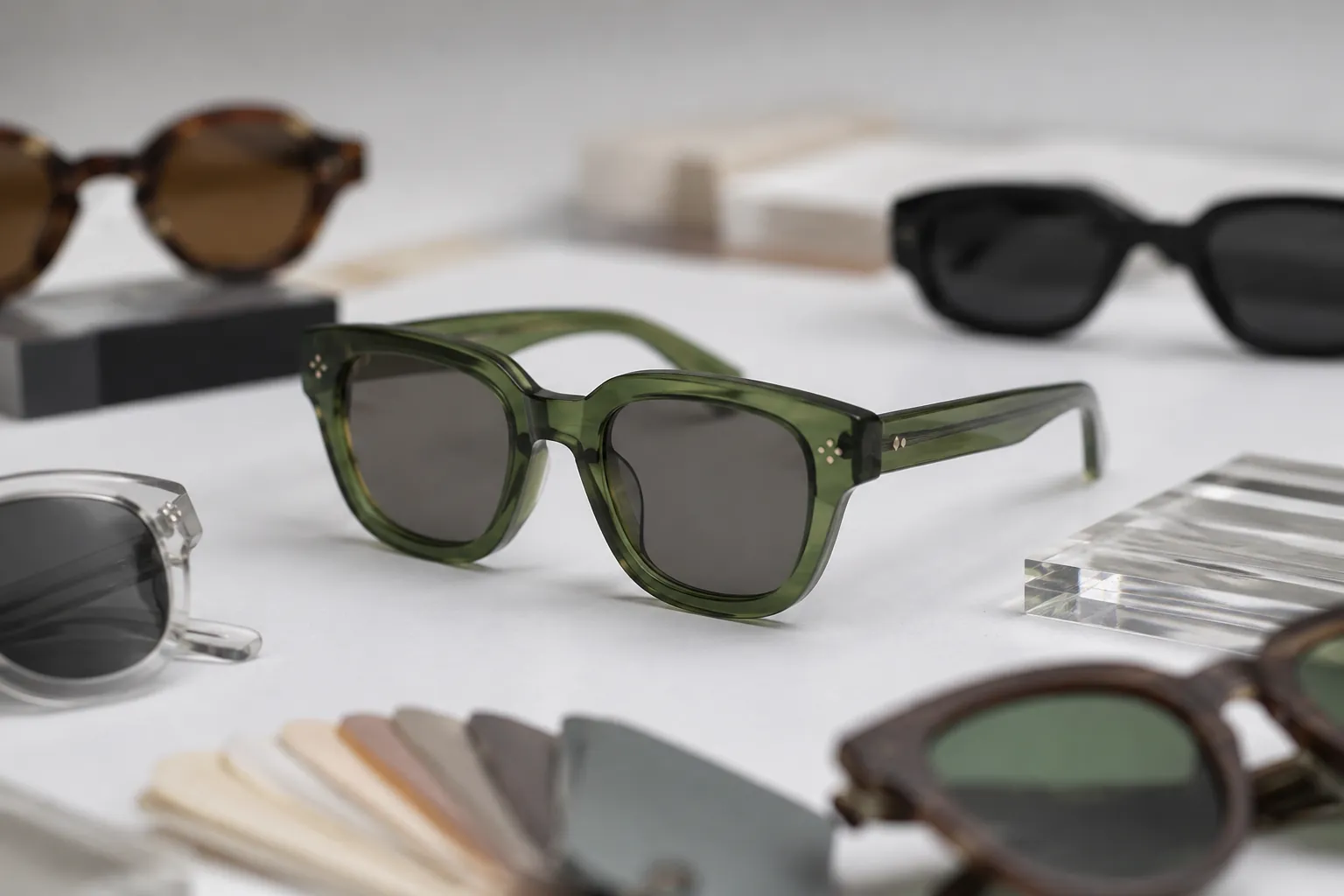
This guide is for boutique retailers, importers, small chains, resort shops, and online eyewear brands that know what sells but do not want to bet on full custom tooling. It shows how to turn proven sunglass shapes into a private-label range using existing molds, controlled cosmetic changes, written tolerances, and sensible order quantities. The goal is not to copy a hot style. The goal is to build a repeatable product line with clear specifications, realistic pricing, compliant lenses, and enough ownable detail to feel like your brand.
Start With Sales Signals, Not Copying
Many small retailers start private label sunglasses the wrong way. They send a photo of a popular style and ask the factory to copy it. That may produce a sample. It rarely produces a range that is safer to sell, easier to defend, or simple to reorder.
Start by separating the sales signal from the exact product. If a rounded acetate-look frame sells well in your store, the useful signal may be the soft lens shape, medium fit, warm tortoise color, brown gradient lens, and under-$40 retail price. You do not need the same hinge, temple profile, bridge curve, lens bevel, or logo position.
Write a sourcing brief before asking for samples. Keep it practical. A useful first brief should include:
- Shape direction: round, square, cat-eye, aviator, rectangle, wrap, shield, or sport.
- Fit target: narrow, standard, or wide; include target front width if known, such as 140 mm to 145 mm.
- Lens size: approximate lens width, bridge, temple length, and front height from a proven seller.
- Retail target: expected shelf price and target landed cost before packaging.
- Use case: beach, driving, fashion, festival, resort, golf, cycling, or gift program.
- Must-haves: UV400, lens category, logo method, barcode, pouch, case, hangtag, or lab report.
This turns a vague copy request into a manufacturing project. It also lets a factory such as LumiShades recommend existing molds that sit close to the commercial look without forcing new tooling. Strong early programs often begin with 2 or 3 existing platforms, then use color, lens, decoration, and packaging to create brand ownership.
Choose What To Own Without Opening A Mold
For boutique volumes, the smartest private-label sunglasses usually start from an existing frame platform. Opening a new injection mold can make sense for a chain retailer or national brand. It is rarely the right first move for a shop testing 50 to 300 pairs per SKU. A new mold adds cost, development time, fitting risk, and extra sampling rounds before you know whether customers will reorder the style.
Ownability comes from changing the right details. Frame color, lens tint, logo treatment, temple decoration, hinge finish, nose pad color, packaging, pouch material, and hangtag design can all change the customer impression without changing the mold. LumiShades often works this way because its MOQ starts at 50 pairs per design, with better pricing at 300, 1000, and 5000+ pairs. At real volume, suitable injection styles can move down toward about $2.10 per pair, depending on material, lens, decoration, QC requirement, and packing.
The rule is simple. Change three things well, not ten things badly. A strong boutique SKU might use an existing square frame, a custom translucent olive frame color, a category 3 smoke lens, and a small metal logo plate on the temple. That can read as a branded product without the cost and risk of a new mold.
Keep structural changes limited in early runs. Changing bridge geometry, hinge position, lens curve, front thickness, or temple length can affect fit, assembly yield, and testing. Cosmetic changes are faster and safer. Mechanical changes usually require a new sample, possible tooling adjustment, and more approval time.
Material And Lens Choices That Change Cost
Frame material is not just a style decision. It affects weight, perceived value, MOQ, processing time, rejection rate, and repeatability. The same design in injection PC, TR-style material, acetate, or metal will behave differently in production.
Injection PC and TR-style frames are efficient for entry and mid-market sunglasses. They suit bright colors, transparent effects, light weight, and fast repeat orders. They are often the cleanest route for low MOQ private-label programs because color and decoration can be controlled without heavy hand-finishing.
Acetate gives richer color depth, especially for tortoise, crystal, layered, and laminated looks. It also takes more time. Cutting, tumbling, polishing, hinge fitting, lens fitting, and final adjustment add manual steps. That can improve feel, but it also increases cost and lead time. Metal frames add plating control, solder joint checks, screw torque, nose pad alignment, and surface inspection.
Lenses need the same discipline. Buyers often request black, brown, gradient, mirrored, polarized, and blue-light options in one small program. That fragments production and makes shade approval harder. Choose lens types by customer use, not catalog excitement.
| Option | Best Use | Cost And Process Impact | Watch Point |
|---|---|---|---|
| Injection PC frame | Fashion, beach, promotional retail, fast color runs | Efficient for 50 to 300 pair tests; fast repeat production | Check flash, shrinkage, surface marks, and hinge tightness |
| Acetate frame | Premium boutique, tortoise, crystal, layered color stories | Higher labor cost; longer polishing and fitting cycle | Check color consistency, front balance, and lens groove fit |
| Metal frame | Aviator, thin rectangle, rimless-look, dress styles | More plating, soldering, screw, and nose pad handling | Check plating defects, temple symmetry, and pad alignment |
| Polarized lens | Driving, fishing, outdoor, higher perceived value | Higher lens cost and more inspection time | Check axis alignment, distortion, and stress marks |
| Mirrored lens | Sport, festival, resort, high shelf impact | More handling risk during assembly and packing | Check scratches, coating uniformity, and color shift |
LumiShades has in-house lens tinting, which helps with sample control and shade matching. Still, approve a physical lens master. Photos under factory lighting are not reliable enough for final approval, especially for gradient, mirror, and brown lenses.
MOQ, Price Breaks, And Inventory Risk
The job is not to buy the cheapest pair. The job is to buy enough units to reach a workable cost without filling shelves with slow colors. For a first private-label drop, a good starting matrix is 2 frame shapes, 2 colors per shape, and 50 to 150 pairs per SKU. That gives enough quantity to test sell-through without locking cash into one unproven color.
At 50 pairs per design, unit cost is higher because color setup, decoration setup, QC, and packing effort are spread across fewer units. At 300 pairs, material buying and line setup become more efficient. At 1000 pairs, the factory can plan production more steadily and cost improves. At 5000+ pairs, price can move into the lowest band on suitable volume styles. Forecasting and compliance discipline matter more at that level. Mistakes get expensive.
| Order Level | Typical Use | Cost Logic | Main Risk |
|---|---|---|---|
| 50 pairs per design | Test new color, lens, or logo treatment | Higher unit cost, low cash exposure | Heavy packaging can damage margin |
| 300 pairs per design | First serious retail run | Better material buying and decoration setup spread | Wrong color mix can tie up inventory |
| 1000 pairs per design | Known bestseller or distributor order | Stronger price break and steadier line setup | Forecast mistakes become expensive |
| 5000+ pairs per design | Chain retail, promotion, large seasonal program | Lowest cost band, down toward about $2.10 on suitable volume styles | Testing, packing, labels, and delivery dates must be locked early |
Samples normally take 7 to 10 days at LumiShades. Bulk production is usually 25 to 35 days after sample approval and deposit, assuming materials, packaging, and logo files are confirmed. Add 5 to 15 days if third-party testing is required before shipment, depending on the lab and destination standard.
Sampling And Tolerances: Approve The Right Things
A sample is not a souvenir. It is the control standard for production. If the approved sample is vague, the bulk order will be vague. Ask for a pre-production sample that represents the actual frame material, lens tint, logo method, hinge finish, packaging, and any barcode or label placement.
If you approve a black sample but order champagne, tortoise, and transparent pink, you still need color chips or approved references for each color. If you approve a smoke lens but order brown gradient and silver mirror, those lenses need their own physical approval. One good sample does not approve the whole assortment.
Before mass production, check the sample like a buyer, not a fan:
- Confirm dimensions: lens width, bridge, temple length, front height, and total front width.
- Measure both sides. A 1 mm imbalance can make the frame sit crooked on the face.
- Open and close temples 20 to 30 times to check hinge feel and screw tightness.
- Place the frame on a flat surface to check rocking, twist, and temple balance.
- Wear the sample for at least 20 minutes to test nose pressure and temple squeeze.
- Inspect lens edge fit, especially near corners where stress marks often appear.
- Rub the logo area lightly to check pad print, foil, or plate adhesion.
- Approve packaging by actual size and structure, not artwork alone.
For injection frames, small dimensional variation is normal. A practical visible-dimension target is often around plus or minus 0.5 mm, depending on structure. Temple opening, front curve, and adjustment angle can vary more after assembly. For logo placement, use millimeter references from a fixed point, such as 8 mm from the hinge edge or 25 mm from the temple tip. For lens tint, approve a master sample and specify acceptable shade direction. "Brown" and "smoke" are not precise manufacturing instructions.
Decoration Choices: Add A Logo Without Cheapening It
Private-label buyers often over-logo the first run. Big temple marks can make a frame look promotional rather than retail. Smaller, cleaner decoration usually sells better in boutique channels, especially on fashion shapes.
LumiShades can handle laser engraving, pad printing, and metal logo plates in-house. Each method behaves differently. Laser engraving is durable on suitable surfaces but can be subtle on dark or transparent materials. Pad printing is flexible and cost-effective for small marks, but ink adhesion depends on surface treatment, curing, and material. Metal plates look more premium, but they add placement tolerance, glue control, and reject risk if the recess or surface is not consistent.
Match decoration to the frame material and price point. A transparent pink frame with oversized white printing may look harsh. A tortoise acetate-style frame often works better with a small gold, gunmetal, or tonal detail. Sport frames can carry bolder marks because customers expect visible branding. Minimal fashion frames often look better with a temple-tip mark or inside-temple print.
Put logo size, color, position, and finish into the spec sheet. Do not rely on "same as sample" only. Use vector artwork, Pantone or metal finish references, and a placement drawing. If a logo sits 3 mm too far forward, the customer may not know why it looks wrong. You will.
Compliance Is A Design Constraint
Sunglasses are not just accessories at import. Lenses, labeling, warnings, and material restrictions must match the destination market. If you sell into Europe, the product should align with CE requirements under EN ISO 12312-1. For the United States, FDA registration and ANSI Z80.3 are common buyer requirements. Australia and New Zealand buyers may need AS/NZS 1067. REACH matters for chemical restrictions in frame materials, coatings, nose pads, and printed parts.
LumiShades lists CE EN ISO 12312-1, FDA registration, ANSI Z80.3, AS/NZS 1067, REACH, ISO 9001, and BSCI as its certification base. Ask for the document that matches your destination and product type. Do not ask the factory to claim standards that do not apply to the shipment.
Compliance affects design choices from the start:
- Lens category: darkness must match labeling and intended use.
- UV protection: confirm performance through testing, not only a UV400 sticker.
- Transmittance: mirrored and gradient lenses still need to meet required limits.
- Driving use: very dark or special lenses may require warnings or restrictions.
- Chemicals: printed logos, coatings, nose pads, and plasticizers may fall under REACH checks.
- Labeling: pouch, hangtag, carton, and instruction sheets should match the sales market.
Build compliance into the sample stage. Fixing a failing lens after packing is expensive and slow. For retailer programs, confirm whether the buyer needs a factory certificate, an existing test report, or a fresh third-party report under the exact SKU and lens combination.
Turn The First Run Into A Repeatable Range
A private-label sunglass range becomes valuable when it can be reordered cleanly. That means every approved SKU needs a basic spec sheet, not just an invoice line or chat history.
Keep one master file per style with frame code, material, color reference, lens type, lens category, logo method, logo placement, packaging, barcode, test requirement, approved sample photos, and factory sample date. Include notes on tolerances that matter, such as front width, temple length, hinge color, lens tint, logo size, and pouch dimensions.
At LumiShades supports repeat programs with documented specifications, approved samples, quality checkpoints and order-specific production records. Its in-house injection molding, acetate cutting, CNC milling, lens tinting, decoration, and QC reduce handoffs. That matters when you reorder a bestseller and need the same hinge feel, lens shade, logo position, and packaging fit.
Use sell-through data to simplify the line. Reorder winners at 300 or 1000 pairs to improve cost. Retire weak colors quickly. Add one controlled variant per season, such as a new lens tint, transparent frame color, or temple finish. Do not average winners and losers together. A clean range with 4 strong SKUs is usually better than 12 unclear ones.
Buyer rule: if you cannot explain why a SKU exists, do not add it to the range.
Have a custom sunglasses project in mind?
Send us your styles, target market and quantities and we will return a detailed quote with MOQ, lead time and a sample plan.
Get a QuoteWhy source this from Wenzhou with LumiShades
Wenzhou in Zhejiang Province is widely regarded as China’s eyewear manufacturing capital, producing a large share of the world’s sunglasses. That concentration matters to buyers: a deep local supply chain for acetate sheet, hinges, lens blanks, plating and packaging means shorter component lead times, easier color and material matching, and a workforce with decades of eyewear-specific skill. LumiShades has manufactured in this ecosystem since 2009, and our vertical integration — in-house injection molding, acetate cutting, CNC milling, lens tinting, decoration and quality control — means no part of your order is quietly subcontracted to a workshop you cannot audit.
For international buyers, that vertical control translates into accountability. When a single factory owns every step, defects are traced and fixed at source rather than bounced between vendors, and your specifications survive intact from first sample to bulk. For procurement review, buyers can request process records, approved samples, quality checkpoints and project-specific compliance files before placing a bulk order. Required testing and documentation are confirmed against the destination market and product specification rather than assumed from a generic certificate list. Explore our manufacturing capabilities and quality control process to see how this works in practice.
Frequently asked questions
Can I start private label sunglasses with only 50 pairs per design? Yes. LumiShades supports MOQ from 50 pairs per design, which is suitable for testing colors, logos, and lens combinations. Expect a higher unit cost than at 300 or 1000 pairs because setup, QC, decoration, and packing effort are spread across fewer units.
Do I need a custom mold to make the sunglasses feel like my brand? Usually no. For boutique runs, use an existing frame mold and customize color, lens tint, logo method, hinge finish, packaging, and hangtags. Save new tooling for styles with proven repeat demand.
How long should I plan from sample request to bulk shipment? Samples normally take 7 to 10 days. Bulk production is typically 25 to 35 days after approval and deposit, assuming materials and packaging are confirmed. Add extra time for third-party testing, complex packaging, or multiple color approvals.
Which compliance documents should I ask for? Match documents to the destination market. Common requirements include CE EN ISO 12312-1 for Europe, FDA registration and ANSI Z80.3 for the United States, AS/NZS 1067 for Australia and New Zealand, and REACH for chemical restrictions.
What is the safest first assortment for a boutique retailer? Start with 2 proven shapes, 2 colorways per shape, and 50 to 150 pairs per SKU. Track sell-through by SKU, then reorder winners at 300 or 1000 pairs to improve cost. Do not keep slow colors just to complete the range.
What should be locked before mass production starts? Approve the physical frame, lens tint, lens category, logo size and position, packaging, barcode or label placement, compliance requirement, and written tolerances. Do not rely only on photos, screenshots, or chat messages.
Ready to start?
Explore our shield & oversized sunglasses or request a quote — our sales team replies within 12 hours.
Request a Quote