
Chain Store Sunglasses Sourcing Guide
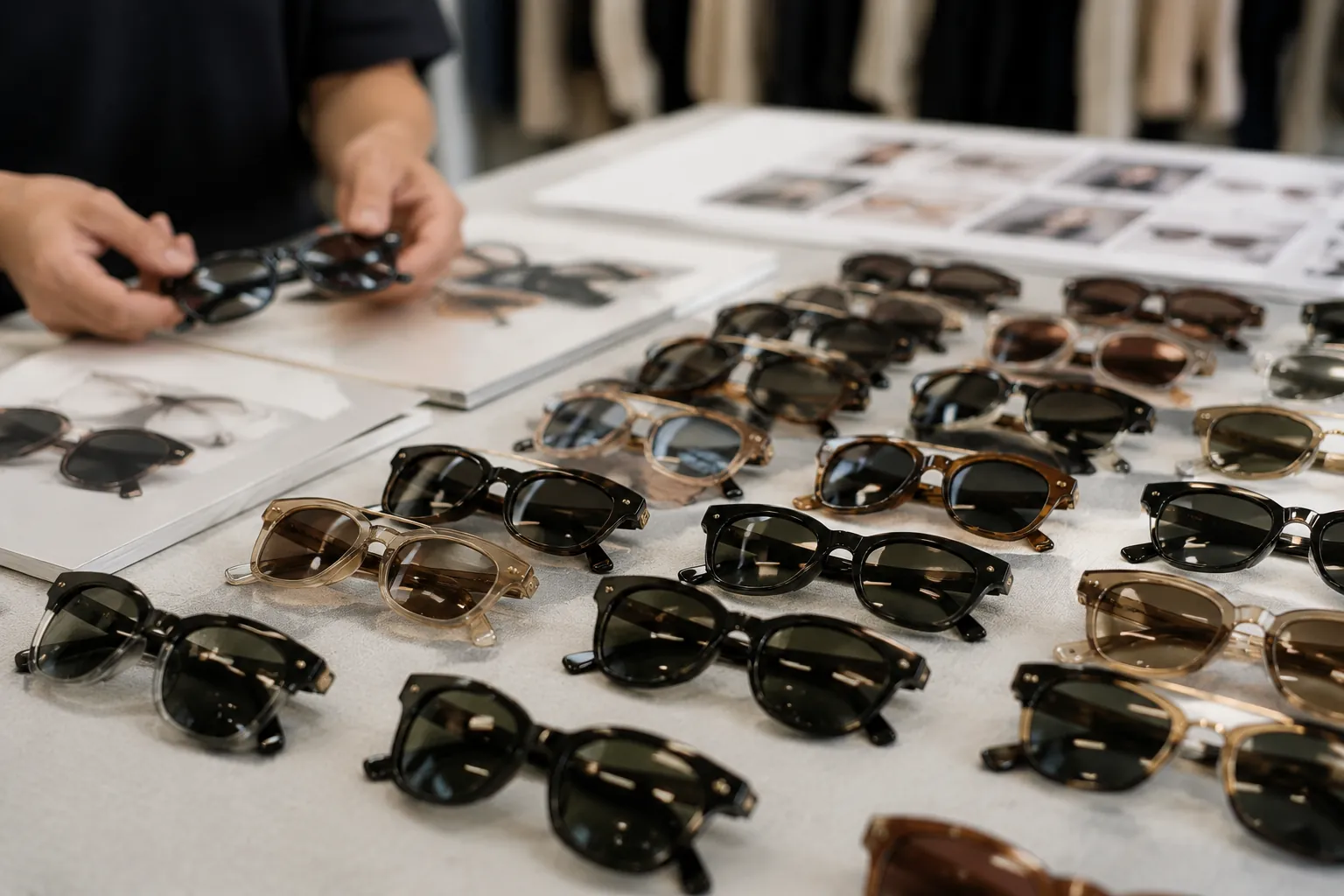
This guide is for buyers managing sunglasses programs across chain stores, franchise networks, travel retail, drugstores, fashion retailers, and regional distributors. The aim is simple: reduce SKU drift, receiving errors, carton rework, compliance gaps, and late replenishment. Good sourcing starts before the purchase order. It depends on disciplined assortment planning, locked specifications, barcode-ready packaging, staged delivery, workable QC tolerances, market-specific compliance, and repeat-order controls. The second and third buy matter as much as the first shipment.
Start With a Retail Assortment Map
Chain retail buying is not a one-time online drop. The main risk is SKU multiplication. A buyer may think the order contains 20 styles. In practice, the warehouse may handle far more live SKUs once frame color, lens color, barcode, hang tag, pouch, language label, store pack, and regional assortment are counted.
Build the assortment map before asking for a quotation. Separate the range into core, seasonal, and test SKUs. Core styles should carry the largest share of forecast volume and stay stable for replenishment. Seasonal styles can use trend shapes, mirror lenses, or brighter colors, but they should not require a new packaging rule unless the margin supports it. Test SKUs should be capped and tied to a defined store group, region, or sell-through trigger.
- Core range: repeatable styles in controlled colors such as black, tortoise, brown, crystal, gunmetal, or gold.
- Seasonal range: trend-driven shapes or colors with controlled volume and no unnecessary packaging variation.
- Test range: limited styles for selected doors, with a clear sell-through trigger and no special carton format unless approved.
- Store pack: fixed unit mix per carton, commonly 12, 24, or 48 pairs, so stores do not sort loose inventory.
Ask the factory to quote by SKU, not only by total order quantity. MOQ and unit cost can change by material, lens type, decoration method, packaging, color split, and compliance documentation. Small test runs may be possible for selected designs. Still, pricing and lead time usually improve when core SKUs are consolidated into larger repeatable quantities.
Choose SKUs That Can Repeat Cleanly
For multi-location retail, the best SKU is not always the most exciting sample. It is the one that can repeat without visible drift in frame color, lens shade, temple tension, logo position, barcode placement, or packaging label. Small differences become obvious when old and new stock sit together on the same display rack.
Material choice should match the price point and the repeat-order risk. PC injection is efficient for entry retail and promotional programs, but thin frames can feel light and may scratch more easily. TR90 costs more, but it can improve flexibility and recovery when processed correctly. Acetate gives better hand feel and richer patterns, but sheet variation is real, especially in tortoise, marble, and laminated colors. Metal frames need tighter control of plating, soldering, alignment, and hinge torque.
| Material | Best Use | Retail Risk | Factory Control Point |
|---|---|---|---|
| PC injection | Entry retail, mass displays, price-driven programs | Low perceived weight, scratches, color inconsistency if masterbatch changes | Confirm frame weight, lens category, drop test approach, and approved color chip |
| TR90 injection | Sport, active, flexible daily-wear ranges | Higher resin cost and possible temple recovery variation | Check temple bend recovery, hinge screw retention, and molding process control |
| Acetate | Fashion, boutique, higher-ticket retail | Sheet pattern variation and longer polishing time | Approve physical sheet chips, pre-production sample, and edge polish standard |
| Metal | Aviator, rimless, semi-rimless, premium displays | Plating marks, solder weakness, nose pad inconsistency | Inspect plating finish, bridge alignment, temple opening angle, and pad fit |
Lock the bill of materials before bulk production. Include frame material, lens material, lens category, hinge type, screw color, logo method, packaging components, label copy, barcode files, and approved reference sample. Also confirm which steps the supplier controls in-house and which are subcontracted. Handoffs create risk. Make them visible.
Set Decoration Rules Early
Logo work is often treated as a late artwork detail. That is a mistake. Decoration affects cost, lead time, defect rate, and replenishment consistency. A one-color temple logo is not the same production task as a metal plate, foil stamp, rubber badge, or laser mark on a curved lens.
Define decoration by surface, position, size, color, durability, and inspection method. Placement tolerance is usually tighter on flat temple areas and wider on curved or flexible surfaces. Confirm the exact tolerance with the factory after reviewing the part geometry and process. Check color against a Pantone reference or physical approved sample, not only a screen file. For pad printing, confirm rub resistance. For metal logos, check adhesive or pin fixing strength. For laser engraving, confirm contrast under retail lighting.
- Pad printing: useful for low-cost temple logos; confirm ink adhesion and rub test requirement before bulk production.
- Laser engraving: clean and durable on metal or selected coated parts; contrast can vary by finish and lighting.
- Metal plate: premium look, but requires placement control and pull-strength inspection.
- Hot stamping: useful for cases and pouches; foil color and pressure must be approved on the actual material.
- Lens sticker: effective for UV or polarized claims, but adhesive must not leave residue or damage presentation.
Approve decoration on a pre-production sample, not only a digital mockup. For repeat orders, keep a physical logo reference at both the buying office and the factory. Do not force the second batch to rely on artwork interpretation.
Make Barcode-Ready Packaging Mandatory
Retail networks lose time when sunglasses arrive as factory goods instead of retail goods. Barcode-ready packaging means the product can move through the importer warehouse, retailer distribution center, and store receiving process without relabeling. That requires more than placing an EAN or UPC on a sticker.
Specify barcode size, quiet zone, placement, print contrast, scannability, carton labels, inner pack labels, and the hierarchy between item barcode, case-pack barcode, purchase order, and destination code. If stores receive by carton, the master carton label matters as much as the individual hang tag. If POS scans at item level, the hang tag, polybag sticker, retail box, pouch label, or lens sticker must survive handling without peeling, curling, hiding the product, or conflicting with consumer-facing claims.
- Send the barcode database, SKU naming rules, retail price rules, and label ownership requirements before artwork starts.
- Decide whether the barcode appears on a hang tag, polybag sticker, lens sticker, pouch label, case label, or retail box.
- Approve the barcode proof at actual printed size, not only as enlarged PDF artwork.
- Run a scan check after packaging sample production using the retailer's scanner type or a verified equivalent where possible.
- Lock the carton label format before bulk packing begins, including PO, SKU, quantity, carton number, destination batch, and any retailer routing code.
A sticker across the lens is easy to scan, but it can leave residue or weaken shelf appeal. A hang tag looks cleaner, but it can rotate away from the scanner. A retail box gives label space and protection, but it increases freight volume. Choose the format based on how stores receive, count, display, and scan the product. Not on factory convenience.
Plan Delivery Batches Before Production
A chain buyer often needs one order to move in waves: launch allocation for all doors, distribution-center reserve, regional splits, and replenishment for faster stores. If this is not planned early, the factory may pack by production sequence instead of retail allocation. Then the importer has to break cartons, rebuild orders, and relabel stock. Errors follow.
Build the calendar from approval milestones, not from the purchase order date alone. Confirm sample lead time, artwork checking time, barcode and packaging proofing, compliance review, inspection booking, bulk production time, final packing, export documentation, and freight handoff. Lead times should be confirmed for the specific material, decoration, lens tinting, packaging, order quantity, and factory schedule.
| Batch Type | Purpose | Packing Method | Instruction Needed |
|---|---|---|---|
| Launch batch | Initial fill for all stores | Store-ready cartons or DC-ready mixed cartons | Store count, unit mix, carton quantity, and ship mark format |
| DC reserve | Buffer for replenishment | SKU-solid cartons | SKU code, barcode, carton quantity, and warehouse label rule |
| Regional split | Different climate, price, language, or fashion needs | Separate pallet, carton group, or packing list section | Region code, destination batch, language label, and routing requirement |
| Follow-up batch | Fast-seller refill | Repeat SKU cartons | Locked color, lens, logo, packaging, barcode, and QC standard |
Ask for the packing list structure before shipment, not after loading. A useful packing list shows PO, SKU, barcode, frame color, lens color, quantity per carton, gross weight, net weight, carton dimensions, carton number, and destination batch. If a carton label says only "sunglasses," it is not ready for chain retail.
Control Lens Compliance by Market
Sunglasses are not only fashion accessories. For overseas retail, lens compliance must match the destination market and the actual product being shipped. Common requirements and references include CE EN ISO 12312-1 for Europe, ANSI Z80.3 for the United States, AS/NZS 1067 for Australia and New Zealand, REACH for chemical compliance, FDA registration where applicable, and factory management or social audit systems such as ISO 9001 and BSCI. Do not request marks, warnings, or claims that do not apply to the product or market.
Set compliance before production. Lens category, visible light transmission, UV protection, impact requirements, warning labels, children's product rules, and polarized claims should be confirmed at SKU level. A gray lens and brown lens in the same frame may need separate checks if transmission differs. Mirror coating can shift readings. Gradient lenses can vary from top to bottom. Polarized lenses add axis alignment and stress inspection.
- EU: confirm CE EN ISO 12312-1, UV protection, lens category, and user information requirements.
- United States: confirm FDA registration status where applicable and ANSI Z80.3 expectations for non-prescription sunglasses.
- Australia and New Zealand: confirm AS/NZS 1067 requirements, category marking, and consumer warnings.
- Chemical compliance: check REACH risk for frame materials, coatings, paints, nose pads, pouches, and packaging contact points.
Compliance documents should match the frame material, lens type, model family, production period, and destination market. A generic certificate with no connection to the SKU is weak support during a retailer audit. Keep test reports, declarations, artwork warnings, approved labels, and registration or audit documents in the order file.
Use QC Gates That Catch Retail Problems
Factory QC for sunglasses should not stop at "looks okay." Chain stores care about consistent shelf appearance, scanability, low return rates, and cartons that match the purchase order. The inspection plan must reflect those risks.
For a retail program, request four QC gates: incoming material check, pre-production sample approval, during-production inspection, and final random inspection. AQL sampling can be used for final inspection when agreed in the purchase order. Some points may still need 100% checks, especially barcode readability, obvious lens defects, and carton quantity. Write practical tolerances into the QC file: logo placement within the approved range, frame color matching the physical standard under agreed light, lens tint within approved sample limits, and carton quantity exact.
- Frame alignment: temples sit evenly, bridge is not twisted, and finished frame does not rock heavily on a flat surface.
- Hinge function: opening and closing feel consistent; screws are not loose, stripped, or over-tightened.
- Lens quality: no deep scratches, bubbles, edge chips, heavy tint mismatch, visible stress, or poor fitting gap.
- Decoration: laser engraving, pad printing, hot stamping, or metal logo plates match approved position, color, and durability requirement.
- Packaging: barcode scans, SKU matches carton label, hang tag orientation is correct, and carton count is exact.
Define critical, major, and minor defects before inspection. Critical defects may include the wrong compliance mark, unsafe sharp edge, wrong lens category, or unreadable barcode. Major defects may include visible lens scratches, twisted frame, wrong logo, or wrong SKU label. Minor defects may include small cosmetic marks outside the primary viewing area. If stores need to fix it, the factory process was not finished.
Build Replenishment Around Locked Files
Replenishment fails when the first order is treated as a one-time project. For chain stores, the second order is often more important than the first. It proves whether the supplier can repeat color, lens shade, logo, packaging, barcode, carton format, and documentation without redevelopment.
Keep a locked reference set: approved frame sample, lens sample, color chip, logo placement sample, packaging sample, barcode file, carton label file, compliance file, and QC checklist. Store one set with the buyer and one set at the factory. For acetate or custom colors, confirm whether the same sheet pattern or masterbatch can be reserved. For injection frames, check mold condition and cavity consistency before repeat production. For lenses, confirm tint formula, coating, and polarized film source if applicable.
Replenishment quantity should follow sell-through and production economics. Low MOQs can support market tests and small-door programs, but unit cost, material purchasing, packaging print runs, and production planning usually improve when the buyer consolidates repeat orders. Before placing the first bulk order, ask the supplier to state the repeat MOQ by SKU, expected lead time, component availability, and any risk that color, lens tint, packaging, or barcode materials may change.
Buyer rule: do not approve a first shipment unless the supplier confirms the repeat-order path: MOQ, component availability, lead time, packaging files, barcode files, compliance documents, and whether lens tint can be matched again.
A factory can produce efficiently only when the buyer's retail rules are built into the order file. Strong repeat programs are not based on memory or informal messages. They rely on approved samples, locked files, agreed inspection standards, and clear replenishment triggers.
Have a custom sunglasses project in mind?
Send us your styles, target market and quantities and we will return a detailed quote with MOQ, lead time and a sample plan.
Get a QuoteWhy source this from Wenzhou with LumiShades
Wenzhou in Zhejiang Province is widely regarded as China’s eyewear manufacturing capital, producing a large share of the world’s sunglasses. That concentration matters to buyers: a deep local supply chain for acetate sheet, hinges, lens blanks, plating and packaging means shorter component lead times, easier color and material matching, and a workforce with decades of eyewear-specific skill. LumiShades has manufactured in this ecosystem since 2009, and our vertical integration — in-house injection molding, acetate cutting, CNC milling, lens tinting, decoration and quality control — means no part of your order is quietly subcontracted to a workshop you cannot audit.
For international buyers, that vertical control translates into accountability. When a single factory owns every step, defects are traced and fixed at source rather than bounced between vendors, and your specifications survive intact from first sample to bulk. For procurement review, buyers can request process records, approved samples, quality checkpoints and project-specific compliance files before placing a bulk order. Required testing and documentation are confirmed against the destination market and product specification rather than assumed from a generic certificate list. Explore our manufacturing capabilities and quality control process to see how this works in practice.
Frequently asked questions
What is a realistic MOQ for a chain store sunglasses test? Ask for MOQ by SKU, not only by total order quantity. A small test may be possible when using available materials, standard colors, and simple packaging. Custom colors, printed packaging, special lenses, or logo hardware can raise the MOQ. Define the store count, units per store, and replenishment trigger first. Then confirm whether the factory can repeat the same SKU after the test.
Can barcode labels be applied at the factory? Yes, if the barcode system is locked before packaging approval. Provide the barcode files, SKU table, label size, placement rule, item description, PO reference, carton label format, and any retailer routing code. Require a printed packaging sample at actual size and ask for a scan check before bulk labeling starts.
How long should we allow from sample to bulk shipment? Build the timeline from approval steps, not from the order date alone. Include sample making, sample review, artwork approval, barcode proofing, packaging sign-off, compliance document review, material purchasing, bulk production, inspection booking, final packing, and export handoff. Ask the supplier to confirm lead time in writing for the exact material, lens, decoration, packaging, and order quantity.
Which compliance standards should we specify for sunglasses? Specify standards by destination market and SKU. Common references include CE EN ISO 12312-1 for Europe, ANSI Z80.3 and FDA registration considerations for the United States, AS/NZS 1067 for Australia and New Zealand, and REACH for chemical compliance. Confirm lens category, UV protection, visible light transmission, warning labels, and polarized claims before production.
Should chain retailers order mixed cartons or SKU-solid cartons? Use mixed cartons when stores need the same launch assortment and the carton can go directly to the selling location. Use SKU-solid cartons for distribution-center reserve, replenishment, and warehouse picking because they are easier to count and less likely to create SKU errors. Confirm carton quantity, inner pack, barcode hierarchy, and destination code before packing starts.
How do we keep repeat orders consistent? Lock a reference set before bulk shipment: approved frame sample, lens tint, color chip, logo sample, packaging sample, barcode files, carton labels, compliance documents, and QC checklist. Ask the factory to confirm repeat MOQ, component availability, mold or material status, lens tint formula, packaging files, and lead time before the first order ships.
Ready to start?
Explore our cat-eye sunglasses or request a quote — our sales team replies within 12 hours.
Request a Quote