
Wholesale Sunglasses for C-Stores & Pharmacies
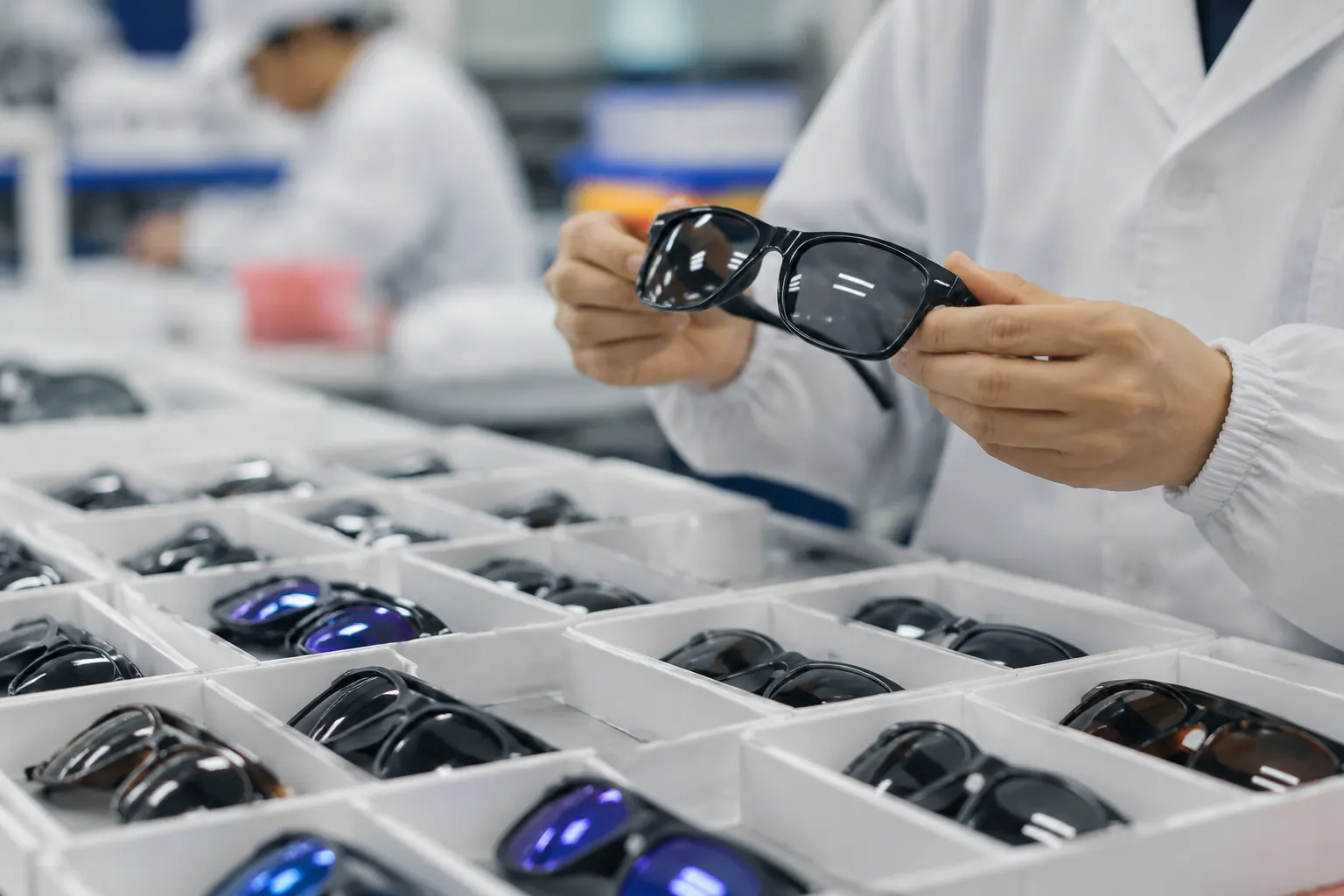
This guide is for distributors, importers, and retail buyers building a practical sunglasses program for convenience stores and pharmacies. This is not a runway assortment. It is a retail line that must be durable, easy to shop, simple to replenish, and priced for impulse and everyday replacement purchases. The article covers shelf planning, frame and lens choices, material behavior, decoration, MOQ logic, packaging, compliance, QC, and lead-time planning using checkpoints buyers can verify.
Start With The Shelf, Not The Catalog
Convenience stores and pharmacies sell sunglasses fast. The shopper may be replacing a lost pair, buying sun protection before driving, or grabbing a spare for the car. The display has seconds to explain the offer: UV protection, driving or polarized options where they make sense, and a tight set of familiar styles.
Start with fixture capacity before choosing designs. A small counter spinner commonly holds about 24 to 72 pairs. A floor spinner may hold about 96 to 144 pairs. A wall display or endcap can hold more, depending on hook count, frame size, packaging format, and retailer planogram rules. Do not crowd the display with near-identical black frames. Shoppers stop seeing the difference.
For a first program, launch 8 to 12 SKUs instead of 30 or 40. Give more depth to the shapes most likely to sell. A 72-pair spinner with 12 SKUs can carry six pieces per SKU at launch. A 24-SKU version carries only three pieces per SKU and can break down quickly after the first sales cycle.
- Starter mix: 60 percent proven unisex shapes, 25 percent polarized or driving-oriented styles, 15 percent seasonal colors or fashion shapes.
- Depth rule: keep at least four to eight pieces per core SKU on the fixture at launch.
- Reorder trigger: review replenishment when store stock falls below about 35 to 40 percent, not when the display is empty.
- SKU discipline: add new colors only after two to four weeks of sell-through data, or after the retailer confirms seasonal demand.
Small test runs help with retail pitches, sample racks, and regional trials. They do not prove full-chain economics. Unit cost, packing efficiency, inspection time, and freight impact usually become clearer at higher order quantities. Ask for quotes at several volume breaks and compare landed cost, not only ex-factory price.
Choose Frame Styles With Fit Discipline
The best convenience-store and pharmacy assortment feels familiar, not random. Start with shapes shoppers recognize: wayfarer, soft square, sport wrap, aviator, and a limited number of round or fashion profiles. Black, tortoise, smoke gray, brown, matte navy, and gunmetal are usually safer opening choices than complex seasonal colors. Tourist, beach, festival, and licensed programs may justify brighter options if demand is proven.
Fit range matters more than catalog variety. Adult unisex frames commonly sit around 50 to 58 mm lens width, 16 to 22 mm bridge width, and 140 to 150 mm temple length. Oversized fashion styles can exceed those ranges, but keep them limited. Very wide frames may slide on smaller faces and create return or markdown risk. Very narrow frames can slow sell-through because fewer adults can wear them comfortably.
| Style Group | Best Channel Use | Suggested Share | Production Detail To Control |
|---|---|---|---|
| Classic wayfarer | Main unisex volume SKU | 20 to 30 percent | Keep temple logo area flat enough for pad print, laser mark, or metal plate |
| Soft square | Pharmacy and everyday adult buyers | 15 to 25 percent | Check bridge comfort and lens edge polish on medium-face fittings |
| Sport wrap | Gas stations, outdoor work, driving | 15 to 20 percent | Control base curve and lens stress to reduce visual distortion |
| Aviator metal | Driving and higher perceived value | 10 to 15 percent | Inspect nose pads, screw torque, plating adhesion, and lens mounting tension |
| Round or seasonal fashion | Impulse and tourist locations | 5 to 15 percent | Limit bright colors until store-level sell-through proves demand |
For the first buy, avoid too many metal combinations unless the supplier has already proven consistent assembly quality. Metal frames add variables: plating thickness, solder joints, screw security, pad arms, nose pads, and lens mounting. Injection-molded PC or TR frames are often easier for opening-price programs. Acetate gives better color depth and hand feel, but it requires sheet cutting, tumbling, polishing, hinge insertion, and more manual finishing time.
Build Price Tiers Around Real Cost Drivers
One large bargain bin makes customers compare only color. A clear good-better-best ladder gives shoppers a reason to trade up. It also helps store staff explain the line. Keep the opening tier simple and durable. Make the middle tier feel better in the hand. Use the upper tier for polarized lenses, stronger hardware, premium material, or better packaging.
The cost drivers are predictable: frame material, lens type, hinge structure, decoration method, packaging, carton configuration, testing, inspection level, and order volume. Cutting every upgrade can lower the quote. It can also create weak hinges, poor lens clarity, unstable logo printing, and scratched back stock. Those costs return as credits, markdowns, and buyer complaints.
- Opening tier: PC or basic TR frame, UV-protective tinted PC lens, standard hinge, hang tag, and barcode label.
- Middle tier: improved hinge, cleaner surface finish, soft-touch coating, microfiber pouch, header card, or stronger color range.
- Upper tier: polarized lens, acetate or metal frame, spring hinge, metal logo plate, premium pouch, or clamshell where theft risk justifies it.
Request quotes at practical volume breaks: sample quantity, first-order quantity, replenishment quantity, and chain rollout quantity. Each quote should state what is included. Confirm lens specification, logo process, packaging, barcode labeling, compliance testing responsibility, inspection standard, inner-box structure, and carton marks. A bare unit price is not enough to compare suppliers.
Match Materials To Store Abuse
Convenience-store sunglasses get handled hard. Customers open temples with one hand, try on several pairs, return frames to the wrong slot, and drop products on tile floors. Material choice should reflect that abuse, not just the product photo.
PC injection frames are light, fast to mold, and cost-efficient for entry programs. They are rigid enough for simple silhouettes but can show stress whitening if over-flexed. TR materials, including TR90-type blends, add flexibility and recovery, which helps sport wraps and youth-oriented styles. Acetate feels heavier and more premium, takes richer colors, and photographs well. It also needs more finishing time and can push retail price beyond some c-store ranges. Metal frames can sell well in driving styles, but they require tighter control of plating, screws, nose pads, and lens groove tension.
Lens selection must match the retail claim. Basic tinted PC lenses can work for value programs if UV protection, optical clarity, and applicable impact-related requirements are confirmed for the destination market. Polarized lenses help reduce glare, especially for driving-oriented products. Still, the supplier should check polarization axis, lens stress, and distortion, especially on curved sport frames. Lock lens category and visible light transmission before packaging claims are printed.
- Confirm target retail price and required margin before selecting material.
- Choose PC, TR, acetate, or metal based on handling abuse and price tier.
- Define lens color, UV claim, polarization, and filter category by market.
- Approve dimensions with physical samples, not photos alone.
- Keep one signed golden sample with the supplier and one with the buyer.
Ask the supplier to document the approved material, color, lens specification, hinge type, logo process, and packaging components in a signed specification sheet. This file should match the golden sample and purchase order. Later, production can be inspected against facts instead of memory.
Plan Decoration Before Sampling
Decide branding before the sales sample is made. A logo that looks simple in artwork may fail on a curved temple, textured TR surface, thin metal arm, or glossy acetate side. Decoration affects minimum order quantity, setup cost, durability, inspection, and lead time.
Pad printing is common for low-cost temple logos. It works well on flat or slightly curved areas, but the print can wear faster if the surface is oily, heavily textured, or handled constantly. Laser engraving gives a cleaner and more permanent mark on suitable materials and coatings, but contrast depends on the substrate. Metal logo plates create a stronger retail look. They also add tooling, adhesive or insert-control issues, and more inspection points. Hot stamping can work for pouches, header cards, and some packaging, but it is usually a poor choice for high-abuse temple areas.
| Decoration Method | Best Use | Typical Constraint | QC Check |
|---|---|---|---|
| Pad print | Opening-tier temple logo | Needs smooth logo area and ink adhesion test | Rub test, alignment, color consistency |
| Laser engraving | Premium plastic, metal, or coated parts | Contrast varies by material and finish | Depth, legibility, placement tolerance |
| Metal logo plate | Upper tier and retail display impact | Adds tooling, assembly, and adhesion control | Plate position, glue overflow, edge lift |
| Packaging print | Header cards, hang tags, pouches | Must match barcode, claim, and country rules | Barcode scan, color proof, spelling, claim accuracy |
Define logo placement tolerance before production. A practical temple-logo tolerance is often around 1 mm from the approved position, but complex curves may need a wider approved range. Check samples under retail lighting. Low-contrast logos can disappear on black, tortoise, or translucent frames.
Make Packaging Work For Replenishment
Packaging has two jobs in this channel. It helps shoppers buy quickly. It helps store teams restock without confusion. Fancy rigid boxes usually fail because they consume shelf space, increase freight volume, slow display refills, and raise landed cost. Retail-ready means clear, scannable, compliant, and easy to handle.
Common options include hang tags, header cards, polybags for back stock, microfiber pouches, and clamshells for higher-shrink locations. Confirm barcode size and placement with the retailer before mass printing. If the product claims UV400, polarized, driving use, Category 3, or kids use, those claims must match the lens specification, test plan, and destination market rules.
Carton discipline matters as much as consumer packaging. If one master carton mixes too many SKUs, warehouse receiving slows down. Store replenishment gets messy. A practical setup uses inner boxes by SKU, with model number, color, lens type, barcode, quantity, and PO reference printed on at least two visible sides. For example, a 300-pair design order can be packed as 10 inner boxes of 30 pairs, then grouped into master cartons by SKU or store allocation.
- Hang tag: lowest cost and fastest for spinner displays, but loose back stock needs scratch protection.
- Header card and polybag: useful for distributor replenishment and barcode control.
- Microfiber pouch: supports middle-tier value, but dye bleeding and lint must be checked.
- Clamshell: helps theft control but increases plastic use, carton volume, and freight cost.
Complete Compliance Before Artwork
Handle compliance before packaging artwork is printed. Sunglasses are not just colored plastic. They carry UV, tint, optical, impact-related, and sometimes polarized claims. The claim on the tag must match the actual lens, production batch, and destination market.
For European programs, CE marking and EN ISO 12312-1 are key references for general-use sunglasses. For the United States, buyers commonly review FDA registration where applicable and ANSI Z80.3 for nonprescription sunglasses and fashion eyewear. For Australia and New Zealand, AS/NZS 1067 applies. REACH is relevant for chemical restrictions in the European market, especially coatings, plastics, metals, and skin-contact components. ISO 9001 and BSCI can support supplier evaluation, but they do not replace product-level testing.
Do not print UV400, polarized, Category 3, or driving-use claims until the lens specification, test plan, and destination market are confirmed.
Request documents tied to the exact product, not a generic certificate folder. A smoke gray non-polarized lens, brown gradient lens, and gray polarized lens may need separate evidence because transmission, UV performance, and polarization are different. For private-label programs, keep records by model, color, lens type, production batch, and purchase order.
- Artwork check: lens category, UV claim, country of origin, importer details, barcode, warnings, and recycling marks.
- Product check: lens transmittance, UV protection, optical distortion, impact-related requirements, and restricted substances.
- Record check: PO, approved sample, batch QC report, packing list, test documents, and shipment photos.
Use MOQ, Lead Time, And QC Math
The biggest distributor mistake is simple: too many designs, not enough depth. A display with 24 designs and two pieces each looks full on day one. Then the best sellers disappear and the rack turns into leftovers. Give core SKUs enough quantity to survive the first sales cycle. Use reorder data to expand winners.
| Order Stage | Pairs Per Design | Best Use | Lead-Time Logic |
|---|---|---|---|
| Sample or retail pitch | 50+ | Test colors, packaging, logo, buyer reaction | Confirm sample timing after specs, materials, and artwork are complete |
| First distributor order | 300+ | Fill displays and hold reserve stock | Confirm production lead time after sample, artwork, and compliance approvals |
| Core replenishment | 1000+ | Reorder proven top sellers | Improves material planning and can reduce setup cost per unit |
| Chain or national program | 5000+ | High-volume retail rollout | Requires earlier planning for materials, packing, testing, and shipment windows |
For reorder planning, separate launch stock from warehouse reserve. If 100 stores need a 48-pair display, the fixture fill alone is 4800 pairs. Add reserve stock based on expected sales velocity, freight timing, and the retailer's replenishment cadence. After two to four weeks, identify the top 20 to 30 percent of SKUs and move those into larger reorder quantities if sell-through data supports it.
Control QC before packing. Check frame symmetry, temple tension, hinge screw security, lens fit, logo placement, surface scratches, color consistency, barcode scan, packaging count, and carton marks. For injection frames, inspect gate marks, sink marks, warping, rough nose-bridge edges, and temple alignment. For acetate, inspect polishing, hinge insertion, and frame balance. For polarized lenses, check axis consistency, stress marks, and visual distortion.
Before bulk production starts, keep a clean order file: signed specification sheet, approved golden sample, artwork proof, compliance plan, AQL inspection requirement, and packing instructions. Clear documents prevent most production disputes because the supplier and buyer inspect against the same approved standard.
Have a custom sunglasses project in mind?
Send us your styles, target market and quantities and we will return a detailed quote with MOQ, lead time and a sample plan.
Get a QuoteWhy source this from Wenzhou with LumiShades
Wenzhou in Zhejiang Province is widely regarded as China’s eyewear manufacturing capital, producing a large share of the world’s sunglasses. That concentration matters to buyers: a deep local supply chain for acetate sheet, hinges, lens blanks, plating and packaging means shorter component lead times, easier color and material matching, and a workforce with decades of eyewear-specific skill. LumiShades has manufactured in this ecosystem since 2009, and our vertical integration — in-house injection molding, acetate cutting, CNC milling, lens tinting, decoration and quality control — means no part of your order is quietly subcontracted to a workshop you cannot audit.
For international buyers, that vertical control translates into accountability. When a single factory owns every step, defects are traced and fixed at source rather than bounced between vendors, and your specifications survive intact from first sample to bulk. For procurement review, buyers can request process records, approved samples, quality checkpoints and project-specific compliance files before placing a bulk order. Required testing and documentation are confirmed against the destination market and product specification rather than assumed from a generic certificate list. Explore our manufacturing capabilities and quality control process to see how this works in practice.
Frequently asked questions
What is the best starting MOQ for a convenience-store sunglasses program? Use small quantities for samples, buyer presentations, or limited regional tests. For a real distributor launch, calculate MOQ from fixture fill plus reserve stock. For example, 100 stores with 48 pairs per display need 4800 pairs before reserve stock. If the assortment has 12 SKUs, that is about 400 pairs per SKU for fixture fill alone.
Should every SKU use polarized lenses? No. Polarized lenses are useful for driving and glare reduction, but using them on every SKU can raise the opening price and reduce value-tier options. A practical starting point is to reserve polarized lenses for the better and best tiers, then expand only after sell-through shows shoppers will pay the higher retail price.
Which materials work best for low-price retail sunglasses? PC injection frames are usually the most cost-efficient for opening price points. TR materials add flexibility for sport, wrap, and youth-oriented styles. Acetate and metal can support higher tiers, but they add finishing, assembly, and QC requirements. Ask the supplier to confirm material, hinge type, lens type, and surface finish in the signed specification sheet.
Which compliance documents should buyers request? Request documents that match the destination market and the exact product. For Europe, review CE and EN ISO 12312-1 documentation. For the United States, review FDA registration where applicable and ANSI Z80.3. For Australia and New Zealand, review AS/NZS 1067. For European chemical compliance, review REACH evidence. Keep records by model, lens color, lens type, batch, and purchase order.
How long should buyers plan from sample approval to shipment? Lead time depends on material, lens type, decoration, packaging, testing, inspection, and order volume. Ask the supplier to split timing into sample development, artwork approval, compliance testing, bulk production, inspection, and shipment booking. Do not start the production clock until the golden sample, artwork, and purchase order details are approved in writing.
What packaging works best for pharmacies and convenience stores? Hang tags and header cards work well for low-price spinner displays because they are compact and easy to replenish. Microfiber pouches can support middle-tier value if lint and dye transfer are checked. Use clamshells only where theft control justifies the extra cost, plastic use, larger cartons, and higher freight volume.
Ready to start?
Explore our square sunglasses or request a quote — our sales team replies within 12 hours.
Request a Quote