
How to Check a Sunglasses Supplier's In-House Depth
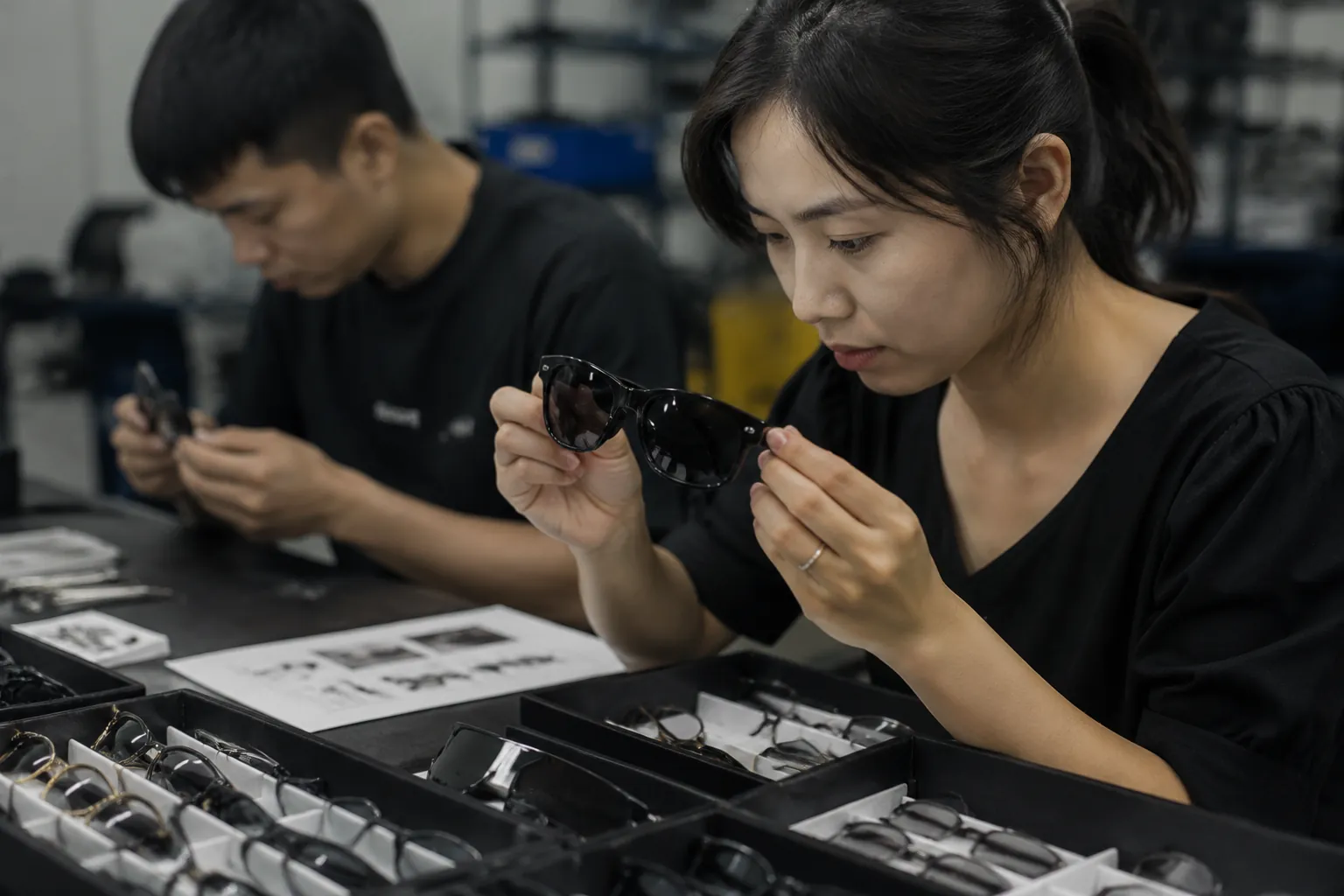
If you buy custom sunglasses for a brand, import program, retail chain, or distribution business, you need to know what the factory actually does itself. The difference between real in-house production and outsourced steps affects mold lead time, color consistency, defect rates, and how much control you keep as volume rises. This checklist helps you separate real capability from brochure language. It also shows how a factory with in-house injection molding, acetate cutting, CNC milling, tinting, decoration, and quality control can reduce handoff risk if those steps are truly under one roof.
Start With the Three Questions That Matter
Before you ask for a catalogue or samples, ask three direct questions: what do you make in-house, what do you outsource, and which steps carry the biggest quality risk? Keep it simple. A supplier can call itself a manufacturer while sending molds, lens tinting, logo work, or final inspection to outside vendors. That usually means longer lead times, weaker accountability, and slower fixes when defects show up.
For sunglasses, the production chain is easy enough to map: material prep, molding or cutting, finishing, lens work, decoration, assembly, and final QC. Fewer handoffs make control easier. That is the point. A factory that keeps injection molding, acetate cutting, CNC milling, lens tinting, decoration, and QC in-house has a very different risk profile from a trading company that leans on subcontractors.
Use this rule: if a supplier cannot explain the process step by step, it may not control enough of it. A real factory should be able to say which operations happen on the shop floor, what gets checked at each station, and what tolerance range triggers reject or rework.
Map the Process Flow, Not the Sales Pitch
Ask the supplier to walk you through one complete style from raw material to packed carton. You want a sequence, not adjectives. Good factories can show the work order flow, the machines used, the inspection points, and the acceptance criteria at each stage. Weak suppliers usually talk about design, packaging, or "flexible service." That is not enough.
For custom sunglasses, a credible flow should cover more than the frame shell. It should include resin drying or sheet selection, mold setup or blank cutting, lens tinting or coating, hinge installation, decoration, cleaning, inspection, and packing. In plastic injection models, gate location, cooling time, and warpage control matter. In acetate styles, cutting direction, sanding sequence, and polishing pressure affect edge quality and fit. In both cases, the shop floor needs to control symmetry, temple alignment, and surface defects before the product reaches packing.
When a supplier says it handles multiple steps in-house, ask for the actual flow of one sample: where it was cut, where it was tinted, where branding was applied, and where final inspection happened. If the supplier can describe the route clearly, that tells you more than broad claims.
- Frame production: injection molding for plastic frames, or acetate cutting and shaping for acetate styles.
- Precision work: CNC milling for logo recesses, hinge seats, or special geometry.
- Lens work: tinting, color matching, and optical checks where needed.
- Decoration: laser engraving, pad printing, hot stamping, or metal logo plates.
- Assembly and QC: hinge torque, temple alignment, cosmetic review, and final packing.
Use a Simple In-House vs Outsourced Comparison
Do not treat "in-house" as a yes/no label. Break it into steps. Ask what changes if each step sits outside the factory. The real question is whether the supplier controls the operations that most affect fit, finish, and color consistency.
| Process step | In-house advantage | Common outsourced risk | Buyer impact |
|---|---|---|---|
| Injection molding | Faster sampling and tighter control of gate marks, sink marks, and warpage | Mold adjustments wait in another vendor's queue; corrections take longer to approve | Lead time can slip and frame fit can vary from batch to batch |
| Acetate cutting | Better control of thickness, edge finish, and repeatability across temples and fronts | Inconsistent sanding and polishing; dimensional drift between runs | Style-to-style variation, higher reject rates, and rework on hinges or temple tips |
| Lens tinting | Shade can be adjusted in-house by batch, density, or immersion time | Batch mismatch, slower correction, and color approval delays | Visible shade variation between lots and more sample loops |
| Decoration | Logo edits can be corrected without waiting on another vendor | Artwork handoff mistakes, extra proof rounds, and plate changes | Branding errors, missed deadlines, and unusable inventory |
| Final QC | Immediate feedback goes to the same team that made the parts | Inspection becomes a report, not a fix, because the shop floor is elsewhere | Defects repeat in later lots and root causes stay unresolved |
If a supplier outsources even one critical step, ask how it controls that step: written specification, incoming inspection, batch approval, and who pays if the defect is found after packing. A factory that truly owns the process should answer directly. No stalls. No vague hand-waving.
Check the Equipment, Not Just the Claim
Ask for actual equipment categories and what each one is used for. You do not need brand names. You do need to know whether the factory has the tools for the styles you want. A supplier making a basic injection frame needs different equipment than one producing acetate temples with CNC detail, mirrored lenses, and metal logo plates.
Look for evidence that the machines match the product mix. Injection lines should support repeatable cycle times and stable melt flow. CNC stations should handle fine detail without chatter or edge burrs. Tinting tanks or coating lines should be set up for consistent immersion timing, bath temperature, or film uniformity. Decoration equipment should hold registration on small logo areas without bleeding or misalignment.
Here is the kind of proof that matters:
- Machine list by process: molding, cutting, milling, tinting, printing, engraving, and assembly.
- Production photos that show active lines, work-in-process, and fixture setups rather than staged corner shots.
- Sample route notes: which station touched the sample, in what order, and what changed between revisions.
- QC checkpoints: incoming material, in-process dimensions, cosmetic inspection, final verification, and packing review.
When a supplier says it handles injection molding, acetate cutting, CNC milling, lens tinting, decoration, and QC in-house, that only matters if it can show the equipment and the sequence. The goal is not to collect machine names. The goal is to confirm the process sits inside the factory walls and that the same team can correct a problem without another vendor in the middle.
Read the Numbers That Predict Scale Pain
In-house depth changes the economics of scaling. Start with MOQ. A low MOQ can hide whether a supplier is actually set up for repeatable production. Small runs are useful for testing, but they do not prove the plant can hold quality as volume increases. The real signal is whether quality stays stable as the order grows.
Price breaks usually reflect setup cost, labor efficiency, and batch utilization. A small run carries more fixed cost per pair: mold setup, lens color matching, logo plate preparation, and inspection time. As volume rises, those setup costs spread across more units. Ask what changes in labor allocation, line balance, and yield assumptions as the order grows. A lower unit price helps only if the reject rate does not climb with scale.
Ask these questions:
- What is the sample lead time, and does it include decoration approval, color matching, and pre-production confirmation?
- What is the bulk lead time for a single style, not a mixed-carton promise?
- What happens at 50, 300, 1,000, and 5,000+ pairs in terms of bottlenecks and staffing?
- Which defects rise first as volume increases: logo misalignment, lens shade variation, hinge fit, surface marks, or temple warp?
A lead-time promise only matters if the same team controls the steps that usually slow an order down. A short sample cycle does not help if the frame has to leave the plant for tinting or the logo needs an outside vendor. Speed without process control just produces fast mistakes.
Verify Compliance at the Process Level
Compliance is not a line on a brochure. It should tie back to materials, testing, and documentation. For overseas buyers, the relevant standards and registrations to ask about are CE EN ISO 12312-1, ANSI Z80.3, AS/NZS 1067, REACH, FDA registration, ISO 9001, and BSCI. Do not ask whether a factory is "certified" in general. Ask which models, materials, or test reports support each claim.
A practical compliance check is straightforward: the lens material, frame compound, coating, and decoration method should match the tested configuration. If a style was tested with one lens tint and one frame resin, a late substitution can break the compliance chain. The same applies to coatings, printing inks, adhesives, and logo plates. Small material changes can affect UV performance, chemical resistance, or cosmetic durability.
Ask for evidence at the product level:
- For CE EN ISO 12312-1, confirm the lens and frame combination matches the tested configuration.
- For ANSI Z80.3 and AS/NZS 1067, ask for the relevant test reports and scope.
- For REACH, ask about material declarations, restricted substances control, and ink or coating sourcing.
- For FDA registration, confirm registration status and product scope, not vague wording.
- For ISO 9001 and BSCI, ask how the quality system and social compliance are applied on the floor.
If decoration or tinting is outsourced, compliance gets harder to manage. A logo plate supplier or lens color vendor can introduce nonconforming material, and that risk grows when there is no direct control over incoming checks or final assembly. In-house control lowers that risk because the same factory handles material verification, process checks, and end-of-line signoff.
Use Sample Orders to Expose Hidden Gaps
Sample orders are where weak factories usually reveal themselves. Do not just approve the look. Test the process. Send one design with a colored lens, one with pad print, and one with a metal logo plate if your program needs those options. Change one detail after the first sample and watch the response time, the clarity of the revision notes, and whether the factory explains the cause of the error.
Good sample handling should feel disciplined. A capable factory should tell you which step caused the change, whether the issue was tooling, color formulation, artwork placement, or assembly tolerance, and what will be different in the next build. If the supplier cannot explain the cause, it is less likely to prevent the problem in bulk. In sunglasses, small sample errors often become expensive lot-wide issues later.
What you learn from the sample round matters more than the sample itself:
- How quickly does the factory acknowledge the change and issue a revised file?
- Does it send a corrected drawing, a new color standard, or only a promise to fix it?
- Are the same defects repeated in the second sample?
- Can it explain why a tint shifted, a logo moved, or a hinge felt loose?
A supplier with real in-house depth usually shortens the loop. The same people who made the part can adjust it, and the feedback stays inside one production system. A supplier that outsources will often need more time for each correction because every change depends on another handoff. That is the hidden cost buyers often miss when comparing only the unit price.
Build a Supplier Scorecard Before You Scale
Use a simple scorecard before placing a larger order. You are not grading style; you are grading process control. Give each item a pass/fail or a 1-to-5 score, then decide whether the factory is ready for volume. A scorecard keeps the conversation factual and makes supplier comparisons easier across programs.
For sunglasses buyers, the best scorecards focus on repeatability, not sales language. You want to know whether the plant can hold the same lens tint across batches, keep temple alignment within an acceptable range, and maintain cosmetic quality when the run goes from a test order to a full-season buy. You also want to know whether the same people who approve the sample are the ones controlling the production line.
| Check | What to ask | Pass sign |
|---|---|---|
| In-house scope | Which steps happen inside the factory? | Clear step-by-step answer with no gaps |
| Process proof | Can they show equipment and flow? | Live line photos, sample route, and QC points |
| Lead time control | What happens at 50, 300, and 1,000+ pairs? | Stable timing and defined bottlenecks |
| Compliance scope | Which tests or registrations apply? | Specific standards matched to the product |
| Problem response | How do they correct a defect? | Fast rework plan with root cause note |
Capacity numbers only matter if the underlying process is controlled. Capacity without process depth creates volume; it does not create reliability. A factory that can explain tolerances, show equipment, and connect sample changes to production corrections is the one that can handle scale without surprise failures.
The right supplier should answer three things clearly: what is done inside, what is checked at each stage, and what changes when your order grows. If those answers are vague, stop there.
Have a custom sunglasses project in mind?
Send us your styles, target market and quantities and we will return a detailed quote with MOQ, lead time and a sample plan.
Get a QuoteWhy source this from Wenzhou with LumiShades
Wenzhou in Zhejiang Province is widely regarded as China’s eyewear manufacturing capital, producing a large share of the world’s sunglasses. That concentration matters to buyers: a deep local supply chain for acetate sheet, hinges, lens blanks, plating and packaging means shorter component lead times, easier color and material matching, and a workforce with decades of eyewear-specific skill. LumiShades has manufactured in this ecosystem since 2009, and our vertical integration — in-house injection molding, acetate cutting, CNC milling, lens tinting, decoration and quality control — means no part of your order is quietly subcontracted to a workshop you cannot audit.
For international buyers, that vertical control translates into accountability. When a single factory owns every step, defects are traced and fixed at source rather than bounced between vendors, and your specifications survive intact from first sample to bulk. For procurement review, buyers can request process records, approved samples, quality checkpoints and project-specific compliance files before placing a bulk order. Required testing and documentation are confirmed against the destination market and product specification rather than assumed from a generic certificate list. Explore our manufacturing capabilities and quality control process to see how this works in practice.
Frequently asked questions
What is the fastest way to tell if a sunglasses supplier really makes product in-house? Ask for the full process flow from raw material to packed carton, plus equipment photos and QC checkpoints. Then ask the supplier to identify which steps are done internally and which are outsourced. If it hesitates, changes the subject, or gives only marketing language, treat that as a risk sign and verify with sample documentation.
Why does in-house decoration matter for custom sunglasses? Decoration steps such as laser engraving, pad printing, hot stamping, and metal logo plate application are common sources of delays and errors. If the factory handles them in-house, it can correct artwork, placement, or registration issues faster and reduce handoff mistakes. Ask for a sample route showing where the branding step happened and who approved it.
Is a low MOQ always a good sign? Not by itself. A low MOQ can help you test a style, but it does not prove the supplier can hold quality at higher volume. Use the sample order to check color consistency, fit, cosmetic quality, and response time, then ask how those results hold at larger quantities.
What should I ask about lead times before I scale an order? Ask for sample lead time, bulk lead time, and the exact steps that sit on the critical path, such as color matching, decoration approval, and final QC. Then ask what changes at 50, 300, 1,000, and 5,000+ pairs. A supplier with real process control should explain where delays come from and how it prevents them.
Which compliance documents should I request for sunglasses? Ask for the support tied to the standards that matter for your market and product: CE EN ISO 12312-1, ANSI Z80.3, AS/NZS 1067, REACH, FDA registration, ISO 9001, and BSCI. Request the relevant test reports, registration details, declarations, or audit evidence for the specific model or material, not a general statement that the factory is "certified."
Ready to start?
Explore our sport wrap sunglasses or request a quote — our sales team replies within 12 hours.
Request a Quote