
How to Vet a Sunglasses Factory Before Scaling
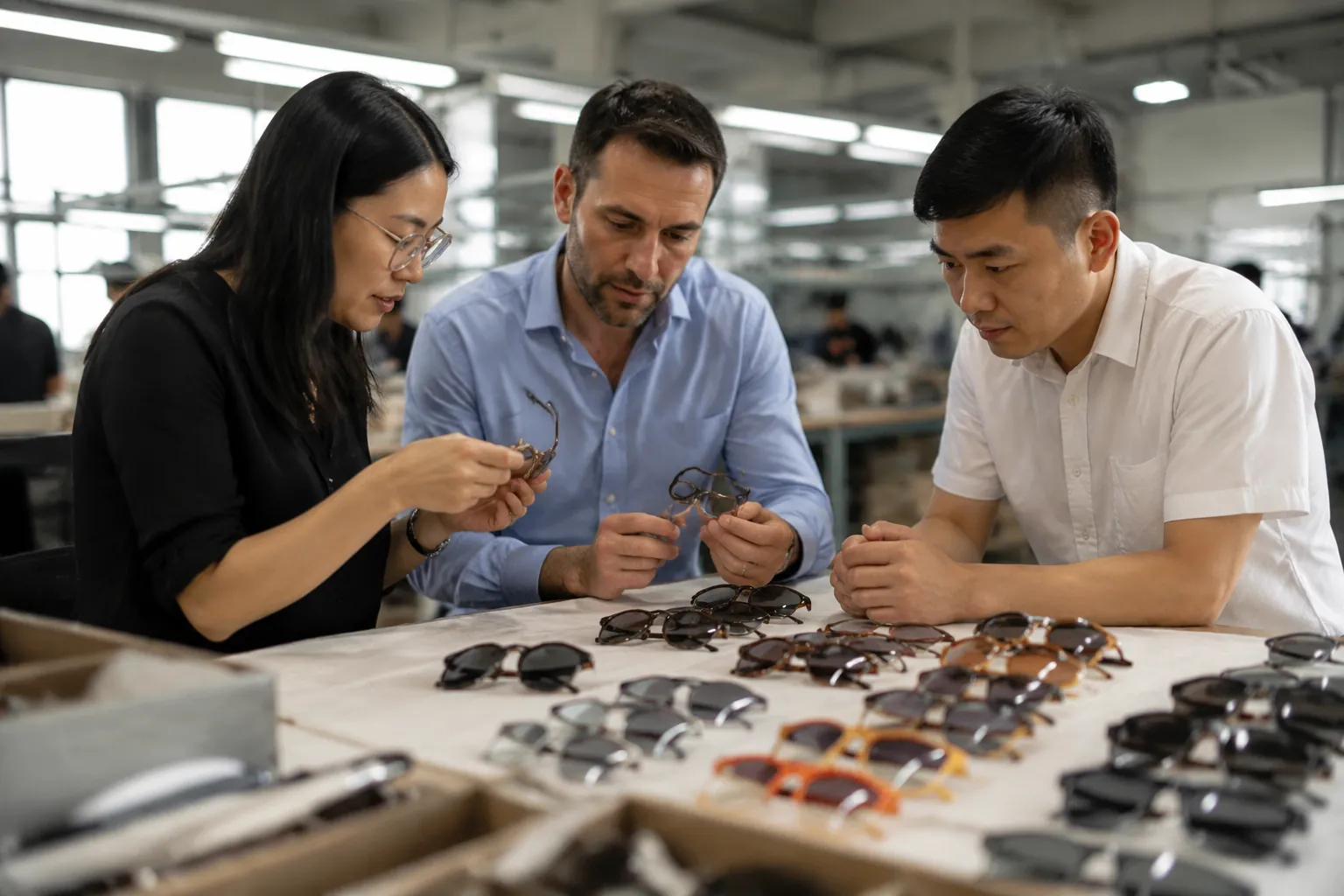
If you buy sunglasses in volume, the claim that matters is not "we do everything." It is whether the supplier can prove which steps are controlled in-house, from incoming material checks to final inspection and packing. This guide is for brands, importers, distributors, and retailers that want less defect risk before they move from samples to larger orders. Use it to separate real manufacturers from trading setups with a workshop label.
Start With the Process Map, Not the Sales Pitch
Before you compare prices, ask the factory to map one frame family from raw material to packed carton. A real manufacturer can name each station, the machine used, the operator role, and the inspection point at each step. For sunglasses, the production flow usually includes incoming material inspection, material conditioning, molding or block cutting, CNC trimming and drilling, sanding or polishing, lens tinting or lens insertion, logo decoration, assembly, final QC, packing, and carton sampling.
You are not checking for a polished presentation. You are checking for ownership and traceability. If molding happens in one building, CNC is farmed out, and QC is done somewhere else, the supplier is not fully controlling the process. That matters because defects often appear where handoffs happen. A hinge hole shifts after cutting. A lens seat changes after polishing. A logo drifts after decoration.
Ask the factory for a process route sheet or line layout. Then ask where they record defects, where rework happens, and where the batch is held if a problem appears. A credible factory should also know its station staffing and cycle rhythm. A small sunglasses line may use a few operators per station. Higher-volume lines usually separate molding, finishing, and QC into different teams.
One good opening question is simple: "Show me the exact route a frame takes from incoming material to packed carton." If the answer is vague, you already have useful information.
Do not accept "we have our own factory" as evidence. Ask for the process route, the machines, the station controls, and the inspection points.
A supplier may say it runs injection molding, acetate cutting, CNC milling, lens tinting, decoration, and QC in-house. That is the right kind of claim to verify. The proof is in the details: machine models, maintenance records, operator counts, first-article approvals, and which steps are done on-site versus subcontracted.
Check the Mold, the Cut, and the CNC Setup
Injection-molded frames and acetate frames fail for different reasons, so ask different questions. On molded frames, the common problems include short shots, flash, sink marks, stress whitening, and hinge misalignment. On acetate, common issues include warping, edge chipping, polishing waves, thickness drift, and poor symmetry after cutting or milling.
For injection molding, ask what machine tonnage they use, how they control mold temperature, and what the standard cycle time is for the frame family you want. The point is stable repeatability, not machine size. Ask how they manage cooling, how often the mold is cleaned, and whether they log mold wear by shot count. A serious shop should be able to explain inspection intervals for critical cavities, vents, and gates.
For acetate cutting and CNC milling, ask what dimensions they control on the parts that matter most: temple length, bridge width, lens groove depth, hinge drilling position, and front symmetry. In practical sourcing terms, you want the factory to think in measurable limits. A disciplined supplier should be able to state internal targets for the key dimensions on your frame family and explain how those targets are checked during production.
Acetate also behaves differently from injection resin. It is sensitive to heat and humidity, which means storage before cutting matters. If sheets or blanks are stored in a hot, damp room, they can move before machining. That movement shows up later as fit variation, polish inconsistency, or temple twist. Ask how the factory conditions acetate before cutting. A credible answer includes dry storage, acclimation time, and a controlled shop environment. Not "we cut when the order comes."
Here is what you want to see during an audit or video call:
- Live machine footage with the current job running, not archive clips.
- Tooling storage with mold IDs, job cards, or traveler sheets.
- First-article parts from the current run, not only showroom samples.
- Scrap bins labeled by defect type, such as flash, warp, or drill offset.
- Maintenance logs for CNC routers, milling heads, and molding equipment.
If a supplier cannot explain how it prevents dimensional drift on long runs, it will struggle on repeat orders. That gets expensive fast when you move from sample quantities to larger production lots.
Use a Sample Set to Test Real Control
Samples are not only for design approval. They are a test of process discipline. If the supplier says samples take 7 to 10 days, that is plausible when tooling is ready, material is on hand, and finishing is controlled. If it needs much longer for a simple sample with no new mold, that can signal poor coordination or heavy outsourcing.
Do not approve one perfect pair and assume the factory can scale it. Ask for at least two sample rounds if the design has functional parts. The first version should confirm styling and fit. The second should show whether the factory can apply correction without breaking the design. If the second sample keeps the same lens sit, temple angle, lens groove depth, and decoration placement, you are much closer to real production control.
Use a simple scorecard. Check the weak points that usually create return rates later:
- Temple symmetry and opening force. A solid hinge should open smoothly and feel consistent on both sides.
- Lens groove depth and seating. Shallow grooves can cause pop-outs; deep or uneven grooves can distort the lens.
- Hinge alignment and screw retention. If screws back out during short use, the assembly process is weak.
- Pad print, hot stamp, engraving, or logo plate placement. Branding errors are expensive to correct after shipment.
- Color consistency across left and right parts. Even a slight tone mismatch becomes obvious in glossy finishes.
Short-run variation is normal. Random variation is not. A factory that controls its own cutting, CNC, tinting, and decoration should be able to explain why a sample changed and what action it took. It may adjust cutter feed, change polishing time, or re-center a drill path. Ask it to document that correction.
Also ask for the approved sample to be signed, photographed, and numbered. Keep one sealed reference sample on your side and one on the factory side. Without a clean reference, disputes later become hard to prove.
A sample window of 7 to 10 days is a reasonable target when the tooling or finishing is already planned. Use that window to test whether the factory can repeat the same result twice, not just once.
Read the QC System Like a Buyer, Not an Inspector
QC only matters if it is built into the process. End-of-line inspection alone misses too much. You want incoming material checks, in-process checks, and final checks. If the factory only talks about final inspection, that is a red flag because the defect was probably created earlier and discovered too late.
A practical QC system for sunglasses should cover frame dimensions, lens tint consistency, optical defects, coating quality, surface finish, hinge function, logo placement, and packaging integrity. For volume orders, ask what AQL it uses and how it classifies defects. A common structure is critical, major, and minor. A critical defect might include a lens safety or compliance failure. A major defect might include a broken hinge or obvious misalignment. A minor defect might include a cosmetic mark that does not affect use. If the factory cannot define those categories, the rejection system is probably informal.
You should also ask what gets measured at each station. Good factories do not wait until the box is packed. They check incoming acetate color or resin lot, monitor work-in-process dimensions, verify lens insertion or tint consistency, and then run a final random inspection. Operators may use calipers, go/no-go gauges, alignment fixtures, and visual standards to catch drift before it multiplies.
Ask for these documents or records:
- Incoming material inspection form.
- In-process QC checklist by station.
- Final inspection report with defect counts.
- Rework and rejection records.
- Calibration records for measuring tools.
One blunt check works well: ask the QC manager to show you the top three defects from the last month and what changed in response. Good factories know their defect pattern. Bad ones say, "We have no problems." That answer is rarely credible.
Test on-time shipment claims against how the factory handles rework. Ask how it balances rework versus ship dates, when it decides to hold a batch, when it splits a shipment, and when it reworks a small lot instead of pushing a flawed order out the door.
Compare In-House Stages Against Outsourced Stages
The biggest sourcing mistake is assuming a factory owns every step because the brochure says so. In eyewear, the difference between in-house and outsourced work shows up in repeatability, lead time, and the speed of corrections. If you are scaling a sunglass program, the question is not just "Can it make it?" It is "Can it make it again with the same fit, finish, and branding accuracy?"
The table below shows the trade-offs buyers care about most.
| Stage | In-House Control | Typical Buyer Benefit | Risk If Outsourced |
|---|---|---|---|
| Injection molding | Tooling, cycle control, visual checks on-site | Better repeatability and faster mold fixes | Longer correction time, hidden defects, slower response to flash or sink marks |
| Acetate cutting | Cutting, shaping, and pre-polish managed internally | Cleaner fit and less edge damage | Variation in temple length, edge chipping, and uneven polish |
| CNC milling | Bridge, groove, and hinge positions controlled in-house | Tighter dimensional consistency | Misalignment, poor lens seating, and drill offset |
| Tinting and decoration | Color, pad print, laser engraving, and logo plate placement on-site | Faster revision and better branding control | Color drift, logo misplacement, and weak adhesion |
| QC | Station checks plus final inspection on-site | Lower defect leakage | Late discovery, more claims, and rework after shipment |
For scale orders, in-house control is usually worth more than a slightly lower unit price from a trading operation. A cheaper quote means little if the factory cannot fix a mold, adjust tint, or correct decoration without waiting on someone else. That delay becomes real money when your launch window is tied to a retailer calendar or seasonal sell-in.
The real cost is not only the unit price, but also defects, delays, and rework. The best suppliers reduce all three at once.
Pressure-Test Compliance Claims With the Right Documents
For overseas buyers, compliance is not a single certificate on a wall. It is a set of documents tied to the product you are actually buying. Common claims in this category include CE EN ISO 12312-1, ANSI Z80.3, AS/NZS 1067, REACH, FDA registration, ISO 9001, and BSCI. Those claims are only meaningful if the paperwork matches the frame material, lens material, tint category, and decoration method on your order.
Ask for the actual test reports or certificates tied to your SKU family. Check the product description, lens material, tint category, model name, and the issuing lab or registration reference where relevant. If you are ordering polarized lenses, mirrored coatings, or a special tint, those details should appear in scope. If you are ordering acetate frames with pad print or a metal logo plate, the decoration materials should also be considered. REACH is especially important for chemical restrictions in plastics, coatings, inks, and surface finishes.
Compliance also changes when the product changes. A factory cannot always reuse the same report if the lens type, coating, or decoration differs from the tested sample. That is normal, not a problem, but you need to know it before you ship.
Use this buyer check:
- Does the claimed standard match the target market?
- Does the report name your product type or a close equivalent?
- Are the frame material and lens type the same as your order?
- Are decoration materials and coatings included in the test scope?
- Is the certificate current, traceable, and linked to the right SKU family?
Do not let a supplier hand-wave with "same factory, same certificate." If the frame structure, lens, or finish changes, you may need fresh verification. Plan for that in your sourcing timeline.
Match MOQ, Price Breaks, and Lead Time to Your Risk
A factory's MOQ and price breaks tell you something about how it handles setup, handling, and production planning. Low MOQs usually absorb more fixed cost per unit because the order still needs setup, sorting, packaging, and QC attention. Larger quantities usually spread those fixed costs more efficiently, which is why the unit price often improves as the order gets bigger.
Use that logic to plan your first order instead of chasing the lowest quote. If you are still validating fit, compliance, and sell-through, a small pilot order is the safer lane. If the frame is proven and the colorway is stable, a larger quantity makes more sense. For a seasonal retail program, buyers often place a smaller first order, then reorder in a larger batch after return rates and sell-through are known.
Typical lead times also matter. Sample lead times in the 7 to 10 day range and bulk lead times in the 25 to 35 day range can be reasonable for an in-house factory that controls molding, cutting, CNC, tinting, decoration, and QC. Bulk timing should always be tested against the order content. A simple frame with existing tooling can move faster than a custom style that needs new mold tuning, color matching, or decoration setup. If a supplier promises a much faster bulk lead time, ask what steps are being skipped or outsourced.
The buyer decision is simple:
- Use low MOQ for design validation and fit testing.
- Use a mid-sized order for market tests and limited retail runs.
- Use larger runs only after defect rates, compliance, and sell-through are stable.
Do not let unit price hide change control. One small tooling adjustment or tint shift can damage a whole purchase order if nobody owns the process. The right question is not "What is the cheapest pair?" It is "What is the safest way to avoid a bad batch?"
Run the Factory Audit Like a Purchase Decision
A useful audit does not need a giant checklist. It needs the right questions, asked in the right order. Start with process ownership, then evidence, then controls, then output. If possible, do the review with the exact product family you plan to buy, not a generic showroom sample.
Here is a practical visit or video-call sequence:
- Ask for the process map and machine list.
- Watch one live production job from start to finish.
- Inspect two recent finished batches and compare them.
- Review QC records for defects, rework, and calibration.
- Confirm compliance documents for the exact product family.
- Lock sample approval before discussing scale pricing.
While you are there, ask how the factory handles the details that matter in eyewear: color matching for translucent acetate, lens tint repeatability, logo positioning on curved temples, and hinge torque consistency. Ask what happens if a batch misses target. Is it reworked on site? Is it sorted into salvage and good stock? Does the line stop until the cause is fixed? Those answers tell you whether the factory is managing risk or only moving cartons.
If the factory is real, this review is routine. If it is not, the conversation becomes slippery. That is your signal.
For a buyer scaling into private label or retail programs, the key question is not "Can it make sunglasses?" It is "Can it make the same sunglasses again, and again, with documented control?" That is the difference between a supplier and a production partner.
In practice, a factory is worth deeper review if it can show in-house control over molding, acetate cutting, CNC milling, tinting, decoration, and QC, plus the right compliance paperwork. If it cannot show those things on demand, keep looking.
Have a custom sunglasses project in mind?
Send us your styles, target market and quantities and we will return a detailed quote with MOQ, lead time and a sample plan.
Get a QuoteWhy source this from Wenzhou with LumiShades
Wenzhou in Zhejiang Province is widely regarded as China’s eyewear manufacturing capital, producing a large share of the world’s sunglasses. That concentration matters to buyers: a deep local supply chain for acetate sheet, hinges, lens blanks, plating and packaging means shorter component lead times, easier color and material matching, and a workforce with decades of eyewear-specific skill. LumiShades has manufactured in this ecosystem since 2009, and our vertical integration — in-house injection molding, acetate cutting, CNC milling, lens tinting, decoration and quality control — means no part of your order is quietly subcontracted to a workshop you cannot audit.
For international buyers, that vertical control translates into accountability. When a single factory owns every step, defects are traced and fixed at source rather than bounced between vendors, and your specifications survive intact from first sample to bulk. For procurement review, buyers can request process records, approved samples, quality checkpoints and project-specific compliance files before placing a bulk order. Required testing and documentation are confirmed against the destination market and product specification rather than assumed from a generic certificate list. Explore our manufacturing capabilities and quality control process to see how this works in practice.
Frequently asked questions
What is the fastest way to tell if a sunglasses factory really makes in-house? Ask for the live process route from raw material to packed cartons, then request machine footage, station checks, and recent QC records. A real factory should be able to show all three without delay and explain which steps are internal versus outsourced. If it cannot, treat the in-house claim as unverified until you see proof on-site or by live video.
Which in-house stages matter most for scaling orders? Injection molding, acetate cutting, CNC milling, tinting, decoration, and QC matter most because they control fit, finish, branding accuracy, and defect leakage. If those stages are split across vendors, repeatability usually gets worse and corrections take longer. For scale orders, ask which of those stages the factory owns directly and which it sources out.
What tolerances should I ask about on sunglasses? Ask about temple length, hinge hole position, bridge width, lens groove depth, and symmetry between left and right parts. A serious factory should speak in measurable targets, even if those targets are internal standards rather than published specs. If the supplier avoids numbers altogether, ask it to show a sample inspection sheet with the dimensions it checks.
How should I use a 50-pair MOQ? Use it for design validation, fit checks, and market response testing. Do not use a 50-pair order to judge full-volume pricing, line efficiency, or long-run yield. For that reason, keep the order small only until the sample is approved and you have checked the factory's consistency on at least one repeat sample.
What compliance documents should I ask for? Request product-specific proof for CE EN ISO 12312-1, ANSI Z80.3, AS/NZS 1067, REACH, FDA registration, ISO 9001, and BSCI, matching the exact frame and lens setup you plan to buy. If the lens, coating, or decoration changes, confirm whether the existing paperwork still applies. Ask for the SKU name, material description, and test scope so you can verify the document against the product you are ordering.
What lead times are realistic for custom sunglasses? For an in-house factory, 7 to 10 days for samples and 25 to 35 days for bulk is a reasonable working range. Faster promises need a close look at what process steps are being skipped, compressed, or outsourced. Ask what is already tooled, what is still being adjusted, and whether decoration or compliance steps add time to the order.
Why do price breaks matter if the design is the same? Because the fixed cost of tooling, setup, QC, and handling gets spread across more pairs. That is why pricing usually improves at higher quantities, especially when the factory controls more of the process in-house. Use the breakpoints to decide whether you are still validating the design or ready to scale it.
Ready to start?
Explore our aviator sunglasses or request a quote — our sales team replies within 12 hours.
Request a Quote