
How to Audit a Sunglasses Factory's In-House Depth
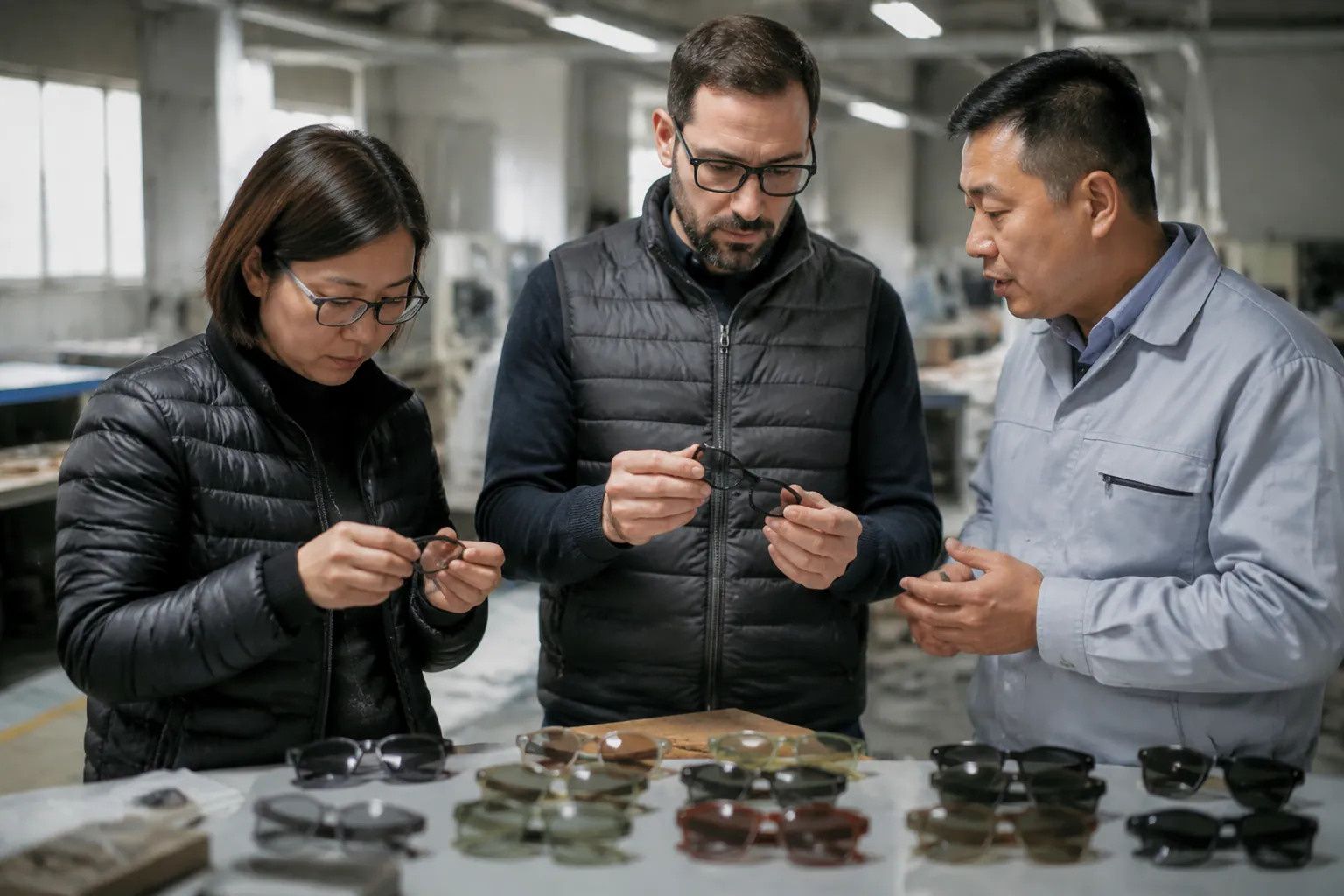
If you buy custom sunglasses for a brand, chain, or distribution business, you need to know what the factory actually does itself. Many suppliers call themselves "in-house" while outsourcing key steps. That can hide delays, defects, and weak accountability. This guide shows overseas B2B buyers how to verify molding, acetate cutting, CNC milling, tinting, decoration, and QC before placing volume orders.
What "in-house" means in eyewear
In sunglasses sourcing, "in-house" should mean the factory controls the steps that affect fit, finish, repeatability, and delivery date. That usually includes mold maintenance, injection or acetate forming, cutting, CNC milling, lens tinting, decoration, final assembly, and outgoing QC. If a supplier only assembles parts from outside vendors, that is not integrated manufacturing. It is coordination. Different thing.
This matters because every outside handoff adds time, shipping risk, color drift, and gaps in responsibility. A lens shade can shift if tinting is not controlled tightly. A hinge seat that is slightly off can make one batch feel loose and the next batch too tight. A logo can pass sample approval and still fail later if the surface was not prepared correctly.
A useful rule is simple: if the factory cannot show the machine, the operator, the in-process check, and the reject record for a step, treat that step as unverified. Real in-house depth is visible on the floor and in the records. Not just in a brochure.
LumiShades, for example, says it handles injection molding, acetate cutting, CNC milling, lens tinting, decoration, and QC in-house. That is the kind of claim buyers should verify step by step. The value is in process control, not the phrase "factory direct."
Molding and frame making
For injection-molded frames, ask how the factory manages resin selection, drying, melt temperature, mold temperature, cycle time, and cavity balance. A serious supplier should explain which resin grades it uses, how long materials are dried, how machine settings are chosen, and what happens when shrinkage changes after a material swap. If the shop uses multi-cavity molds, ask how it keeps cavity-to-cavity variation within range. A capable team speaks in numbers. Cycle time. Cavity count. First-article dimensions. Reject rate. Vague answers are a warning sign.
Acetate is different. The material can vary in thickness, internal stress, and color depth from lot to lot. If the incoming sheet is supposed to be 6.0 mm, ask what tolerance the factory accepts, how it checks thickness at multiple points, and how it handles warpage after cutting and rough shaping. Good shops inspect incoming sheet, then check critical dimensions again after heating, milling, and polishing. A small shift can change bridge fit, hinge alignment, or lens groove depth. Small problem. Big effect.
Ask the factory to show:
- How incoming resin or acetate sheet is checked before production, including thickness, color lot, and surface defects
- How often molds are cleaned, vented, and inspected for wear, flash, or cavity imbalance
- What first-piece dimensions are measured and who signs off before the run starts
- How scrap, rework, and mixed lots are separated and labeled on the floor
If the supplier truly runs these steps in-house, it should answer directly and show records without needing to "check with the engineer" for every basic question.
CNC milling and cutting
CNC milling is where many factories claim precision but lose it at volume. The right question is not whether they own CNC machines. The question is what they control and how they prove it. For custom sunglasses, good factories usually define and monitor the dimensions that matter most for fit and assembly, including bridge fit, hinge seat location, and lens groove depth. If the supplier cannot describe its tolerance targets or inspection method, it is not managing the process consistently.
Acetate cutting and milling should match the frame design. Thick, rounded frames can hide small tool marks. Thin, angular profiles expose everything: burn marks, uneven grooves, rough edges, and temple misalignment. Ask what cutter speed they use for different material densities, how they reduce edge chipping, and how they control tool wear. A real in-house shop will mention feed rate, dust extraction or cooling, tool replacement frequency, and first-piece checks. For high-gloss acetate, polishing sequence matters too: rough polish, medium polish, fine polish, then final cleaning. Skip a stage and you get haze, sink marks, or a surface that looks good in photos but scratches too easily in packing.
Here is a practical comparison buyers can use during a factory review:
| Process area | Good in-house sign | Warning sign | Buyer impact |
|---|---|---|---|
| Injection molding | Mold log, machine settings, first-article measurement, reject rate by cavity | Only finished frames shown; no machine or mold history | More stable fit and fewer unexpected warpage issues |
| Acetate cutting | Incoming sheet thickness check, cutting allowance, polishing sequence, tool wear records | No explanation for chip control or polishing flow | Cleaner edges, better repeatability, fewer assembly defects |
| CNC milling | Controlled bridge, hinge seat, and groove dimensions with documented checks | No discussion of dimensions or sample-to-bulk control | Better lens retention and assembly fit at scale |
| Decoration | Artwork verification, fixture-based placement, post-process inspection before packing | Decoration handled elsewhere after bulk approval | Lower risk of logo defects, delays, and rework |
A factory with real depth will not be bothered by these questions. It should welcome them. Process detail is what protects quality later.
Tinting and lens work
Lens tinting is often treated like a small step. It is not. Tint concentration, bath temperature, dip time, drying conditions, and batch load all affect shade consistency. Small changes can produce visible variation across a lot. That shows up fast in retail. One pair looks right. The next looks washed out or too dark. Customers notice. Then returns start.
Ask how the factory controls tinting for sun lenses versus fashion lenses. Ask whether it checks visible light transmission against the approved sample, not just against a general formula. Ask what it does with black, smoke, brown, and gradient tints because they behave differently in production. If it makes polarized styles, ask how it controls lamination alignment, bubble control, and orientation during cutting. If it makes mirrored lenses, ask how it protects coating adhesion during handling, drying, and final packing. Poor handling leaves marks you can see under light.
For compliance, the target market matters. A serious factory should know the practical difference between CE EN ISO 12312-1, ANSI Z80.3, and AS/NZS 1067. These are not the same tests. The paperwork is not the same either. FDA registration is not a product pass mark by itself, but U.S. buyers still need import discipline and traceability. REACH also matters, especially for coatings, inks, and plastic components. If the supplier cannot speak clearly about restricted substances, material declarations, and dye or coating inputs, expect problems later.
The signal is simple: a capable factory can explain not only the result, but the variables that shape the result. That is what in-house depth looks like in lens work.
Decoration and logo control
Decoration sounds simple until the logo chips, smears, ghosts, or fades after packing and shipping. In-house decoration should cover the full path from artwork confirmation to final inspection. That includes laser engraving, pad printing, hot stamping, and metal logo plates. Each one fails differently. Laser engraving can overburn on glossy acetate or leave weak contrast on dark material. Pad printing can fail because of poor ink transfer, wrong viscosity, dirty pads, or fixture misalignment. Metal plates can lift if adhesive, surface prep, or pressure cure is not controlled.
Ask what the factory does before printing or plating. Surface prep matters more than many buyers realize. If the part is not cleaned, treated, or properly dried before decoration, adhesion becomes the weak point. A supplier trying to catch up on a late order may print too fast, skip cure time, or stack parts too early. That is how logo defects show up after the carton is sealed.
Use this checklist during an audit or video call:
- Confirm whether logo artwork is checked against the approved file before production starts.
- Ask what jig, fixture, or alignment stop is used to keep placement consistent across the run.
- Request examples of common decoration defects and how the factory prevents them.
- Check whether decoration is inspected before assembly and again before packing.
- Ask how the factory isolates rework so corrected and uncorrected goods never mix.
If logo quality is uneven, the problem is usually process control, not the logo design. That distinction matters when you are trying to fix the root cause instead of replacing one bad batch after another.
QC and traceability
QC is not a final glance at the box. It should be built into the process. For sunglasses, that means incoming material checks, first-piece approval, in-process checks, final inspection, and packing verification. A real factory can tell you what gets measured at each stage and who signs off. It can also tell you which defects it sees most often for each product type. Common examples include lens scratches, uneven temple tension, hinge looseness, crooked frames, logo defects, color variation, surface contamination, and coating haze.
Ask what internal acceptance standard the factory uses. Many good factories work to an AQL plan, but the exact number matters less than whether the factory can explain it and apply it consistently. If it cannot answer with a written standard, it is not controlling output. It is hoping for luck. Ask for the inspection method too: visual angle, lighting conditions, sample size, and whether QC checks happen at the line or in a separate room. That tells you a lot about discipline.
Traceability should cover lot number, production date, machine or line identity, and carton identification. This matters if a retailer flags one shipment and you need to isolate the problem instead of blocking all inventory. It also matters for warranty and rework decisions. If the factory keeps only one bulk record, it will be much harder to trace a defect back to a resin lot, tint batch, or decoration run.
Buyer rule: never approve a supplier on sample beauty alone. Approve them on how they catch problems before packing.
LumiShades says it has in-house QC, which is the right direction. But buyers should still ask how records are stored, how a defect report is handled, and how fast the team can quarantine a bad lot. That response tells you more than a polished showroom.
A practical factory audit sequence
If you visit the factory or run a remote audit, use a sequence that exposes weak claims quickly. Start at materials, move through the first forming step, then inspect machining, decoration, and final packing. This is the fastest way to see whether the factory is organized around process flow or just trying to keep the sample room looking clean.
- Start at incoming materials. Ask where resin, acetate sheets, lenses, screws, and hardware are stored, and whether each lot is labeled.
- Move to the first forming step. Watch one operator explain the machine setup, not just the sales rep narrate it.
- Inspect the cutting or CNC area. Look for scrap bins, tool wear control, dimensional checks, and first-piece approval records.
- Go to tinting and decoration. Ask how they prevent color drift, burn marks, ink misalignment, and mixed rework.
- Finish at final QC and packing. Check whether the inspection sheet matches the purchase order and approved sample.
If a supplier claims high annual output and strong on-time delivery, ask how the floor is organized to support that output without pushing problems downstream. Volume alone is not proof of depth. Stable flow is.
Price logic matters too. A low MOQ usually means setup, tooling, and decoration time are spread across fewer units, so the unit price is often higher. As order quantity rises, unit cost can improve because cutting, printing, and inspection overhead are diluted. But only in-house depth lets those savings show up cleanly. If each step is outsourced, every scale increase also adds coordination cost and delay risk.
For buyers, the business impact is direct: a factory with in-house control can protect sample-to-bulk consistency, react faster to changes, and reduce schedule slippage. That matters when lead time depends on frozen specs, available materials, and one production flow under one roof.
Questions to ask before a PO
Use these questions before you commit to bulk:
- Which steps are truly in-house, and which are subcontracted?
- What can you show me for first-piece approval, in-process QC, and final inspection?
- What tolerances do you control on bridge fit, hinge seat, lens groove, and temple alignment?
- Which certifications or compliance standards do you support for my target market: CE EN ISO 12312-1, ANSI Z80.3, AS/NZS 1067, REACH, FDA registration, ISO 9001, or BSCI?
- What is the sample lead time and bulk lead time for my style, and what changes reset the clock?
- How do you handle rework without mixing lots or losing traceability?
- What MOQ, price breaks, and packaging changes affect your production flow most?
For a factory like LumiShades, the stated sample time is 7 to 10 days and bulk production is 25 to 35 days. That can be a useful benchmark for integrated production, but only if artwork, materials, and approvals are frozen on time. A low MOQ of 50 pairs is useful for testing process control. A 300-pair order often tests whether decoration and QC stay consistent. A 1,000- to 5,000-pair order tests whether the factory can scale without outsourcing the difficult parts.
If a factory can answer these questions clearly, show the machines, and prove the records, it is doing more than assembly. That is the level you want when buying custom sunglasses for a brand or retail program.
Have a custom sunglasses project in mind?
Send us your styles, target market and quantities and we will return a detailed quote with MOQ, lead time and a sample plan.
Get a QuoteWhy source this from Wenzhou with LumiShades
Wenzhou in Zhejiang Province is widely regarded as China’s eyewear manufacturing capital, producing a large share of the world’s sunglasses. That concentration matters to buyers: a deep local supply chain for acetate sheet, hinges, lens blanks, plating and packaging means shorter component lead times, easier color and material matching, and a workforce with decades of eyewear-specific skill. LumiShades has manufactured in this ecosystem since 2009, and our vertical integration — in-house injection molding, acetate cutting, CNC milling, lens tinting, decoration and quality control — means no part of your order is quietly subcontracted to a workshop you cannot audit.
For international buyers, that vertical control translates into accountability. When a single factory owns every step, defects are traced and fixed at source rather than bounced between vendors, and your specifications survive intact from first sample to bulk. For procurement review, buyers can request process records, approved samples, quality checkpoints and project-specific compliance files before placing a bulk order. Required testing and documentation are confirmed against the destination market and product specification rather than assumed from a generic certificate list. Explore our manufacturing capabilities and quality control process to see how this works in practice.
Frequently asked questions
How do I tell if a sunglasses factory is really doing molding in-house? Ask to see the molding machine, the mold log, first-piece inspection records, and reject handling for a current order. Then ask one operator to explain resin drying, machine settings, and how the factory monitors shrinkage or flash. If the team can only show finished frames or a sample shelf, the process is not verified yet. A real molding operation should explain its controls in plain language and show matching records.
What is the biggest risk of outsourced decoration? The biggest risks are inconsistent logo placement, poor adhesion, and weak repeatability from one batch to the next. Outsourced decoration also adds another handoff, which can extend lead time and make rework harder to trace. To reduce risk, ask whether the factory controls artwork approval, fixture positioning, surface preparation, and post-print inspection itself.
Which certifications should a serious sunglasses supplier be able to speak to? For the markets named in this guide, the supplier should clearly understand CE EN ISO 12312-1, ANSI Z80.3, AS/NZS 1067, REACH, FDA registration, ISO 9001, and BSCI. Ask which ones apply to your target market and request supporting documents, not just verbal claims. FDA registration is not a product certification, so U.S. buyers should also ask about product testing, labeling, and traceability for the specific style they plan to import.
What sample and bulk lead times are realistic for custom sunglasses? Lead time depends on spec complexity, material availability, and whether decoration and lenses are in house. For a well-organized factory, a sample window of about 7 to 10 days and bulk production of about 25 to 35 days can be realistic when the spec is final and no major changes are introduced. Ask the factory what changes reset the schedule, such as lens color, frame material, logo method, packaging, or compliance testing.
Does a low MOQ mean weak factory capability? No. A low MOQ can be useful for testing process control, especially on a first order. The real question is whether the factory can keep consistency as the quantity increases and whether it can explain how setup time, inspection effort, and unit cost change at 50, 300, 1,000, and 5,000+ pairs. Strong factories can describe that clearly and back it up with production records.
Ready to start?
Explore our square sunglasses or request a quote — our sales team replies within 12 hours.
Request a Quote