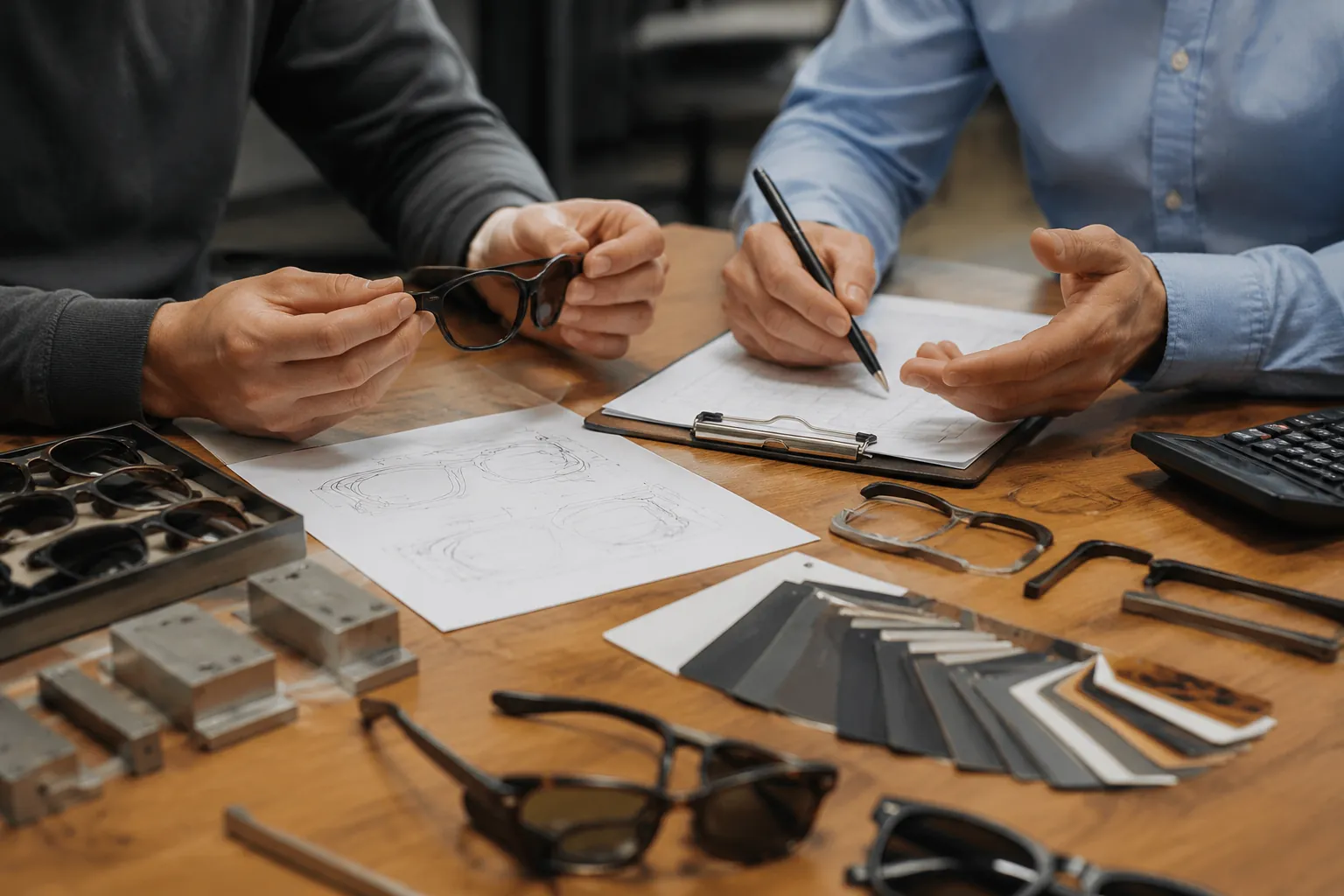
This is for overseas brands, importers, distributors, and retailers buying custom sunglasses in volume. The problem is not finding a factory. It is structuring tooling, sample, and payment terms so you do not fund the whole job upfront. Done properly, you protect cash flow, keep the factory committed, and reduce deadline drift and quality disputes.
Start With Commercial Risk, Not Unit Price
Many weak sunglasses deals start with one question: "What is the best unit price?" That sounds efficient. It is not. In custom eyewear, the bigger risks are tooling spend, sample revisions, delayed approvals, and the point at which the factory has enough of your money to lose urgency.
Break the program into four commercial buckets: tooling, samples, mass production, and final settlement. Do not blend them into one line item. Once they are separate, you can negotiate each stage on its own terms. That matters in OEM sunglasses, where a project may include new molds, custom lens tinting, decoration, and packaging.
Write numbers against each stage. For a simple private-label reorder, tooling may be minimal or nonexistent. For a new frame with a modified front geometry, custom temple shape, or relocated hinge, tooling can become the most sensitive cost item. Sample development usually costs less than mass production, but it is where delays and rework create hidden expense.
Ask a better question: "Which terms tie money to completed work?" That protects cash flow. It also gives both sides a clearer path through the order.
Rule: do not negotiate a custom sunglasses program as one lump sum. Break it into milestones, or you will pay for uncertainty.
Tooling Terms That Keep You in Control
Tooling is where buyers often overpay quietly. For custom frames, tooling may include mold design, steel selection, CNC machining, first shots, sample correction, and sometimes jig or fixture setup for assembly. Cost depends on complexity. A simple injection frame is one thing. A layered acetate front, a metal-core temple, or a custom hinge position is another.
Ask for a tooling brief before any steel is cut. It should show the exact frame dimensions, lens curve, bridge width, temple length, hinge position, and any logo relief or engraving. If the supplier cannot show a drawing or 3D confirmation before production, they are asking you to pay for guesswork.
Use wording that protects both sides. "Free tooling" sounds attractive, but the cost usually reappears elsewhere in the quote. A cleaner approach is tooling amortization: pay the tool fee upfront or in part, then offset a portion against the first or second production order once the agreed volume is reached. The supplier gets coverage. You get a clear recovery path.
Approve a tooling drawing before steel is cut.
State whether the mold is buyer-owned, supplier-owned, or transferred after payment.
Ask for photo or video evidence of the first shot and any correction steps.
Define how many modification rounds are included before extra charges apply.
Write whether tooling is refundable, creditable, or non-refundable.
For acetate and metal styles, state whether the tool is exclusive to your design or reusable on a similar frame later. Exclusivity limits reuse, so it can justify a higher fee. If the supplier can reuse a base mold or core component on another program, that may support a lower fee. If you require exclusive ownership, ask for it in writing and confirm handover terms.
Also confirm practical tolerances. A molded frame front should not be treated as defective if the specification allows a small variance. Define what matters most: lens fit, temple symmetry, hinge alignment, and overall visual balance. If those are not written, every minor deviation becomes a dispute.
Samples: Pay for Speed, Not Endless Rounds
Sample terms should reward speed, clarity, and controlled iteration. A capable factory should usually deliver an initial sample in about 7–10 days for a straightforward custom sunglasses project once artwork and technical data are complete. If the project needs new tooling, a second round may be normal. If the process runs to three or four rounds, the brief was likely incomplete or the supplier is not controlling the line.
Pay sample fees separately from bulk production. A paid sample is normal in B2B eyewear procurement because it covers material loss, machine time, and setup. What matters is whether that fee is creditable later. If you expect a credit, write the threshold into the PO. For example: "Sample fee credited against the first bulk order above 1,000 pairs." Without that line, the credit is only verbal.
Strong sample approval needs measurable checkpoints. "Looks good" is too vague. Use a sign-off sheet that covers frame alignment, lens fit, hinge tension, temple opening force, surface finish, color match, logo placement, and pack-out contents. For a premium program, you may also want a documented tolerance on lens centering, temple-tip symmetry, and the fit between lens and groove.
Decoration is where many sample disputes start. Laser engraving, pad printing, hot stamping, metal logo plates, and in-mold markings behave differently. Laser engraving is durable, but depth and burn can vary by substrate. Pad printing is flexible, but alignment, ink opacity, and curing matter. Metal plates look premium, but they add parts, adhesive control, and insertion labor. Freeze color, size, position, and finish before bulk.
Keep the artwork file locked and match it to the physical approved sample. If anything affects appearance or compliance labeling, do not rely on email approval alone.
Use a Milestone Table, Not a Flat Deposit
For volume programs, a flat deposit-and-balance structure is often too blunt. Milestones let the buyer connect payment to visible progress and give the factory working capital when it actually needs it. That is especially useful when tooling, materials, and decoration all happen before shipment.
Payment option
Buyer cash risk
Factory motivation
Best use case
50% deposit / 50% before shipment
High
Moderate
Small repeat orders, simple SKUs, low tooling risk
30% deposit / 30% after sample approval / 40% before shipment
Medium
High
New custom frames with clear approval gates
30% deposit / tooling paid separately / balance after pre-shipment photos and inspection
Lower
High
Larger programs with stronger QC and timeline control
If a supplier resists milestones, do not stop at "no." Ask what proof of commitment they need. Often the answer is a signed PO, finished artwork, realistic volume visibility, or a forecast that covers the expected order stages. A factory that sees repeat business is more willing to accept staged payments than one-off terms.
Price should also be discussed as a ladder, not a single number. Ask for pricing at specific breakpoints such as 50 pairs for prototyping, 300 pairs for a test run, 1,000 pairs for a first commercial order, and 5,000+ pairs for a scale program. The price move between those levels tells you more than the headline unit cost. If a supplier quotes "$2.10/pair," clarify whether that includes the exact lens type, decoration method, packaging, carton configuration, and shipment term. Otherwise the number is not comparable.
On a real OEM sunglasses order, the lowest price may come with a longer lead time, less customization, or a less durable finish. The right question is not "what is cheapest?" It is "what combination of cost, lead time, and risk gives me the best landed margin?"
Tie Payment to the Manufacturing Sequence
Factory cash flow and buyer protection should follow the production sequence, not a generic contract template. For sunglasses, the usual sequence is final artwork, tooling or component setup, sample approval, raw material prep, production, assembly, inspection, packing, and shipment. Each stage creates a checkpoint that can support a payment release or a holdback.
A practical sequence looks like this: first approve the technical pack, including frame dimensions, lens tint, hinge type, decoration method, packaging, and label placement. Then approve the sample and freeze every visible detail in writing. Release the production deposit only after sample sign-off. Ask for mid-production proof on critical steps such as injection parts, acetate cutting, CNC milling, or lens edging. Finally, require pre-shipment photos, carton counts, and QC records before the balance is paid.
Approve the technical pack and measured drawings.
Confirm the sample and freeze visible details in writing.
Release the production deposit after sample sign-off.
Request mid-production proof on critical manufacturing steps.
Require pre-shipment photos, carton counts, and inspection records before final payment.
If you pay too early, you lose leverage on defects, delays, and packing mistakes. If you pay too late, a genuine factory may slow the line because it is carrying material and labor risk without enough cash coverage. The right balance depends on order size, tooling burden, and how much of the process is visible to you.
Use clear acceptance language. "Balance due after factory inspection report and buyer-approved pre-shipment photos" is much stronger than "balance before shipment." If there is a dispute, the written gate matters more than memory.
Know Where the Real Cost Drivers Sit
Custom sunglasses pricing is driven by more than plastic, lenses, and labor. Complexity and change are the real cost drivers. Every change after sample approval adds work, and the later it happens, the more expensive it becomes. A logo move of 2 mm may seem minor. If it affects printing registration, curing, or rework, it becomes a factory problem, not just a design preference.
These factors move cost and lead time the most:
Frame material: injection molding is usually best for repeat geometry; acetate often needs more hand finishing and polishing; CNC-cut styles carry more setup and scrap risk.
Lens type: basic tinted lenses are easier than polarized lenses, mirrored coatings, gradient tints, or other specialty lens constructions.
Decoration: laser engraving is precise but may require testing on each substrate; pad printing adds alignment and ink-curing control; metal plates add parts and assembly time.
Packaging: custom boxes, microfiber pouches, inserts, and barcodes add coordination, kitting, and inspection steps.
Color matching: a custom Pantone request may require multiple adjustments before the buyer accepts the shade under the chosen lighting conditions.
Lead times should reflect those variables. A clean sample in 7–10 days and bulk in 25–35 days can be reasonable for a manufacturer with in-house control if the specification is frozen and materials are on hand. If you are still changing temple length, lens tint, logo size, or packaging copy after approval, the schedule will slip. The supplier is not being slow. The buyer is changing the job.
Ask the supplier to state what happens if you change the order after tooling starts. The answer should be specific: certain changes are included within a defined number of revision rounds, and everything else is chargeable or time-shifting. That makes the commercial risk visible instead of hidden.
For volume planning, ask about MOQ logic. Some factories can do 50 pairs for a prototype run, 300 pairs for a trial, and 1,000+ for better unit economics. The issue is not the lowest MOQ on paper. It is whether the factory can keep stable color, lens consistency, and assembly quality at each step. A lower MOQ with unstable QC is expensive in the end.
Compliance Is a Payment Topic Too
Compliance is not separate from commercial terms. If the order needs CE EN ISO 12312-1, ANSI Z80.3, AS/NZS 1067, REACH, FDA registration context, ISO 9001 alignment, or BSCI alignment, define that before production starts. A supplier may be capable of compliance work but still miss a detail if the buyer never states which market the goods are for.
Do not ask for "all certifications." Ask for the ones that match the destination and the channel. A retailer in Australia may care most about AS/NZS 1067 and labeling. A US program may need ANSI Z80.3 expectations and FDA registration context. EU-bound goods should align with CE EN ISO 12312-1 and relevant REACH material control.
Put compliance in the acceptance checklist. That should include lens transmittance, labeling, batch traceability, and material declarations where relevant. If compliance documents are missing, the final payment should not release until they arrive. That is standard trade discipline, not punishment.
Be explicit about packaging and markings. If the cartons need SKU, barcodes, country of origin, or market-specific warnings, those items belong in the approval pack, not in a side email. Many "compliance problems" are documentation problems that should have been caught before production.
A Buyer's Short Negotiation Checklist
Use this before you sign anything. It keeps the conversation tight and avoids vague promises that create cost later.
Separate tooling, samples, production, and freight.
Define what is refundable, creditable, or non-refundable.
Lock sample approval criteria in writing.
Use milestone payments tied to visible work.
State the lead time only after specifications are frozen.
Require pre-shipment photos, carton counts, and QC records.
Match compliance documents to the destination market.
Confirm price breaks at 300, 1,000, and 5,000+ pairs.
If the supplier is organized, this structure is welcome. It shows that you understand commercial reality and are not asking them to carry all the risk for free. If they resist every checkpoint, that is also useful information. It usually means they want your cash more than your repeat business.
The best negotiations are not about winning a lower price on day one. They are about building a program where tooling is controlled, samples are finite, payments are staged, and both sides can predict the next step. That is how custom sunglasses orders stay profitable instead of becoming a long chain of avoidable surprises.
Use the Deal to Protect the Relationship
Good commercial terms do not make the relationship colder. They make it easier to manage. A factory that knows when it will be paid, what it must prove, and how changes are handled can plan materials and labor better. A buyer that knows the approval gates can defend margin and avoid surprise charges. In eyewear procurement, clarity is not bureaucracy. It is how you keep the program moving.
For most overseas buyers, the right target is not the cheapest quote or the biggest deposit discount. It is a structure that matches money to work done: drawings approved, samples signed off, production visible, and shipment supported by records. When those pieces are in place, you can negotiate harder on price without losing control of delivery.
If you are buying from a Wenzhou eyewear factory or any other OEM sunglasses supplier, insist on that structure from the first conversation. The factories that can support it will usually welcome it. The ones that cannot will show themselves quickly, which saves you time before the order becomes expensive.
Have a custom sunglasses project in mind?
Send us your styles, target market and quantities and we will return a detailed quote with MOQ, lead time and a sample plan.
Wenzhou in Zhejiang Province is widely regarded as China’s eyewear manufacturing capital, producing a large share of the world’s sunglasses. That concentration matters to buyers: a deep local supply chain for acetate sheet, hinges, lens blanks, plating and packaging means shorter component lead times, easier color and material matching, and a workforce with decades of eyewear-specific skill. LumiShades has manufactured in this ecosystem since 2009, and our vertical integration — in-house injection molding, acetate cutting, CNC milling, lens tinting, decoration and quality control — means no part of your order is quietly subcontracted to a workshop you cannot audit.
For international buyers, that vertical control translates into accountability. When a single factory owns every step, defects are traced and fixed at source rather than bounced between vendors, and your specifications survive intact from first sample to bulk. For procurement review, buyers can request process records, approved samples, quality checkpoints and project-specific compliance files before placing a bulk order. Required testing and documentation are confirmed against the destination market and product specification rather than assumed from a generic certificate list. Explore our manufacturing capabilities and quality control process to see how this works in practice.
Frequently asked questions
Should I pay tooling upfront or split it into milestones? Split it where possible. A practical approach is to pay after the mold drawing is approved, then release the next portion after the first sample is confirmed. If the supplier needs upfront coverage, keep it limited, written, and tied to a defined tool plan and ownership term.
What sample terms are fair for custom sunglasses? A paid sample is normal for a new frame because it covers material loss, machine time, and setup. If you want the sample fee credited later, write the condition into the PO, including the order quantity threshold and when the credit will be applied.
What deposit is reasonable for a new custom order? For a new program, 30% is often easier to justify than 50% because it funds raw material prep while preserving buyer leverage. The rest should be tied to sample approval, production progress, or shipment readiness. If a supplier asks for more, ask what specific risk the extra cash is covering.
How do I avoid paying for endless revisions? Freeze the technical pack before sample work starts and define the number of correction rounds in writing. After that, extra changes should be chargeable or scheduled separately. If revisions keep changing, the most effective fix is to lock artwork, measurements, and decoration details before the next round begins.
Can I hold final payment until after inspection? Yes, if that is written into the deal. A common structure is balance due after pre-shipment photos, inspection records, and carton confirmation. Make sure the documents you require are named clearly in the PO so there is no dispute about what counts as completion.
Which compliance documents should I ask for first? Match the documents to the destination market and the product type. For the EU, ask for CE EN ISO 12312-1 and REACH-related material control. For the US, ask about ANSI Z80.3 expectations and FDA registration context. For Australia and New Zealand, ask for AS/NZS 1067 alignment. If the supplier also has ISO 9001 or BSCI, treat those as factory-management references, not substitutes for product compliance.