
Wholesale Sunglasses: Assortment, QC, and Reorders
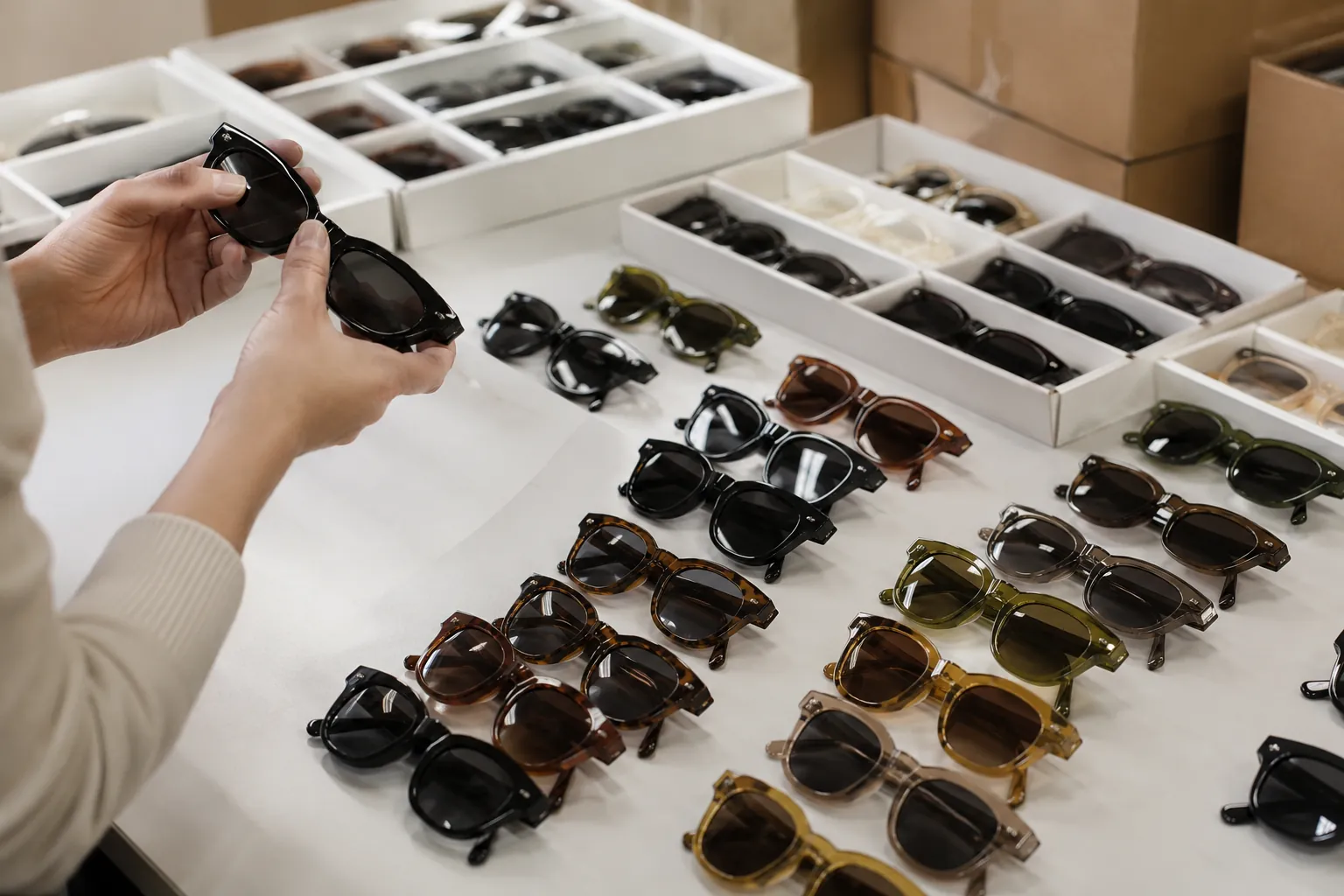
This guide is for importers, regional distributors, retail groups, and B2B resellers building a sunglasses range for wholesale resale. It shows how to choose stock styles, private-label options, price tiers, materials, compliance paths, QC checkpoints, and reorder rules without locking cash into slow colors or untested shapes. The advice follows practical eyewear sourcing logic: MOQ planning, decoration control, sample approval, bulk lead-time checks, inspection criteria, and document review before purchase orders are placed.
Start With SKU Roles, Not Frame Shapes
A profitable wholesale sunglasses range does not start with attractive catalog pages. It starts with roles. Each SKU needs a job. Some models drive repeat volume. Some protect margin through private-label presentation. Some test seasonal demand without taking over the inventory budget. If the role is vague, the reorder decision will be vague too.
Most distributors should build the first buy in three layers: core stock, margin builders, and controlled experiments. Core stock means proven commercial colors such as black, tortoise, brown, smoke lens, G15-style green lens, plus a few metal aviator or square models that can sell across many retailer types. Margin builders are private-label frames with controlled changes: logo, pouch, case, lens color, hangtag, barcode label, or temple detail. Experiments are narrow fashion lenses, translucent seasonal colors, oversized shapes, or resort styles ordered in smaller quantities until sales prove them.
If a supplier offers MOQ from 50 pairs per design, treat that as a testing tool. Not a buying strategy. A proven square PC or TR90 frame in black may justify a deeper order because the unit cost can improve and stockout risk is lower. A translucent orange fashion lens should usually start as a small test unless a named account has committed volume. For a first range, many distributors perform better with 12 to 20 active SKUs than with 60 shallow SKUs that cannot be replenished cleanly.
A useful starting split is 60% core styles, 25% margin-building private label, and 15% experiments. Review that split every 60 to 90 days using sell-through, gross margin, return reasons, and retailer feedback. Do not fear predictable winners. They pay warehouse rent, sales commissions, freight bills, and future product tests.
Build a Core Range Buyers Can Reorder
Wholesale buyers need dependable choices. A retailer does not want a catalog where every frame is new, untested, and hard to explain. Keep the core range tight enough for sales reps to remember and broad enough to cover face shapes, retail price points, gender-neutral styling, and age groups.
- Classic square plastic: black, tortoise, matte black, smoke lens, and brown lens. Suitable for fashion stores, beach retailers, travel shops, convenience channels, and general impulse programs.
- Aviator metal: gold, silver, gunmetal, gradient smoke, green, or brown lens. Useful for resort, travel, and men's accessory accounts when plating, screw retention, and lens fit are controlled.
- Sport wrap: PC or TR90 frame, UV400 or polarized lens, rubber nose pads, and secure temple fit. Relevant for outdoor retailers, petrol stations, fishing, driving, and travel programs.
- Kids styles: smaller bridge, flexible temple, rounded edges, bright colors, and stronger hinge checks. Do not market kids sunglasses as toys if they are sold for UV protection.
- Premium acetate: thicker hand-feel, polished finish, rivet detail, metal logo plate, or laser logo. Better for boutiques, gift channels, and private-label brand lines where retail price supports the material cost.
Use color discipline. A distributor often makes more profit with 12 strong, replenishable SKUs than with 60 half-stocked colors. Keep black, tortoise, brown, smoke, and green lens options in the main line. Move pink, orange, crystal blue, mirror coatings, and festival colors into seasonal or account-specific programs. If only one account wants a special color, price it as a custom run instead of weakening the general inventory plan.
Specify lens width, bridge, temple length, and total front width. A common adult square style may sit around 52-55 mm lens width, 18-22 mm bridge, and 140-145 mm temple, but final sizing must match the approved sample and target wearer. Kids frames usually need shorter temples and a narrower bridge. These measurements reduce returns caused by fit, not styling.
Match Materials to Channel and Risk
Frame material affects cost, hand-feel, durability, production time, repairability, and the sales story. It also changes the QC risk. Injection-molded PC and TR90 frames are efficient for repeat production once tooling and color standards are controlled. Acetate can look richer, but it needs cutting, CNC milling, tumbling, polishing, and hand adjustment. Metal frames add plating control, solder joint checks, screw control, nose-pad alignment, and lens-fit inspection.
| Material | Best Use | Typical Behavior | Factory Control Point |
|---|---|---|---|
| PC injection | Entry stock styles, promotions, impulse retail | Low cost and stable for simple shapes, but can stress-whiten or feel less premium if flexed hard | Gate marks, shrinkage, lens groove fit, color consistency, hinge seating, and print adhesion |
| TR90 injection | Sport, travel, flexible everyday frames | Better rebound and flexibility than basic PC, usually with higher material cost | Temple symmetry, hinge seating, frame recovery, rubber part bonding, and lens retention |
| Acetate | Private label, boutique resale, higher retail price | Richer hand-feel and polish, but longer processing and more manual variation | CNC accuracy, lamination lines, tumbling time, polishing marks, and heat adjustment |
| Metal | Aviator, navigator, rimless, thin fashion frames | Light appearance and premium styling, but plating and solder joints create additional risk | Plating adhesion, solder strength, screw retention, nose pad alignment, and lens tension |
For a mixed-material program, ask which processes are controlled in-house and which are subcontracted. This matters. A delay in lens tinting, plating, logo decoration, packaging, or final assembly can hold the whole shipment. Clear process ownership also helps trace defects, approve corrective samples, and keep reorders consistent.
Material choice should follow the sales channel. Petrol station and impulse programs usually need robust PC or TR90, simple packaging, and fast repeatability. Boutique private-label programs can support acetate, custom hardware, and stricter cosmetic sorting. Sport accounts may care less about fashion color and more about lens stability, temple grip, polarization performance, and fit security.
Use MOQ Without Damaging Margin
Wholesale distributors live between factory cost and retailer resistance. The mistake is chasing the lowest unit price on every item. A better method is to assign price tiers: entry, standard, and premium. Each tier needs rules for material, lens type, hinge quality, packaging, decoration, inspection level, and compliance documentation.
Use MOQ according to demand evidence. Small MOQs are useful for testing new colors, new shapes, or account-specific ideas. Larger quantities should be reserved for proven A SKUs, confirmed account orders, or styles with repeat sales history. A lower unit cost does not improve margin if the extra stock sits for months, is discounted heavily, or dies after the season.
- Entry tier: PC frame, UV400 lens, standard hinge, simple temple print, polybag or basic pouch. Suitable for bins, seasonal displays, and price-sensitive retailers.
- Standard tier: PC or TR90 frame, improved hinge, polarized option where required, logo on temple, microfiber pouch, and controlled color assortment. Suitable for repeat wholesale accounts.
- Premium tier: acetate or metal frame, custom lens tint, metal logo plate, branded case, stricter cosmetic sorting, and stronger presentation. Suitable for boutiques and brand programs.
Calculate landed cost, not just ex-factory cost. Freight, duty, inspection, inner boxes, barcodes, carton volume, and cases can change the real margin. A bulky hard case may improve retail presentation but increase carton count and freight cost. Before confirming, ask for carton dimensions, pairs per carton, gross weight, packing method, barcode placement, and whether retail-ready packaging is included. One packaging change can rewrite the margin.
Keep Private Label Reorderable
Private label helps distributors defend margin. But too much customization slows reorders and increases quality variation. The safer route is a repeatable base frame with controlled changes: logo, lens color, temple print, pouch, case, hangtag, barcode label, and sometimes a hinge or metal plate detail. Full new tooling only makes sense when confirmed volume, protected design value, or a retailer program justifies the cost.
For a first private-label range, choose two or three proven shapes and keep branding consistent. Pad printing can work on PC and TR90 temples when the artwork is simple and the surface is suitable. Laser engraving is cleaner for metal parts and some acetate surfaces. Hot stamping can work on cases and pouches. Metal logo plates can add perceived value, but they need secure placement, scratch checks, and color approval. Lens tinting can separate a line. Keep the palette tight. Gray, brown, green, gradient smoke, and polarized smoke cover many commercial needs.
Confirm sampling and bulk lead time in writing before committing to launch dates. Standard customization often takes less time than new mold work, custom hardware, special packaging, or unusual lens colors. Still, every supplier's schedule depends on capacity, material availability, artwork approval, and inspection requirements. Packaging files are a common delay point, so approve dielines, color references, barcode content, warning labels, and case or pouch materials before bulk production is scheduled.
Keep a master specification for each private-label SKU: frame code, material, color reference, lens color, UV requirement, polarization requirement, logo size, logo position, packaging components, barcode, inspection level, market compliance path, and approved sample date. Reorders move faster when the factory and buyer work from the same controlled specification instead of old email threads.
Plan Compliance Before Purchase Orders
Compliance is not a sticker decision at the end. Decide target markets first. Then set lens category, labeling, warnings, user information, and test requirements before sampling. Sunglasses sold into Europe, the United States, Australia, and New Zealand do not follow one identical paperwork path.
Use only relevant, verifiable documents. Common references include CE requirements under EN ISO 12312-1 for Europe, ANSI Z80.3 for non-prescription sunglasses in the United States, AS/NZS 1067 for Australia and New Zealand, REACH for chemical restrictions in the EU, FDA registration where applicable to the supplier or importer context, ISO 9001 for quality management systems, and BSCI for social compliance audits. Be clear: FDA registration, ISO 9001, and BSCI are not substitutes for product testing. They support supplier review, but they do not prove that a specific sunglasses SKU meets lens, labeling, or chemical requirements.
- EU: Check CE requirements under EN ISO 12312-1, UV protection, lens category, user information, declarations, and applicable markings.
- US: Review FDA registration relevance and ANSI Z80.3 requirements for non-prescription sunglasses, including optical and labeling expectations.
- Australia/New Zealand: Use AS/NZS 1067 to confirm lens category, labeling, and consumer information requirements.
- Chemicals: Review REACH for frame materials, coatings, inks, packaging, nose pads, and metal components when selling into the EU.
- Children's products: Apply stricter review to small parts, coatings, fit, impact risk, and labeling, especially for major retailers or regulated channels.
Group SKUs by compliance path. Do not mix children's sunglasses, sport shields, polarized driving styles, novelty lenses, and adult fashion frames into one loose test plan. The risk is not just a failed report. It is stock that cannot be sold, relabeled in time, or accepted by a retailer's compliance team.
Set QC Tolerances Before Bulk Production
Wholesale sunglasses fail in predictable places: loose screws, hinge tension, lens pop-out, color variation, printing rub-off, frame warpage, plating spots, crooked nose pads, and packaging damage. Define inspection points before bulk production. Waiting until cartons arrive is expensive.
On plastic injection frames, check gate marks, shrinkage, temple symmetry, hinge alignment, lens groove fit, and stress marks. On acetate, check polishing quality, lamination lines, front curve, temple opening angle, and heat adjustment. On metal, check plating spots, solder joints, screw retention, nose pad placement, bridge alignment, and lens tension. Lens checks should include tint consistency, visible distortion, UV protection, polarization if ordered, and cosmetic scratches.
Use measurable tolerances where possible. Temple logo position should stay within an agreed tolerance against the approved sample, often around 1 mm if the design requires precise placement. Lens color should be compared with the approved sample under consistent lighting, not random warehouse light. Hinges should open and close smoothly without grinding, excessive looseness, or uneven resistance between left and right temples. Frame fronts should sit level on a flat surface without obvious twist. Packaging checks should cover crushed cases, wrong barcodes, missing pouches, incorrect labels, and mixed SKUs.
For bulk orders, use AQL inspection or an agreed internal QC sampling plan. The buyer still needs a written specification sheet, an approved sample, and clear defect classifications. Verbal quality expectations are not quality control. If a defect affects compliance, UV protection, safety, retail acceptance, or sellability, classify it as more serious than a minor cosmetic mark hidden inside the temple.
Reorder With Inventory Discipline
Distributors make money by having the right stock available. Not every style. Build reorder rules around production lead time, inspection time, freight time, customs clearance, sell-through, and account commitments. If production and freight take several weeks, the reorder point must come before the warehouse looks empty.
Separate the assortment into A, B, and C SKUs. A SKUs are proven sellers that deserve deeper stock and earlier reorders. B SKUs are useful but need monthly review. C SKUs are seasonal, experimental, or account-specific; keep them controlled. Larger production quantities make sense only when sales history, retailer commitments, or replenishment data support the risk. For C SKUs, small test quantities can prevent dead stock.
Simple reorder rule: average monthly sales multiplied by total replenishment time, plus safety stock for large account orders. If a style sells 600 pairs per month and replenishment takes two months door to door, reordering at 1200 to 1500 pairs is safer than waiting for the last 300 pairs.
Track returns by reason, not just quantity. Separate hinge complaints, lens scratches, fit issues, broken packaging, wrong barcode, missing compliance labeling, and slow sell-through. If one model has repeated hinge complaints, pause reorders until the hinge, screw, or assembly process is corrected. If polarized styles sell slower but return less often and support a higher price, keep them in the standard tier. Inventory discipline is practical. It is the difference between profit and a warehouse full of last season's colors.
Have a custom sunglasses project in mind?
Send us your styles, target market and quantities and we will return a detailed quote with MOQ, lead time and a sample plan.
Get a QuoteWhy source this from Wenzhou with LumiShades
Wenzhou in Zhejiang Province is widely regarded as China’s eyewear manufacturing capital, producing a large share of the world’s sunglasses. That concentration matters to buyers: a deep local supply chain for acetate sheet, hinges, lens blanks, plating and packaging means shorter component lead times, easier color and material matching, and a workforce with decades of eyewear-specific skill. LumiShades has manufactured in this ecosystem since 2009, and our vertical integration — in-house injection molding, acetate cutting, CNC milling, lens tinting, decoration and quality control — means no part of your order is quietly subcontracted to a workshop you cannot audit.
For international buyers, that vertical control translates into accountability. When a single factory owns every step, defects are traced and fixed at source rather than bounced between vendors, and your specifications survive intact from first sample to bulk. For procurement review, buyers can request process records, approved samples, quality checkpoints and project-specific compliance files before placing a bulk order. Required testing and documentation are confirmed against the destination market and product specification rather than assumed from a generic certificate list. Explore our manufacturing capabilities and quality control process to see how this works in practice.
Frequently asked questions
What is a safe first order size for a new distributor sunglasses range? Start with a focused range of about 12 to 20 SKUs. Order deeper only on proven core colors or account-backed styles, and use smaller quantities for new colors, fashion lenses, or seasonal shapes. Before increasing quantity, check expected monthly sell-through, landed cost, retailer commitments, and total replenishment time.
How long should I allow from sample request to bulk shipment? Build the schedule from separate steps: sample development, sample approval, packaging artwork approval, bulk production, inspection, freight booking, customs clearance, and delivery to your warehouse or retailer. Ask the supplier to confirm each step in writing because custom packaging, special lens colors, new tooling, or compliance testing can extend the timeline.
Which compliance documents should I ask for before ordering? Match documents to the destination market and product type. For Europe, review CE requirements under EN ISO 12312-1 and REACH where relevant. For the US, review ANSI Z80.3 and FDA registration relevance. For Australia and New Zealand, review AS/NZS 1067. Check that reports match the ordered product, lens type, material, test date, and issuing lab.
Is private label worth doing at low MOQ? Yes, if the customization is controlled and reorderable. Start with proven base frames and add practical branding such as temple logo, pouch, case, hangtag, barcode label, or approved lens tint. Avoid new tooling until there is enough confirmed volume or a retailer program that justifies the cost and development time.
How do I reduce slow-moving inventory? Classify every SKU as A, B, or C before ordering. Give A SKUs earlier reorder points, review B SKUs monthly, and keep C SKUs limited to seasonal tests or account-specific programs. Do not move to larger production quantities until sales history, retailer orders, and margin data support the risk.
What should be checked during sunglasses QC? Check hinge tension, screw retention, lens fit, UV protection, tint consistency, polarization if ordered, logo placement, scratches, frame symmetry, plating quality, packaging damage, barcodes, labels, and compliance markings. Use an approved sample, written specification sheet, and AQL or agreed sampling plan before shipment.
Ready to start?
Explore our shield & oversized sunglasses or request a quote — our sales team replies within 12 hours.
Request a Quote