
OEM Sunglasses Factory Audit Checklist
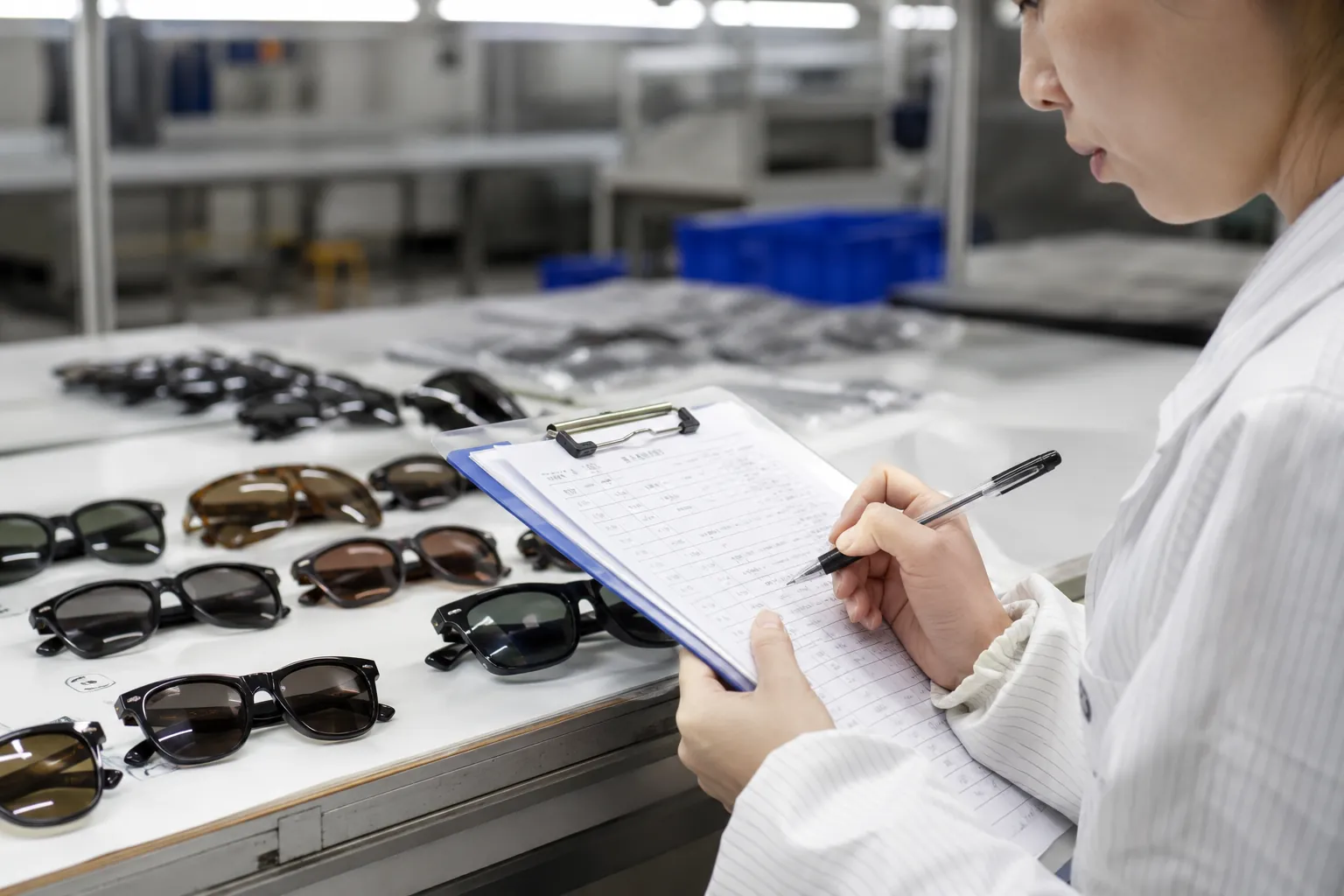
This checklist is for overseas brands, importers, distributors, and retail buyers preparing to place OEM sunglasses orders. It shows what to verify before paying a deposit: legal identity, production control, lens safety, material traceability, physical tolerances, compliance documents, MOQ logic, decoration stability, quality records, and delivery planning. Use it to tell a capable OEM manufacturer from a supplier that cannot prove how your sunglasses will be made, tested, packed, and shipped.
Start With Factory Identity and Order Fit
A serious audit starts before the factory tour. Confirm who legally takes the order, who controls production, where frames and lenses are made, and whose bank account receives the deposit. In eyewear, many suppliers can coordinate production. Fewer can prove direct control over frame forming, lens preparation, decoration, assembly, and final QC under one documented system.
Ask for the business license, export registration if applicable, ISO 9001 certificate if claimed, BSCI report if claimed, factory address in Chinese and English, and the exact company name on the proforma invoice and bank account. The names should match or have a documented relationship. If payment is requested to a different company, stop and ask why. Get a written explanation, company chop or authorized signature, and approval from your finance or compliance team before moving forward.
- Product fit: confirm the factory has produced your frame type before: injected PC, TR90, acetate, metal, mixed-material, sport shield, kids, reading sunglasses, or optical-ready frames.
- MOQ fit: confirm the MOQ by design, color, lens type, logo method, and packaging option; small pilot runs may be possible, but cost and production efficiency usually improve as quantity increases.
- Price fit: ask the supplier to separate cost drivers such as frame material, lens type, hinge type, logo method, surface coating, packaging, testing, and inspection requirements.
- Market fit: confirm the target standard before sampling: CE EN ISO 12312-1 for the EU, ANSI Z80.3/FDA requirements for the US, AS/NZS 1067 for Australia/New Zealand, REACH where applicable, or multiple-market compliance.
Do not audit for the cheapest quote alone. Audit whether the factory can repeat the same product without drifting on lens color, hinge feel, temple angle, logo position, barcode, labeling, or carton marking.
Verify Capacity With Machines, Output, and Bottlenecks
Capacity claims are easy to print in a company profile. Real capacity shows up in equipment, staffing, production records, and current workload. During the audit, count active injection machines, CNC stations, acetate cutting equipment, polishing equipment, lens tinting or lens matching areas, spray booths, decoration lines, assembly benches, and QC tables. Ask how many shifts run per day, how many workers are assigned to eyewear assembly, and how much confirmed work is already scheduled for the next production window.
Do not accept one annual capacity number without context. Injection molded PC or TR90 frames and acetate frames do not move at the same speed. A single-color injected frame with stock lenses can move quickly after mold, material, and approvals are ready. A laminated acetate style is slower. It may require sheet conditioning, CNC shaping, barrel tumbling, hand polishing, hinge insertion, lens matching, and final adjustment.
| Process | Typical Audit Check | Practical Risk |
|---|---|---|
| Injection molding | Machine count, mold storage, cycle records, resin drying, first-shot approval | Mixed resin, shrinkage variation, weak hinge boss, unstable color |
| Acetate processing | Sheet storage, CNC programs, bridge drilling, tumbling time, hand polishing quality | Warped fronts, uneven thickness, cloudy polishing, poor lens fit |
| Lens tinting or matching | Color standard, UV test record, visible light transmittance category, batch labeling | Shade drift between batches or incorrect category marking |
| Decoration | Pad print fixture, laser engraving depth, metal plate position, adhesion test | Crooked logo, weak ink adhesion, inconsistent branding |
| Assembly and QC | Hinge torque, temple alignment, lens seating, cleaning, AQL plan | Loose screws, popped lenses, scratched lenses, mixed SKUs |
Ask the planner to show the production schedule, not just describe it. If a lead time is promised, the factory should show where mold trial if needed, material purchase, lens production or sourcing, decoration, assembly, inline QC, final inspection, and packing fit into that window.
Map In-House Processes and Outsourced Work
Outsourcing is not automatically a problem. Hidden outsourcing is. Many eyewear factories purchase hinges, screws, lens blanks, nose pads, pouches, cases, cleaning cloths, labels, and cartons. Some also outsource plating, special coating, logo plates, lens treatment, or acetate polishing. The buyer needs to know who controls timing, color matching, inspection, and rework when an outside supplier is involved.
For OEM sunglasses, the key controls are frame forming, lens specification control, decoration setup, assembly, and final QC. If the factory claims in-house injection molding, acetate cutting, CNC milling, lens tinting, laser engraving, pad printing, metal logo plate application, or QC, ask to see the equipment, operators, work instructions, batch records, and inspection records. A claim has value only when it is visible and documented.
- Follow one sample style from raw material to finished packing and ask where each step happens.
- Match every process to an operator, machine, work instruction, first-piece sample, and QC checkpoint.
- Identify purchased parts: hinges, screws, lenses, nose pads, pouches, cases, cloths, labels, cartons, and barcodes.
- Review incoming inspection records for lens blanks, acetate sheets, resin, hinges, screws, and packaging.
- Ask what happens if a lens tint, pad print, or metal logo position fails after partial production has already started.
A capable factory should be comfortable showing process flow and batch records. Overseas buyers often lose money in the gaps between workshops: frames ready but lenses late, logo plates approved but plating delayed, or cartons printed with an old barcode.
Audit Materials, Fit, and Physical Tolerances
Sunglasses look simple. They are not. Small physical errors create returns. A lens under stress can pop out during shipping. A temple that opens too tightly feels cheap. A bridge width error can change fit and hurt customer reviews. Ask the factory to define measurable tolerances before mass production, not after defects appear.
For plastic frames, check frame front width, lens groove consistency, temple length, hinge alignment, screw depth, pantoscopic angle, bridge symmetry, and temple opening angle. Tolerances should be written in the technical drawing or quality standard. If no drawing exists, create one from the approved sample and define acceptable variation for key dimensions. For many non-prescription fashion frames, visible dimensions need tighter control than hidden structural dimensions. Logo placement should also have its own visual and measurement standard.
Material behavior matters. PC is economical and impact-resistant, but it can show sink marks if wall thickness is uneven. TR90 is flexible and lightweight, but it needs controlled molding temperature and cooling to reduce distortion. Acetate feels premium and polishes well, but it can warp under heat and requires stable sheet quality, proper machining, and controlled polishing. Metal parts need plating adhesion, solder strength, screw thread consistency, and corrosion resistance checks.
- Frame dimensions: compare bulk parts to the approved sample and technical drawing with calipers, not only by eye.
- Lens fitting: lenses should sit flat in the groove without stress whitening, gaps, edge chips, or rattling.
- Temple movement: both temples should open smoothly with similar resistance; loose screws usually get worse in transit.
- Surface finish: inspect under consistent light for sink marks, scratches, orange peel, dust in coating, and uneven polishing.
- Logo position: approve a fixture and position standard before bulk production, especially for pad printing and metal plates.
Treat the pilot order as a control run. It should create the golden sample, BOM, tolerance standard, packaging standard, and defect limit for future repeat orders.
Review Lens Safety, Compliance, and Documentation
Compliance is not a sales deck accessory. It decides whether goods clear customs, pass retail intake, and avoid recalls. For sunglasses, confirm the destination market and request current documents that match the product category, lens type, material, and claims on your packaging or product page.
Relevant documents may include CE EN ISO 12312-1, FDA registration, ANSI Z80.3, AS/NZS 1067, REACH, ISO 9001, and BSCI. Ask what each document covers: sunglasses, lenses, frame materials, coatings, inks, metal parts, the factory quality system, or social compliance. A test report for one lens color or material may not cover your finished product if the lens color, coating, frame material, metal trim, or labeling changes.
| Market or Use | Document To Verify | Buyer Check |
|---|---|---|
| European Union | CE EN ISO 12312-1 and REACH | Check lens category, UV protection, labeling, and restricted substance scope |
| United States | FDA registration and ANSI Z80.3 | Confirm optical and impact requirements for non-prescription sunglasses |
| Australia/New Zealand | AS/NZS 1067 | Check category marking and suitability for driving or high-glare use |
| Polarized sunglasses | Polarization test record | Verify polarization direction, efficiency, and distortion control |
| Factory system | ISO 9001 and BSCI if required | Check certificate holder, address, scope, expiry date, and corrective actions |
For lenses, request UV transmission test results, visible light transmittance category, polarization test method if applicable, color matching records, and batch traceability. Lens category affects use claims. A dark fashion lens that reduces visible light without proper UV protection is a safety and compliance risk.
Inspect QC Control Points From Incoming to Packing
A factory that inspects only finished sunglasses is already late. QC should begin with incoming materials and continue through molding, machining, decoration, assembly, and packing. During the audit, identify who can stop production when defects appear. If only the sales manager talks about quality, you still do not have proof of a working quality system.
Ask for the inspection standard used for your order. It should define critical, major, and minor defects. Critical defects include unsafe lenses, sharp edges, broken hinges, wrong compliance marking, and wrong customer branding. Major defects include obvious scratches, loose lenses, crooked logos, color mismatch, poor temple alignment, and incorrect packaging. Minor defects may include small surface marks outside the main viewing area, depending on your approved limit.
For final inspection, many buyers use ANSI/ASQ Z1.4 AQL sampling. A common starting point is 0 critical, 2.5 major, and 4.0 minor, but strict retail programs may require tighter limits. Set the inspection level, defect list, sample size, acceptance criteria, and reinspection rules before production starts.
- Incoming QC: resin, acetate sheets, lenses, hinges, screws, packaging, and logo parts are checked before production.
- First-piece approval: molding, CNC, tinting, printing, logo placement, and assembly setup are approved before bulk output.
- Functional QC: temples open and close properly, screws hold, lenses stay seated, and nose pads align.
- Optical QC: lens tint, UV protection, visible light category, and polarization are checked where relevant.
- Final QC: finished pairs are inspected against the golden sample, order sheet, carton mark, barcode, and packing method.
Ask how defects are recorded. A useful factory can show defect trends by style, process, operator, and material batch. If every inspection report says pass with no detail, it is not a useful control record.
Confirm Sampling, MOQ, Pricing, and Change Control
Sampling is where many OEM sunglasses orders drift. A buyer approves a good-looking sample, then bulk production uses a different lens, hinge, material, or logo method because the sample room did not document the build. Prevent this with a signed golden sample, bill of materials, lens category, Pantone or physical color reference, logo artwork, packaging specification, carton mark, and inspection criteria.
Ask the supplier to confirm sample lead time, sample cost, tooling cost if any, bulk lead time, MOQ by style and color, and the assumptions behind the quotation. MOQ may change when the order uses custom lenses, custom colors, custom metal parts, special coatings, private packaging, or compliance testing. Price usually improves at higher quantities because setup costs, decoration fixtures, material purchasing, QC time, and packing labor are spread across more units.
| Order Level | Typical Use | Pricing and Production Logic |
|---|---|---|
| Pilot run | Fit check, finish check, market test | Higher unit cost because setup, artwork, QC, and packing are spread over few units |
| Small wholesale run | Retailer test, event order, limited drop | Better material purchase efficiency and more stable logo or tint setup |
| Repeat production run | Retail or distributor replenishment | Stronger scheduling visibility, clearer AQL plan, and better cost control |
| Volume program | Seasonal or ongoing private label program | Lowest practical unit cost when materials, packaging, approvals, and inspection standards are locked |
Decoration method changes affect cost and stability. Pad printing is economical for simple logos, but it needs ink adhesion checks. Laser engraving is durable, but it depends on material contrast and depth. Metal logo plates look premium, but they require tooling, plating, adhesive or insertion control, and position tolerance. Any change after sample approval should be written, including lens category, tint, frame material, hinge, logo size, logo method, pouch, case, barcode, carton quantity, and shipping mark.
Test Delivery Reliability Before Paying the Deposit
Delivery reliability is not just the number of days quoted. It is the factory's ability to protect the schedule when one process slips. During the audit, ask how on-time delivery is measured: ready-to-ship date, forwarder pickup date, vessel departure, or customer receipt. These are different dates. Do not let them blur together.
Review several recent production schedules with customer names removed if needed. Look for planned date, actual date, delay reason, and corrective action. Common eyewear delays include late custom hinges, unstable lens tint, logo plate rework, packaging artwork changes, missing barcode files, incomplete deposit, and late golden sample approval.
- Before deposit: confirm sample approval date, material purchase date, production start date, inline inspection date, final inspection date, and ready-to-ship date.
- During production: request photos or short videos at material receiving, frame forming, lens tinting or matching, decoration, assembly, and packing stages.
- Before balance payment: review final inspection results, carton labels, packing list, product photos by SKU, and any rework records.
- For repeat orders: compare the new order against the previous golden sample, BOM, defect history, and written change list.
Practical rule: if your launch date is fixed, do not plan around the shortest quoted lead time. Add time for sample approval, material confirmation, packaging artwork, inspection, rework if needed, export documents, and freight booking.
The best audit result is not a perfect showroom. It is control. Documents match the floor, operators follow standards, QC records contain real defects, and the planner can explain exactly where your order will sit in the line.
Have a custom sunglasses project in mind?
Send us your styles, target market and quantities and we will return a detailed quote with MOQ, lead time and a sample plan.
Get a QuoteWhy source this from Wenzhou with LumiShades
Wenzhou in Zhejiang Province is widely regarded as China’s eyewear manufacturing capital, producing a large share of the world’s sunglasses. That concentration matters to buyers: a deep local supply chain for acetate sheet, hinges, lens blanks, plating and packaging means shorter component lead times, easier color and material matching, and a workforce with decades of eyewear-specific skill. LumiShades has manufactured in this ecosystem since 2009, and our vertical integration — in-house injection molding, acetate cutting, CNC milling, lens tinting, decoration and quality control — means no part of your order is quietly subcontracted to a workshop you cannot audit.
For international buyers, that vertical control translates into accountability. When a single factory owns every step, defects are traced and fixed at source rather than bounced between vendors, and your specifications survive intact from first sample to bulk. For procurement review, buyers can request process records, approved samples, quality checkpoints and project-specific compliance files before placing a bulk order. Required testing and documentation are confirmed against the destination market and product specification rather than assumed from a generic certificate list. Explore our manufacturing capabilities and quality control process to see how this works in practice.
Frequently asked questions
What should I ask for before arranging a factory audit? Ask for the business license, factory address in Chinese and English, product catalog, process flow for your exact frame type, relevant certificates or test reports, MOQ and price-break assumptions, sample lead time, estimated bulk lead time, bank account details, and the company name that will appear on the proforma invoice. Check that the legal name, address, bank account, and certificate holders are consistent or clearly documented.
Is a small pilot order enough to test an OEM sunglasses supplier? Yes. A pilot order can test communication, sample accuracy, fit, finish, logo placement, packaging, carton marks, and basic delivery discipline. It does not prove full-volume efficiency. Use the pilot to lock the golden sample, BOM, lens category, tolerance standard, packaging file, barcode, defect list, and QC plan before placing a larger order.
Which certifications matter most for sunglasses imports? For the EU, verify CE EN ISO 12312-1 and REACH where applicable. For the US, verify FDA registration requirements and ANSI Z80.3 test evidence for non-prescription sunglasses. For Australia and New Zealand, verify AS/NZS 1067. If your company requires factory system or social compliance review, check ISO 9001 and BSCI, including certificate holder, factory address, scope, expiry date, and corrective action status.
How do I know if lens quality is properly controlled? Ask for UV transmission results, visible light transmittance category, tint standard, polarization test method if applicable, and batch records tied to your order. Compare the test report to the actual lens color, lens type, coating, and finished product. The factory should test against a written standard and retain batch traceability. Lens safety and tint consistency should not be judged by eye alone.
What is a realistic lead time for custom sunglasses? Lead time depends on frame material, lens type, decoration method, packaging, testing, approval speed, and factory workload. Ask the supplier to break the schedule into sample approval, material purchasing, frame production, lens preparation, decoration, assembly, inspection, packing, and ready-to-ship date. Treat new molds, acetate frames, custom lenses, metal logo plates, special coatings, new packaging, and late artwork approval as schedule risks.
What is the biggest red flag during an eyewear factory audit? The biggest red flag is lack of traceability. Examples include no clear process flow, no first-piece approval, no defect records, no material batch control, no lens test records, no written change control, or certificates that do not match the factory address and product scope. If the supplier cannot connect your approved sample to materials, production steps, inspections, and shipment records, the order risk is high.
Ready to start?
Explore our shield & oversized sunglasses or request a quote — our sales team replies within 12 hours.
Request a Quote