
Stock Frames vs Custom Molds: When Tooling Makes Sense
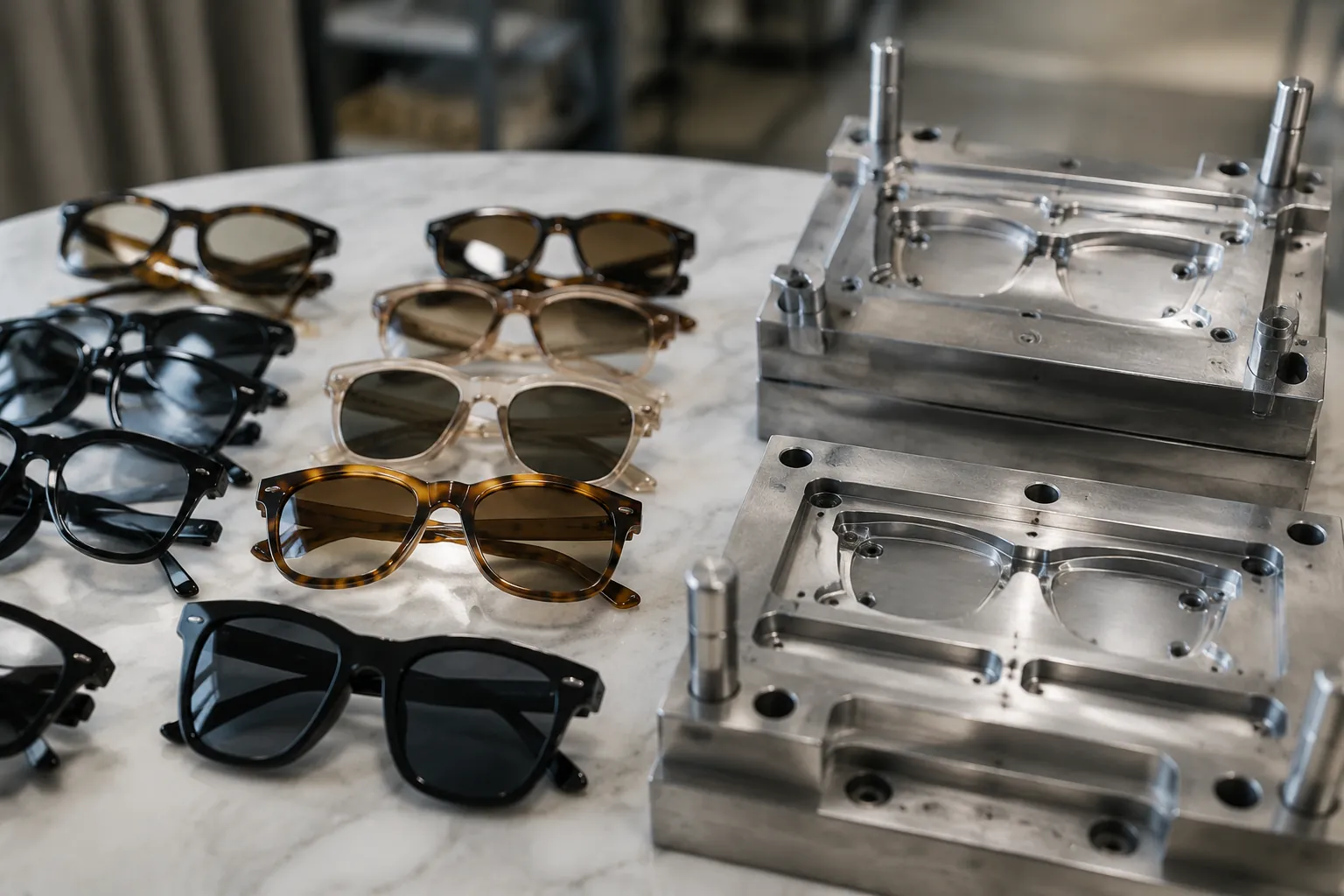
This guide is for brand owners, importers, distributors, and retail buyers deciding whether to launch on stock sunglass frames or pay for new tooling. The choice is not mainly about styling. It is about lifetime volume, margin, reorder stability, fit, brand separation, and the compliance path for the finished product. The framework below compares stock frames and custom molds using basic commercial logic, development constraints, and supplier checkpoints a buyer can verify.
Start with the business case, not the sketch
Buyers often treat this as a design choice: use an existing shape or create a new one. That is too narrow. The better question is simple: what business result will a custom mold produce over the life of the style?
Stock frames use existing factory tooling. That usually means lower upfront cost, faster development, and less risk of paying for a shape that never reorders. For a trend test, a market-entry program, or a small private-label run, stock is often the practical starting point. You keep budget for lenses, branding, packaging, and sell-through validation instead of burying it in tooling.
Custom molds add non-recurring cost and more approval steps before production starts. That can still be the right move if the style is likely to reorder, if stock frames cannot meet the fit or geometry requirement, or if you need a shape competitors cannot lift from the same factory catalog. So the real comparison is not stock versus custom in the abstract. It is speed and low risk versus control and differentiation over time.
What you can change on a stock frame before paying for tooling
Many buyers jump to a new mold too early. On an existing injected or acetate frame, there is often enough room to build a credible private-label program without changing the tool.
- Color and finish: depending on construction, buyers may be able to choose different frame colors, transparent effects, tortoise patterns, matte finishes, gloss finishes, or soft-touch coatings.
- Lens specification: lens tint, gradient, mirror coating, polarized upgrade, and lens material can often be adjusted if the frame design and lens-thickness range allow it.
- Decoration: common options include pad printing, laser marking, foil transfer, or applied metal logo pieces where the frame has a usable surface.
- Packaging: pouch, cloth, box, barcode label, warning label, and outer-carton marks can usually be customized without changing the frame itself.
- Minor component variation: depending on construction, a buyer may be able to adjust hardware finish, nose pad specification, or other non-structural parts.
What usually cannot be changed without new tooling is the core geometry: eye size, bridge shape, front curve, hinge location, temple cross-section, lens outline, and overall silhouette. That is the line. If the commercial goal depends on those points, color and logo changes will not solve it.
Where custom molds create real value
New tooling creates value when it improves margin control, supply continuity, fit, or technical performance. Not just appearance.
- Price protection: a proprietary shape is harder for retailers and competitors to compare directly against open-market frames.
- Reorder control: the buyer is less exposed to a factory dropping a stock style or spreading it across multiple customers.
- Branding surfaces: temples and fronts can be designed around logo placement, hardware integration, or cleaner decoration zones.
- Engineering control: wall thickness, groove design, hinge support, and other structural details can be set around the target lens and use case.
These points matter because small geometry choices affect production stability. Lens seating, hinge alignment, temple opening feel, and surface consistency all depend on details that may not be adjustable on a stock frame. A custom program gives the buyer a chance to review those details before bulk production instead of inheriting them from an existing tool.
Break-even math: use a simple test
You do not need a complex model. Use this equation: Break-even pairs = tooling cost divided by unit margin gain or unit cost saving. Margin gain can come from a higher selling price, lower landed cost at scale, fewer markdowns, or fewer returns if fit and specification are better controlled.
| Program | Lifetime volume | Tooling assumption | Extra margin or saving per pair | Decision signal |
|---|---|---|---|---|
| Trend test | 300 pairs | $3,000 | $0.40 | Break-even is 7,500 pairs, so stock clearly wins |
| Seasonal line with one reorder | 1,500 pairs | $3,000 | $0.80 | Break-even is 3,750 pairs, so tooling is still difficult to justify |
| Core carryover style | 5,000 pairs | $3,500 | $1.00 | Break-even is 3,500 pairs, so custom begins to make commercial sense |
| Retail-exclusive fit program | 8,000 pairs | $4,500 | $1.20 | Break-even is 3,750 pairs, so custom is often justified |
Exact tooling cost and unit economics vary by material, construction, cavity count, finish requirement, and factory process. Ask for a written quotation that separates mold cost, sample cost, unit price by quantity, and any maintenance or modification charges. First-order price alone is not enough. The comparison that matters is lifetime margin across realistic reorders.
Lead time and development risk buyers underestimate
Stock development is usually limited to color, lens, branding, packaging, and approval samples. Custom development adds engineering and correction loops. That takes time.
- Confirm the technical brief: target size, material, hinge type, lens specification, branding points, and target market.
- Review a drawing, rendering, CNC sample, or equivalent development sample for proportions and fit intent.
- Cut tooling or prepare the required production fixtures and programs.
- Run trial parts and check dimensions, lens fit, temple alignment, surface quality, and assembly behavior.
- Approve corrections, confirm the final sample, and only then release bulk production.
The exact timing depends on material, factory workload, and the number of revision rounds. But one point is consistent: custom programs usually take longer than stock programs because trial parts and corrections are normal. Not exceptional. Buyers should ask for a milestone schedule that shows who approves each stage, what happens if a trial fails, and whether tool modifications are included in the original quotation.
Compliance applies to the finished product
For regulated markets, compliance applies to the finished product configuration: frame, lens, coatings, markings, and packaging as sold. Relevant programs a buyer may encounter include CE EN ISO 12312-1, ANSI Z80.3, AS/NZS 1067, REACH, FDA registration, ISO 9001, and BSCI.
- Performance standard: confirm which sunglass standard applies in the destination market and whether testing covers the final lens category, transmission range, and labeling.
- UV claim: do not assume a dark lens provides adequate UV protection. Ask for test evidence tied to the actual lens specification.
- Retention and construction: frame geometry, lens thickness, and assembly tolerances can affect how securely the lens seats in the finished frame.
- Chemical compliance: plastics, coatings, inks, adhesives, and metal parts may all require review against applicable chemical restrictions such as REACH.
- Labeling and traceability: the category marking, warnings, and packaging copy should match the tested configuration and the destination-market requirement.
Custom designs can add compliance risk if they introduce unusual lens shapes, thin rim sections, aggressive curves, or new materials. That does not make custom a bad choice. It means the compliance path should be confirmed before tooling approval, not after a trial build.
A practical decision framework for buyers
Use this checklist before approving new tooling.
- Forecast: is there a realistic case for repeat demand over the life of the style, not only the first order?
- Price position: will a proprietary shape help protect margin, support channel separation, or reduce direct price comparison?
- Technical need: do you need a specific fit, lens shape, branding surface, or construction feature that stock frames cannot provide?
- Calendar: can the launch absorb sample review, trial parts, and correction time without missing the selling window?
- Compliance path: have you defined the destination market and confirmed how the final specification will be evaluated?
- Control terms: who owns the mold, where is it stored, who pays for maintenance, and what happens if the program goes inactive?
Also confirm whether the supplier keeps a sealed approval sample, what inspection standard applies at shipment, and whether spare parts or replacement lenses can be supported on repeat orders. Those terms affect the long-term value of a custom mold as much as the design itself.
Why many buyers phase risk instead of picking one path
A staged approach is often the more disciplined option. Phase 1 uses a stock frame to test shape acceptance, lens preference, price resistance, and retailer response. Phase 2 uses reorder data, returns, and fit feedback to tighten the brief. Phase 3 funds custom tooling only after there is evidence that the style has a longer life.
This sequence often leads to a better custom program because the second-round brief is built on market data, not assumptions. The buyer can see what actually needs to change: bridge fit, temple width, branding area, front curve, or a structural detail affecting assembly.
Good buyers do not treat tooling as a design trophy. They treat it as a capital expense that should improve control, protect margin, or support repeatable supply.
If speed, flexibility, and low upfront risk matter most, stock is often the better answer. If the style is turning into a core part of the line and the numbers support repeat volume, custom molds can become the stronger long-term choice.
Have a custom sunglasses project in mind?
Send us your styles, target market and quantities and we will return a detailed quote with MOQ, lead time and a sample plan.
Get a QuoteWhy source this from Wenzhou with LumiShades
Wenzhou in Zhejiang Province is widely regarded as China’s eyewear manufacturing capital, producing a large share of the world’s sunglasses. That concentration matters to buyers: a deep local supply chain for acetate sheet, hinges, lens blanks, plating and packaging means shorter component lead times, easier color and material matching, and a workforce with decades of eyewear-specific skill. LumiShades has manufactured in this ecosystem since 2009, and our vertical integration — in-house injection molding, acetate cutting, CNC milling, lens tinting, decoration and quality control — means no part of your order is quietly subcontracted to a workshop you cannot audit.
For international buyers, that vertical control translates into accountability. When a single factory owns every step, defects are traced and fixed at source rather than bounced between vendors, and your specifications survive intact from first sample to bulk. For procurement review, buyers can request process records, approved samples, quality checkpoints and project-specific compliance files before placing a bulk order. Required testing and documentation are confirmed against the destination market and product specification rather than assumed from a generic certificate list. Explore our manufacturing capabilities and quality control process to see how this works in practice.
Frequently asked questions
What order volume usually justifies a new sunglass mold? There is no fixed threshold. The answer depends on tool cost, expected reorder frequency, and the commercial benefit of exclusivity. Calculate break-even by dividing total tooling cost by expected extra margin or cost saving per pair, then compare that figure with realistic lifetime volume for the style. Before approving tooling, ask the supplier for a written cost breakdown, expected mold life, and unit pricing at planned reorder quantities so the model is based on actual quotations, not guesswork.
Can I make a stock frame look private label enough without new tooling? Often yes, especially for a first launch or market test. Ask the supplier which parts of the stock program can be customized without changing the mold: frame color, lens tint, polarized or mirror upgrade, logo method, packaging, and labels. Then request a pre-production sample showing the exact decoration areas and finishes. The limit is usually not creativity. It is the available surface, construction, and compatibility of the base frame.
Does custom tooling always reduce unit price? No. Custom tooling usually raises the cost of the first order once mold charges, development samples, and extra approval time are included. The financial case improves only if repeat orders are large enough to spread the non-recurring cost and if the custom design either protects selling price, improves sourcing efficiency, or reduces markdowns and returns. Compare landed margin across the full program life, not just piece price on the opening order.
How much extra time should I allow for a custom mold program? Allow time for technical review, development sampling, trial parts, corrections, final approval, and then normal bulk production. The exact schedule varies by material and factory capacity, so ask for a milestone plan with dates for drawing approval, trial completion, correction window, final sample signoff, and production start. If the selling season is fixed, work backward from the in-market date and add contingency for at least one revision round.
Do stock and custom frames both need compliance testing? Yes, because the finished product specification matters in both cases. A stock frame with a different lens, coating, marking, or packaging may need a different compliance review than the original factory sample, and a custom frame adds variables in geometry and construction. Confirm the destination market, identify the applicable standard or requirement set, and request test reports or compliance documents that match the final sold configuration rather than a similar reference item.
Ready to start?
Explore our wayfarer sunglasses or request a quote — our sales team replies within 12 hours.
Request a Quote