
Split Sunglasses Orders Without Losing MOQ Pricing
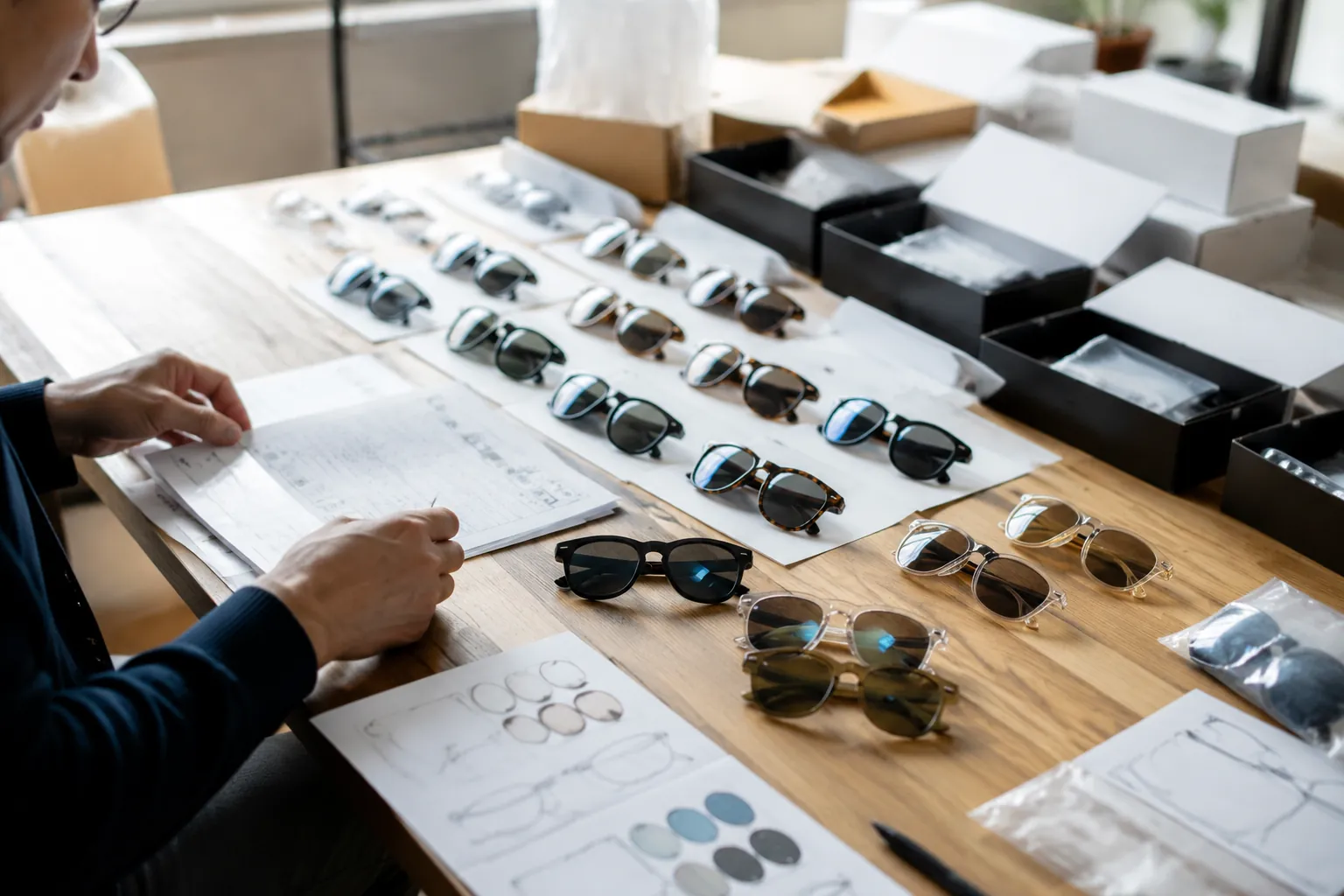
This guide is for brand owners, importers, distributors, and retail buyers who want a wider sunglasses assortment without pushing every SKU into small-run pricing. The goal is not to divide units across more references for its own sake. It is to build the order around shared tooling, lens specs, hardware, colors, decoration methods, and packaging so the factory can run efficiently. If the assortment follows production logic, you can add range, reach MOQ faster, protect lead time, and reduce compliance and QC risk.
Start with the real cost driver: changeovers
Buyers often ask whether one order can be split across several styles while keeping volume pricing. Usually, yes. But only if those styles share enough technical structure that the factory does not treat them as separate jobs.
In sunglasses production, MOQ economics are driven less by SKU count than by setup loss and changeovers. Every change in frame material, mold, temple tooling, lens size, base curve, tint, logo fixture, packaging format, or inspection standard can slow the line and raise scrap or sorting risk.
That does not mean every split is expensive. It means you need to know which differences are cosmetic and which create a real process change. Changing only frame color within the same approved build is usually manageable. Changing lens geometry, hinge type, and logo method at the same time is not.
Ask a better question. Not, "How many SKUs can I fit into one PO?" Ask, "How many real production changes am I asking the factory to make?" Start there.
Build frame families around shared geometry and tooling
A frame family is a group of SKUs that look different in the market but share core geometry, components, or process settings. This is usually the cleanest way to split an order without losing pricing discipline.
In sunglasses, efficient frame families often follow one of these structures:
- Same front, different temples, colors, or logos: useful for price-sensitive programs because the main build stays stable.
- Same lens size and shape, different front styling: gives more visual variation while keeping lens planning and fitting under tighter control.
- Same temple construction across several fronts: common when brand identity sits mainly on the temple profile or branding.
For a first order, do not build the assortment from unrelated designs. Start with one or two frame families, then split each family into a limited number of colorways. That gives the line width without multiplying molds, lens programs, and inspection points.
Ask the factory to confirm exactly which parts are shared and which are unique. At minimum, check:
- front mold or front machining file
- temple tooling or temple machining file
- lens cut size in mm
- base curve, such as 4C, 6C, or 8C
- hinge type and screw specification
- wire core dimensions for acetate temples, if applicable
- print area and decoration fixture location
These details matter. A small spec change can force a different process path. A lens size change may require different cutting and fitting controls. A base-curve change can affect sourcing and insertion. A hinge change can affect both cost and assembly time. Map the shared parts early, and the order can be grouped more efficiently across molding, machining, decoration, assembly, and final QC.
Use colorways to add SKUs without creating new styles
Color is usually the safest way to widen a sunglasses assortment. But only if the split stays disciplined. Problems start when each colorway becomes its own technical variant with a different lens recipe, logo treatment, finish, and packaging instruction.
A practical first-order model is to divide each frame family into three color roles:
- Core color: the main commercial color, often black, dark tortoise, or another proven neutral.
- Commercial support color: a second scalable color such as brown, olive, crystal grey, or smoke.
- Test color: a lower-volume color used to evaluate trend potential, seasonal demand, or a more directional finish.
This gives the line visible width while keeping most units on standard materials and repeatable lens specs. Lens planning is where weak splits get expensive fast. If several small colorways each require a different tint density, mirror effect, or coating, the factory may need separate control steps for each. If most colorways can share one approved lens program and only one variant uses a different lens, production is easier to manage.
Finish strategy matters too. A shared frame with different solid colors may be straightforward. But if one small variant adds a rubberized coating, a mirrored lens, and a separate metal logo plate, that SKU may no longer behave like part of the same family from a cost or control standpoint.
Keep the split simple. Create width through frame color, temple branding, and limited lens variation. That is usually the safest path to preserving MOQ pricing.
Share hidden parts. Customize visible ones.
Not all components carry the same commercial value. End customers notice frame shape, frame color, lens appearance, branding, and finish first. They do not usually care whether two styles share the same screw size, hinge footprint, pouch dimensions, or internal temple construction.
Use that to your advantage. Standardize hidden technical parts where possible, then spend your customization budget on the details customers actually see.
| Component or process | What customers notice | Best sourcing approach | Cost / lead-time impact |
|---|---|---|---|
| Screws, hinge dimensions, wire cores | Very low | Standardize across the family | Reduces purchasing complexity and assembly errors |
| Lens base curve, thickness, cut size | Low unless fit is poor | Keep common where possible | Supports lens sourcing, fitting consistency, and repeatable testing |
| Temple print, laser logo, metal plate | High | Customize by SKU where needed | Creates visible differentiation with a manageable process impact if fixtures are planned well |
| Front shape and frame color | Highest | Use selectively for real assortment breadth | Strong retail effect but can increase tooling, approval, and QC load |
This matters even more for acetate and CNC-processed styles, where fronts and temples may pass through cutting, milling, tumbling, polishing, fitting, and manual alignment. If each style also uses different hinges, wire cores, and decoration methods, assembly slows down and control gets harder. If the visible design changes but the hardware and construction stay common, the collection can still look premium while remaining easier to manufacture.
Treat decoration the same way. Pad printing, laser marking, and metal logo plates can all create differentiation, but they do not have the same process impact. Ask which methods can share fixtures and which require separate setup, curing, or attachment control.
Know which split structures preserve price
Some split models are factory-friendly. Others only look efficient on a spreadsheet. Use the structure below when discussing MOQ and pricing with a supplier.
| Order structure | Example split | Factory impact | Typical price effect | Lead-time risk |
|---|---|---|---|---|
| One style, one color | Single frame build with one lens and one packaging format | Highest efficiency, minimal changeover | Best baseline price | Low |
| One style, several colors | Shared mold and lens specification across multiple frame colors | Limited material and sorting changes | Slight increase, often manageable | Low to moderate |
| Several styles in one frame family | Shared lens size, temples, or hardware across multiple SKUs | Manageable if parts, fixtures, and QC standards are aligned | Moderate increase | Moderate |
| Several unrelated styles | Different constructions, lenses, decoration methods, and pack-outs in one PO | Multiple setups across production and inspection | Noticeable increase | High |
Here is the rule: if the split requires separate material sourcing, separate lens planning, separate decoration fixtures, separate packaging workflows, and separate inspection criteria for each SKU, then it is not functioning as one efficient order. It is several small orders grouped together.
So ask the supplier to quote by structure, not just by total volume. Request at least two views: the blended price for the proposed assortment and the price effect of simplifying key variables such as lens programs, logo methods, or packaging formats. That makes the cost of each variation visible and helps you decide where assortment width is worth paying for.
Freeze structural decisions early
Sampling is where good assortment logic either gets protected or lost. Some decisions need to be fixed early because they affect tooling, component planning, testing, or pack-out. Others can stay flexible a little longer.
Freeze these items at or before sample approval:
- Frame construction: injection, acetate, metal, TR, or mixed material
- Lens dimensions and base curve: these affect sourcing, cutting, fitting, and testing scope
- Hinge type and temple length: these affect assembly and fit
- Main compliance target: CE EN ISO 12312-1, ANSI Z80.3, AS/NZS 1067, REACH, or another market requirement tied to the product
- Primary packaging size and format: late packaging changes can disrupt pack-out and carton planning
You can usually keep these flexible slightly longer, as long as they do not change tooling or test scope:
- final color ratio by customer or market
- pad-print artwork version
- laser artwork position adjustment within the same approved area
- mix between printed pouch variants if size and material stay unchanged
The rule is simple. If the change alters fit, function, test applicability, or component sourcing, freeze it early. If it only changes a controlled surface decoration within the same approved build, it may stay open longer.
Before bulk production starts, ask for a pre-production breakdown listing SKU, color, lens spec, decoration method, packaging, and shared components. If the supplier cannot show the common parts and the still-open variables clearly, the split is probably too complex.
Do not let assortment width create QC and compliance failures
Every added SKU creates more control points. In sunglasses, the common failures are rarely dramatic. They are basic mistakes that become expensive: wrong lens tint, mixed logo versions, left-right color mismatch, decoration misplacement, finish inconsistency, or a variant packed under the wrong SKU.
QC should work at two levels: family checks first, then variant checks.
Common family checks:
- frame alignment and temple opening balance
- hinge torque consistency
- lens fit and retention
- surface quality, including scratches, sink marks, polishing defects, or visible finishing issues
- carton pack-out by SKU and color ratio
Variant-specific checks:
- correct lens tint, gradient, or mirror finish by colorway
- correct decoration method and artwork position
- correct logo plate attachment and orientation, where used
- correct material and restricted-substance controls for the target market, including REACH where applicable
Compliance needs the same discipline. If the program targets CE EN ISO 12312-1, ANSI Z80.3, or AS/NZS 1067, tie the approved lens spec and frame construction to the exact SKU or SKU family covered by the technical file or test record. Do not assume one tint or coating covers another variant. Changes in visible light transmission, lens category, coating, or intended use may require review or added testing.
Documentation matters more as assortments widen. ISO 9001 and BSCI do not replace product testing, but they can support better record control, traceability, and process consistency. If the supplier is also handling U.S. market requirements, clarify whether FDA registration is relevant to the specific product category and intended claim instead of assuming it applies to all sunglasses programs.
A practical split model for first orders and repeat buys
If demand is still uncertain, the safest way to widen assortment is to stage the program, not to launch too many unrelated references in one PO.
Recommended first-order model:
- Choose one or two frame families, not a wide spread of unrelated styles.
- Limit each family to a controlled number of colorways.
- Keep one common lens specification across most units unless there is a clear commercial reason to add another.
- Use branding, finish, and selective color variation to create visible differentiation.
- Ask for a family-based BOM and family-based QC plan before confirming bulk production.
Recommended replenishment model:
- Repeat the winning family without changing its core structure.
- Adjust the color ratio based on actual sell-through.
- Add only one controlled new variable at a time, such as one colorway or one decoration update.
- Where possible, place repeat volume together with the trial SKU so the factory can group production more efficiently.
This gives you a cleaner learning cycle. The first order tests which visible variations matter commercially. The repeat order scales what sold without reopening too many technical variables. Keep the basic rule in view: standardize what the customer does not care about, and vary what the customer will notice.
Have a custom sunglasses project in mind?
Send us your styles, target market and quantities and we will return a detailed quote with MOQ, lead time and a sample plan.
Get a QuoteWhy source this from Wenzhou with LumiShades
Wenzhou in Zhejiang Province is widely regarded as China’s eyewear manufacturing capital, producing a large share of the world’s sunglasses. That concentration matters to buyers: a deep local supply chain for acetate sheet, hinges, lens blanks, plating and packaging means shorter component lead times, easier color and material matching, and a workforce with decades of eyewear-specific skill. LumiShades has manufactured in this ecosystem since 2009, and our vertical integration — in-house injection molding, acetate cutting, CNC milling, lens tinting, decoration and quality control — means no part of your order is quietly subcontracted to a workshop you cannot audit.
For international buyers, that vertical control translates into accountability. When a single factory owns every step, defects are traced and fixed at source rather than bounced between vendors, and your specifications survive intact from first sample to bulk. For procurement review, buyers can request process records, approved samples, quality checkpoints and project-specific compliance files before placing a bulk order. Required testing and documentation are confirmed against the destination market and product specification rather than assumed from a generic certificate list. Explore our manufacturing capabilities and quality control process to see how this works in practice.
Frequently asked questions
Can I combine different colors to meet the MOQ for one style? Usually yes, but confirm the rule in writing with the supplier because MOQ may apply at different levels: per model, per color, per lens, or per packaging format. Ask the factory to state whether the split is allowed only when the frame construction, lens specification, decoration method, and packaging stay the same. Also ask whether any color triggers a surcharge because of special material, finish, or sorting requirements. Do not approve the split until the supplier shows the exact quantity break, unit price, and any color-specific adders on the quotation.
What is the safest way to get more SKUs into a first order without losing control? Start with one or two frame families and create variation through color, branding, and limited finish changes rather than through unrelated constructions. Keep lens size, base curve, hinge type, and hidden hardware common wherever possible. Then ask the supplier for a pre-production matrix showing each SKU against shared parts, unique parts, lens spec, decoration, and packaging. If that matrix looks complicated, the order is probably too fragmented for a first run.
Does sharing components lower price in a meaningful way, or is it mostly a factory talking point? It can lower cost in a meaningful and verifiable way because shared components reduce purchasing complexity, setup time, fixture changes, assembly variation, and inspection points. To verify the impact, ask the supplier to quote the same assortment in two versions: first with shared lenses, hardware, and packaging, and second with the custom variations separated. That side-by-side quote will show whether the shared structure is actually preserving price or whether the factory is still treating each SKU as a separate run.
If one colorway uses a different lens tint, does that affect compliance? It can. Different tints, mirror treatments, gradients, and coatings may change visible light transmission and the lens category relevant to CE EN ISO 12312-1, ANSI Z80.3, or AS/NZS 1067. Do not assume one approved lens automatically covers another. Ask the supplier which specific SKUs are covered by existing test evidence, what the approved lens specification is for each, and whether any new tint or coating needs review or additional testing before shipment.
When should I freeze the SKU mix before bulk production? Freeze anything that affects tooling, fit, function, testing scope, or packaging dimensions at sample approval. That includes frame construction, lens dimensions, base curve, hinge type, and the target compliance path. Color ratios and some artwork details can usually stay flexible slightly longer if they do not change the approved build. A practical way to manage this is to set a written cut-off date for structural changes and a later cut-off date for cosmetic changes, then require the supplier to confirm both dates on the PI or production schedule.
Ready to start?
Explore our aviator sunglasses or request a quote — our sales team replies within 12 hours.
Request a Quote