
ODM Sunglasses Catalog Buying: Launch Faster, Risk Less
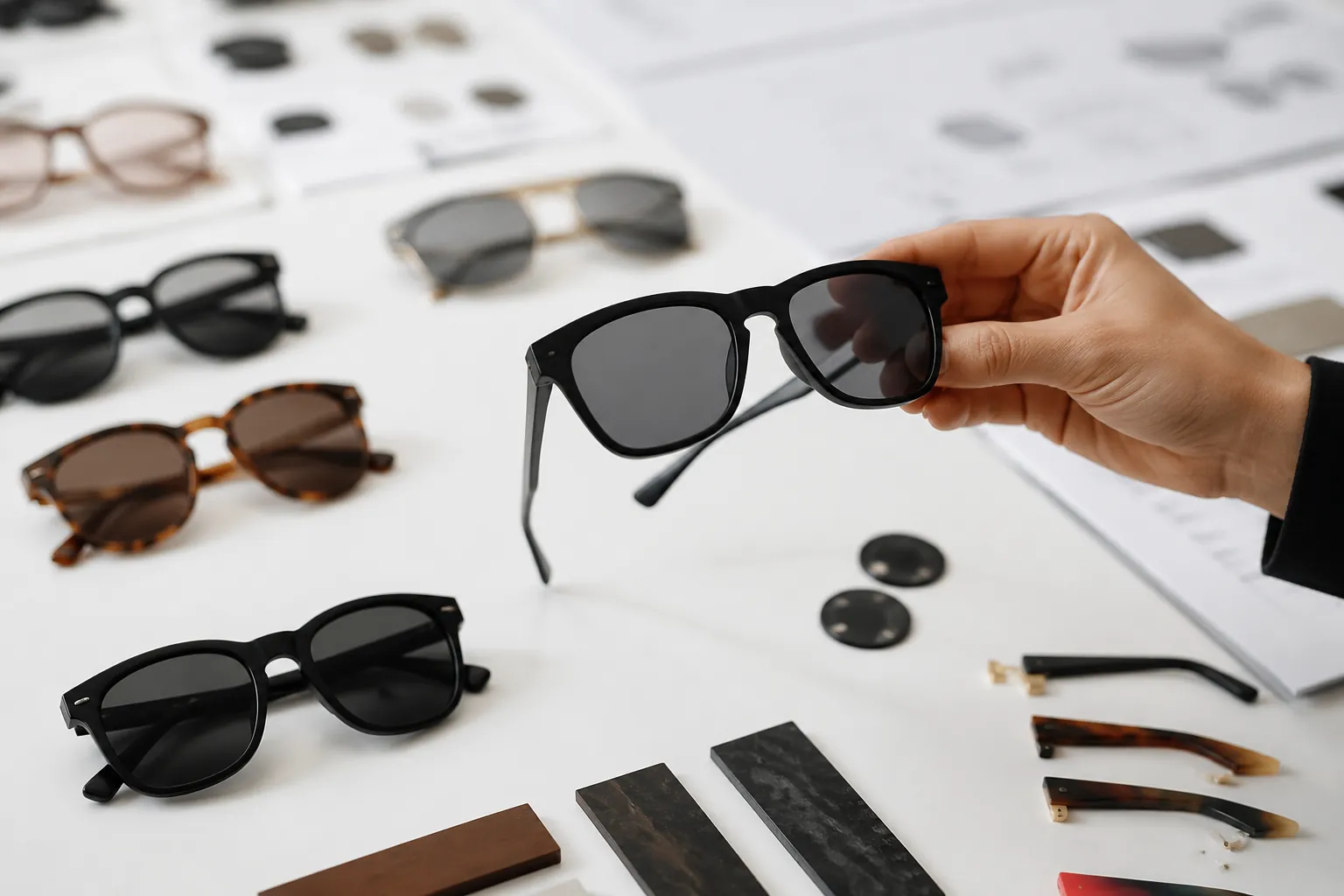
This guide is for overseas distributors, retailers, importers, promotional buyers, and brand owners that want to launch sunglasses without opening new frame molds. It shows how to read an ODM catalog, shortlist models by channel and market fit, specify color and logo changes, check compliance documents, and reduce avoidable quality risk. The payoff is practical: cleaner sampling, lower inventory exposure, tighter purchase specifications, and a faster path from approved sample to sellable stock.
What ODM Catalog Buying Means
ODM catalog buying means selecting factory-developed sunglass models and customizing only the parts that do not require new frame tooling. The buyer usually keeps the original frame mold, hinge construction, lens outline, bridge geometry, and temple shape. Changes often cover frame color, lens tint, mirror coating, polarization, logo method, packaging, barcode labels, warning text, and carton marks.
That is not the same as full OEM development. OEM may require drawings, mold opening, engineering trials, fit correction, durability testing, and several sample rounds before mass production. ODM starts from models that already have a production route, component sources, and known inspection points. It is faster. It is not risk-free. Sample approval, compliance review, and written specifications still matter.
A practical ODM sample for color, lens, logo, or packaging changes is often ready in about 7-10 working days when standard materials and decoration methods are used. Bulk production commonly takes about 25-35 days after the sample, artwork, packaging, order details, and payment terms are approved. Confirm timing order by order. Special acetate colors, new metal logo parts, third-party testing, complex packaging, or mixed-SKU packing can add days or weeks.
Treat MOQ and pricing as model-specific. A low-MOQ test order helps buyers check fit, sell-through, and decoration quality before committing to larger quantities. Price changes with material, lens type, polarization, coating, hinge, logo method, packaging, inspection level, and shipment schedule. Ask for quotes that separate product, packaging, testing, and logistics assumptions. Do not compare only the headline unit price.
Start With the Market, Not the Catalog
A thick ODM sunglasses catalog can create false speed. If the buyer has not defined the selling environment, the team may request too many samples and still miss the right product. Before asking for 20 or 30 models, narrow the brief by sales channel, retail price band, face fit, lens category, compliance market, and packaging format. A gas-station spinner program, surf shop collection, fashion retailer capsule, and corporate promotion order should not use the same selection logic.
- Channel: impulse retail needs durable, low-cost shapes with simple packaging; boutiques can support acetate, metal trim, and a heavier hand feel.
- Target wearer: bridge width, front width, temple length, and frame curve should match the intended market instead of relying on catalog photos.
- Retail price band: a value program should avoid unnecessary metal logos, multi-layer coatings, and complex boxes; a higher retail band can justify better hinges, lenses, and packaging.
- Climate and storage: hot markets need stable frame materials, consistent lens tint, plating that resists sweat, and packaging that will not deform in container or warehouse heat.
- Compliance destination: confirm required documents before artwork approval, including CE EN ISO 12312-1, ANSI Z80.3, AS/NZS 1067, REACH, FDA registration, ISO 9001, or BSCI when relevant.
Ask the factory for best-moving models by region or channel, but do not copy blindly. A shape that sells well in one chain may fail in another because the nose bridge slips, the lens is too dark for local preference, or the frame feels too light on the shelf. Start with the buyer's rack, margin, customer profile, and return-risk tolerance. Then open the catalog.
Compare Frame Materials Before Selection
Many catalog frames look similar in photos. Material choice changes cost, feel, decoration performance, lead time, and defect risk. Confirm the material code and production method, not just the style name. PC injection, acetate, TR-type flexible materials, and metal-combination frames behave differently during coloring, assembly, packing, and shipment.
| Material Option | Best Use | Typical Advantage | Buyer Watchpoint |
|---|---|---|---|
| PC injection frame | Promotional, value retail, fast replenishment | Low unit cost, repeatable molding, suitable for larger repeat orders | Can feel light; approve color by chip, resin sample, or master sample, not by screen image |
| Acetate frame | Fashion retail, private label, higher price band | Better polish, color depth, and premium hand feel | More labor; cutting, tumbling, polishing, and hand adjustment can add lead time |
| TR-type flexible frame | Sport, kids, outdoor casual | Good flexibility and impact resistance when the right grade is used | Pad print, coating, and ink adhesion need testing because some surfaces reject decoration |
| Metal-combination frame | Aviator, clubmaster, dress, classic programs | Higher perceived value and thinner profile | Plating, solder joints, screw torque, and nose pad assembly need tighter QC |
For ODM work, ask which processes are handled in-house and which are subcontracted. In-house injection molding, acetate processing, lens tinting, decoration, or packing can speed communication. Still, verify samples and inspection records. Traceability is the point: the approved sample, production materials, logo method, and packaging must match the final purchase specification.
Use Samples to Check Fit and Function
A catalog image cannot prove fit. It cannot show whether a frame sits evenly, feels stable, or opens smoothly. Order samples for the short list and inspect them like a buyer, not a consumer. Put the glasses on several face shapes. Open and close the temples repeatedly. Place the frame on a flat surface and check whether it rocks. Look through the lens at a straight line and slowly move your head. Visible waviness or distortion needs an answer before approval.
For ODM selection, record measurable points in a spec sheet before the bulk order: lens width, bridge width, temple length, total front width, lens height, frame curve, hinge type, screw size, lens category, logo size, logo position, and packaging reference. Small numbers matter. A narrow bridge can make a frame slip. A short temple can press behind the ear. A front that is too narrow can make an adult fashion frame feel like a youth product.
Set practical tolerances with the factory before production starts. For many molded sunglasses, buyers use visual approval against a master sample plus dimensional tolerances agreed by material, construction, and customer requirement. Temple alignment should be symmetrical. Lens seating should be flush. Screws should not back out under normal use. Hinges should move smoothly without grinding or looseness.
Blunt rule: do not approve production from catalog photos. Approve from physical samples whenever possible. If timing is compressed, use a documented pre-production sample approval with clear photos, measurements, lens details, logo placement, packaging references, and written deviation notes. For first orders, physical approval is usually worth the courier cost.
Control Color, Lens, and Logo Changes
Most ODM orders succeed or fail in the customization details. Frame color, lens tint, and logo placement must be specified in a way the production floor can follow. Use Pantone references or physical color chips for solid colors. For transparent injection frames, ask for actual resin samples because wall thickness changes perceived color. For acetate, approve a real material sheet or finished frame component because pattern distribution varies from piece to piece.
- Choose the base catalog model and confirm material, hinge, lens size, and available lens categories.
- Select frame color by Pantone, chip, resin sample, acetate sheet, or approved master sample.
- Select lens type: solid tint, gradient, mirror, polarized, category-specific sun lens, or customer-specified visible light transmission range.
- Confirm logo method: laser engraving, pad printing, hot stamping, metal logo plate, temple insert, or lens logo.
- Approve packaging artwork, barcode position, warning text, importer information when required, and country-of-origin marking.
- Lock the approved sample with SKU, date, version number, and written buyer approval.
Laser engraving is clean and durable on many temples, but it can look too subtle on dark materials. Pad printing is flexible and economical for low-MOQ work, but adhesion should be tape-tested, especially on TR-type flexible frames, rubber coatings, or matte finishes. Metal logo plates can improve shelf perception, but they add tooling, plating, gluing or riveting, and extra inspection points. Lens logos need tight placement control because poor position can interfere with the viewing area.
Lens tint also needs process control. A gray lens that drifts brown can change the product position. A mirror coating can show scratches more easily than a plain tint. For polarized programs, confirm polarization before packing. For category lenses, ask the factory to confirm visible light transmission range and labeling before packaging is printed.
Factory-floor note: If you approve a black frame from a phone photo, you are not approving a production color. You are approving an image affected by lighting, camera settings, screen display, and file compression. Use a physical master sample for repeat orders.
Understand MOQ, Price Breaks, and Timing
ODM catalog buying reduces tooling risk, but it does not remove production economics. The first threshold is MOQ. A small order helps buyers test several models without locking too much cash into slow-moving inventory. At that level, unit price is usually higher because color preparation, logo setup, packing labor, QC, and export handling are spread across fewer pairs.
At higher quantities, buying becomes more efficient. Setup costs are spread across more units. Components can be purchased in more practical batches. Lens and packaging costs may improve when the buyer standardizes pouches, tags, boxes, barcodes, or cartons across several SKUs. The quote still depends on material, lens type, decoration, packing, inspection level, payment terms, and delivery schedule.
| Order Level | Typical Buyer Use | Cost Behavior | Planning Advice |
|---|---|---|---|
| Low MOQ | Market test, influencer pack, small retailer trial | Highest unit cost, lowest inventory exposure | Keep decoration simple and use standard packaging |
| Mid-size order | Regional launch or distributor sell-in | Better setup absorption | Standardize lens and packaging across SKUs where possible |
| Chain or seasonal order | Retail chain program or seasonal private label line | Improved component and packaging purchasing when specifications are stable | Freeze colors, logos, labels, and barcodes early to protect delivery |
| Volume replenishment | Repeat program or national distribution | Most efficient on suitable models with stable materials and packaging | Use pre-shipment inspection, batch records, and carton-level traceability |
Standard ODM samples often take 7-10 working days when the change is color, lens, logo, or packaging. Bulk production often needs 25-35 days after all approvals. Add time for special acetate colors, new metal logo parts, multiple lens categories, third-party testing, complex retail packaging, or shipment before a fixed store reset date. A safer schedule includes one approval buffer, one production buffer, and one inspection or rework buffer.
Check Compliance Before Packaging
Compliance is not a sticker exercise. Sunglasses sold into different markets must meet the right lens, labeling, and documentation requirements. For EU programs, buyers commonly request CE EN ISO 12312-1 support. For the United States, buyers may request ANSI Z80.3 alignment and FDA registration documentation. For Australia and New Zealand, AS/NZS 1067 is commonly relevant. REACH is relevant for restricted substances in frame materials, coatings, inks, and metal parts.
Ask for documents before approving packaging artwork. Incorrect claims create rework and can create customs or customer-audit risk. The carton, hangtag, pouch, and retail box may need lens category, warnings, importer details, country of origin, SKU, barcode, batch reference, and recycling marks. Do not add certifications, logos, or performance claims that are not supported by current documents for the product or material scope.
For polarized lenses, request a polarization check. For dark lenses, confirm the visible light transmission category. For kids' sunglasses, be stricter with small parts, hinge strength, impact resistance, chemical restrictions, and warning labels. Retail returns are expensive. Customs delays, failed customer audits, and packaging reprints are worse. Build compliance into the approval flow before mass production, not after cartons are packed.
Build a Clean ODM Purchase Specification
A clean purchase specification prevents arguments later. It should include model code, material, frame color, lens color and category, logo method, logo size and position, hinge type, packaging, carton marks, inspection standard, compliance documents, approved sample reference, quantity by SKU, and delivery schedule. Keep one controlled version. Do not rely on scattered chat messages, screenshots, or old catalog photos.
Quality control should cover incoming materials, in-process checks, final inspection, and packed-carton verification. Practical eyewear checks include hinge opening tension, screw tightness, lens seating, frame symmetry, temple alignment, logo position, lens scratches, color match, coating defects, barcode readability, pouch count, and carton assortment. For mixed-SKU orders, carton marking is not minor. Wrong assortment can slow warehouse receiving and trigger retailer chargebacks.
If the supplier provides ISO 9001 or BSCI documentation, confirm the document owner, validity date, and audit scope. Do not assume every product or process is covered. Buyers should still define acceptance criteria. Common AQL inspection plans are often used in eyewear sourcing, but the exact plan should match order value, defect risk, and customer requirements. Name critical defects clearly: no lens scratches in the central viewing area, no loose hinge screws, no sharp burrs, no obvious color mismatch against the approved sample, no missing required label, and no incorrect barcode.
ODM buying is fast because the frame foundation already exists. It works best when the buyer is disciplined: choose models based on channel, approve real samples, lock specifications, verify compliance, inspect before shipment, and scale only after the first shipment proves its sell-through and return rate.
Have a custom sunglasses project in mind?
Send us your styles, target market and quantities and we will return a detailed quote with MOQ, lead time and a sample plan.
Get a QuoteWhy source this from Wenzhou with LumiShades
Wenzhou in Zhejiang Province is widely regarded as China’s eyewear manufacturing capital, producing a large share of the world’s sunglasses. That concentration matters to buyers: a deep local supply chain for acetate sheet, hinges, lens blanks, plating and packaging means shorter component lead times, easier color and material matching, and a workforce with decades of eyewear-specific skill. LumiShades has manufactured in this ecosystem since 2009, and our vertical integration — in-house injection molding, acetate cutting, CNC milling, lens tinting, decoration and quality control — means no part of your order is quietly subcontracted to a workshop you cannot audit.
For international buyers, that vertical control translates into accountability. When a single factory owns every step, defects are traced and fixed at source rather than bounced between vendors, and your specifications survive intact from first sample to bulk. For procurement review, buyers can request process records, approved samples, quality checkpoints and project-specific compliance files before placing a bulk order. Required testing and documentation are confirmed against the destination market and product specification rather than assumed from a generic certificate list. Explore our manufacturing capabilities and quality control process to see how this works in practice.
Frequently asked questions
Can I change the lens shape on an ODM catalog model? Usually no. The lens shape is tied to the frame groove, front curve, bridge geometry, and tooling. You can normally change lens color, tint, mirror finish, polarization, and visible light transmission category if the existing frame supports it. If you need a different lens outline, ask the factory whether it requires new frame tooling, a new lens cutting program, or a full OEM project.
What is the safest first order size for testing several models? Use the lowest practical MOQ for the first test so you can compare fit, shelf appeal, logo quality, returns, and sell-through across several SKUs. Keep the first round simple: standard frame colors, proven lens options, simple logo methods, and standard packaging. Move winning SKUs to larger quantities only after you confirm buyer feedback, compliance needs, decoration durability, and repeatable sample quality.
How long should I allow from sample request to bulk shipment? For standard ODM changes, plan about 7-10 working days for samples and about 25-35 days for production after sample, artwork, packaging, order details, and payment terms are approved. Add buffer for third-party testing, custom packaging, special acetate colors, new metal logo parts, holiday periods, mixed-SKU packing, inspection, and ocean or air freight. Do not book a fixed retail launch date until the supplier confirms the production schedule in writing.
Which certifications should I ask for before ordering sunglasses? Match documents to the destination market and customer requirement. Ask for CE EN ISO 12312-1 support for EU programs, ANSI Z80.3 and FDA registration documentation when required for US-related programs, AS/NZS 1067 for Australia and New Zealand, and REACH support when restricted substance control is required. For factory-level review, ISO 9001 and BSCI can be useful, but check validity dates, document owner, scope, and whether the documents apply to the ordered product category.
Can I use my own logo on low-MOQ ODM sunglasses? Yes, but choose a method that matches the material, quantity, and retail position. Pad printing is common for small runs and color logos, but it should pass adhesion testing on the selected surface. Laser engraving can be durable and clean on suitable temples, but contrast may be low on dark materials. Metal logo plates usually make more sense at higher quantities because they add tooling, plating, assembly, and inspection cost.
What should be in the approved pre-production sample? The approved pre-production sample should match the final frame material, color, lens type, lens category, logo method, logo position, hinge, packaging, warning text, barcode, and country-of-origin marking. Mark it with model code, SKU, date, version number, and written approval status. Keep one sample with the buyer and one with the factory so production and inspection teams judge bulk goods against the same reference.
Ready to start?
Explore our aviator sunglasses or request a quote — our sales team replies within 12 hours.
Request a Quote