
Wholesale Sunglasses Price Breaks by Quantity
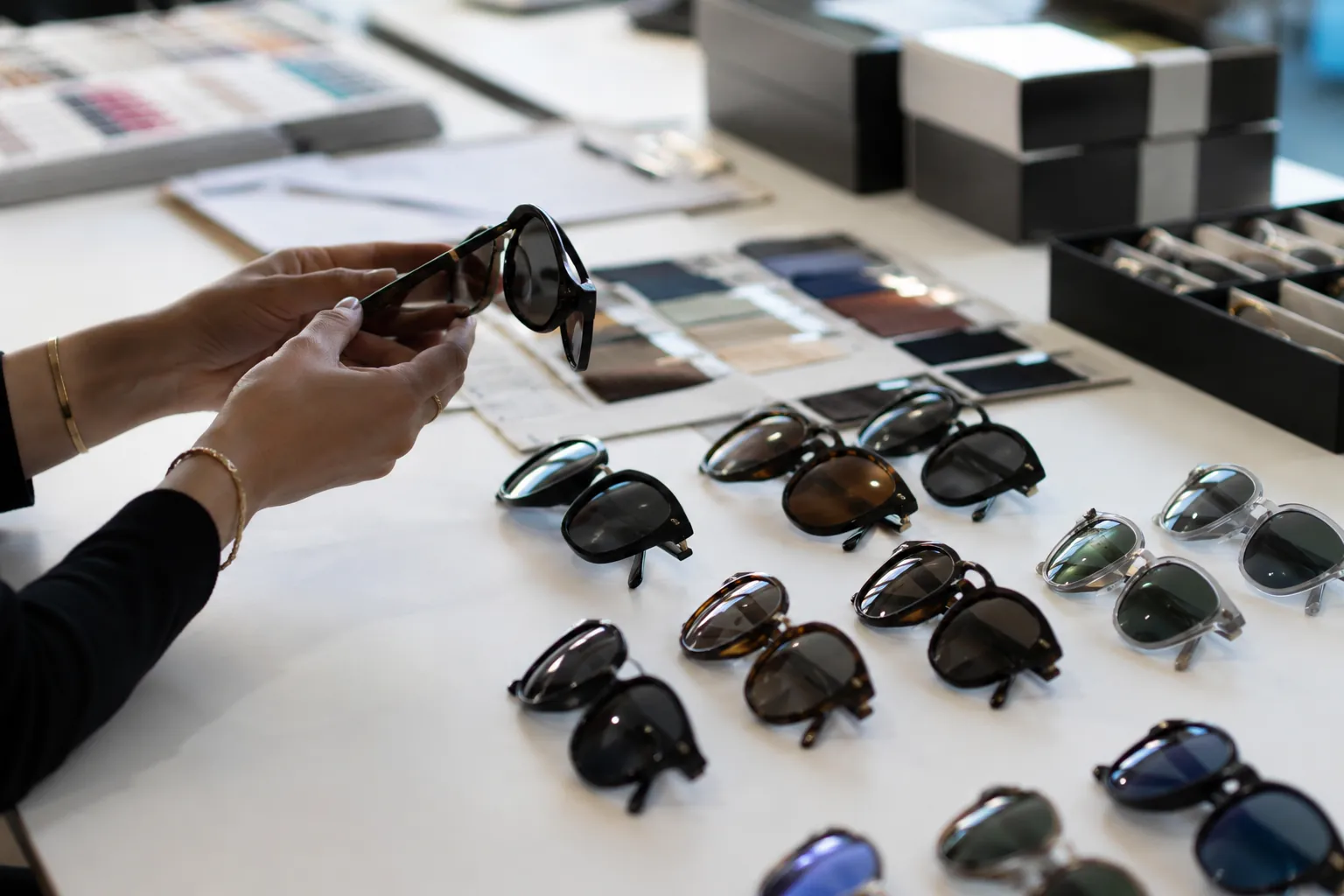
This guide is for overseas brands, importers, distributors, and retailers planning custom sunglasses orders, from small pilot runs to larger retail programs. It explains what usually changes at 50, 300, 1000, and 5000+ pairs: unit-cost structure, customization choices, material control, tooling decisions, QC workload, compliance documents, and delivery timing. Use it to avoid three common mistakes: over-customizing a test order, under-specifying a large retail program, or comparing factory quotes built on different assumptions.
Why Quantity Changes the Real Unit Cost
Wholesale sunglasses pricing is not just frame material plus assembly labor. A complete factory quote may include setup time, material preparation, pigment or color matching, lens cutting or tinting, logo fixture adjustment, packing labor, QC inspection, reject allowance, export cartons, labels, and shipping documents.
At 50 pairs, those fixed tasks are spread across very few units. The unit cost is high. At 5000 pairs, the same setup work becomes a smaller part of the price because production runs longer and planning is more efficient.
A low MOQ is useful. It does not mean a low unit price. A 50-pair order can work for pilot runs, retail tests, influencer drops, sales samples, or distributor presentations. The buyer gets flexibility and lower upfront risk, not the lowest cost per pair.
Price usually improves around 300, 1000, and 5000+ pairs because the order moves from short-batch handling into a more stable production flow. The size of the improvement depends on the specification. An existing molded PC frame with a standard tinted lens prices very differently from an acetate frame with polarized lenses, mirror coating, metal logo plates, printed pouches, and retail boxes. Higher quantity helps. A controlled specification helps more.
Price Break Logic at 50, 300, 1000, and 5000+ Pairs
The table below is not a universal price list. A PC promotional frame, TR90 sports frame, acetate fashion frame, metal hinge, polarized lens, mirror coating, microfiber pouch, and printed retail box all change the quote. Still, these bands show why factories price the same design differently at different quantities.
| Order Quantity | Best Use | Customization Depth | Cost Behavior | Typical Timing |
|---|---|---|---|---|
| 50 pairs/design | Market test, buyer meeting, small retail drop | Existing mold, available color, standard lens, one logo method | Highest unit cost; setup, artwork, QC, and packing are spread over few pairs | Samples commonly 7-10 days after details are confirmed; small bulk depends on approved materials and decoration |
| 300 pairs/design | First commercial order, distributor trial, seasonal SKU launch | Controlled color, standard decoration, basic private-label packing | Noticeable improvement; decoration setup and packing labor start to make more commercial sense | Bulk commonly 25-35 days after sample approval for standard specifications |
| 1000 pairs/design | Stable retail SKU, online replenishment, regional wholesale | More lens options, custom pouch or box, clearer QC sampling plan | Material purchasing, batch consistency, and line efficiency can reduce unit cost | Often 25-35 days if lens, color, decoration, and packaging are frozen early |
| 5000+ pairs/design | Chain retail, national distribution, annual program | Fuller customization, planned production blocks, tighter carton and label control | Lowest general band; savings depend on stable specifications and efficient production planning | Often 25-35 days for standard programs; staged production or shipment may be safer for complex orders |
Compare quotes on equal terms. Use the same frame material, lens type, logo method, packaging, inspection level, compliance target, and Incoterms. If one supplier quotes a plain polybag and another includes a microfiber pouch, printed box, barcode label, carton mark, and drop-test requirement, the cheaper FOB price may not be cheaper in landed cost.
The 50-Pair Order: Useful, but Strictly Limited
A 50-pair order is useful when the buyer is still proving demand. It is not the right size for every custom feature. The cleanest 50-pair programs use an existing frame mold, an available frame color, a standard lens category, and one decoration method.
Laser engraving on the temple, pad printing on the outside arm, or a simple lens logo may work if the artwork is clean and the logo area is flat enough. Keep it simple. Small orders punish complexity.
At this size, the factory still has to check artwork, prepare laser files or printing plates, pull components, tint or select lenses, assemble, inspect, and pack. The per-pair cost carries all of that work. Small orders also have less buffer for sorting loss. If a transparent color shows shade variation or a mirror lens has coating scratches, there may not be enough extra stock to replace rejects without re-running material.
- Use 50 pairs for: sales samples, photo shoots, retail shelf tests, buyer presentations, and distributor feedback.
- Avoid at 50 pairs: new molds, complex metal trim, multi-color printing, unusual box structures, and tight launch dates with no revision time.
- Keep decoration simple: one logo position, one print color, or laser engraving on a tested temple surface.
- Specify early: frame material, lens category, logo size, logo position, packing method, barcode needs, compliance market, and target delivery date.
If the buyer needs the lowest possible unit price, 50 pairs is usually the wrong quantity. If the buyer needs physical proof before committing to 1000 or 5000 pairs, 50 pairs can be a practical validation step.
The 300-Pair Order: The First Commercial Band
At about 300 pairs per design, production becomes more rational. The line can run long enough to reduce handling waste. Decoration setup is spread across more units. Basic private-label packaging becomes easier to justify.
This is often the right level for a new brand SKU, a retailer trial, or a distributor testing two or three colorways. But the order still needs discipline. Choose one frame style, two frame colors, and one lens family instead of five scattered versions. Fewer variants mean fewer changeovers, fewer wrong-label risks, and better QC consistency.
For injection frames, color stability improves when the batch uses one approved resin and pigment setup. For acetate frames, cutting and polishing time is more predictable if sheet material is confirmed before bulk planning.
At this level, practical private-label work may include lens tinting and decoration such as laser engraving, pad printing, heat transfer, or metal logo plates where the frame design supports them. Metal plates need more engineering control than printing. Recess depth, adhesive area, temple curve, plating finish, and edge burrs can all affect the reject rate.
Approve a physical pre-production sample before bulk. A digital mockup cannot show lens darkness, temple logo sharpness, hinge feel, nose fit, frame balance, or packaging fit. For many styles, define logo-position tolerance in millimeters, such as +/-0.5 mm to +/-1.0 mm depending on the surface and method. Do not write only "centered."
The 1000-Pair Order: Specification Discipline Pays
At 1000 pairs per design, the buyer has enough volume to require a tighter written specification, and the factory has enough volume to plan material purchasing and QC more efficiently. This is where vague buying gets expensive.
"Good quality lens," "strong hinge," and "premium packing" are not specifications. They are opinions. A useful 1000-pair tech pack should include frame material, Pantone or physical color standard, lens material, lens category, UV requirement, logo artwork file, logo tolerance, hinge type, screw color, pouch or box details, carton marks, barcode placement, destination compliance needs, and inspection standard.
If the sunglasses will be sold in a regulated market, compliance is not decoration. It affects lens selection, labeling, test documents, warnings, and user information.
- Approve frame shape, fit, temple pressure, and wearing comfort using a physical sample.
- Approve lens color, visible darkness, UV400 requirement, filter category, and any required category marking.
- Confirm decoration method, logo position, artwork size, color, and acceptable placement tolerance.
- Freeze packaging artwork before pouches, boxes, hang tags, barcode labels, or cartons are ordered.
- Set inspection points for incoming materials, in-process assembly, final AQL inspection, barcode scans, and carton verification.
For sunglasses, common compliance references include CE EN ISO 12312-1, ANSI Z80.3, AS/NZS 1067, REACH, FDA registration, ISO 9001, and BSCI. The applicable requirement depends on the destination market, product type, buyer policy, and retail channel. State the sales market before quoting, not after production. A pair intended for Australia under AS/NZS 1067 expectations may need different labeling and documents than a simple promotional pair for another channel.
The 5000+ Pair Order: Lower Cost, Higher Risk
At 5000+ pairs per design, the unit price can move lower because setup, material preparation, decoration fixtures, inspection planning, and packing work are spread across more units. The exact price still depends on the frame, lens, decoration, packaging, compliance, and inspection scope.
Large orders should not be treated as a casual repeat of a sample order. Manage them as a program. Lock the golden sample, and keep signed reference samples with both buyer and factory.
Confirm carton size and master carton weight if the goods will enter retailer distribution centers. Check whether the buyer needs inner carton labels, suffocation warnings, SKU stickers, hang tags, country-of-origin marks, barcode grades, case-pack quantities, or pallet requirements. These details prevent warehouse rejection, chargebacks, and relabeling costs.
For 5000+ pairs, production efficiency comes from stable runs: fewer color changes, fewer decoration changes, and early material booking. If a buyer needs four colors, it may be cheaper and safer to split the purchase order into planned production blocks instead of pushing random mixed assortments through the line. Inspect first finished cartons before the full order is packed. Catch problems early.
Factory-floor rule: large orders are not harder because every step is more complex. They are harder because the cost of a small miss is multiplied.
What Drives Cost Besides Quantity
Quantity is only one lever. Two 1000-pair orders can have very different prices if one uses a basic PC lens and polybag while the other uses polarized lenses, mirror coating, metal logo plates, microfiber pouch, printed box, barcode labels, and retail carton requirements.
Separate must-have features from nice-to-have features before asking for price breaks. Otherwise, the quote becomes hard to read and harder to negotiate.
| Cost Driver | Lower-Cost Choice | Higher-Cost Choice | Buyer Note |
|---|---|---|---|
| Frame material | Injection PC or existing molded style | Acetate sheet cutting or complex TR90 sports structure | Acetate requires cutting, tumbling, polishing, and more manual handling |
| Lens | Standard tinted PC or AC lens | Polarized, mirror, gradient, TAC, or special tint | Confirm UV400, filter category, and target standard before sampling |
| Decoration | One-color pad print or laser engraving | Metal logo plate, multi-position print, special finish | Curved temples need fixtures to keep logo alignment consistent |
| Packaging | Polybag or simple pouch | Printed box, microfiber pouch, hang tag, barcode labels | Retail packaging often adds more cost, artwork risk, and lead time than expected |
| QC level | Standard final inspection | Extra in-process checks and tighter sorting | Better inspection costs money but can reduce downstream claims |
Tolerances also matter. Logo placement should be discussed in millimeters, not described as "centered." Lens fit should show no obvious gap, rattle, stress whitening, or pressure mark around the rim. Hinges should open and close smoothly across production, not only on the approved sample. For retail programs, carton marks, barcode scans, case pack, and mixed-SKU ratios should be checked before shipment, not after goods arrive.
How to Build a Smarter RFQ for Price Breaks
The fastest way to get usable price breaks is to send one clear RFQ instead of several vague emails. Ask the factory to quote the same design at 50, 300, 1000, and 5000 pairs with the same specification. Then ask where cost drops if you change one item: lens type, packaging, logo method, color count, inspection level, or carton requirement.
That gives you decisions, not just numbers.
A strong RFQ should include target market, expected annual volume, first-order quantity, frame reference, material preference, lens requirement, logo files, packaging requirement, inspection requirement, compliance requirement, Incoterms, and delivery deadline. If the buyer already has a target price, say it. A serious factory can explain what needs to change to approach it. Maybe the retail box is the problem. Maybe the metal logo plate is too much at 300 pairs. Maybe 1000 pairs is the point where the preferred polarized lens becomes workable.
For standard custom sunglasses orders, sample timing is commonly about 7-10 days after artwork and materials are confirmed. Bulk production is commonly about 25-35 days after sample approval. These ranges can change with special lenses, color matching, custom molds, packaging artwork, compliance documents, holidays, or late buyer revisions. Factory lead time starts after decisions are frozen, not while the buyer is still changing lens color, logo position, packaging artwork, or carton labels.
For price planning, compare landed cost, not only FOB unit price. Freight, duty, inspection, packaging volume, defect handling, relabeling risk, compliance documents, and chargeback exposure all matter. A slightly higher factory price can be cheaper if cartons are packed correctly, test documents are ready, barcodes scan properly, and the reject rate is controlled.
Have a custom sunglasses project in mind?
Send us your styles, target market and quantities and we will return a detailed quote with MOQ, lead time and a sample plan.
Get a QuoteWhy source this from Wenzhou with LumiShades
Wenzhou in Zhejiang Province is widely regarded as China’s eyewear manufacturing capital, producing a large share of the world’s sunglasses. That concentration matters to buyers: a deep local supply chain for acetate sheet, hinges, lens blanks, plating and packaging means shorter component lead times, easier color and material matching, and a workforce with decades of eyewear-specific skill. LumiShades has manufactured in this ecosystem since 2009, and our vertical integration — in-house injection molding, acetate cutting, CNC milling, lens tinting, decoration and quality control — means no part of your order is quietly subcontracted to a workshop you cannot audit.
For international buyers, that vertical control translates into accountability. When a single factory owns every step, defects are traced and fixed at source rather than bounced between vendors, and your specifications survive intact from first sample to bulk. For procurement review, buyers can request process records, approved samples, quality checkpoints and project-specific compliance files before placing a bulk order. Required testing and documentation are confirmed against the destination market and product specification rather than assumed from a generic certificate list. Explore our manufacturing capabilities and quality control process to see how this works in practice.
Frequently asked questions
Is 50 pairs enough for a custom sunglasses order? Yes, if the order uses an existing frame or mold and keeps customization simple: standard lens color, one logo position, and basic packing. Confirm frame color, lens category, logo artwork, logo placement tolerance, packing method, target market, and any required compliance documents before ordering. Treat 50 pairs as a test or sales-sample quantity, not as the lowest-cost production tier.
At what quantity does the price usually improve in a meaningful way? The first practical improvement is often around 300 pairs per design because setup and decoration costs are spread over more units. Larger improvements may appear around 1000 pairs and 5000+ pairs when material purchasing, batch consistency, QC planning, and line utilization improve. The exact break depends on the specification, so ask suppliers to quote the same design and options at each quantity.
Can I use different colors within the same price break? Sometimes, but each color can add pigment setup, material control, sorting, label checks, and QC work. If 1000 pairs are split into many small colorways, the factory may price the order more like several small batches. For better pricing, limit the number of colors, define the quantity per color, and approve a physical color standard or Pantone reference before bulk production.
What tolerances should I define for logos and assembly? Define logo position in millimeters, commonly around +/-0.5 mm to +/-1.0 mm depending on the surface, logo size, and decoration method. Also define acceptable print sharpness, color, lens fit, hinge feel, screw color, temple opening, visible scratches, and packaging defects. Put these limits in the purchase order or tech pack so final inspection has objective criteria.
What compliance should I mention when requesting a quote? State the sales market and required standard at RFQ stage. Common references include CE EN ISO 12312-1, ANSI Z80.3, AS/NZS 1067, REACH, FDA registration, ISO 9001, and BSCI, but not every order needs every item. Ask the supplier which test report, declaration, labeling, user information, or registration document can be provided for your exact product and destination market.
How long should I allow from sample to bulk delivery? For standard custom sunglasses, allow about 7-10 days for samples after details are confirmed and about 25-35 days for bulk production after sample approval. Add time for custom color matching, polarized or mirror lenses, packaging artwork, special labels, compliance documents, peak-season capacity, holidays, or multiple colorways. Do not start counting bulk lead time until the sample, artwork, lens, packaging, and carton marks are approved.
How can I compare two supplier quotes fairly? Make both suppliers quote the same frame material, lens type, lens category, UV requirement, logo method, packaging, inspection level, compliance target, quantity, Incoterms, and shipping assumptions. Ask each supplier to list what is included and excluded. Then compare landed cost, including freight, duty, inspection, packaging volume, defect handling, and any required documentation.
Ready to start?
Explore our aviator sunglasses or request a quote — our sales team replies within 12 hours.
Request a Quote