
When Injection Frames Beat Acetate for Volume Orders
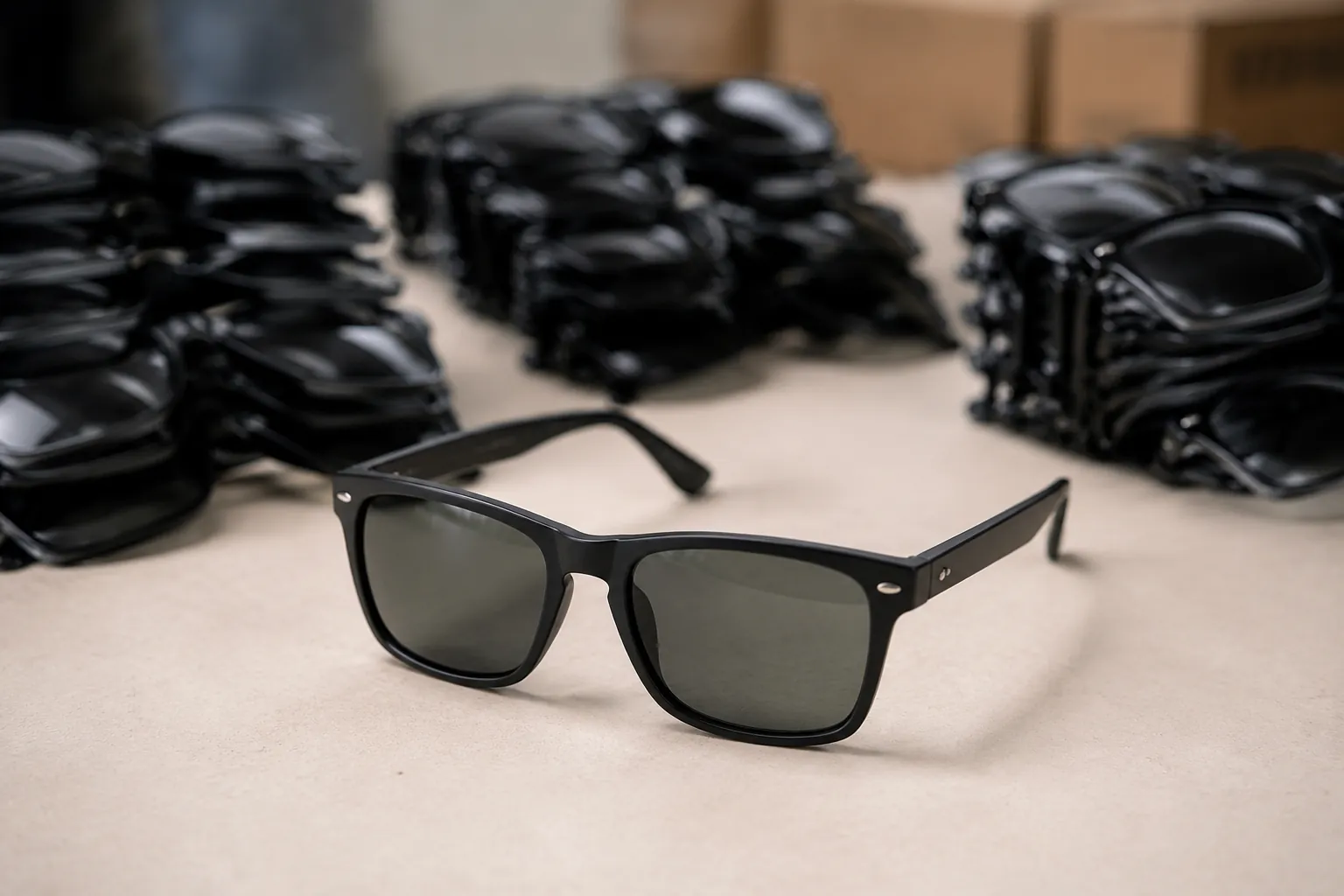
This guide is for brand owners, importers, distributors, and retail buyers deciding between injection-molded and acetate sunglasses for volume programs. The material choice affects more than appearance. It changes tooling economics, unit-cost behavior, process variation, lead-time control, decoration consistency, and how reliably the same style can be reordered later. For short-run fashion capsules, acetate can be the right call. For styles likely to repeat at real volume, injection molding often gives better commercial control because the process is more standardized and less dependent on handwork. That is the real question: not which material sounds more premium, but which process protects margin, reduces avoidable variation, and fits the way the SKU will actually be bought, shipped, tested, and replenished.
Start with program economics, not material image
Too many sourcing discussions start with image: acetate is framed as premium, injection as basic. That is not a useful buying framework. For a commercial buyer, the first question is simpler: how is this style expected to perform over its life cycle? Is it a one-time launch, a seasonal capsule, a distributor item, a chain-retail line, or a carry style with planned replenishment?
If the product story depends on visible pattern depth, laminated color effects, or a hand-finished retail message, acetate may justify the extra processing. If the style is meant for promotions, travel retail, event programs, chain stores, multi-country distributor channels, or private-label replenishment, injection should be in the first comparison set. The manufacturing logic is different from the start, and so are the cost drivers.
Injection molding shifts more cost into tool development, then lowers labor content in repeat production by forming parts in a controlled mold. Acetate usually avoids that mold investment, but it stays labor-heavy on every batch. Parts still need to be cut from sheet, CNC machined, beveled, tumbled, polished, fitted with hinges, heat-formed, and hand-aligned. The result is a different risk profile. Injection can get more efficient over repeated runs. Acetate stays dependent on manual work each time, and manual work is where throughput drift and cosmetic variation tend to accumulate.
So assess the program before debating the material story. At low exploratory quantities, the priority is design validation and market testing. Once a style has a real reorder path, repeatability, reject risk, schedule control, and documentation discipline matter more than the sales language around the raw material.
Where cost really sits: tooling, labor, scrap, and reorders
Acetate and injection frames do not just use different materials. They consume factory time in different ways. Buyers who compare only opening sample quotes often miss the real cost picture because they do not separate startup cost from repeat production cost.
In acetate production, the front and temples usually start as sheet stock. The factory cuts parts, machines profile details, shapes bevels and lens grooves, tumbles, polishes, installs hardware, heat-forms the frame, and corrects alignment. Every step adds labor. Every step can also add cosmetic variation, rework, or sorting loss. Patterned acetate can reduce usable yield further because sheets must be selected and matched for acceptable visual consistency, especially when left and right temples are expected to look balanced at retail.
Injection molding works on a different cost base. The mold is the main upfront asset. Once approved, the frame front and temples can be produced with more consistent cycle-based output and less reliance on manual shaping. Secondary operations still matter, especially lens fitting, hinge assembly, temple screw setting, pad printing, hot stamping, laser marking, and final adjustment. But the base part geometry comes from the tool, not from repeated machining and polishing.
| Factor | Injection-Molded Frames | Acetate Frames |
|---|---|---|
| Upfront development cost | Higher because tooling is usually required; more suitable when the style is expected to repeat | Lower tooling burden; often easier to start for short runs or image-led concepts |
| Typical unit-cost behavior | Often improves with volume once tooling is in place and the process is approved | Usually remains more labor-heavy because machining, polishing, and fitting continue on every batch |
| Labor exposure | Lower on base-part formation; labor concentrates in assembly, decoration, inspection, and packing | Higher across the full process because cutting, machining, polishing, forming, and correction are repeated every run |
| Scrap exposure | Can be lower after process approval if resin, color, and machine settings are controlled | Can be higher because sheet variation, polishing, heat forming, and manual correction introduce more opportunities for rework |
| Reorder efficiency | Strong when the same approved tool and build are reused | More limited because each batch still requires substantial manual processing |
| Commercial sweet spot | Repeat programs, replenishment, promotions, distributor business, and private-label volume | Fashion capsules, pattern-led concepts, and material-story-driven launches |
It also helps to compare cost using a broader landed-cost view instead of ex-works price alone. A frame that costs slightly less on paper can still be the weaker buy if it creates more inspection failures, more late shipments, more retailer deductions, or more airfreight upgrades to recover a delayed launch.
The takeaway is direct. If a style has a credible chance of repeating, injection often gives the buyer a better way to spread development cost over time and keep conversion cost more stable on reorders.
Tooling amortization changes the answer after the first PO
Many teams reject injection too early because they treat the mold as a cost tied only to the first order. That distorts the decision. A mold is a production asset. It should be judged over the likely life of the style, not only over the opening PO.
Suppose one shape launches in black, crystal smoke, and tortoise-look colorways for different retail channels. If that frame reorders across several seasons or countries, the tooling cost is no longer carried by a single PO. It is spread across cumulative volume while the molded-part process stays relatively efficient. Acetate does not create the same labor benefit on reorders because the core processing steps still repeat batch after batch.
That is why buyers should model expected lifetime demand by style, not just opening order quantity. Ask one blunt question: how many pairs is this frame likely to sell before it is retired, revised, or replaced?
- Early validation quantities: best treated as concept approval, sales sampling, account presentation, or market testing.
- Developing volume: enough to compare total landed cost, reject exposure, packaging needs, and reorder likelihood.
- Established repeat volume: where consistency, decoration accuracy, schedule reliability, and operational efficiency start to matter more materially.
- Large recurring volume: where process stability, replenishment discipline, and documentation control often matter more than the perceived prestige of the raw material.
For private-label buyers, this calculation becomes even more important when one approved shape is sold under several customer brands. If the same frame platform can be repeated with different lens colors, logo applications, or packaging packs, injection can offer a stronger return on the original tooling investment.
Review first-order economics and lifetime style economics side by side. The first tells you the entry cost. The second tells you which process is more likely to support margin once the style becomes a real program, not a one-off launch.
Lead time is not just speed. It is control.
Quoted lead time is only part of the decision. What matters in a live program is whether the timeline holds when retailer reset dates, campaign launches, or shipment windows are fixed. A nominally fast process that slips at final assembly or QC is not actually fast in commercial terms.
Injection programs are often easier to schedule because more critical variables are factory-controlled: tool readiness, resin supply, color approval, machine planning, lens preparation, assembly sequence, and final QC. Acetate production usually has more manual bottlenecks. Tumbling, polishing, fitting correction, hinge insertion, and alignment work can make throughput more sensitive to labor availability, queue changes, and batch-specific rework.
That does not mean every injection order is faster than every acetate order. New tooling can add time at the start of a project, and complex assemblies can still slow production. But once the mold exists and the build is approved, repeat runs are often easier to plan because the factory can return to an established process window with known cycle time, known component list, and known inspection criteria.
That matters because buyers dealing with penalty clauses, narrow receiving windows, or promotion-driven ship dates are not buying speed for its own sake. They are buying schedule reliability. A delay can trigger markdowns, missed launches, chargebacks, customer claims, or expensive freight upgrades. In some channels, one missed reset date can cost more than the mold would have.
Injection also tends to support tighter change control on repeat orders. If the buyer needs the same frame construction, lens specification, and logo application again, a standardized molded build is usually easier to reproduce than a style that depends more heavily on hand finishing and correction. That is especially useful for replenishment business where one customer expects the same fit and appearance six months after the first shipment.
When asking suppliers about lead time, request a milestone schedule rather than a single number. The critical checkpoints usually include tool completion, first-off samples, color approval, pre-production sample, lens procurement, mass production start, in-line inspection, final inspection, and shipment readiness. That schedule tells you where the real risk sits.
Repeatability comes from process control, tolerances, and decoration discipline
Some of the most expensive sourcing problems do not show up on the opening quote. They appear later as incoming failures, hidden rework, inconsistent logo placement, fit issues, or customer complaints. Injection molding can reduce that risk, but only if the supplier runs the process with discipline.
On a stable injection program, the factory should control part dimensions and assembly checkpoints such as front width, eye size, bridge shape, lens groove geometry, temple length, temple symmetry, hinge position, opening and closing feel, base curve, bridge contact area, and color consistency. Buyers should expect critical dimensions to be defined and checked against tolerances, not accepted on visual judgment alone. In practice, that means verifying symmetry, lens seating, assembly fit, and decoration placement on a repeatable basis.
The advantage is straightforward. The molded part starts from a fixed cavity. Acetate can also achieve strong quality, but it usually requires more intervention to hold consistency because the part must be cut, machined, polished, formed, and corrected through multiple manual steps. That is where labor, elapsed time, and variation build up.
Decoration is a good example. On private-label programs, buyers commonly use one or more of the following:
- Pad printing for cost-efficient logo application on temples or inner marks
- Laser engraving for durable identification marks, size data, or batch coding
- Hot stamping or foil effects for higher-contrast branding on suitable surfaces
- Metal logo plates or inserts when the design requires a fixed branded component
Each method depends on stable base geometry. If temple dimensions or surface finish vary too much after hand processing, the logo becomes another reject point. Ask suppliers how they control both part dimensions and decoration location, how often they verify print position during production, and how they separate cosmetic defects from functional defects during inspection.
For practical QC, buyers should also ask for the inspection list used on bulk orders. A useful list usually covers lens fit, hinge pull or torque consistency, scratch and sink-mark checks, warpage, color difference, logo position, logo adhesion or rub resistance where relevant, assembly alignment, carton marking, and assortment accuracy. Those details matter more than broad claims about craftsmanship.
Compliance control gets easier when the approved build stays fixed
Sunglasses are regulated consumer products, not just fashion accessories. The material and process choice affects how easily a factory can keep the approved build consistent across production runs and test documentation.
Relevant standards and systems often referenced in export programs include CE EN ISO 12312-1, ANSI Z80.3, AS/NZS 1067, REACH, FDA registration, ISO 9001, and BSCI. Buyers need to read these correctly. They do not mean every style is automatically compliant in every market. They also do not remove the need to confirm the exact lens category, UV performance, chemical restrictions, labeling, warnings, traceability marks, and documents required for the destination country.
Injection can help because once the mold, resin, lens specification, and assembly method are fixed, the product build is usually easier to reproduce with less variation. That matters after testing. If a style is approved with a defined frame geometry, lens thickness, tint, filter category, and hardware configuration, future reorders should stay as close as possible to that tested construction.
- Confirm the destination-market standard and lens category before approving samples.
- Lock the approved lens material, tint, UV performance, and any other tested optical characteristics before mass production.
- Freeze the frame resin, hinge specification, and decoration method once testing and approval are complete.
- Maintain a signed specification sheet, approved artwork, approved labels, and a golden sample for every reorder.
- Do not change resin, lens color, logo process, hardware, or packaging claims without checking whether the change affects compliance, labeling, or test validity.
Acetate can also be fully compliant. It just demands tighter execution control when more of the result depends on manual finishing and post-process correction. The more process steps that can drift, the more discipline is required to make sure the shipped build still matches what was tested and approved.
For buyers importing under their own brand, it is also worth defining who owns each compliance task. That usually includes sample submission, test-report review, declaration review, label text approval, carton marking, and record retention. Process choice does not remove those responsibilities, but a more standardized build often makes them easier to manage over repeat orders.
Common defect patterns buyers should compare before choosing a process
One useful way to compare acetate and injection is to look at defect patterns rather than general positioning. Different processes fail in different ways, and those failures drive inspection cost, rework time, and claim risk.
| Risk Area | Injection-Molded Frames | Acetate Frames |
|---|---|---|
| Part geometry | Typically stable after tool approval, but poor molding control can create warpage, sink, flash, or short shots | More exposed to machining drift, forming variation, and alignment correction issues across batches |
| Surface consistency | Usually uniform when resin, temperature, and mold condition are controlled | Can vary with polishing time, sheet quality, and hand finishing consistency |
| Color repeatability | Often easier to hold in standard solid colors once the approved master and process settings are fixed | Pattern and translucency can vary by sheet lot and by visual matching during production |
| Logo placement | Usually easier to repeat when part dimensions stay stable | Can drift when hand processing changes temple shape or surface position slightly |
| Lens fitting | Lens groove consistency can improve fitting repeatability if molding is controlled | Fit quality depends more on machining consistency and later correction work |
| Rework burden | Often lower once process settings are locked | Often higher because more manual steps create more opportunities for touch-up and sorting |
This comparison does not mean injection is automatically low-risk. It means the risk is often easier to define and control after the process is stabilized. For a buyer, that can translate into fewer surprises during final inspection and fewer arguments about whether a repeat order still matches the approved sample.
Where acetate still wins, and where buyers overpay for the story
Injection is not the right answer for every brief. Acetate still has real strengths. If the retail value depends on visible material layering, rich tortoise variation, translucent depth, or the tactile message of a hand-finished frame, acetate remains commercially relevant. It can also be the better option when expected lifetime volume is too low to justify tooling or when the project needs a fast material-led prototype without waiting for mold development.
Acetate may also fit better when the silhouette relies on a sculpted, optical-inspired fashion look that sits at the center of the selling story. In those cases, the market may support the extra processing, slower throughput, and higher unit cost because the material itself helps justify the retail position.
Where buyers get into trouble is choosing acetate for image reasons on programs that actually depend on operational consistency, stable margin, and repeatable delivery. That problem shows up most often in distributor lines, event merchandise, travel retail, chain private label, mass promotional business, and country-program rollouts where the same approved model may need to be reordered with only minor packaging or logo changes.
In those channels, the customer is usually buying price point, delivery reliability, and usable styling, not inspecting material depth as the main source of value. If the style is expected to sell mostly in standard colors and the brand message is carried through lens color, logo treatment, packaging, and channel execution, the commercial advantage of acetate is often overstated.
In those cases, injection often delivers the more practical result: lower labor exposure, easier replenishment, more stable repeat output, and fewer avoidable quality surprises. The buyer is not paying for a story the end customer may never reward.
A practical buying framework for the next RFQ or PO
If you are evaluating acetate versus injection on a live project, use a commercial filter instead of a material stereotype.
| Question | If Yes | Likely Direction |
|---|---|---|
| Will this style reorder across seasons, channels, or countries? | Yes | Favor injection |
| Is expected lifetime volume high enough to spread tooling over repeat demand? | Yes | Favor injection |
| Is the retail story dependent on acetate pattern depth or a hand-finished material narrative? | Yes | Keep acetate in play |
| Are delivery windows tight and retailer penalties meaningful? | Yes | Favor injection |
| Is the style based on standard colors with logo decoration rather than material storytelling? | Yes | Favor injection |
Then ask the supplier for operating data, not broad claims. The RFQ package should cover the points below in a format that can be compared across factories:
- Ex-works price by quantity break and by color assortment
- Tooling cost, tool ownership terms, and expected tool maintenance responsibility
- Sample lead time, pre-production sample lead time, and bulk lead time
- Available decoration methods, setup charges, and decoration durability limits
- Resin or acetate specification, hinge type, lens material, and lens category
- QC checkpoints used for hinges, lens fitting, logo placement, cosmetic inspection, and packing accuracy
- Compliance documents offered for the destination market and any exclusions the factory expects the buyer to handle
A credible factory should also be able to explain the common defects tied to the proposed process and how those defects are prevented, checked, and dispositioned. For injection styles, that usually includes molding consistency, color control, hinge assembly, lens fit, and logo location. For acetate, it usually includes machining variation, polishing consistency, heat-forming drift, sheet matching, and alignment correction.
For scalable programs, injection-molded sunglasses often outperform acetate because they support stronger repeatability, better lead-time control, and cleaner reorder economics. Not always. But often enough that injection should be treated as a serious benchmark for volume sourcing, not dismissed as a lower-tier option.
Have a custom sunglasses project in mind?
Send us your styles, target market and quantities and we will return a detailed quote with MOQ, lead time and a sample plan.
Get a QuoteWhy source this from Wenzhou with LumiShades
Wenzhou in Zhejiang Province is widely regarded as China’s eyewear manufacturing capital, producing a large share of the world’s sunglasses. That concentration matters to buyers: a deep local supply chain for acetate sheet, hinges, lens blanks, plating and packaging means shorter component lead times, easier color and material matching, and a workforce with decades of eyewear-specific skill. LumiShades has manufactured in this ecosystem since 2009, and our vertical integration — in-house injection molding, acetate cutting, CNC milling, lens tinting, decoration and quality control — means no part of your order is quietly subcontracted to a workshop you cannot audit.
For international buyers, that vertical control translates into accountability. When a single factory owns every step, defects are traced and fixed at source rather than bounced between vendors, and your specifications survive intact from first sample to bulk. We back this with 15+ years of experience, shipments to 60+ countries, more than 5 million pairs produced per year and a 98.5% on-time delivery rate. Our certifications — CE EN ISO 12312-1, FDA registration, ANSI Z80.3, AS/NZS 1067, REACH, ISO 9001 and BSCI audit — mean the compliance documentation your market requires already exists. Explore our manufacturing capabilities and quality control process to see how this works in practice.
Frequently asked questions
At what order quantity does injection molding usually make more sense than acetate? There is no universal break-even quantity because the answer depends on tooling cost, frame complexity, resin choice, decoration, lens specification, and the likelihood of repeat orders. Buyers should ask the supplier for a side-by-side comparison showing first-order cost, tooling cost, repeat-order cost, sample cost, expected reject assumptions, and lead time for both processes. In practice, injection usually becomes more attractive when the style has a credible reorder path and enough lifetime volume to spread tooling across multiple POs, rather than being judged only on the opening order.
Does injection-molded mean lower quality? No. Injection-molded describes the manufacturing process, not the quality level. Quality depends on tool precision, resin selection, molding control, lens fit, hinge assembly, surface finish, and final inspection discipline. For a buyer, the useful question is whether the supplier can hold critical dimensions, color consistency, assembly function, and logo placement within defined tolerances across repeat runs. Ask for the QC plan, inspection checkpoints, defect criteria, and approved-sample retention method instead of relying on material assumptions.
How fast can a custom injection program move? Timing depends on whether a new mold is required, how quickly color and sample approvals are completed, the lens specification, the decoration method, and current factory capacity. A repeat order from an existing approved mold is usually easier to schedule than a new development. To evaluate timing properly, ask for a milestone-based schedule covering tooling, first-off samples, approval, lens procurement, mass production, final inspection, and shipment readiness. Also ask which steps are on the critical path and what could delay them, especially if the order is tied to a fixed retail or promotional date.
Can injection-molded sunglasses meet major export compliance requirements? Yes, provided the exact build being sold is designed, tested, labeled, and controlled for the destination market. Relevant references may include CE EN ISO 12312-1, ANSI Z80.3, AS/NZS 1067, REACH, FDA registration, ISO 9001, and BSCI, but those references do not replace product-specific verification. Buyers should confirm the applicable market standard, lens category, UV performance, chemical requirements, labeling language, warnings, and any required test reports or declarations before shipment. The key control point is keeping production aligned with the approved tested build.
What should I lock before approving bulk production? Lock the final frame geometry, resin specification, lens material, lens tint, lens category, UV performance, any tested optical characteristics, hinge specification, decoration method and placement, packaging details, labeling content, approved artwork, carton marks, and the golden sample. Then make sure those same details appear on the signed specification sheet and PO. After approval, do not allow casual substitutions in resin, lens color, hardware, logo process, packaging claims, or compliance markings without checking both QC impact and regulatory impact first. That is the simplest way to reduce reorder disputes and compliance risk.
Ready to start?
Explore our square sunglasses or request a quote — our sales team replies within 12 hours.
Request a Quote