
When Acetate Justifies the Higher Cost in Sunglasses
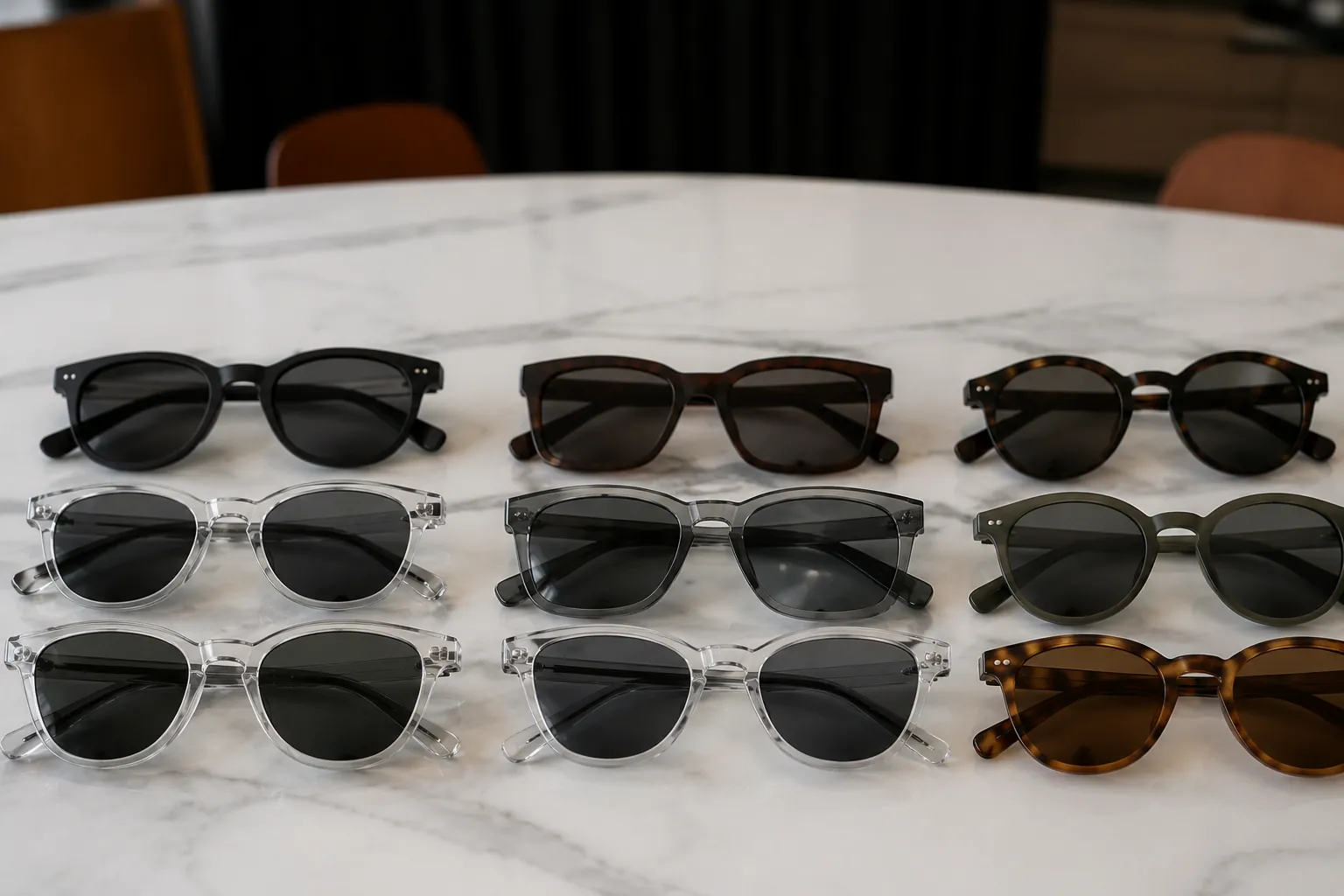
This guide is for buyers deciding whether acetate frames can support a higher selling price, not just a higher factory quote. If you run a brand, import program, or retail line, the question is simple: can acetate create enough margin, shelf appeal, and sell-through to justify its higher material cost, slower machining, extra polishing, and longer development cycle? This playbook breaks that decision into retail positioning, unit economics, lead times, tolerances, and QC risk so you can judge it before placing the PO.
Start with the retail story, not the material name
Acetate is not premium by default. It earns a premium position only when the customer can see, feel, and understand the difference fast enough to accept a higher price. Buyers get into trouble when they approve acetate because it sounds upscale, then sell it in a channel where shoppers compare only price, lens tint, and shape.
Use acetate when at least two of these conditions are true:
- Your target retail price leaves room for a higher landed cost while still protecting gross margin.
- Your product story depends on visible color depth, layered patterns, polished edges, or a heavier hand feel.
- Your retail environment supports close-up display, staff explanation, or stronger packaging.
- Your customer buys for finish and feel, not just UV protection and trend shape.
In practice, acetate works best when the frame can hold a real retail gap over a similar injected style without looking overpriced. If the market will accept only a small shelf-price increase, the material upgrade often disappears into lower margin. If the channel can support a clearly higher shelf price because the product looks better in hand, the premium story can carry the cost.
If your channel is promotion-driven, replenishment-heavy, or built around opening price points, injected plastic usually makes more sense. Simple as that. Acetate helps most when shoppers handle the frame before buying. That tactile moment matters.
Buyer rule: If the end customer is unlikely to notice the difference in a short in-store comparison, acetate may not pay for itself.
What acetate changes in cost, lead time, and margin math
Acetate costs more for practical reasons. The sheet material is usually more expensive than standard injected plastic. Production is slower. Finishing takes more labor. Scrap can also run higher, especially on patterned sheets where visual matching matters. The more decorative the sheet—tortoise, marble, translucent lamination, or multi-color blends—the more care goes into selecting blanks that look consistent across the front and temples.
That does not automatically mean worse margin. Sometimes acetate supports a higher retail price and lower markdown pressure. The key is to model the full commercial stack: sample cost, development time, unit price by volume, packaging, freight, duty, and expected sell-through. If acetate adds cost but creates a clear retail upgrade, the economics may work. If it adds cost without lifting the product story, it usually fails later through markdowns or slower sell-through.
| Factor | Acetate frame | Injected plastic frame | Buyer impact |
|---|---|---|---|
| Material cost | Higher | Lower | Acetate needs a higher retail target to protect margin. |
| Finishing labor | Higher | Lower | Polishing, edge dressing, and alignment checks add labor minutes per pair. |
| Development complexity | Higher | Lower | More approvals on color, lamination look, polishing level, and hardware fit. |
| MOQ sensitivity | Higher by color and pattern | Easier to spread | Small runs get expensive when you split too many finishes. |
| Lead-time risk | Finishing-dependent | Mold-dependent | Acetate slips if polishing, hinge setting, or rework expands. |
| Retail price support | Often stronger | Often weaker | Acetate can justify a larger shelf price gap if execution is visible. |
Lead times vary by factory, style complexity, approval speed, and material availability, so do not rely on generic promises. Ask the supplier for a stage-by-stage timeline covering sample development, approval revisions, production, finishing, inspection, and shipment readiness. Acetate programs often slow down after buyers request multiple color revisions, logo changes, or hardware changes post-approval.
Pricing also improves when volume is concentrated into fewer SKUs. That matters more with acetate because color and pattern variation can increase setup loss and material waste. A small test order split across too many colors usually produces weak pricing and weaker consistency. The takeaway is blunt: acetate works better when you buy deeper into fewer finishes.
Where acetate actually wins
Acetate gives buyers three advantages that customers can usually notice.
- Color depth and pattern: Layered, translucent, and tortoise effects often look richer in acetate than in standard injected plastic. On clear, honey, smoke, olive, and shell-inspired colors, the edge usually shows more depth than a flatter molded finish.
- Hand feel: A well-finished acetate frame often feels denser and more deliberate in the hand. That matters in premium retail, gifting, and fashion or optical environments where customers compare several options side by side.
- Visible finish: Beveled fronts, chamfered temples, and high-polish surfaces can create a bigger jump in perceived value than a minor shape change alone.
These strengths matter most in classic and fashion-led shapes such as square, panto, wayfarer-inspired, cat-eye, and thicker statement frames. They matter less in ultra-light sport styles, wrap shapes, or low-retail basics where injected materials may do the job at lower cost and lower weight.
Material behavior matters too. Acetate can be cut, milled, formed, and polished in ways that give designers more control over edge character and surface depth. But it has limits. Poor heat control can cause warping. Overworking can leave stress marks. Temples designed too thin can become fragile. Ask for actual dimensions and cross-sections, not just renders.
Also remember this: acetate is not only a frame-front decision. The premium story depends on lens tint consistency, hinge fit, logo application, and packaging too. If the frame looks expensive but the pad print is messy, the hinge torque is loose, or the lens tint varies pair to pair, customers notice the weak point first.
Failure modes that kill the premium story
Most acetate problems show up after the buyer has already agreed to pay more. The approval sample looks right. The production lot tells the truth.
- Color mismatch between sample and bulk: Acetate sheet lots can vary in dye lot, translucency, and pattern distribution. If the sample came from an especially attractive part of the sheet and bulk does not follow the same reference, consistency drifts.
- Poor polishing: Dull edges, waviness, burn marks, or over-buffed corners cut perceived value fast. Premium buyers expect clean edges with no obvious haze or sanding marks under normal retail lighting.
- Hinge fit drift: If temple alignment, screw retention, or opening torque is inconsistent, the heavier premium feel quickly turns into complaints about crooked fit or loose closure.
- Decoration mismatch: Metal logo plates, laser engraving, hot stamping, and pad printing must be centered and repeatable. Premium frames make decoration mistakes easier to spot.
- Weight imbalance: Thick acetate can feel substantial, but if the frame becomes nose-heavy or poorly balanced, comfort complaints rise.
Define tolerances before production. For a premium sunglass line, many buyers use visible-appearance standards as well as functional standards: approved color should be tied to a physical master, alignment should be checked visually and dimensionally, and logo placement should be measured from fixed reference points. The real question is not what the factory can achieve once on a sample. It is what the factory can hold in bulk.
Process control matters. If the supplier manages acetate cutting, CNC work, decoration, and QC in-house, it is often easier to catch edge finish, logo placement, and hinge consistency before shipment. Ask for approval checkpoints at three stages: raw frame before final polish, finished frame before lens insertion, and packed AQL sample before final release. For premium acetate, request close-up photos or video of the first production batch under neutral lighting, not just styled product shots.
Be specific. State what is acceptable on color variation, temple alignment, lens fit, and logo position. If premium quality is left undefined, average quality is what usually arrives.
Decoration, lenses, and hardware decide the result
Acetate programs often succeed or fail on the details around the frame, not on the frame shell alone. Buyers focus on the front silhouette. Then they miss the finishing stack.
Logo methods behave differently. Laser engraving can give crisp detail and works well on darker acetate, but depth and clarity must stay consistent. Pad printing allows flexible branding in color, but small misalignment stands out on glossy surfaces. Metal logo plates can feel premium, though they require clean routing, accurate placement, and secure fixing. Hot stamping can be economical, but it is less forgiving on highly curved or uneven surfaces.
Lens choice also shapes premium perception. Set a reference tint, confirm the lens category and performance requirements for the destination market, and define an acceptable edge-finish standard. Even a strong acetate frame can look poorly made if the lens is visibly miscentered, the bevel fit is uneven, or tint consistency drifts across the lot.
Hardware matters more than many first-time buyers expect. Hinge type, screw quality, rivet execution, and temple opening feel all influence perceived quality. A premium acetate frame should open smoothly, close evenly, and sit without obvious wobble. If torque is too loose, the frame feels cheap. If torque is too tight, it feels forced.
So do not treat acetate as a single cost line. It is a system: sheet selection, machining quality, polishing, hinge fit, decoration, lens fit, and packaging. One weak step can break the whole story.
Compliance is not the selling point, but it is the gate
Premium positioning does not remove compliance obligations. The frame material may drive the look, but the shipment still needs the right testing and documentation for the target market and product claim.
Common references and management standards buyers may encounter include CE EN ISO 12312-1, ANSI Z80.3, AS/NZS 1067, REACH, FDA registration, ISO 9001, and BSCI. These do not all mean the same thing. Some relate to product performance or chemical compliance, while others relate to quality-management systems or social compliance. Match each requirement to the destination market, product category, and customer expectations, then confirm what applies to the exact model and lens category being purchased.
| Requirement | Why it matters | Buyer check |
|---|---|---|
| CE EN ISO 12312-1 | Core sunglass safety and performance reference for applicable markets | Confirm the test report matches the model or representative construction and final lens category. |
| ANSI Z80.3 | Common US performance reference for nonprescription sunglasses | Check lens performance, labeling, and whether testing reflects the final lens tint and construction. |
| AS/NZS 1067 | Relevant performance standard for Australia and New Zealand programs | Validate category, labeling, and documentation before production starts. |
| REACH | Chemical compliance requirement relevant to materials and finishes in applicable markets | Confirm that frame materials, coatings, adhesives, and decoration components are covered where relevant. |
| FDA registration | Administrative requirement often requested in US supply chains | Do not confuse registration with product performance certification. |
ISO 9001 and BSCI can be useful indicators of supplier systems and audit status, but they do not replace product-specific compliance testing. Do not use compliance as a marketing claim. Use it as a shipment gate. The operational question is whether your final combination of frame, lens tint, coating, and decoration still falls within approved parameters after customization.
A practical sourcing framework: when to say yes to acetate
If you need a fast decision, use this framework.
- Set your target retail first. Define your intended shelf price or wholesale-to-retail ladder before discussing material.
- Estimate landed cost by volume tier. Compare low-MOQ and scaled-volume scenarios, including freight, duty, packaging, and expected defect allowance.
- Test whether the premium is visible. Ask for side-by-side samples in acetate and injected plastic in the same shape, similar color family, and comparable lens specification.
- Reduce SKU spread. If you choose acetate, limit launch colorways so you can buy deeper and keep pricing and consistency under control.
- Lock appearance standards early. Approve color reference, polish level, logo method, hinge feel, and lens tint before mass production.
- Match compliance to destination. Confirm whether CE EN ISO 12312-1, ANSI Z80.3, AS/NZS 1067, REACH, FDA registration, ISO 9001, or BSCI are relevant to your program and supply chain.
A useful commercial test is simple. If the material upgrade creates a product the customer can clearly perceive as better, the higher cost may be justified. If it only raises your factory quote without improving the selling story, skip it.
The strongest acetate launches are focused: one hero shape, two or three strong colors, a clear packaging concept, and a tight QC standard. Buyers who treat acetate like a broad opening-price assortment often give back margin through complexity, delay, and markdowns.
Buyer scenarios and the shortlist before you issue the PO
Scenario A: independent fashion retailer or premium private label. You need a stronger shelf story, less direct price comparison, and styles that feel giftable. Here, acetate often makes sense if frame finish, color depth, and packaging support a clear retail upgrade. Start with a controlled SKU count. Do not fragment volume too early.
Scenario B: distributor supplying promotional chains or value-led general retail. The order may be large, but the channel is price-led and replenishment-sensitive. Here, injected plastic often wins. The customer is less likely to reward the extra tactile value of acetate, and the risk of overbuilding the product is real.
For buyers working with a supplier that can handle both materials, the choice should be strategic. Use acetate for the hero line where margin and presentation matter. Use injected plastic for the volume line where price and speed matter. Do not force one material to do two different jobs.
Before you approve bulk production on acetate sunglasses, confirm these points in writing:
- Approved frame color reference, including acceptable variation lot to lot.
- Edge and surface finish standard, especially on bevels, polished corners, and temple tips.
- Decoration method and placement tolerance for laser engraving, pad printing, hot stamping, or metal logo plates.
- Hinge specification, opening feel, screw retention, and alignment standard.
- Lens tint reference, lens category where relevant, and any market-specific compliance requirement.
- Sample and production timeline, with approval deadlines on your side.
- Volume-break pricing and whether the chosen color split weakens the quote.
Also ask for a pre-production checklist covering raw sheet reference, first-cut approval, polishing approval, decoration approval, pre-pack AQL, and carton marking confirmation. Those checkpoints catch expensive surprises before goods leave the factory.
Acetate is worth the upgrade when it gives you a stronger premium story and enough margin protection to offset its extra cost and slower development. If it only gives you a better-looking sample, it is usually the wrong commercial choice.
Have a custom sunglasses project in mind?
Send us your styles, target market and quantities and we will return a detailed quote with MOQ, lead time and a sample plan.
Get a QuoteWhy source this from Wenzhou with LumiShades
Wenzhou in Zhejiang Province is widely regarded as China’s eyewear manufacturing capital, producing a large share of the world’s sunglasses. That concentration matters to buyers: a deep local supply chain for acetate sheet, hinges, lens blanks, plating and packaging means shorter component lead times, easier color and material matching, and a workforce with decades of eyewear-specific skill. LumiShades has manufactured in this ecosystem since 2009, and our vertical integration — in-house injection molding, acetate cutting, CNC milling, lens tinting, decoration and quality control — means no part of your order is quietly subcontracted to a workshop you cannot audit.
For international buyers, that vertical control translates into accountability. When a single factory owns every step, defects are traced and fixed at source rather than bounced between vendors, and your specifications survive intact from first sample to bulk. We back this with 15+ years of experience, shipments to 60+ countries, more than 5 million pairs produced per year and a 98.5% on-time delivery rate. Our certifications — CE EN ISO 12312-1, FDA registration, ANSI Z80.3, AS/NZS 1067, REACH, ISO 9001 and BSCI audit — mean the compliance documentation your market requires already exists. Explore our manufacturing capabilities and quality control process to see how this works in practice.
Frequently asked questions
How small can I start if I want to test acetate in one style? You can start small, but keep the test tight. Use one shape, one or two colors, one lens specification, and no late-stage changes. Before approving the trial order, ask the supplier for the exact MOQ by color, whether sample material will match bulk sheet availability, and how pricing changes at the next volume break. Also confirm whether the factory will treat the test run as true production or as a sample-based build, because consistency and repeatability can differ.
Does acetate automatically mean better quality than injected plastic? No. Acetate can create a more premium look and hand feel, but it is not automatically better made. Quality depends on execution: sheet selection, machining accuracy, polishing quality, hinge installation, lens fit, and decoration control. To judge quality, ask for side-by-side samples in the same shape, inspect edges under direct light, check temple alignment on a flat surface, open and close both temples repeatedly, and review close-up photos of branding and lens fit.
What is the main cost mistake buyers make with acetate? The most common mistake is spreading a small order across too many colors or patterns. That weakens pricing, complicates sheet matching, and increases the chance of inconsistency in bulk. A better approach is to launch with fewer SKUs, confirm which sheet colors are standard versus custom, and ask the supplier to quote by color split so you can see exactly how assortment complexity changes unit cost.
Which compliance documents should I ask for on a sunglass program? Ask for documents based on destination market and final product specification, not generic factory claims. For applicable programs, that may include CE EN ISO 12312-1, ANSI Z80.3, AS/NZS 1067, REACH-related declarations or test support where relevant, and FDA registration if your US supply chain requires it. If the supplier presents ISO 9001 or BSCI, treat those as factory-system documents, not proof of sunglass performance. Always check that reports or declarations match the final lens category, tint, and construction you are actually buying.
How should I approve an acetate sample to reduce bulk surprises? Do not approve only a beauty sample. Build a documented approval package. That should include the physical color reference or retained master sample, lens tint reference, branding artwork with placement dimensions, hinge specification, and written appearance standards for polish, edge quality, and alignment. If possible, review the raw frame before final polish and one pre-shipment QC sample from bulk. Ask the supplier to confirm how bulk material will be matched to the approved sample, what inspection points will be used in-line, and what rework criteria apply if color or finish drifts.
Ready to start?
Explore our sport wrap sunglasses or request a quote — our sales team replies within 12 hours.
Request a Quote