
PC Injection vs Acetate Sunglasses: Bulk Buyer Tradeoffs
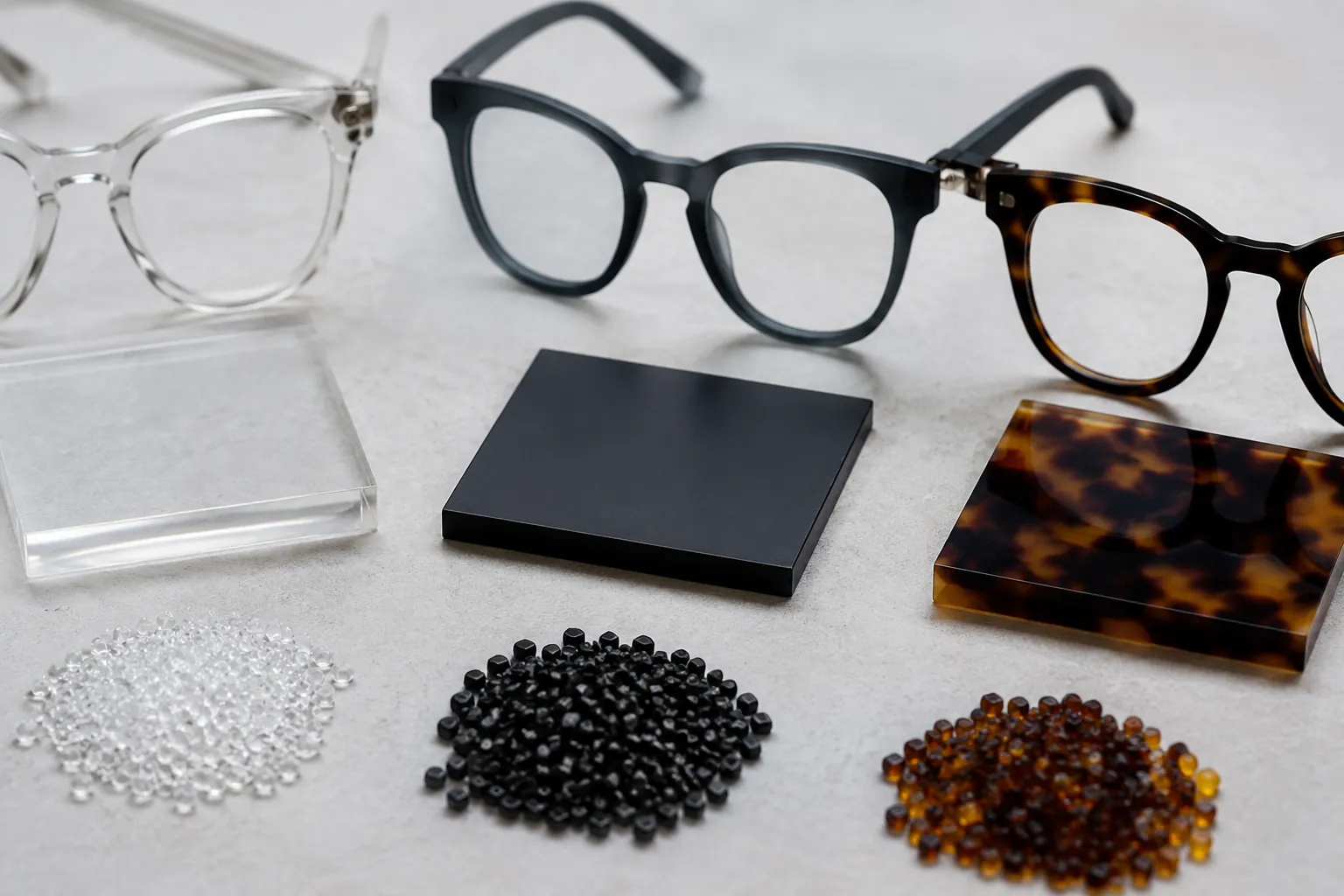
This guide is for brand owners, importers, distributors, and retail buyers comparing polycarbonate injection frames with hand-cut acetate sunglasses for bulk programs. Material matters. The bigger decision is the production route behind it. Tooling cost, MOQ, lead time, tolerance control, finish, decoration, and reorder economics all change depending on whether the frame is molded or cut from sheet. A price-driven promotional line follows one logic. A premium fashion or optical collection follows another. This article explains the tradeoffs in practical sourcing terms and focuses on points a buyer can verify during development, sampling, production, and compliance review.
Start with the business model, not the material pitch
Buyers often start by asking which frame material is better. For sourcing, that is usually the wrong first question. Ask which production method fits your target retail price, launch date, expected reorder pattern, and quality standard.
PC injection and hand-cut acetate solve different business problems. Injection molding is built for repeatability, efficient output at scale, and lower labor per unit after tooling and process settings are approved. Acetate is chosen for visual depth, polished edges, denser hand feel, and a stronger premium impression at shelf level. Neither route is always better. Each has its own cost structure, development path, and risk profile.
A high-volume promotional program with a stable shape, simple solid color, and printed logo will often lean toward injection. A fashion capsule with laminated tortoise, polished bevels, and visible core-wire temples will often lean toward acetate. Different goals. Different math.
- Start with injection if your program is cost-sensitive, volume-driven, and likely to repeat with minimal geometry changes.
- Start with acetate if your program is fashion-led and customers will notice polish, lamination pattern, transparency, or hand feel on first touch.
- Do not choose on material alone; compare total program economics across development, first order, and likely reorders.
How the two production routes work
The methods split early in development. Injection is mold-driven. Acetate is machining- and finishing-driven.
| Step | PC Injection Frame | Hand-Cut Acetate Frame |
|---|---|---|
| Base material | Polycarbonate resin pellets, either pre-colored or prepared for later surface finishing | Acetate sheet stock, selected by thickness, pattern, transparency, and color |
| Core forming method | Molten resin injected into a steel mold under controlled pressure, temperature, and cooling conditions | Sheet cutting, CNC milling, drilling, beveling, heat forming, tumbling, polishing, and assembly |
| Main setup cost | Steel mold tooling, usually the main upfront investment for a new shape | CAD/CAM programming, cutting paths, and fixtures; typically lower upfront tooling than injection |
| Typical tolerance strength | Strong repeatability on lens groove, front symmetry, and hinge location when the mold and process window are stable | Good dimensional control is possible, but more process stages can introduce variation if finishing is not tightly controlled |
| Surface finish path | Mold texture plus optional paint, coating, or printing depending on the design | Color and pattern run through the material, followed by tumbling and polishing to create the final finish |
| Color creation | Resin color, masterbatch, or surface paint/coating depending on the specification | Sheet pattern, transparent layers, laminations, or custom-developed acetate combinations |
| Best commercial use | Repeat programs, promotional lines, and scale-oriented private label | Premium collections, fashion stories, and acetate-led shelf presentation |
Injection development usually includes 3D design review, mold engineering, mold fabrication, trial molding, process adjustment, trimming, hardware assembly, lens fitting, decoration, and final QC. Common issues are sink marks in thicker sections, warpage after cooling, stress at the bridge, and lens groove fit that needs adjustment after shrinkage is measured.
Acetate development starts with sheet selection. Fronts and temples are cut from sheet, milled to shape, beveled, drilled, heat formed, tumbled, polished, assembled, fitted with lenses, and decorated. There is more manual handling and more process stages. That also creates the look many premium buyers want: depth in tortoise patterns, cleaner transparency, and more refined edge polish.
That is the real difference. Injection is a controlled mold system. Acetate is a controlled machining and finishing system.
Where cost moves: tooling, labor, yield, and MOQ
Many buyers compare only quoted unit price. That is not enough. Split the numbers into one-time cost, repeat cost, and defect risk.
For injection, the decision starts with tooling. A new mold creates upfront cost, but once approved, cycle time is usually efficient and labor per frame is lower than for hand-finished acetate. That is why injection often gets more competitive as volume rises and reorders become more likely.
For acetate, there is usually less mold-type investment for a new style, but piece price often stays higher because cutting, milling, polishing, pattern matching, and fitting require more labor. Yield matters too. If a laminated sheet chips during edge work, if a bevel is over-polished, or if front and temple patterns miss the agreed visual standard, usable yield falls and true cost per accepted pair rises.
| Commercial factor | PC Injection | Acetate |
|---|---|---|
| MOQ practicality | Usually makes more sense when volume is sufficient to absorb tooling cost | Can be useful for lower-volume style tests where full mold investment is premature |
| Upfront investment | Higher due to mold tooling for a new shape | Lower, usually driven by programming, setup, and material selection |
| Per-unit labor | Lower after the process is validated | Higher because of machining, polishing, fitting, and visual QC |
| Best reorder logic | Strong when geometry is stable over time and repeat demand is likely | Useful when styles change often and design flexibility matters more than scale efficiency |
- Injection cost drivers: mold complexity, cavity count, cycle time, secondary finishing, lens specification, logo method, and packaging requirements.
- Acetate cost drivers: sheet grade, thickness, pattern loss, CNC time, polishing labor, hinge installation, lamination complexity, and visual matching standards.
- Shared cost drivers: packaging, lab testing, compliance files, and the number of sample revision rounds.
If you expect frequent style changes or uncertain reorder volume, acetate can be the safer commercial choice because it avoids early mold commitment. If the style is stable and likely to repeat, injection often offers the better long-term margin structure.
Lead time and development risk
Lead time is not just factory speed. It is development time, buyer approval time, production time, and rework risk.
With injection, sampling can move fairly fast when a design is based on an existing platform or the supplier already has a similar mold structure. If a fully new mold is required, the schedule depends on mold fabrication, trial runs, and corrections after first shots. Delay points usually include sink marks, cooling-related twist, hinge alignment issues, and lens groove fit changes after shrinkage is measured.
With acetate, you may avoid waiting for full mold fabrication, which can help early sample development. But production includes more manual stages, and each one can slow the line. Common delay points are sheet availability, approval of custom colors or laminations, CNC capacity, tumbling time, hand polishing, and post-assembly fit correction.
- Choose injection if your launch depends on repeatable bulk output after design approval.
- Choose acetate if material story and finish quality matter more than the fastest path to high-volume production.
- For urgent launches, ask which operations are done in-house and which are outsourced, especially molding, acetate cutting, CNC, lens production, logo application, and final QC.
One more point. Buyer-side delays wipe out process advantages fast. If artwork, Pantone references, packaging files, or lens specifications change after sample approval, both methods lose time.
Appearance, hand feel, and what shoppers notice
This is where acetate often wins in a side-by-side comparison, especially for premium positioning.
Hand-cut acetate carries color and pattern through the material, which creates depth that surface paint usually cannot match. Tortoise patterns, crystal transparencies, laminated stripes, and polished bevels look richer because they are built into the sheet, not applied on top. Acetate also usually feels denser in hand. That helps in fashion and optical retail.
Injection has a different strength: visual uniformity. That can be useful for sports styles, promotional lines, and simple fashion programs where consistent matte black, uniform translucent colors, or branded color blocking matter more than material depth. It also scales well for straightforward geometry.
Do not rely on first impression alone. Inspect samples against specific checkpoints.
- Injection checkpoints: gate vestige, parting line visibility, sink at thicker sections, stress whitening near hinges, paint or coating coverage, coating adhesion, and lens seating consistency.
- Acetate checkpoints: edge polish clarity, symmetry of milling, bevel consistency, front-to-temple pattern match, tumble marks, hinge setting straightness, and symmetry after heat bending.
- Both routes: opening and closing torque, logo position, lens cleanliness, basic fit balance, bridge comfort, and carton pack accuracy.
Decoration also changes perceived value. Injection commonly uses pad printing, screen printing, hot stamping, or surface coatings depending on substrate and design. Acetate commonly uses foil logos, laser engraving, metal inlays, or branding integrated with metal parts. If decoration durability matters, ask for actual adhesion or abrasion results for the specified finish, not just sample photos.
Consistency, tolerances, and QC risk
Injection is often chosen for repeatability because the mold defines geometry. Fair enough. But repeatability only matters if the process window is controlled and the mold is properly validated.
Injection can usually hold tighter lot-to-lot consistency on lens groove geometry, temple fit, bridge symmetry, and hinge location than a process with multiple manual finishing stages. In sourcing terms, that can simplify lens fitting, assembly, and repeat ordering. The right buyer question is not just whether the frame is injection. Ask which dimensions are monitored in production and what tolerance band is accepted for those checkpoints.
Acetate can also deliver strong quality, but consistency depends more on discipline during cutting, milling, polishing, heat bending, and assembly. Sheet thickness variation, heat response, and over-polishing can all affect final fit and symmetry. So acetate programs need stronger in-process QC, not just final inspection.
Buyer takeaway: Injection usually reduces piece-to-piece variation for stable designs. Acetate usually raises the importance of operator skill, in-process inspection, and visual standard alignment.
A practical QC plan for either route should include incoming material checks, first article approval, in-line dimensional checks, hinge torque verification, lens inspection, logo durability checks where relevant, and final AQL-based shipment inspection. Ask the supplier to define measurement points, visual standards, and defect criteria in writing before production starts.
Compliance, lenses, and document control
Sunglasses are a compliance product. The frame method does not remove testing or documentation obligations. The finished product still has to meet the rules of the destination market, and lens specification is often just as important as frame construction.
Common standards and systems buyers may encounter include CE EN ISO 12312-1, ANSI Z80.3, AS/NZS 1067, REACH, FDA registration, ISO 9001, and BSCI. Not every item applies the same way to every transaction. Request only the documents relevant to the target market, product type, and commercial claim.
- CE EN ISO 12312-1: commonly relevant for general-purpose sunglasses placed on applicable markets.
- ANSI Z80.3: commonly referenced for sunglasses sold into the US market.
- AS/NZS 1067: relevant to applicable Australia and New Zealand requirements.
- REACH: relevant for chemical compliance expectations on materials, coatings, inks, and finishes where applicable.
- FDA registration: may appear in US import and supplier documentation, but buyers should verify product classification and required records for the exact program.
- ISO 9001 and BSCI: these indicate management system or social compliance status, not product performance compliance.
Model-specific document control matters. If you change lens category, polarized construction, mirror coating, paint system, or topcoat, the compliance file may no longer match the shipped product. A clear sample frame does not prove that a mirrored production version will test the same way. Ask for the bill of materials used for testing, confirm that it matches the production specification, and keep the approved report, label copy, and packaging records tied to the same model code and revision level.
A practical decision framework for buyers
If you need a short answer, use this framework.
| Buying situation | Better fit | Why |
|---|---|---|
| Promo line, tight retail target, repeat volume | PC injection | Usually offers lower cost at scale, stronger repeatability, and more efficient bulk throughput after approval |
| Fashion collection with premium shelf presentation | Hand-cut acetate | Better color depth, edge finish, denser hand feel, and stronger perceived value |
| Uncertain reorder volume, many style tests | Often acetate | Lower upfront commitment when the design is still being validated commercially |
| Simple geometry, solid color, logo-driven private label | PC injection | Efficient production, easier repeat control, and a stronger fit for stable designs |
| Statement frame with laminated pattern story | Hand-cut acetate | The material itself creates the visual effect more effectively than surface-applied color on molded parts |
Before placing a PO, confirm four numbers:
- Your target landed cost per pair.
- Your required ex-factory or ship date.
- Your realistic first-order quantity and expected reorder volume.
- Your acceptable reject rate at incoming inspection.
If the program starts small and may change next season, do not overcommit to a tooling-heavy route without clear reorder confidence. If the plan is a stable, repeatable volume program, invest in the route that lowers repeat cost and protects margin over time. The material shows up on the spec sheet. The production method drives the commercial result.
Have a custom sunglasses project in mind?
Send us your styles, target market and quantities and we will return a detailed quote with MOQ, lead time and a sample plan.
Get a QuoteWhy source this from Wenzhou with LumiShades
Wenzhou in Zhejiang Province is widely regarded as China’s eyewear manufacturing capital, producing a large share of the world’s sunglasses. That concentration matters to buyers: a deep local supply chain for acetate sheet, hinges, lens blanks, plating and packaging means shorter component lead times, easier color and material matching, and a workforce with decades of eyewear-specific skill. LumiShades has manufactured in this ecosystem since 2009, and our vertical integration — in-house injection molding, acetate cutting, CNC milling, lens tinting, decoration and quality control — means no part of your order is quietly subcontracted to a workshop you cannot audit.
For international buyers, that vertical control translates into accountability. When a single factory owns every step, defects are traced and fixed at source rather than bounced between vendors, and your specifications survive intact from first sample to bulk. We back this with 15+ years of experience, shipments to 60+ countries, more than 5 million pairs produced per year and a 98.5% on-time delivery rate. Our certifications — CE EN ISO 12312-1, FDA registration, ANSI Z80.3, AS/NZS 1067, REACH, ISO 9001 and BSCI audit — mean the compliance documentation your market requires already exists. Explore our manufacturing capabilities and quality control process to see how this works in practice.
Frequently asked questions
Is PC injection always cheaper than acetate? No. Injection is often cheaper on a repeat basis when volume is high enough to spread mold cost over many pairs. For a new style, compare total program cost, not just unit price: mold cost, sample revisions, expected reorder volume, decoration, packaging, and defect risk. Ask the supplier for two scenarios in writing: first order with all setup costs included, and reorder pricing assuming no geometry change.
Which method is faster for a new custom design? It depends on the development path. If a new injection mold is required, mold fabrication and trial correction can make injection slower at the front end. Acetate can move faster in sampling because it relies on cutting and milling rather than full mold making. For a useful comparison, ask for a stage-by-stage timeline: CAD approval, sampling, corrections, lab testing if needed, bulk production, and packaging readiness. Do not accept a single total lead-time number without those milestones.
Which frame type gives better consistency on reorders? PC injection usually gives stronger lot-to-lot consistency for shape, lens groove fit, symmetry, and hardware location because the mold fixes the geometry. Acetate can also be consistent, but only if the supplier controls sheet selection, machining, polishing, heat bending, and assembly carefully. Before approving a supplier, ask what dimensions are measured in production, what tolerance bands are used, and whether reorder samples are compared against a retained golden sample.
Do compliance requirements change based on frame method? No. Choosing injection or acetate does not remove market compliance requirements. What matters is the finished sunglasses configuration, especially lens performance, coatings, and materials used. For an active buying decision, ask for the specific documents relevant to your market and model: finished-product test reports where required, REACH-related material declarations where applicable, labeling copy, and a bill of materials that matches the tested version. Also verify whether ISO 9001 or BSCI documents are factory-level documents rather than product compliance records.
What order size starts to favor injection strongly? There is no universal cutoff because the answer depends on mold cost, frame complexity, cavity plan, lens specification, finish, and the likelihood of reorders. The right way to evaluate it is to ask the supplier for a break-even comparison across at least three volumes, such as pilot order, medium run, and expected repeat run. If the design is stable and reorder probability is high, injection usually becomes more attractive. If the style is uncertain or likely to change quickly, acetate may be the lower-risk commercial choice even when the nominal unit price is higher.
Ready to start?
Explore our square sunglasses or request a quote — our sales team replies within 12 hours.
Request a Quote