
Kids' Sunglass Frame Materials: TR90, PC, Acetate, Metal
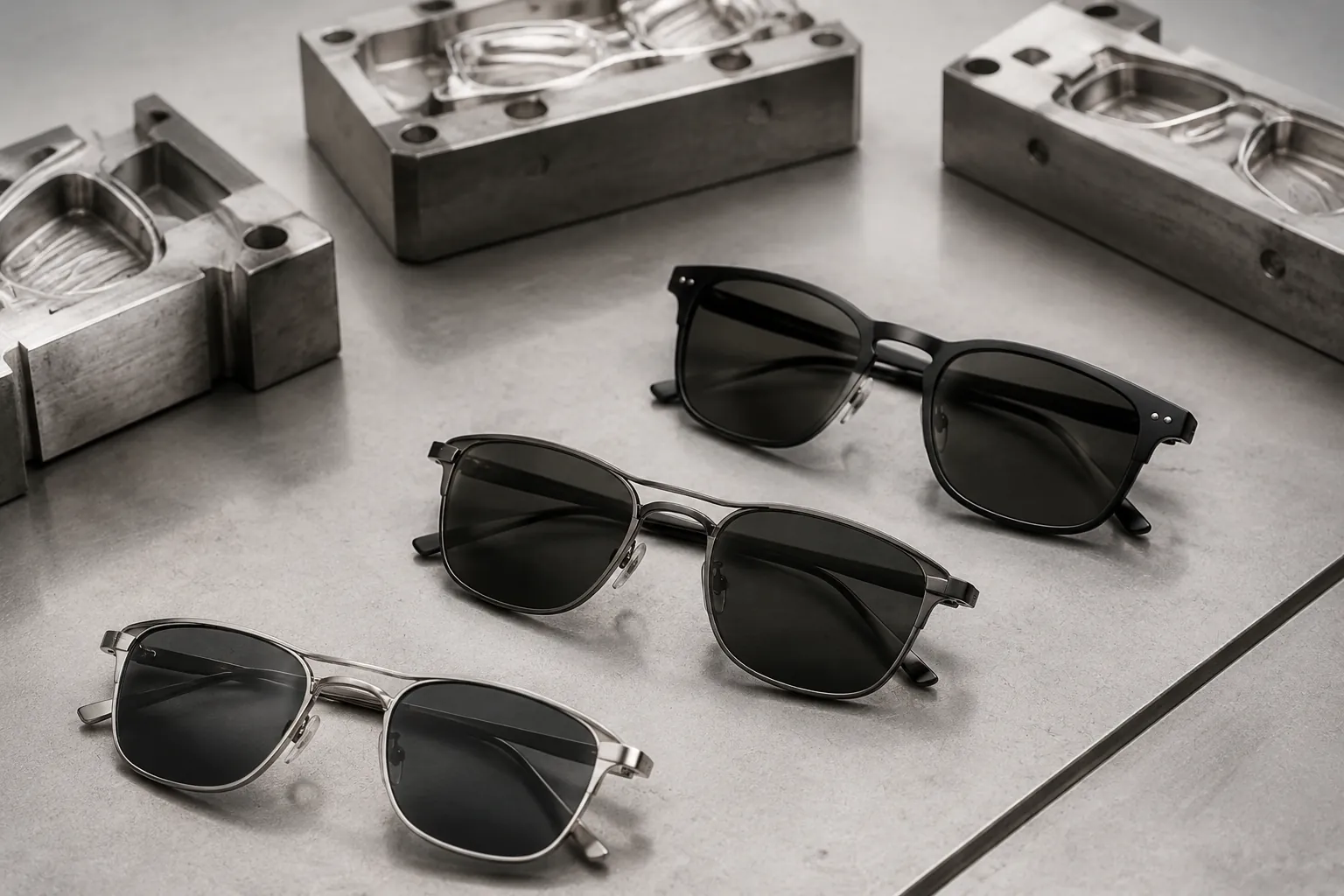
For kids' and youth sunglasses, frame material affects durability, comfort, fit stability, decoration performance, and production consistency. For B2B buyers, it is not just a styling choice. It affects return risk, compliance planning, and total landed cost. This guide covers the main material options used in kids' and youth sunglasses—TR90-style nylon, polycarbonate, acetate, and metal—and shows how to evaluate them in sourcing, sampling, and bulk production.
Start with the use case, not the material name
When sourcing sunglasses for children or youth, start with how the product will actually be used. Kids' frames are handled roughly, stored badly, and worn for long periods. Youth frames face more style pressure, but they still need to keep their fit and finish through daily use.
Before you choose TR90, polycarbonate, acetate, or metal, define the main risk you want to reduce:
- Breakage: often tied to rigid construction, weak hinge areas, thin bridges, or poor assembly.
- Fit complaints: usually caused by frame geometry, temple spread, bridge shape, or excess weight.
- Skin reaction or odor concerns: can come from low-grade materials, coatings, adhesives, or plating.
- Decoration failure: pad printing, painted finishes, and logo attachments depend on both the base material and surface prep.
For younger children, buyers usually prioritize low weight, rounded edges, and flexibility. For older kids and preteens, appearance matters more. But durability still has to lead. A frame that looks good in a catalog and fails at the hinge is a bad buy.
Ask one blunt question: what does this frame need to survive in normal use? If the answer includes repeated bending, drops, backpack compression, and frequent cleaning, the material and design should favor resilience over looks.
What changes in use: TR90, PC, acetate, and metal
Four material families are common in kids' and youth sunglasses: TR90-style nylon, polycarbonate, acetate, and metal. They behave differently in molding, finishing, decoration, repair, and long-term wear.
| Material | Typical behavior | Weak points | Best fit |
|---|---|---|---|
| TR90 / injected nylon | Lightweight, flexible, generally comfortable, suitable for active use | Decoration options may be more limited than acetate; processing quality affects shape stability and finish | Kids' utility frames, active styles, everyday wear |
| Polycarbonate (PC) | High impact resistance, widely used in injection molding, cost-effective for volume programs | Can feel stiffer than TR90; surface appearance may look less premium depending on finish | Budget lines, sport-inspired shapes, simple molded programs |
| Acetate | Strong color depth, premium appearance, broad styling and finishing options | Usually heavier than injected plastics; less forgiving under rough handling; more labor to finish | Older kids, youth fashion lines, higher perceived-value collections |
| Metal / stainless steel | Slim profiles, clean appearance, adjustable nose pad options in some constructions | Needs tighter control over hinge quality, welding, plating, and edge finishing; less suitable for very young children | Older youth, preteen fashion, mixed-material designs |
TR90 and polycarbonate are often chosen for utility and durability. Acetate is usually chosen for appearance and color depth. Metal can work well for older age groups, especially where a slim look matters. It is less forgiving in rough use.
Material type alone does not decide performance. Resin grade, processing conditions, wall thickness, hinge design, and finishing quality all affect the finished frame. Buyers should compare the material and the factory's process control. Both matter.
For kids, weight, flex, and edge safety matter most
For younger children, flexibility and comfort are central. Frames get twisted, dropped, and packed into bags without cases. A frame that is too rigid, too heavy, or poorly finished is more likely to cause complaints or break.
In sample review and supplier checks, focus on these points:
- Temple spring-back: the temple should flex in normal use without stress whitening, cracking, or permanent distortion.
- Hinge retention: screws, rivets, or embedded hinge parts should stay secure after repeated opening and closing.
- Edge finishing: lens grooves, bridge areas, hinge pockets, and temple tips should be smooth and free from sharp edges.
- Weight control: lighter frames are usually easier for children to wear and less likely to slide on small noses.
TR90-style injected frames are common in kids' programs because they combine low weight with good flexibility. Polycarbonate can also work, especially in simple molded designs, but the grade and frame construction affect how stiff it feels. Acetate may suit older children or youth products, but it usually needs more care in design because it is heavier and more rigid than many injected plastics. Metal can perform well in older youth styles if hinge quality, plating, and end-piece finishing are controlled.
Smaller frames leave less room for error. Repeatability matters. Ask suppliers for written tolerances on lens groove, bridge width, temple alignment, and front symmetry. Without those tolerances, sample approval is hard to turn into consistent bulk production.
Compliance depends on the full build
Frame material does not certify a product on its own, but it affects how easily a sunglass program passes testing and documentation. Match the material and decoration plan to the destination market before you approve tooling or pre-production samples.
- CE EN ISO 12312-1: relevant for sunglasses placed on the EU market.
- ANSI Z80.3: commonly referenced for non-prescription sunglasses in the U.S. market.
- AS/NZS 1067: relevant for Australia and New Zealand.
- REACH: important for chemical compliance in materials, coatings, inks, adhesives, and decorative parts where applicable.
- FDA registration: relevant to U.S. commercial setup and shipment paperwork, but not a substitute for product testing.
- ISO 9001: a quality management system standard, not product certification.
- BSCI: covers social compliance and factory audit practice, not product certification.
Material choice can shift where risk shows up. Flexible injected materials may behave differently from acetate or metal in handling, assembly, or decoration. More often, failures come from the full build: coatings, printed logos, glued badges, plated parts, or assembly methods.
Test the actual production version, not just an undecorated sample. If the order includes pad printing, laser marking, soft-touch coating, metal logo plates, or painted finishes, those features should be on the approval sample and, where needed, on test samples too.
Buyer rule: approve and test the frame in its final material-and-decoration combination, not as a stripped-down prototype.
Ask for supporting documents by material lot where possible, especially for frames, coatings, inks, and plating inputs used in children's products.
How material affects tooling, MOQ, and unit cost
Material choice affects performance, but it also affects the manufacturing route, setup effort, and commercial flexibility. That matters in kids' programs, where buyers often need multiple sizes or colorways without adding too much risk.
Injection-molded TR90 or polycarbonate programs are often easier to repeat at volume once tooling is stable. Acetate usually needs more manual finishing, color control, and polishing. Metal programs may require tighter controls for welding, plating, and assembly.
| Material | MOQ logic | Cost trend at volume | Lead-time behavior |
|---|---|---|---|
| TR90 / injected nylon | Usually works well for repeat programs once molds and color standards are approved | Often competitive at volume because molding and assembly are efficient | Depends on mold readiness, decoration, and color approval |
| Polycarbonate | Often suitable for straightforward molded programs and budget-driven assortments | Typically cost-effective on simple constructions | Can be efficient once tooling and finish standards are fixed |
| Acetate | Needs closer control of sheet color, polishing, and finishing consistency | Usually higher because of material cost and labor input | May be longer where hand-finishing or color matching is involved |
| Metal | Best managed with tighter design discipline and fewer unnecessary variants | Cost can rise with plating, welding, nose pad assemblies, and decorative details | Timing is often influenced by plating yield and assembly complexity |
Compare quotes on the same basis. Unit price changes fast with color count, coating type, logo method, hinge construction, packaging, and inspection level. A basic molded frame and a frame with special coatings, multi-step decoration, and custom hardware are not the same product.
Also confirm whether the factory handles molding, finishing, decoration, and QC in-house or through subcontractors. That affects lead time, traceability, and consistency on repeat orders.
Choose by age band, not just style
A frame that works for a young child is often wrong for a preteen. Age band changes fit, acceptable weight, likely abuse level, and the balance between function and style.
- Young kids: prioritize low weight, rounded edges, stable fit, and forgiving materials. TR90 and polycarbonate are common starting points.
- Older kids: broader style choices are possible, including thicker injected frames or selected acetate constructions, as long as comfort and durability stay strong.
- Youth / preteen: style matters more, so acetate, metal, or mixed-material designs may work if the frame still holds fit and finish in normal use.
Overbuilding is not always the answer. A thick temple or heavy front can look strong and still feel bad on the face. Temple tip angle, bridge shape, front curve, and balance often matter as much as material choice.
For line planning, think in size bands instead of only using broad labels like "kids" or "youth." A platform approach—one material family across multiple sizes with controlled changes in eye size, bridge width, and temple length—can simplify tooling and improve reorder consistency.
What to ask before you approve a sample
Good sourcing questions reduce risk before bulk production starts. Sample approval should confirm appearance, material identity, process control, and documentation readiness.
- Which material or resin grade is being used, and will the same grade be used in bulk production?
- What hinge construction is used, and how does the factory verify hinge durability internally?
- How are logos and decorations applied: pad printing, laser marking, paint, in-mold detail, attached metal badge, or another method?
- What are the written tolerances for lens groove, bridge width, temple alignment, and front symmetry?
- Can the supplier provide relevant compliance support documents, such as REACH-related declarations where required?
- Which market standard is the product intended to meet: CE EN ISO 12312-1, ANSI Z80.3, or AS/NZS 1067?
Also ask how QC is structured: incoming material inspection, in-process checks, decoration inspection, final assembly inspection, and pre-packout review. If the supplier holds ISO 9001 certification, that may show a formal quality system, but you still need to verify how it applies to the actual sunglass program. If the supplier has BSCI audit coverage, that can support social compliance review, but it does not replace product quality checks.
For any new decoration method or unfamiliar material mix, a pilot run is often worth it. It can expose problems with color consistency, adhesion, finish stability, or assembly quality under real production conditions.
A simple rulebook for volume buyers
If you need a short list, use this:
- Choose TR90 when low weight, flexibility, and everyday durability are the top priorities.
- Choose polycarbonate when you need an impact-resistant molded frame with cost control and simple styling.
- Choose acetate when color depth, perceived value, and fashion presentation matter most, usually for older kids or youth.
- Choose metal when the design needs a slimmer profile or adjustable fit features, usually for older youth rather than very young children.
Then check the choice against the real specification: final decoration method, target compliance market, packaging format, and quality controls. A frame should not be treated as approved until the actual production version has been reviewed.
For repeat buying, document the approved material, finish, color standard, critical dimensions, and compliance file references. That gives you a usable baseline for reorders and helps stop later production drift.
Final rule: choose the material for the user and use case first, confirm the decoration and compliance path second, and lock production controls third. That order prevents a lot of avoidable sourcing mistakes in kids' and youth sunglasses.
Have a custom sunglasses project in mind?
Send us your styles, target market and quantities and we will return a detailed quote with MOQ, lead time and a sample plan.
Get a QuoteWhy source this from Wenzhou with LumiShades
Wenzhou in Zhejiang Province is widely regarded as China’s eyewear manufacturing capital, producing a large share of the world’s sunglasses. That concentration matters to buyers: a deep local supply chain for acetate sheet, hinges, lens blanks, plating and packaging means shorter component lead times, easier color and material matching, and a workforce with decades of eyewear-specific skill. LumiShades has manufactured in this ecosystem since 2009, and our vertical integration — in-house injection molding, acetate cutting, CNC milling, lens tinting, decoration and quality control — means no part of your order is quietly subcontracted to a workshop you cannot audit.
For international buyers, that vertical control translates into accountability. When a single factory owns every step, defects are traced and fixed at source rather than bounced between vendors, and your specifications survive intact from first sample to bulk. We back this with 15+ years of experience, shipments to 60+ countries, more than 5 million pairs produced per year and a 98.5% on-time delivery rate. Our certifications — CE EN ISO 12312-1, FDA registration, ANSI Z80.3, AS/NZS 1067, REACH, ISO 9001 and BSCI audit — mean the compliance documentation your market requires already exists. Explore our manufacturing capabilities and quality control process to see how this works in practice.
Frequently asked questions
Is TR90 better than polycarbonate for kids' sunglasses? Not always. TR90 is often preferred when buyers want a lighter, more flexible frame for younger users. Polycarbonate is also widely used and can be a strong option for impact-resistant, cost-sensitive programs. Ask the supplier for both materials in the same frame design, then compare flexibility, weight, finish quality, and decoration performance before deciding.
Can acetate be used for children's frames? Yes. Acetate can be used for children's or youth frames, but it is usually a better fit for older kids and preteens than for very young children. Because acetate is heavier and less forgiving than many injected plastics, pay close attention to weight, hinge strength, edge finishing, and fit comfort during sample review.
What compliance should I ask for on kids' sunglasses? Start with the destination market. For the EU, ask about CE EN ISO 12312-1. For the U.S., review ANSI Z80.3. For Australia and New Zealand, check AS/NZS 1067. If your market needs chemical control, request REACH-related documentation where applicable. If the supplier mentions FDA registration, treat it as administrative support, not proof that the product itself meets sunglass performance requirements.
How does material choice affect MOQ and price? Injected materials such as TR90 and polycarbonate are often more efficient for volume production once tooling is approved, which can make them more cost-competitive on repeat orders. Acetate and metal usually need more finishing or assembly steps, which can increase cost and lead time. To compare pricing properly, ask for quotes based on the same specification set: material, colorways, decoration, hinge type, packaging, inspection level, and target compliance market.
What is the main sample risk with decorated frames? The main risk is that the plain frame looks fine, but the final decorated version behaves differently. Pad printing, laser marking, paint, soft-touch coatings, glued logos, and plated parts can create adhesion, abrasion, appearance, or corrosion problems. Approve and, where needed, test the exact final decoration method and placement used for production.
Ready to start?
Explore our square sunglasses or request a quote — our sales team replies within 12 hours.
Request a Quote