
Choosing Straight, Curved, or Wire-Core Temples
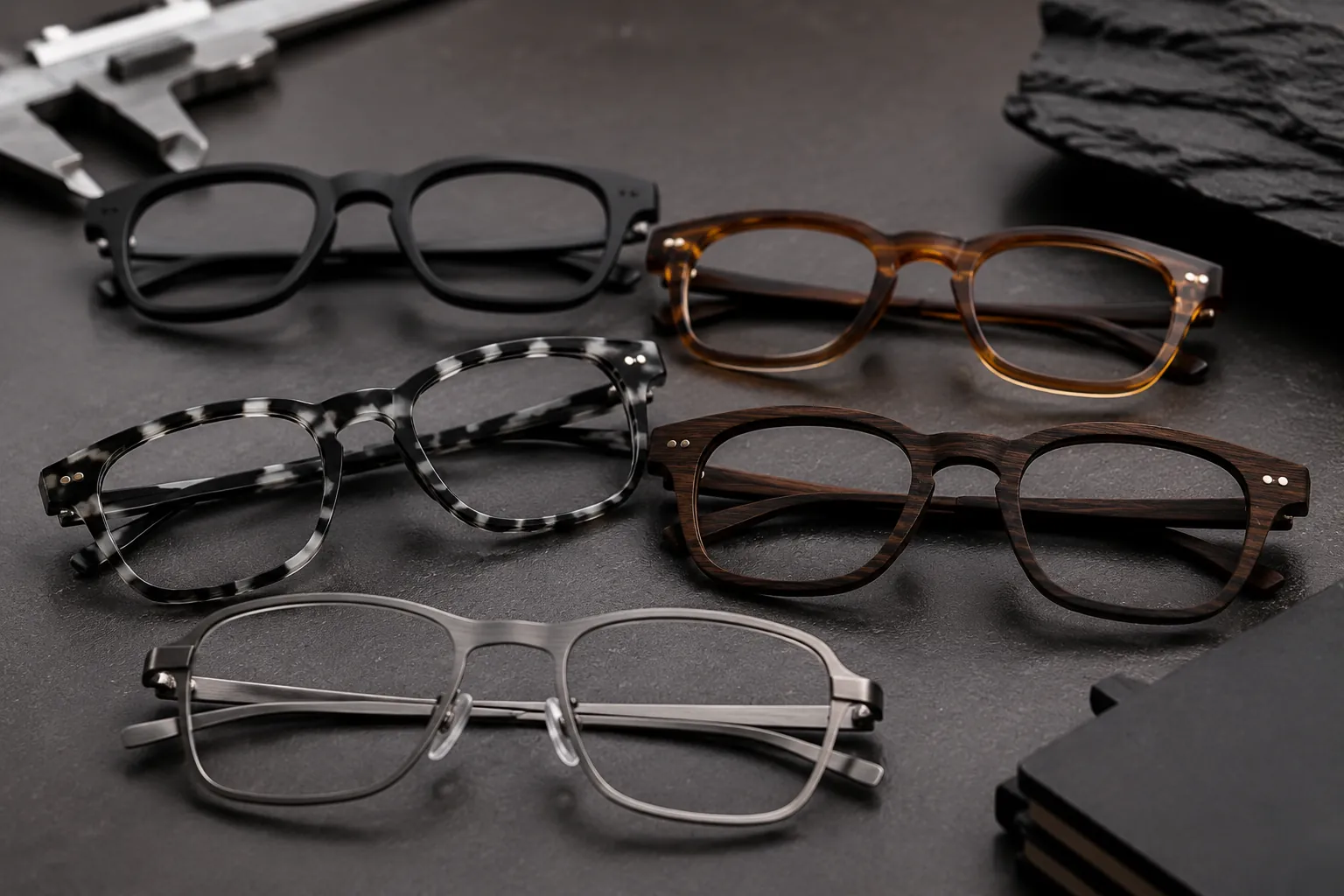
This guide is for brands, importers, distributors, and retailers buying custom sunglasses in volume. Temple construction may look like a small detail on a drawing, but it affects fit, comfort, branding space, manufacturability, and QC risk. Choose badly at the start and you invite sample revisions, decoration limits, alignment problems, and wearer complaints later. This article explains how straight, curved, and wire-core temples differ in use, production, and sourcing so buyers can write clearer specifications before approving samples or placing bulk orders.
Start with the use case, not the sketch
Many product teams start with the front shape, lens color, or logo placement and treat the temple as secondary. That is often the wrong order. Temple structure affects how the frame sits, where pressure lands, how stable the sunglasses feel in motion, and how much usable space is left for branding.
Three common temple constructions are:
- Straight temples: little or no drop behind the ear. Common on fashion styles, slim injection frames, and some sport-inspired silhouettes.
- Curved temples: a built-in bend toward or around the ear to improve retention and broaden off-the-shelf fit acceptance.
- Wire-core temples: usually acetate temples with a metal core inside, used to support shaping, adjustment, and a more substantial feel.
Start with wearer behavior and product intent. If the frame is lightweight and side branding matters, a straight temple may be the right call. If the product must fit a wider range of wearers with less adjustment, a curved temple is often the safer default. If the frame uses acetate and needs shape retention, a visible core, or post-production adjustability, wire-core should be evaluated from the start. It changes the process. It also changes inspection.
Temple choice is rarely isolated to one drawing detail. It can affect milling or molding strategy, decoration placement, polishing, final alignment, and the inspection criteria used to release production.
How each temple type behaves on the face
Fit complaints usually come from pressure distribution and retention, not lens width alone. A temple that is too straight may let the frame slide forward if the end tip does not grip well behind the ear. A temple with too much bend can create pressure behind the ear or increase inward force at the hinges.
For buyers, three variables matter most: opening angle, contact point, and pressure spread. Straight temples depend more on bridge fit, front weight, and overall balance. Curved temples improve retention by creating a more positive stop around the ear. Wire-core temples add one more practical advantage in acetate programs: they can usually be adjusted with more control during finishing or after purchase than a non-core acetate temple.
| Temple type | Typical fit behavior | Comfort profile | Branding space | Manufacturing complexity |
|---|---|---|---|---|
| Straight | Often works best on lighter frames; more dependent on bridge fit and front balance | Light feel, less ear contact, may move more during activity | Usually provides the longest uninterrupted outer surface for print or engraving | Low to moderate |
| Curved | Generally offers better retention across varied head shapes | Secure when bend geometry is well controlled; can pinch if over-curved | Usable decoration area may be reduced near the bend | Moderate |
| Wire-core | Supports stable shaping and controlled adjustment, especially in acetate | Often gives a more substantial feel and more tunable fit | Suitable for premium decoration and visible-core designs | High |
As a rule, the more forward weight a frame carries, the less forgiving a straight temple becomes. Thick acetate fronts, large lenses, and heavier constructions usually need either a curved temple or a wire-core acetate temple that can better support final adjustment.
During sampling, ask the factory to check at least three fit-related points: left-right opening symmetry, end-tip contact position, and flat-surface alignment after assembly. Those checks are more useful when compared against an approved reference sample or drawing than when judged only by eye.
Material and frame type change the right answer
Temple construction should match the frame material and manufacturing method. Injection and acetate behave differently in production and in post-assembly adjustment, so the best temple design for one process may be wrong for another.
Injection frames commonly use straight or gently curved temples molded to shape. They are often selected for cost control, repeatability, and faster development on entry-price or promotional programs. Because the outer surface is defined directly by the mold, a straight injection temple can also provide a predictable area for side branding when the wall design and draft are suitable.
That said, injection temples usually offer less flexibility for internal reinforcement than acetate wire-core construction. If a style needs a heavier hand feel, visible internal structure, or more controlled post-production tuning, injection may not deliver the same result as an acetate program.
Acetate frames follow a different process route. Temple production may include cutting, CNC milling, beveling, polishing, hinge fitting, and, when specified, core insertion and heat-based shaping. In this context, wire-core construction is useful because it helps the temple hold its intended shape and allows more controlled adjustment. That matters most in thicker temples, premium collections, and transparent or translucent designs where internal construction is part of the look.
Mixed-material or metal-accent styles need additional planning. Straight temples may leave a longer uninterrupted zone for a logo plate, print, or engraving. Curved temples can shorten that usable zone or complicate placement if decoration sits too close to the bend. If side branding matters, temple profile and decoration method should be reviewed together before sampling is approved.
Material choice also affects tolerance control. Acetate can shift slightly during heating, polishing, and manual adjustment, so final angle and symmetry depend heavily on process discipline. Injection parts may be more dimensionally consistent from cavity to cavity, but they can still show defects such as surface marks, sink, or mismatch if the part design or molding conditions are not controlled.
Branding area is not just length. It is usable flatness
Buyers often request a logo size based on total temple length, but total length is not the same as usable branding area. Curvature, hinge location, draft angle, wall thickness, and final bend all affect whether decoration can be applied cleanly and consistently.
Straight temples usually give the most flexible outer-face decoration zone. Pad printing is easier on flatter sections. Laser engraving is more consistent when the surface radius does not change sharply. Metal logo plates need enough thickness for pocketing or secure attachment without distortion or read-through on the inside face.
Curved temples reduce usable decoration area near the end bend. That does not make them poor for branding. It just means the logo may need to move closer to the hinge, become smaller, or use a different process. If a style depends on a strong side logo for retail photography or brand recognition, a straight temple is often easier to execute consistently.
Wire-core temples add another branding option: visible-core storytelling in transparent or translucent acetate. That can be visually strong, but it also raises the standard for centering, polishing control, and left-right consistency. On clear materials, small shifts in core position may be obvious, especially under direct light.
For decoration planning, define the process as well as the artwork:
- Pad print: best on flatter zones; requires compatible surface treatment and adhesion control.
- Laser engraving: best on stable surfaces; depth and contrast should be validated on the actual material finish.
- Metal logo plate: requires defined pocket geometry, placement tolerance, and adequate wall thickness.
- Hot stamping or foil effects: suitable only when the substrate, curvature, and heat response support consistent transfer.
A stronger RFQ does not just show artwork size. It identifies the usable logo zone in millimeters on the temple drawing and notes whether that area is measured before or after final shaping.
What changes on the factory floor
Temple structure changes production risk. Straight temples are generally simpler to mold or machine, decorate, inspect, and pack. Curved temples require tighter left-right matching after assembly. Wire-core temples add process steps where asymmetry or cosmetic defects can enter the part.
A wire-core acetate temple may involve core preparation, insertion, heat-based shaping, CNC refinement, hinge fitting, polishing, manual alignment, and final QC. Each stage can affect symmetry, appearance, or final fit. If the core sits off-center, it may be visible through transparent acetate. If heat is not controlled, the surface can mark or the bend can drift. If too much material is removed during finishing, the visual relationship between the core and the outer wall can become inconsistent.
A capable supplier should control these points with defined checks, not visual judgment alone. Common inspection items include core position, left-right temple length, hinge-axis alignment, end-tip geometry, opening balance, and cosmetic consistency in the decoration zone. Exact tolerances vary by style, material, and decoration method, so it is better to agree a measurable inspection standard against the approved sample than to rely on generic terms such as "acceptable" or "premium."
Curved injection temples also need process control. The mold sets the base geometry, but post-molding stress, hinge assembly, and final frame adjustment still affect actual spread and ear-set. QC should cover both visual and functional review.
Simple designs often fail for simple reasons: left-right bend mismatch, hinge angle drift, decoration shift, and temples that look fine in the tray but sit unevenly after assembly.
Cost, MOQ, and lead-time trade-offs buyers should expect
Temple choice affects cost through tooling approach, labor content, finishing time, and defect risk more than through raw material alone. Simpler structures are easier to sample and scale. More complex structures demand more process control and may need more iterations before approval.
| Option | Best fit for | Relative cost impact | Sample timing impact | Bulk risk points |
|---|---|---|---|---|
| Straight injection temple | Promotional, entry-price retail, fast-turn fashion | Lowest | Often the simplest to develop | Possible movement on heavier fronts; decoration consistency still matters |
| Curved injection or acetate temple | General retail, broader fit acceptance | Low to medium | May require fit review if bend geometry is not well defined | Left-right bend consistency, pressure comfort |
| Acetate wire-core temple | Premium acetate lines, thicker frames, visible-core styling | Medium to high | Typically needs more detailed sample evaluation | Core centering, polishing variation, higher manual input |
MOQ and development strategy should reflect the risk level of the chosen construction. Buyers often use smaller trial quantities or pre-production sample rounds to confirm whether a temple concept works on the face and whether branding is realistic in production. Once the shape, decoration, and alignment standard are stable, scaling becomes more predictable.
Lead time depends on process complexity and how complete the specification is at the start. Straight injection programs are usually easier to sample than wire-core acetate programs because there are fewer variables to align. Wire-core acetate often takes longer to finalize because bend profile, core appearance, polishing, and decoration all interact. If the launch date is fixed, the safer sourcing choice is usually the simplest temple construction that still meets fit and branding requirements.
Compliance and QC checks that relate directly to temples
Temple construction is part of the finished product and should be reviewed within the compliance and quality requirements of the target market. Depending on the market and product category, buyers may ask suppliers to support testing or documentation related to CE EN ISO 12312-1, ANSI Z80.3, AS/NZS 1067, REACH, and, where applicable, FDA registration. At the management-system level, some buyers also review whether the supplier operates under ISO 9001 and BSCI.
Temple-specific QC should go beyond a basic cosmetic check. A practical inspection plan should cover function, alignment, finish, and consistency against the approved sample. Temples should open and close with consistent resistance, sit symmetrically, and show no obvious mismatch in spread, bend, or decoration position.
Recommended checks include:
- Hinge pull and opening resistance: temples should open smoothly without excessive looseness or binding.
- Symmetry check: left and right temple angle, spread, and end position should match the approved reference.
- Surface inspection at the decoration zone: important for print adhesion, engraving clarity, and metal logo fit.
- Core visibility review: on transparent or translucent acetate, confirm that core placement is visually consistent pair to pair.
- Flat-table stability check: useful as a quick indicator of alignment drift after assembly.
For styles intended for active or repeated daily use, ask how hinge durability and repeated opening performance are checked during development or production. Request QC records or reference photos tied to the approved golden sample so alignment and temple geometry are judged against a defined standard, not just a general appearance expectation.
A practical selection framework for your next RFQ
If you are writing a tech pack or RFQ, decide temple structure with four questions.
- How heavy and forward-balanced is the front? Lighter fronts can tolerate straight temples more easily. Heavier or thicker fronts usually need more retention support.
- How broad is the target fit range? Wider retail distribution generally favors curved temples because they are more forgiving across head shapes.
- How important is side branding? If the logo must be prominent and easy to reproduce, straight temples often provide the cleanest usable area.
- How much development risk can the program absorb? If timing is tight or the order is a first run, simpler construction usually reduces revision risk.
For many buyers, the practical call is clear: straight temples for low-complexity fashion or promotional styles, curved temples for mainstream retail fit, and wire-core temples for premium acetate programs where adjustment, feel, or visible construction justify the extra work.
Before sample approval, ask the factory for three specific items: side-view photos on a consistent reference, flat-surface alignment photos, and a marked drawing that confirms the usable decoration zone after final shaping. If the temple includes a wire core or a decorative plate, also request close-up images showing placement and symmetry on both sides.
The temple is not a small detail. It is where fit, finish, branding, and manufacturing discipline meet. Specify it early. Define it clearly. Choose the least complex structure that still meets the product's fit and brand objectives.
Have a custom sunglasses project in mind?
Send us your styles, target market and quantities and we will return a detailed quote with MOQ, lead time and a sample plan.
Get a QuoteWhy source this from Wenzhou with LumiShades
Wenzhou in Zhejiang Province is widely regarded as China’s eyewear manufacturing capital, producing a large share of the world’s sunglasses. That concentration matters to buyers: a deep local supply chain for acetate sheet, hinges, lens blanks, plating and packaging means shorter component lead times, easier color and material matching, and a workforce with decades of eyewear-specific skill. LumiShades has manufactured in this ecosystem since 2009, and our vertical integration — in-house injection molding, acetate cutting, CNC milling, lens tinting, decoration and quality control — means no part of your order is quietly subcontracted to a workshop you cannot audit.
For international buyers, that vertical control translates into accountability. When a single factory owns every step, defects are traced and fixed at source rather than bounced between vendors, and your specifications survive intact from first sample to bulk. We back this with 15+ years of experience, shipments to 60+ countries, more than 5 million pairs produced per year and a 98.5% on-time delivery rate. Our certifications — CE EN ISO 12312-1, FDA registration, ANSI Z80.3, AS/NZS 1067, REACH, ISO 9001 and BSCI audit — mean the compliance documentation your market requires already exists. Explore our manufacturing capabilities and quality control process to see how this works in practice.
Frequently asked questions
Are straight temples a bad choice for sunglasses? No. Straight temples are a valid choice for lightweight sunglasses, fashion-led styles, and programs where a long, clean branding surface matters. They are less forgiving when the frame front is heavier or when the product must stay stable during frequent movement. Before approving them, ask the supplier for wear-fit photos, side-view photos, and a flat-surface alignment check on the actual sample.
When should I specify a wire-core temple instead of solid acetate? Specify wire-core when you need controlled shaping, better post-production adjustability, stronger shape retention, or a visible-core design in transparent or translucent acetate. It is most useful on thicker acetate temples and premium programs. In your RFQ, state whether the core is functional only or also decorative, and ask the supplier to confirm how core centering will be checked during sampling and bulk production.
Will a curved temple increase lead time? It can, but the effect depends on how clearly the bend geometry is defined. A curved temple may require extra sample review if the first bend does not deliver the intended fit or comfort. The bigger timing risk usually comes when the drawing leaves the bend, contact point, or decoration position open to interpretation. To reduce delays, include a side profile, bend location, and target decoration zone in the tech pack.
How should I define logo space on the temple in my tech pack? Do not specify logo space by total temple length alone. Mark the actual usable zone on the drawing in millimeters, identify whether the area is flat or radiused, and note the decoration method: pad print, laser engraving, metal logo plate, or foil. If the temple is curved, ask the factory to confirm the usable area after final shaping, not just before bending or polishing.
What minimum order works for testing a new temple construction? There is no universal minimum because MOQ depends on the factory, material, tooling route, and decoration method. For a new temple concept, the safer approach is to start with a development sample or pilot run large enough to evaluate fit, alignment, decoration, and assembly consistency before committing to full production. Ask the supplier to separate sample cost, tooling cost, and production MOQ so you can compare options clearly.
Ready to start?
Explore our rimless sunglasses or request a quote — our sales team replies within 12 hours.
Request a Quote