
What to Put in a Sunglasses PO Beyond Price
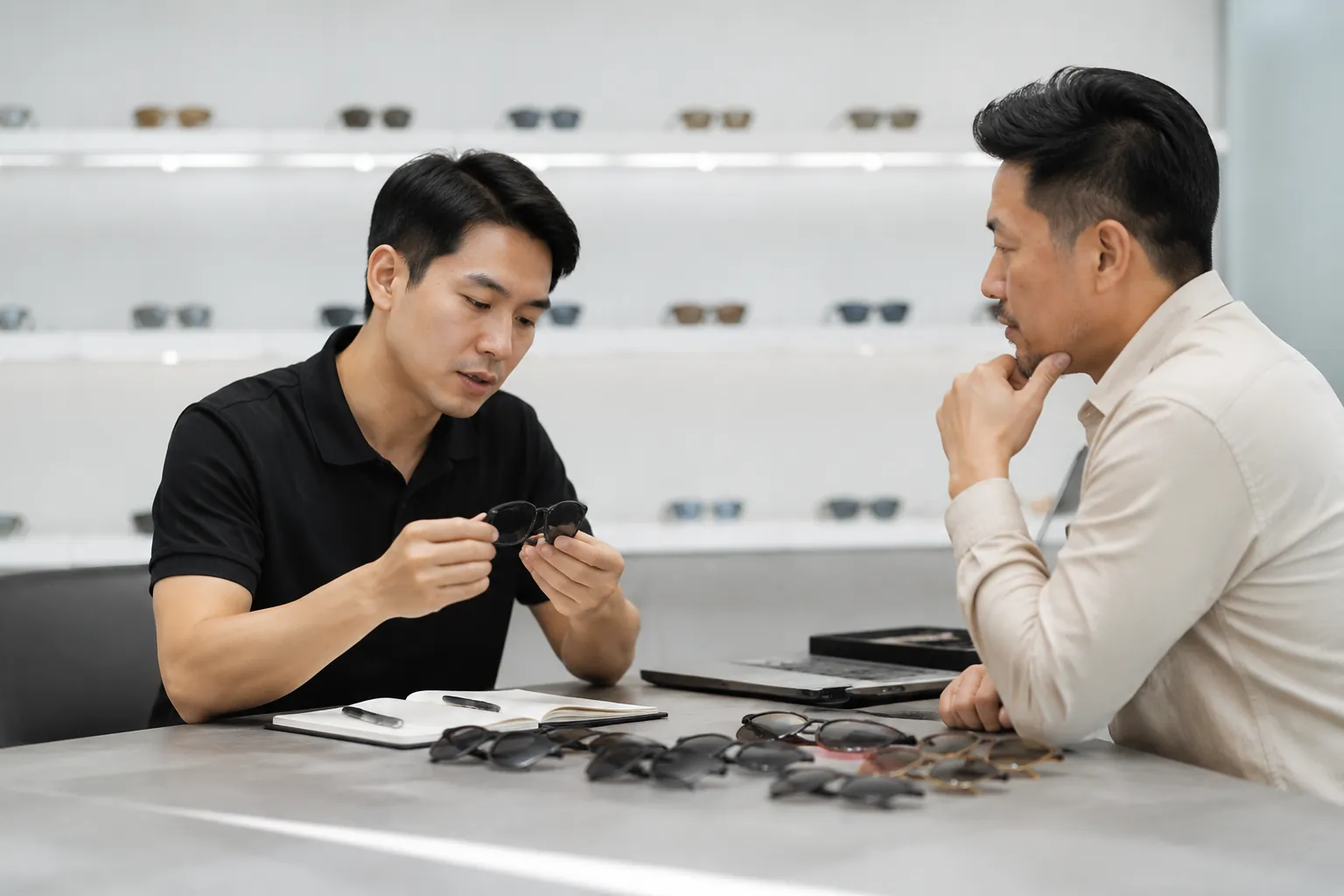
This guide is for brand owners, importers, distributors, and retail buyers placing custom sunglasses orders in volume. If your purchase order lists only style, price, and quantity, it leaves too much open once production starts. In eyewear, small gaps get expensive fast: hinge tension is off, logo placement drifts, carton labels are wrong, or a compliance requirement was assumed but never written down. A strong PO is the production rulebook. It locks the approved build, required standards, packaging packout, inspection logic, and shipment terms before bulk production begins. That is how you cut rework, avoid disputes, and protect margin on custom programs.
Treat the PO as the production rulebook
A sunglasses PO should do more than authorize payment. It should tell the manufacturer what to build, how to check it, how to pack it, when to inspect it, and what must happen before shipment is released. If those points are vague, the factory fills the gap with its own defaults. You may still get usable goods. You may not get the goods you approved.
For custom eyewear, the PO should lock six areas: product construction, decoration, lens and compliance requirements, packaging, quality tolerances, and commercial shipment terms. Attach every controlled reference: approved artwork, Pantone or color-chip references, packaging layouts, barcode files, carton-mark format, and pre-production sample records. If you approved a sample, put the sample code, approval date, and revision level on the PO. Be exact. Otherwise the factory can fairly ask which version is frozen.
A practical opening block on the PO should include:
- Style code, version number, and customer SKU
- Approved sample code and sign-off date
- Order quantity by colorway, lens tint, and logo variant
- Incoterm with named port or destination
- Requested ship window and cancel date, if applicable
- Inspection standard, defect classification, and release authority
- Packaging configuration down to pair count and carton-mark format
Lead time also needs a written start point. State it. In most programs, the clock starts only after artwork, materials, packaging text, and sample approval are all frozen. Many delays come from a simple mismatch: the buyer counts from deposit date, while the factory counts from final approval date.
Define materials and construction, not just appearance
Do not write black frame, smoke lens and assume the rest is obvious. Similar-looking sunglasses can be built from very different materials with very different cost, weight, polish, flexibility, and breakage risk. Acetate, TR90, injected polycarbonate, and mixed-metal builds are not interchangeable just because the silhouette is close.
Your PO should specify frame front material, temple material, hinge type, lens material, trims, and any assembly notes. For acetate, list sheet thickness, visible lamination acceptability, and whether color variation between temple and front is allowed within a defined standard. For injected plastic, state whether flow lines, gate marks, or ejector marks are acceptable in hidden areas only. For metal logos or inserts, specify base metal, finish, attachment method, and required retention strength.
Dimensions need real tolerance numbers. Not estimates. Sunglasses are wearable products, so small drift matters. A 1.0 mm shift at the bridge or temple spread can change fit. A logo drifting 1.5 mm may still function, but it can still fail at retail.
| Item to specify | Why it matters | Typical PO note |
|---|---|---|
| Frame material | Affects weight, polish, flexibility, and cost | Front and temple in cellulose acetate, approved chip LS-A12, gloss polish to approved sample |
| Lens material | Affects optical quality, impact behavior, and tint repeatability | CR39 smoke lens, base 6, visual color to approved master sample |
| Hinge construction | Controls durability and alignment retention | 5-barrel nickel-silver hinge, screws secured per approved process, no loose opening after function check |
| Metal trim | Frequent source of plating and adhesion disputes | Stainless steel logo plate, gold-tone finish, recessed mount, no exposed glue, no sharp edges |
| Critical dimensions | Controls fit consistency in bulk | Eye 52 mm ±0.5, bridge 20 mm ±0.5, temple 145 mm ±1.0, logo placement ±0.3 mm from approved point |
Also ask where the supplier controls tolerance in the process: cutting, CNC, tumbling, hand polish, lens edging, or final assembly. That matters because each step creates different drift. Acetate dimensions can shift slightly after tumbling and polishing. Logo placement drift usually comes from manual decoration or jig repeatability, not from material cutting.
Lock down logo method and decoration standards
"Add our logo on the temple" is not a production instruction. Decoration method changes both appearance and failure mode. Pad printing can give strong contrast at low cost, but it may fail abrasion tests. Laser engraving is permanent, but it can look faint on glossy black acetate unless filled. Metal logo plates look premium, but they add manual assembly, adhesive risk, plating variation, and yield loss.
Your PO should define artwork file revision, location, dimensions, orientation, finish, and durability expectations. State the measurement reference point, such as distance from hinge centerline or temple tip. Also state whether left and right temples should mirror each other or carry the same logo orientation.
| Decoration method | Best use | Main risk | Typical PO control point |
|---|---|---|---|
| Pad printing | High-contrast brand marks on flat or slightly curved surfaces | Rub-off, incomplete coverage, edge fuzz | 1-color white print, 18 mm wide, 12 mm from hinge center, no missing ink, no visible smear at 30 cm |
| Laser engraving | Permanent marking on acetate, TR, metal, or coated parts | Low contrast, burn variation, shallow mark depth | Laser-engraved logo, line depth and appearance matched to approved sample, centered ±0.3 mm |
| Metal logo plate | Premium retail presentation | Plating defects, adhesive overflow, loose insert | Stainless logo plate, brushed gold, secure fit, flush mounting, no tilt, no exposed adhesive |
If more than one decoration method is possible, write the decision path before production starts. For example: if pad-print adhesion fails on a specific temple finish, does the factory stop and wait for re-approval, or switch to a pre-approved fallback method? Put that hierarchy on the PO. If you do not, the supplier may substitute whatever is easiest to ship on time.
Specify lens color, test standard, and optical acceptance
Lenses trigger more disputes than many buyers expect. Visual similarity is not enough. Two gray lenses can look almost the same indoors and still differ in transmittance, color cast, mirror density, or cosmetic quality. If you do not define both the standard and the visual target, you are buying interpretation.
List lens material, base curve if relevant, tint reference, coating, and target market standard. If the goods are sold in Europe, note conformity with CE requirements and the applicable product standard, such as EN ISO 12312-1 where relevant. In the US, buyers often reference ANSI Z80.3. In Australia and New Zealand, AS/NZS 1067 may apply. If chemical compliance matters, state REACH on the PO. If your importer needs supplier registration records or test files for market entry, require them before shipment release, not after the goods are on the water.
Then define cosmetic reject rules in plain language. Factories inspect lenses under controlled light and distance, so your PO should state that condition. A workable rule is visual inspection under standard white light at roughly 30-40 cm, with no scratches, pits, bubbles, coating voids, or contamination in the main field of view.
- Left and right lens tint must match visually as a pair
- No scratches, pits, bubbles, or coating marks in the direct line of sight
- No edge chips visible after assembly
- No lens rattle in the assembled frame
- No stress whitening or stress cracks around the lens groove after fitting
For repeat programs, require the factory to keep one sealed production reference pair from the last approved batch. That gives both sides a physical standard for the next order. It is especially useful when tinting is controlled partly by master sample and partly by instrument reading.
Write packaging and carton details line by line
Packaging mistakes often happen late, after product development is done. They still cost money. Retailer chargebacks, warehouse receiving errors, and customs problems often start with missing labels, mixed SKUs, overweight cartons, or the wrong country-of-origin mark. Your PO should specify every packaging layer, not just the unit pack.
Define lens protection, polybag type and thickness if used, pouch or case material, cleaning cloth size, leaflet version, barcode label, inner box, master carton, and carton-mark format. If the order covers multiple SKUs or colorways, state whether mixed-color inners are prohibited. In most retail and e-commerce programs, they should be.
| Packaging point | What to define | Common failure if omitted |
|---|---|---|
| Unit pack | Pouch or case, cloth, leaflet, SKU barcode, country-of-origin label | Missing accessories, wrong barcode, retail noncompliance |
| Protection | Lens film, temple sleeve, polybag thickness, anti-rub separator | Lens rub marks and temple scuffing in transit |
| Inner pack | Pairs per inner, no SKU mixing, inner label format | Warehouse receiving errors and picking delays |
| Master carton | Carton dimensions, max gross weight, board strength | Carton crush, warehouse refusal, pallet instability |
| Carton marks | PO number, style, color, quantity, destination, made-in statement | Misrouting, customs confusion, relabel cost |
Add one more control point: require a packed-carton photo set before shipment release. If the goods are going to Amazon FBA or a strict retail DC, attach the exact label layout and placement drawing. A sentence in the PO body is not enough for warehouse-sensitive shipments.
Set defect limits, tolerances, and inspection timing
"Quality as approved sample" is not an inspection standard. A sample shows intent. It does not define acceptance logic for thousands of units. Your PO should state measurable tolerances, defect classes, inspection stage, and who has authority to release the goods.
At minimum, define tolerance or acceptance criteria for dimensions, frame alignment, logo placement, lens cosmetics, hinge function, and packaging accuracy. Example checks include temple opening feel, screw tightness, frame stand balance on a flat plate, and left-right lens tint match. Cosmetic inspection should reference consistent lighting and viewing distance. Functional checks should state whether every unit or only a sample is tested.
Useful PO language is blunt: No cracked frames, loose hinges, mixed left-right lens tint, missing logos, exposed glue, sharp edges, wrong barcode labels, or wrong country-of-origin marks accepted. If you use third-party inspection, state the sampling level and AQL, or use your own defect classification. If critical, major, and minor standards differ by sales channel, attach the matrix.
Typical release logic might look like this:
- Critical defects: compliance failure, sharp edges, cracked frame, wrong labeling, missing lens protection if required — shipment blocked
- Major defects: visible scratch in field of view, severe color mismatch, crooked logo, loose hinge, wrong accessory — rework or sorting required
- Minor defects: slight polish inconsistency in hidden area, carton scuff, small acceptable mold mark in non-visible area — accepted within agreed limit
Also define timing. First article checks dimensions and decoration before mass production. In-line inspection checks assembly and tint consistency during production. Final random inspection verifies the packed lot before balance payment or shipment release. Skip staged checkpoints and many issues will surface only after all cartons are sealed.
Tie commercial terms to MOQ, pricing, and lead time
Price and quantity still matter. They just should not stand alone on the PO. If your supplier works from MOQ 50 pairs per design and offers different pricing at higher quantities, write the quantity logic clearly. State whether MOQ applies per design, per colorway, or across a style family. Buyers and factories often assume different rules here, especially for private-label color splits.
Near a price break, specify whether overrun or underrun is allowed and how it will be billed. For example, if you order 980 pairs against a 1000-pair tier, the factory may price at the lower tier unless the PO says the run can ship up to a defined overage to reach the next bracket. The same applies to under-shipment. If shortage is not acceptable, say so. State whether the balance must be remade, credited, or shipped later at agreed terms.
Lead time should be broken into real process steps:
- Sample development: 7-10 days
- Sample revision or artwork correction: 3-7 days if needed
- Bulk material prep: 5-10 days depending on acetate, hardware, and packaging
- Production and assembly: 15-25 days depending on volume and decoration complexity
- Inspection and booking: 3-7 days
Payment terms and shipment terms need the same precision. Write the Incoterm and named place in full. FOB Shenzhen, EXW Wenzhou, and DDP Los Angeles are not close substitutes. "FOB China" is incomplete. If shipment release depends on passing final inspection, carton-photo approval, or receipt of compliance documents, put that condition on the PO instead of leaving it buried in email.
Use a final PO checklist before deposit release
Before sending a deposit, run one final cross-check. It is simple. It works. This step catches most preventable disputes because it forces the buyer to compare the commercial order against the technical pack, approved sample, and shipping instructions.
- Match PO style code, artwork revision, packaging revision, and approved sample code.
- Confirm material callouts for frame, lens, hinge, trims, and any coatings or plating.
- Confirm logo method, size, location, finish, and allowed placement tolerance.
- Confirm compliance target and document package required before shipment.
- Confirm packaging packout, barcode files, carton marks, and carton weight limit.
- Confirm defect definitions, sampling plan, and inspection timing.
- Confirm MOQ logic, quantity split by colorway, price tier, overrun rule, and lead-time start point.
- Get written acknowledgement from the factory that all attachments are received, reviewed, and frozen for production.
Use a simple rule: if a disagreement would cost money later, write it into the PO now. In custom sunglasses sourcing, a detailed purchase order is not paperwork for its own sake. It is the document that turns a design concept into a repeatable bulk product.
Have a custom sunglasses project in mind?
Send us your styles, target market and quantities and we will return a detailed quote with MOQ, lead time and a sample plan.
Get a QuoteWhy source this from Wenzhou with LumiShades
Wenzhou in Zhejiang Province is widely regarded as China’s eyewear manufacturing capital, producing a large share of the world’s sunglasses. That concentration matters to buyers: a deep local supply chain for acetate sheet, hinges, lens blanks, plating and packaging means shorter component lead times, easier color and material matching, and a workforce with decades of eyewear-specific skill. LumiShades has manufactured in this ecosystem since 2009, and our vertical integration — in-house injection molding, acetate cutting, CNC milling, lens tinting, decoration and quality control — means no part of your order is quietly subcontracted to a workshop you cannot audit.
For international buyers, that vertical control translates into accountability. When a single factory owns every step, defects are traced and fixed at source rather than bounced between vendors, and your specifications survive intact from first sample to bulk. We back this with 15+ years of experience, shipments to 60+ countries, more than 5 million pairs produced per year and a 98.5% on-time delivery rate. Our certifications — CE EN ISO 12312-1, FDA registration, ANSI Z80.3, AS/NZS 1067, REACH, ISO 9001 and BSCI audit — mean the compliance documentation your market requires already exists. Explore our manufacturing capabilities and quality control process to see how this works in practice.
Frequently asked questions
Should I put the test standard on the PO if the style already passed a sample test? Yes. Put the required standard on every bulk PO. A passed sample does not define the bulk requirement, especially if lens material, tint density, mirror coating, decoration, or packaging changes between sample and production. The PO should state the exact market standard or compliance target you need, such as CE/EN ISO 12312-1, ANSI Z80.3, or AS/NZS 1067 where applicable.
How specific should logo placement be? Specific to a measurement point and tolerance. For example: logo width 18.0 mm, placed 12.0 mm from hinge centerline, tolerance ±0.3 mm, white pad print, artwork file REV C. "Centered on temple" is too vague for repeatable production. Also state whether the reference is from the hinge centerline, temple tip, or another fixed point.
Can I combine colors to meet MOQ 50 pairs per design? Do not assume. State whether MOQ is pooled by design, split by colorway, or split by logo variant. Put the exact quantity breakdown on the PO and get written confirmation from the supplier before deposit. If the MOQ is tied to one color or one decoration variant, combining colors may not count.
What tolerance is reasonable for sunglass dimensions? It depends on the part and construction, but a practical PO often controls lens width to about ±0.5 mm, bridge width to ±0.5 mm, and temple length to ±1.0 mm. Branding details such as logo placement are usually controlled tighter, often around ±0.3 mm if the logo is prominent. The key is to write the tolerance on the PO and tie it to the approved sample or technical drawing.
Do I need to specify packaging if I am buying plain polybag packing? Yes. Even basic packing needs written rules: bag type, protective film, pair count per carton, gross weight limit, barcode or outer labels, and carton marks. Many shipment errors start in these simple packing details, not in the product itself. If the goods must meet REACH, FDA registration, ISO 9001, or BSCI-related supplier requirements in your supply chain, specify the document set you expect before release.
Ready to start?
Explore our cat-eye sunglasses or request a quote — our sales team replies within 12 hours.
Request a Quote