
Why Sunglasses Quotes Change After Sampling
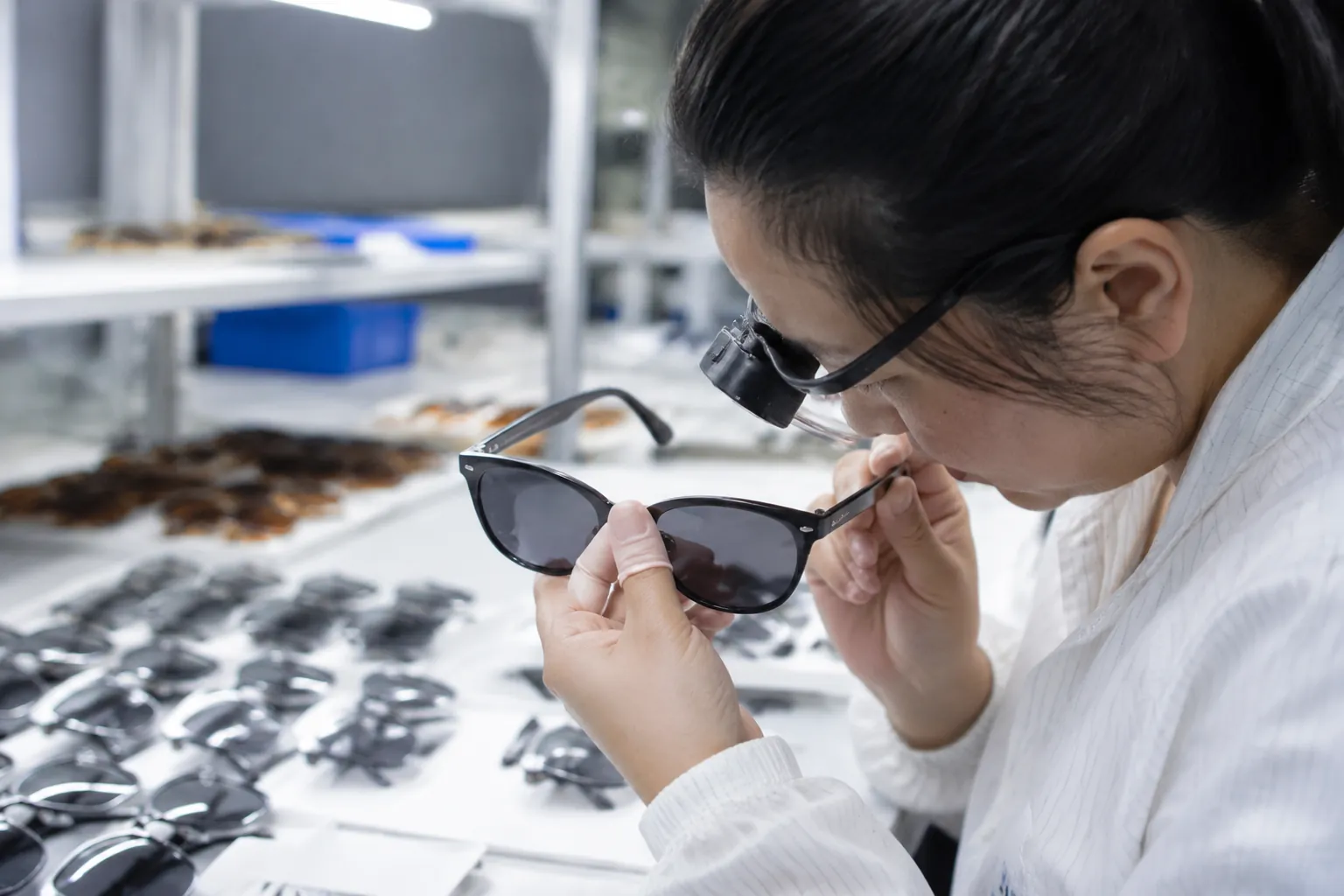
This guide is for brands, importers, distributors, and retailers buying custom sunglasses in volume. It explains why a quote that looked fine at sample stage can change once the supplier builds a bulk production cost sheet. In eyewear, the gap usually comes from details visible in the sample but not fully fixed for production: material grade, color reference, lens spec, logo method, packaging, inspection scope, and market compliance. The goal is simple: freeze the production specification before PO release so the approved sample and the bulk price refer to the same product.
Why quotes change after sample approval
Most post-sample price changes are not random. They happen because a sample is often costed as a prototype, while bulk production must be costed as a repeatable manufacturing process.
A counter sample can be hand-polished, built from available stock material, fitted with near-match lenses, and packed in basic protective material. Bulk production cannot run on those assumptions if the final order needs a fixed bill of materials, repeatable color, stable assembly quality, and retail-ready packaging.
In eyewear, small spec changes affect material use, labor time, and yield. A thicker temple adds weight. A tighter logo placement tolerance may require a fixture or slower manual positioning. A lens accepted by eye at sample stage may need tighter process control in production if the buyer later requires a defined lens category, polarization, mirrored finish, or stronger left-right consistency. A sample that works at five pieces does not prove the same look can be produced at scale with the same reject rate.
Even factories with broad in-house capability still need a frozen production spec. If the approved sample does not clearly define material, color reference, lens spec, decoration method, packaging, labeling, and acceptance criteria, the quote is still provisional. The sample confirms appearance and basic fit. It does not, by itself, lock production cost.
Key point: sample approval is an aesthetic and functional milestone. A production quote becomes dependable only when the BOM, tolerances, packaging, and compliance scope are fixed in writing.
Six production gaps buyers often miss
- Material changes between sample and bulk. A sample may use stock polycarbonate or acetate sheet close to the target color. Bulk production may require a specific resin grade, a custom color batch, or a selected acetate lamination to match the approved look more closely.
- Decoration is under-defined. Pad printing, laser engraving, hot foil, and metal logo plates do not carry the same setup, labor, or QC demands. If placement tolerance or adhesion standard is tightened after approval, cost can rise.
- Lens requirements tighten after approval. A visual tint match is not the same as a controlled production lens spec. Polarized lenses, mirrored coatings, gradients, and stricter transmission consistency require more process control than a basic tinted lens.
- Packaging gets finalized late. Export-safe packing and retail-ready packaging are not the same. A polybag and barcode label cost far less than a full set with pouch, case, retail box, insert, labels, and carton dividers.
- Production yield is estimated differently from sample yield. In acetate programs, yield can be affected by sheet variation, CNC machining loss, and polishing. In injection programs, production may reveal warp, sink, or color variation that did not appear in a very small sample run.
- Compliance and document scope were assumed, not written. If the buyer later asks for support related to CE EN ISO 12312-1, ANSI Z80.3, AS/NZS 1067, REACH, FDA registration, ISO 9001, or BSCI-related audit requirements, the supplier may need added testing, file preparation, relabeling, or process verification.
None of this is unusual. The avoidable mistake is approving a sample without turning it into a production-ready specification with measurable standards.
Sample quote vs. production quote: why the math changes
Samples and bulk orders are not costed the same way. Sample pricing often includes manual fitting, engineering time, available materials, and low-volume handling. Bulk pricing is built from machine time, labor minutes, expected yield, pack-out configuration, and inspection scope. That is why the same style can carry one number at sample stage and another at production stage.
| Cost driver | Sample stage | Bulk stage | Why price changes |
|---|---|---|---|
| Frame material | Nearest stock color or sheet | Confirmed resin grade or acetate batch | Custom color batching, material selection, or lower production yield can raise cost |
| Decoration | Hand-applied or one-time setup | Fixture-based, repeatable process | Tighter placement tolerance and adhesion control can increase labor and reject risk |
| Lens | Visual target match | Production tint or coating standard | Transmission consistency, mirror uniformity, or polarization quality adds process control |
| Packaging | Protective sample packing | Retail-ready set with labels and inserts | Materials, packing labor, and carton configuration were not fully included earlier |
| QC standard | Appearance approval | AQL, measurement, hinge function, labeling | More checkpoints increase labor time per pair |
| Order quantity | Trial or low-volume handling | MOQ and volume tier pricing | Unit price depends on quantity only when the specification is unchanged |
MOQ structures vary by supplier and construction. Some factories offer low-MOQ stocked programs. Fully custom programs may require higher minimums because of tooling, custom material preparation, dedicated lens runs, or packaging setup. Ask for the MOQ by color, by logo method, and by packaging configuration. Do not assume one MOQ applies to the whole project.
Lead time works the same way. A simple sample can often be made faster than a bulk order because it uses available materials and temporary handwork. Bulk lead time is reliable only when lens, logo, packaging, labeling, and testing scope are already defined. Add custom materials, special hardware, or third-party compliance testing later, and both cost and schedule can move.
Freeze these production specs before approving a bulk price
If you want the quote to hold, freeze the variables that affect material consumption, labor time, and QC. A sample photo is not enough. The supplier needs a production specification sheet tied to the approved sample.
- Frame material: specify polycarbonate, acetate, metal, or mixed construction; include color code, swatch, or approved physical reference; define finish such as gloss, matte, rubberized, or polished.
- Critical dimensions and tolerances: specify eye size, bridge, temple length, front width, and any points that matter for fit or assembly. If you require measured tolerances, state them in the spec sheet instead of assuming the supplier's internal standard.
- Lens specification: define lens material, color, intended lens category if applicable, UV requirement, polarization requirement, mirror or flash coating, and destination-market standard.
- Decoration method: lock the artwork version, size, location, color reference, and the exact process used. If a metal logo plate is required, define attachment method and approval standard.
- Assembly standard: define hinge type, screw finish, alignment expectation, and any functional checks that must be part of final inspection.
- Packaging: specify pouch, case, box, insert, barcode label, carton ratio, and shipping marks. If retail packaging is part of the sale, attach the layout or dieline version.
- Documents and labeling: define country-of-origin marking, warning text if required, report scope, REACH expectation, and whether support for CE EN ISO 12312-1, ANSI Z80.3, AS/NZS 1067, or FDA registration is needed for your market.
Ask the supplier to convert the approved sample into a BOM-linked production sheet before PO issue. If the sample used temporary handwork, substitute stock material, or provisional packaging, that should be disclosed line by line. If not, you are approving a look while the factory has not yet priced the real production route.
Process choices that change cost fast
Different materials and decoration routes behave differently in production. Buyers often compare quotes without realizing that suppliers are costing different process assumptions.
| Process choice | Typical production behavior | Main cost risk | Best use case |
|---|---|---|---|
| Injected polycarbonate frame | Efficient for larger runs with lower hand labor | Color matching, warp, and tooling revision if the design changes | Promotional and volume programs focused on cost control |
| Acetate CNC + polishing | Premium appearance with more hand-finishing | Sheet yield loss, polishing labor, and visual variation between acetate batches | Fashion-oriented and higher-end programs |
| Pad-printed logo | Relatively simple setup on suitable surfaces | Abrasion resistance and position consistency | Basic branding on cost-sensitive runs |
| Metal logo plate | Premium appearance with an added assembly step | Adhesion, alignment, and added inspection time | Brand programs where perceived value justifies more labor |
| Standard tinted lens | Lower process complexity than advanced coatings | Shade variation if the target is loosely defined | Entry- to mid-tier programs |
| Polarized mirrored lens | Higher material and coating control requirement | Film quality, coating consistency, and added QC or testing | Outdoor, sports, and premium fashion lines |
This is why "same style, same quantity" does not always mean "same price." A quote based on injected polycarbonate, pad print, and basic export packing is not comparable to one that includes acetate, metal logo plates, polarized lenses, and a rigid retail set. The visual gap at sample stage may be small. The production route is not.
Price-protection clauses that work
Asking for a price lock is not enough. The clause has to define what is frozen and what can trigger a change. If not, the supplier can argue that the bulk order is materially different from the approved sample.
- Validity period: define how long the unit price remains valid after sample approval and tie it to the quoted quantity tier and agreed Incoterm.
- Spec freeze: state that no price change is allowed if frame material, lens spec, decoration method, packaging, carton ratio, and compliance scope remain exactly as approved.
- Written change-order rule: require any buyer-requested change to show a price delta, MOQ impact, and lead-time impact before production starts.
- No unilateral increase after PO acceptance: state that price cannot increase after PO acceptance unless there is a documented buyer-approved spec change or another contractually defined trigger.
- Attachment control: make the approved sample reference, BOM/spec sheet, artwork version, packaging layout, QC standard, and labeling file part of the PO package.
These attachments matter. They show whether the supplier is re-quoting the same item or a changed item. If the production documents are not attached to the PO, later disputes often turn into arguments over memory instead of evidence.
How to review a quote before hidden cost comes back
A good quote review is line by line. Do not compare only the unit price. Compare the assumptions behind it. If the supplier cannot explain what is included, the quote is not ready for approval.
| Quote item | What to ask | Risk if unclear |
|---|---|---|
| Mold or tooling | Is this a new mold, a mold modification, a texture change, or no tooling charge? | Late tooling invoice or added lead time |
| Lens process | Is the lens made in-house, sourced as a standard component, or built with a polarized construction that needs separate approval? | Shade mismatch, unstable quality, or cost addition after approval |
| Logo process | Is the logo pad print, laser, foil, or metal plate? Are setup and fixtures included? | Decoration scrap or setup cost missing from quote |
| Packaging | Is this export-safe packing only or full retail pack-out? | Large increase in labor, materials, and freight cube |
| Testing/documentation | Are any reports or documentation support included? If yes, which ones? | Unexpected test fees or document charges |
| QC level | Is the quote based on visual inspection only, or does it include measurement and functional checks? | Higher defect risk or later surcharge for inspection |
Then check whether the quote fits the supplier's operating model. If the factory quoted standard timing based on available materials, but your program requires custom acetate color matching, premium packaging components, market-specific labeling, or third-party testing, the original timing and price assumptions may not hold.
A practical buyer workflow is simple: define quantity tiers and destination market in the RFQ; request separate lines for unit price, tooling, decoration, packaging, and testing; ask the supplier to disclose any sample-only materials or handwork; approve against a written spec sheet; request a BOM-based bulk quote by quantity tier; attach all references to the PO; and require a pre-production sample if anything changed after initial approval.
When a price increase is reasonable, and when it is not
Some re-quotes are justified. If you change from non-polarized to polarized lenses, move from stock material to a custom acetate construction, add a molded case, tighten the logo placement requirement, or expand the compliance scope for a new market, the unit cost can change. Those are real production changes. They affect material, labor, process control, or documentation.
What is harder to justify is a late increase for factors the supplier could already see during sampling: the approved logo size, the stated retail packaging concept, the declared destination market, or a known requirement for standards and labeling support that was already disclosed in the RFQ. If those inputs were known and the quote did not reflect them, the original quote was incomplete.
Margin protection in eyewear is not about forcing the lowest possible price. It is about making sure the quoted product and the delivered product are the same item, built to the same specification, with the same packaging and compliance scope. The more precise the specification, the fewer chances there are for surprise cost recovery later. If a supplier wants room to move, ask for the exact trigger in writing. If it cannot be defined, treat the quote as provisional.
Have a custom sunglasses project in mind?
Send us your styles, target market and quantities and we will return a detailed quote with MOQ, lead time and a sample plan.
Get a QuoteWhy source this from Wenzhou with LumiShades
Wenzhou in Zhejiang Province is widely regarded as China’s eyewear manufacturing capital, producing a large share of the world’s sunglasses. That concentration matters to buyers: a deep local supply chain for acetate sheet, hinges, lens blanks, plating and packaging means shorter component lead times, easier color and material matching, and a workforce with decades of eyewear-specific skill. LumiShades has manufactured in this ecosystem since 2009, and our vertical integration — in-house injection molding, acetate cutting, CNC milling, lens tinting, decoration and quality control — means no part of your order is quietly subcontracted to a workshop you cannot audit.
For international buyers, that vertical control translates into accountability. When a single factory owns every step, defects are traced and fixed at source rather than bounced between vendors, and your specifications survive intact from first sample to bulk. We back this with 15+ years of experience, shipments to 60+ countries, more than 5 million pairs produced per year and a 98.5% on-time delivery rate. Our certifications — CE EN ISO 12312-1, FDA registration, ANSI Z80.3, AS/NZS 1067, REACH, ISO 9001 and BSCI audit — mean the compliance documentation your market requires already exists. Explore our manufacturing capabilities and quality control process to see how this works in practice.
Frequently asked questions
Can a factory reasonably raise the unit price after I approve a sample? Yes, but only if the bulk order is different from what was actually quoted or if the quote was clearly marked as subject to final production costing. Before accepting any increase, ask the supplier to identify the exact change: material, lens, logo process, packaging, quantity tier, labeling, or compliance scope. Then request a revised BOM or cost summary showing what changed. If your PO matches the approved spec, quantity, and agreed terms, ask the supplier to point to the written clause that allows the increase.
What is the biggest cause of post-sample re-quoting in custom sunglasses? The biggest cause is an unfrozen specification. In practice, the most common gaps are packaging, decoration method, lens construction, color reference, and compliance scope. To reduce this risk, turn the approved sample into a written production spec before PO release. At minimum, lock material, color, lens type, logo method, packaging, labeling, quantity, and destination market.
Should I ask for a pre-production sample after the approval sample? Yes, especially if the first sample used substitute materials, hand-applied decoration, temporary packaging, or any method that may differ from bulk production. The pre-production sample should be made from the actual production BOM and final artwork files. Approve it against the same spec sheet attached to the PO, and keep a dated approval record so the reference is clear if a dispute arises later.
How do compliance requirements affect quote stability? Compliance affects both cost and process scope, so it needs to be declared before bulk pricing is finalized. If your market requires support related to CE EN ISO 12312-1, ANSI Z80.3, AS/NZS 1067, REACH, FDA registration, ISO 9001 documentation, or BSCI-related sourcing requirements, state that in the RFQ and ask whether testing, labeling, and document support are included in the quote. Do not assume the supplier has included these items unless they are listed in writing.
What should be attached to the PO to protect the price? Attach the approved sample reference, BOM or production spec sheet, final artwork version, packaging layout, labeling file, QC standard, quantity tier, lead time, and the price-protection clause. Also include any agreed compliance scope and test-report responsibility. The goal is to make the PO package complete enough that both sides can verify whether a later re-quote relates to the same product or to a changed product.
Ready to start?
Explore our cat-eye sunglasses or request a quote — our sales team replies within 12 hours.
Request a Quote