
OEM vs ODM Sunglasses: Which Model Cuts Launch Risk?
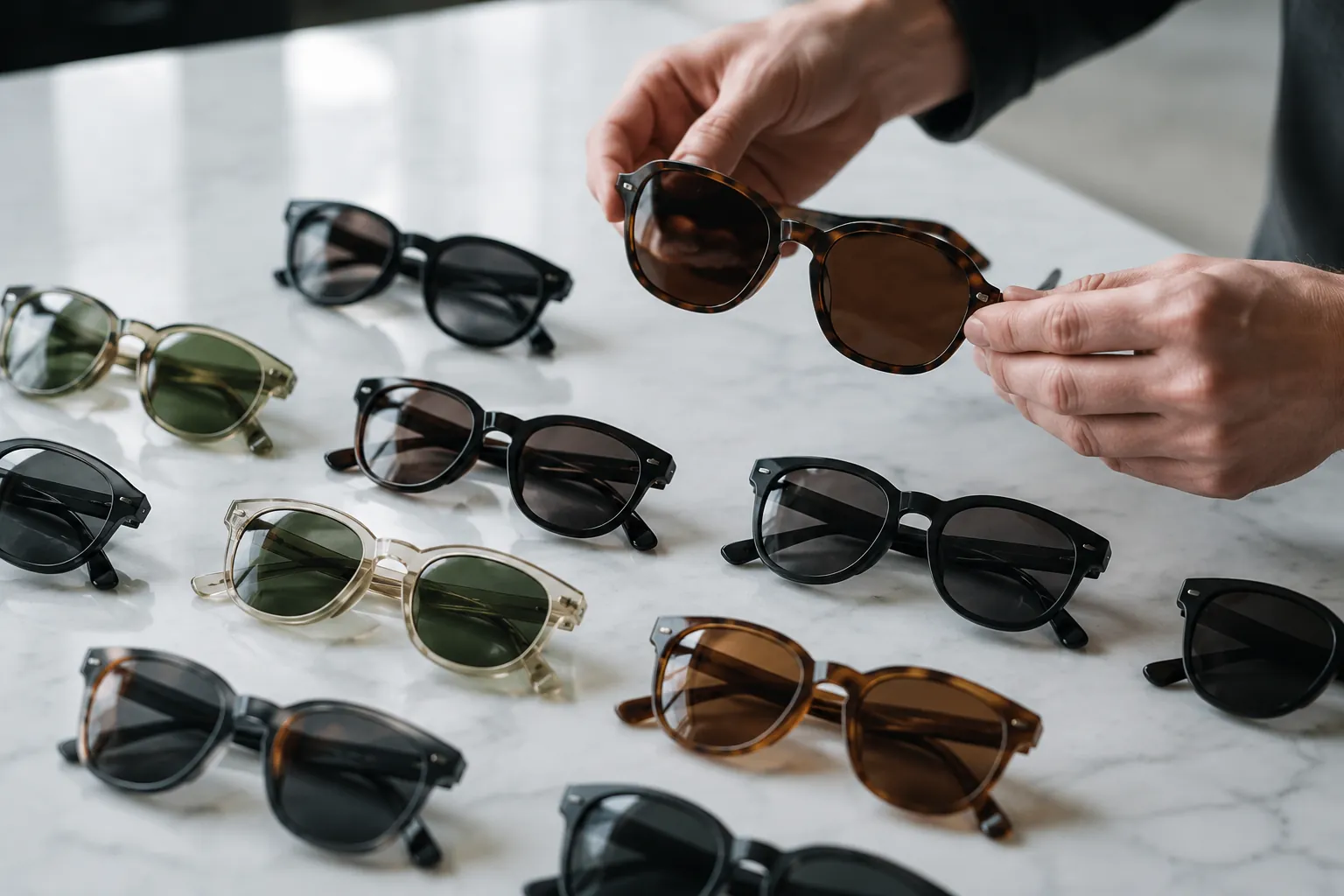
This guide is for brand owners, importers, distributors, and retailers planning a sunglasses launch and deciding how much customization they really need. The sourcing model affects development cost, lead time, compliance work, MOQ planning, and how much design control you keep. The better choice is usually the one that reduces the risk most likely to damage your launch: delay, cash exposure, compliance failure, inventory overhang, or weak differentiation. This article explains where ODM is the safer route, where OEM earns the extra process, and what to verify before you place a purchase order.
Start with the risk you actually need to reduce
Buyers often frame OEM versus ODM as a branding choice. In real sourcing work, it is first a risk choice. The better question is not "Which model sounds more premium?" but "Which failure would hurt us most?" For sunglasses, the main risks are usually launch delay, development overspend, compliance gaps, excess inventory, and weak shelf differentiation.
ODM means you start from a factory's existing frame platform and customize selected elements such as color, lens option, logo application, and packaging. OEM means the product is developed to your specification, drawing, marked sample, or technical brief, with more control over geometry, materials, and detailing.
If your priority is speed and fewer technical unknowns, ODM is usually the lower-risk route because the base construction has already been produced. If your priority is a distinctive shape, hardware detail, or fit story you can repeat across seasons, OEM can be the stronger choice. But it demands tighter specs and more validation.
That is the point. Choose the model that limits the risk your business can least afford.
Head-to-head: how OEM and ODM differ in practice
| Factor | ODM route | OEM route |
|---|---|---|
| Starting point | Existing frame platform already offered by the factory | New frame developed from your brief, sketch, CAD, or reference sample |
| MOQ logic | Often better suited to lower opening volumes because development work is limited | Usually more economical when expected volume can absorb development and tooling cost |
| Sample process | Typically focuses on confirming color, lens option, logo method, and packaging | Typically includes prototype review, fit and construction revision, and pre-production approval |
| Bulk lead time risk | Usually lower because the frame structure is already known to the factory | Usually higher because development, revision, and final validation may still be open |
| Unit-cost logic | Lower upfront development cost; less financial exposure on small test orders | Higher upfront cost, but can become more efficient if the same design is reordered repeatedly |
| Brand uniqueness | Moderate; differentiation comes mainly from color, lenses, branding, and packaging | Higher; silhouette, dimensions, hardware, and finishing can be made brand-specific |
| Technical risk | Lower because the frame system has already been manufactured before | Higher because lens fit, hinge action, symmetry, cosmetics, and manufacturability must be proven |
| Compliance risk | Can be lower if the exact frame-lens construction already has current supporting test documentation | Higher until the final construction is tested and documented for the destination market |
The short version is simple: ODM removes unknowns early. OEM creates more unknowns early, then removes them through specification, sampling, testing, and revision control.
That difference matters in eyewear because failures are often dimensional and functional, not just visual. A frame can look right in a photo and still fail in production if lens seating, alignment, or hinge consistency is off.
Choose ODM if speed, lower exposure, and demand testing matter most
ODM is usually the practical choice for buyers testing a new category, entering a new market, or launching against a fixed calendar. It works especially well when the first order is meant to test sell-through, not establish a proprietary frame architecture.
Most ODM customization is cosmetic or semi-cosmetic:
- Frame color: solid, translucent, layered-looking effects, matte, gloss, or other finish variations supported by the factory's process.
- Lens options: solid tint, gradient, mirrored finish, polarized options, or other lens treatments the supplier already runs.
- Branding: pad print, laser marking, hot stamping, metal logo application, or other standard logo methods available on the chosen frame.
- Packaging: pouch, case, cleaning cloth, outer carton, hang tag, barcode label, and insert materials.
What you usually do not control fully on ODM is frame geometry. Bridge form, front curve, temple profile, end piece shape, and overall silhouette are constrained by the existing construction. So ODM works best when your commercial angle is speed, price point, color story, or merchandising rather than a signature frame design.
It can also reduce production risk because the factory already knows the model's recurring defect points and assembly requirements. That matters in both injection-molded and acetate programs, where quality depends on process stability, finishing discipline, and consistency between sample and bulk.
For many launches, that is enough. Start clean. Prove demand first.
Choose OEM if the frame itself is part of the brand asset
OEM makes more sense when the frame is not just carrying your logo. It is the product story. If customers are meant to recognize your brand through shape, proportion, bevel language, hardware detail, fit concept, or a repeatable design code, OEM gives you the control to build that asset.
It is also the more rational route when you expect repeat orders on the same chassis or plan to carry one frame architecture across several colorways, lens programs, or seasons. In that case, the upfront work can pay back over time.
But OEM only lowers risk when the brief is specific. Vague direction creates revision loops. Revision loops burn time and money. A usable eyewear brief should define the critical points clearly, including size specification, material family, hinge type, lens category, finish expectation, branding method, and any non-negotiable aesthetic features.
A disciplined OEM process usually looks like this:
- Confirm design intent with a drawing, CAD, or marked reference sample.
- Review manufacturability for the selected construction method, such as injection, acetate, or hybrid build.
- Produce a prototype and review dimensions, fit, balance, cosmetics, and assembly logic.
- Revise as needed for lens retention, hinge action, alignment, comfort, and finish quality.
- Approve a pre-production sample that reflects the intended mass-production method.
- Confirm compliance documentation for the final frame-lens construction for the destination market.
Where OEM gets risky is obvious: buyers keep changing structural details after development starts. Small changes to front shape, lens contour, material choice, or decoration interface can affect manufacturability, cost, and the need for more validation.
Tooling, unit price, and the cost math buyers often miss
Many buyers compare OEM and ODM only on quoted unit price. That is not enough. Compare total project cost against the number of sellable pairs you expect to move, including development charges, sampling rounds, packaging changes, testing, and the cost of delay.
ODM usually makes more sense for early-stage programs because development exposure is lower. If your order quantity is modest and demand is still uncertain, paying for a fully custom product can wreck the economics before you know whether the line will reorder.
OEM becomes easier to justify when one or more of the following is true:
- You expect repeat orders on the same frame design.
- You need a shape that is not easily compared with common open-line products.
- You can extend one developed chassis across multiple lens colors, finishes, or seasonal collections.
Ask the supplier to break costs out clearly: development or tooling charges, sample charges, frame price, lens upgrades, logo application, packaging components, and any special assembly or labeling costs. If the supplier cannot explain what changes the cost, it will be hard to control the project later.
Also confirm the assumptions behind the quote. Price can move if the hinge changes, the lens material changes, the polarization requirement changes, or the packaging spec gets more complex. Those are cost drivers. Not details.
One blunt rule helps: if the first order only works under perfect sell-through and leaves no room for markdowns, freight changes, or normal defect handling, the launch is carrying too much risk.
Compliance is part of product definition, not a paperwork step
For sunglasses, compliance is part of the product. Lens performance, labeling, traceability, and material chemistry all need to match the market where the goods will be sold. This should be checked early, not after bulk production starts.
Depending on market and claim set, the standards and compliance frameworks buyers commonly review include CE EN ISO 12312-1 for Europe, ANSI Z80.3 for the U.S. market, AS/NZS 1067 for Australia and New Zealand, REACH for chemical compliance in relevant supply chains, and FDA registration where applicable to the supplier or product category context in the U.S. Buyers may also review factory-level systems such as ISO 9001 and social compliance frameworks such as BSCI, but those do not replace product testing.
The practical rule is simple: make sure the exact frame and lens construction you are buying is the one supported by the relevant documentation. A document tied to a different style, different lens, or older construction should not be treated as coverage for your order.
ODM can reduce compliance risk when the existing model already has current documentation for the same frame-lens combination you plan to buy. OEM needs more caution because design changes can alter the final tested configuration. If the lens specification, material combination, or physical construction changes, the documentation often needs to be checked again.
Plain rule: never assume that a report or certificate for one version of a style automatically applies to your modified version.
Check chemical compliance early too. REACH questions can come from coatings, colorants, soft-touch finishes, nose pad materials, temple tips, adhesives, and metal trims. If you add decorative parts or special finishes, ask the supplier to identify the actual materials used and confirm supporting documentation before bulk approval.
For regulated markets, request a compliance file package before shipment that matches the final approved sample and identifies the relevant frame and lens specification. That makes retailer review, customs questions, and post-shipment traceability easier to manage.
Material and process choices that push you toward one route
Not every concept belongs in OEM, and not every launch should default to ODM. Often, the material and process already tell you which route is safer.
| Construction choice | What it does well | Risk to watch | Better fit |
|---|---|---|---|
| Injection-molded frame | Repeatable production, scalable cost, efficient for larger commercial runs | Warping, sink marks, visible parting lines, and reduced flexibility after tooling is committed | ODM for faster rollout; OEM when volume and design control justify development |
| Acetate frame | Premium finishing, rich color effects, strong fashion positioning | Variation in finishing consistency, alignment, and lens fitting if process control is weak | OEM when shape detail matters; ODM when using a proven geometry |
| CNC-milled or hybrid construction | Greater control over detailing, bevels, inserts, and visible differentiation | More process steps, longer development path, and more opportunities for revision delay | OEM for brands that need product-level distinction |
Process detail matters because the likely failure modes differ by construction. Injection programs depend heavily on tooling accuracy and process stability. Acetate depends more on material handling, machining quality, finishing discipline, and assembly consistency. Hybrid builds add more interfaces, which means more control points.
Decoration method also affects durability, appearance, and risk. Pad printing is efficient but may be weak in high-rub zones. Laser marking is durable on some surfaces, but its visual effect varies by substrate and finish. Hot stamping can look premium but requires surface compatibility. Metal logos can raise perceived value, but they also add assembly complexity and material-compliance questions.
The more your concept depends on tightly controlled visual details, construction-specific finishing, or multi-step assembly, the more likely OEM is the right path.
A practical checklist before you place the PO
If you need a simple operating rule, use this: choose ODM when your priority is speed, lower development exposure, and market testing; choose OEM when your priority is stronger product ownership and repeatability over time.
- If your launch date is fixed and there is little room for development delay, start by evaluating ODM options first.
- If demand is not yet proven, avoid overcommitting to custom development until you know what sells.
- If the silhouette is central to your brand and likely to repeat, invest in OEM with a complete technical brief.
- If you will sell into regulated markets, reduce unnecessary variation and lock compliance requirements early.
- If your team cannot define the product clearly, do not force an OEM program before the specification work is ready.
Before paying a deposit, ask for four approvals in writing: final sample reference, approved color standard, approved logo method and position, and full packaging specification. Then confirm that production timing starts from final approval, not from the date of quotation or informal sample discussion.
Also confirm what the factory will control on key quality points, such as alignment, lens fit, hinge function, finish consistency, branding position, and packaging configuration. The point is not to demand perfection. It is to make sure buyer and supplier are working to the same production standard.
Many buyers do not need a pure OEM or pure ODM strategy. A practical route is to launch with an ODM frame, test demand, identify the winning size and color direction, and then turn that commercial learning into a more proprietary OEM program if the category proves repeatable.
Have a custom sunglasses project in mind?
Send us your styles, target market and quantities and we will return a detailed quote with MOQ, lead time and a sample plan.
Get a QuoteWhy source this from Wenzhou with LumiShades
Wenzhou in Zhejiang Province is widely regarded as China’s eyewear manufacturing capital, producing a large share of the world’s sunglasses. That concentration matters to buyers: a deep local supply chain for acetate sheet, hinges, lens blanks, plating and packaging means shorter component lead times, easier color and material matching, and a workforce with decades of eyewear-specific skill. LumiShades has manufactured in this ecosystem since 2009, and our vertical integration — in-house injection molding, acetate cutting, CNC milling, lens tinting, decoration and quality control — means no part of your order is quietly subcontracted to a workshop you cannot audit.
For international buyers, that vertical control translates into accountability. When a single factory owns every step, defects are traced and fixed at source rather than bounced between vendors, and your specifications survive intact from first sample to bulk. We back this with 15+ years of experience, shipments to 60+ countries, more than 5 million pairs produced per year and a 98.5% on-time delivery rate. Our certifications — CE EN ISO 12312-1, FDA registration, ANSI Z80.3, AS/NZS 1067, REACH, ISO 9001 and BSCI audit — mean the compliance documentation your market requires already exists. Explore our manufacturing capabilities and quality control process to see how this works in practice.
Frequently asked questions
Can I start with ODM and later switch the same concept to OEM? Yes. That is a common low-risk sequence. Start with an ODM style to test price point, fit acceptance, best-selling lens options, and reorder potential. If the style proves demand, build an OEM brief from what you learned: target size, material, hinge preference, logo method, packaging level, and the design changes needed to make the frame more proprietary. Before switching, confirm whether new testing or updated compliance documentation will be required for the OEM version.
What is the lowest-risk order size for a new sunglasses line? There is no universal number because MOQ depends on the factory, material, lens option, and packaging complexity. The lower-risk approach is to match the order to proven demand. If demand is uncertain, ask suppliers for the smallest commercially workable ODM quantity by style, color, and lens combination, then compare that against your expected sell-through and marketing plan. For a first launch, avoid splitting volume across too many styles or colors, because complexity can raise both inventory and compliance risk.
How much customization is realistic on an ODM style? Usually you can customize color, lens option, logo application, and packaging, plus selected trim details if the supplier already supports them on that model. In practice, ask the supplier for a model-specific customization list rather than assuming all options apply. If you want to change geometry, hinge placement, bridge structure, temple profile, or other construction features, the project is likely moving into OEM territory and should be quoted and validated as such.
Do compliance documents for one style cover another style if only the color changes? Not automatically. You should verify whether the documentation is tied to the exact frame-lens construction you are buying. A color-only change may look minor, but you still need confirmation that the final specification, labeling, and material inputs remain within the documented scope. Ask the supplier to identify the exact style code, lens specification, and applicable test report or certificate reference for your order, and review whether any modification triggers an update or new test.
What should I approve before bulk production starts? Approve the final production sample, frame and lens specification, logo method and position, approved color standard, packaging details, and market-specific labeling requirements. Also request the compliance documents relevant to the destination market and confirm that they match the approved construction. In addition, put the commercial terms in writing: order quantity by SKU, shipment terms, production lead time counted from final approval, and the standard for handling defects or non-conforming goods.
Ready to start?
Explore our round sunglasses or request a quote — our sales team replies within 12 hours.
Request a Quote