
ODM vs OEM Sunglasses: Margin, Speed, Control
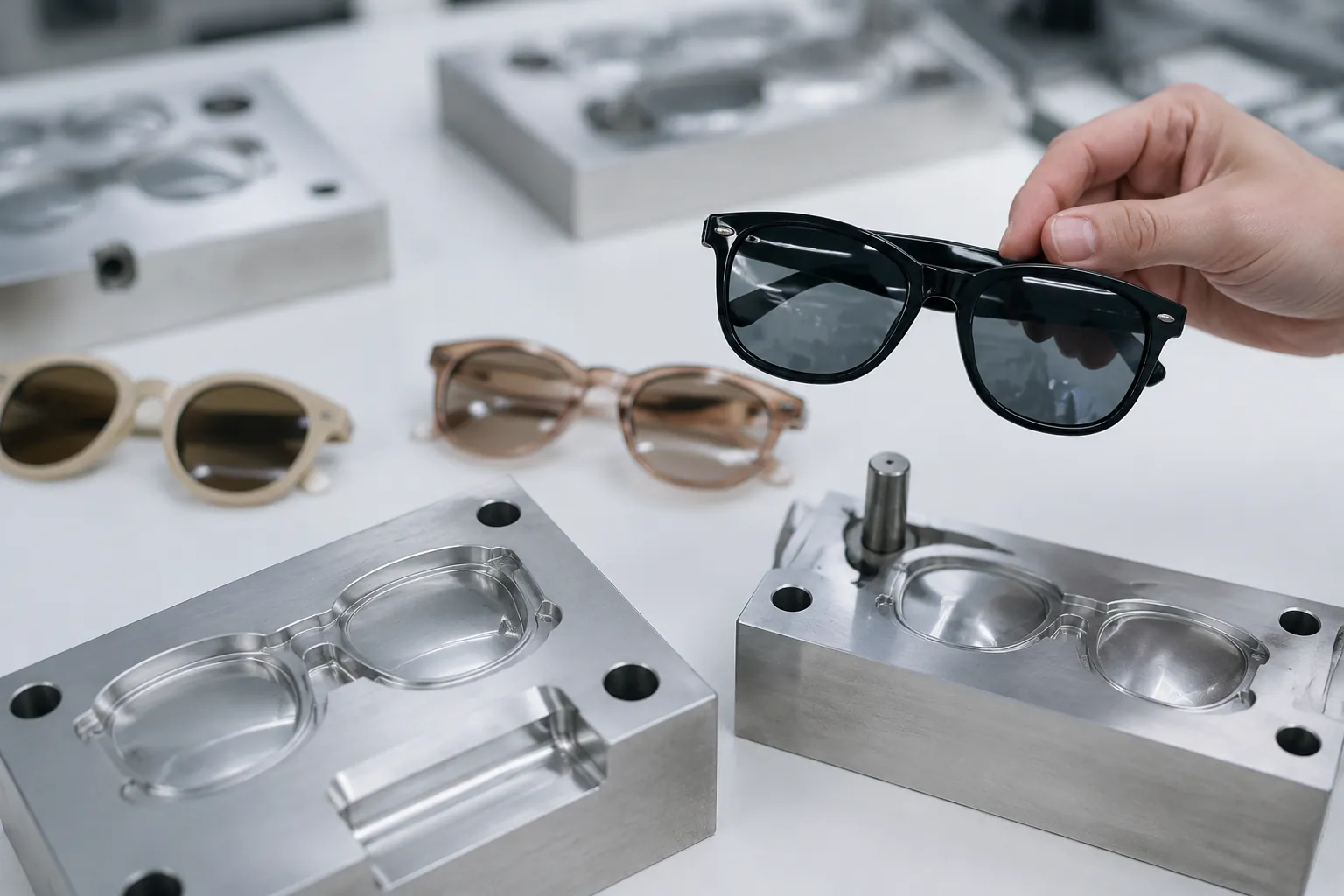
This guide is for brand owners, importers, distributors, and retailers deciding whether to launch sunglasses from an existing factory platform or develop a frame to their own specification. The choice affects development cost, launch timing, product differentiation, compliance work, and reorder reliability. It uses sourcing criteria, not sales talk, so buyers can judge which model fits their margin target, timeline, and risk tolerance.
Start with the real question: speed, exclusivity, or both?
ODM and OEM are often used loosely. In eyewear sourcing, they are not the same thing.
ODM usually means the factory already has an existing frame platform, mold, or production-ready design. The buyer changes selected details such as frame color, lens tint, logo application, packaging, and sometimes surface finish or hardware color. The base design already exists. That matters.
OEM means the product is developed to the buyer's own specification. That may begin with a drawing, a reference sample, a tech pack, or a 3D file. The supplier still has to check whether the design can be produced consistently and whether the dimensions, assembly points, and lens fit work in mass production.
So what is the real decision?
- Launch speed: Do you need to reach sampling and production quickly, or do you have time for development rounds?
- Upfront spend: Can you fund engineering, molds, and repeat samples, or do you need to keep launch cost down?
- Exclusivity: Is this a market test, or does the frame shape need to stand out?
- Reorder stability: Do you want a simple replenishment model, or are you prepared to manage custom specs across multiple runs?
That is the practical split. ODM reduces development work because the factory starts from something already made. OEM gives the buyer more control, but it adds more points that must be checked, approved, and recorded.
Head-to-head: what changes between ODM and OEM
| Factor | ODM sunglasses | Full custom OEM sunglasses |
|---|---|---|
| Development starting point | Existing frame platform, mold, or factory design | Buyer-defined design developed from drawings, sample, or 3D file |
| Sample timing | Often shorter because the base design already exists | Often longer because engineering review and revision may be needed |
| Bulk timing | Usually more predictable if materials and trims are confirmed | More variable if tooling, fit, or finish issues must be resolved first |
| Upfront cost | Usually lower because less development work is required | Usually higher because engineering, tooling, or additional sampling may be required |
| MOQ logic | Often more flexible because production uses an existing platform | Often higher in practice because setup cost must be recovered |
| Unit cost | Can be efficient quickly, especially for straightforward customizations | May remain higher at lower volumes if the design is complex |
| Exclusivity | Limited because the underlying structure is not unique to one buyer unless contractually reserved | Typically stronger if the buyer controls the design and any related tooling terms |
| Reorder risk | Usually lower if the platform remains active and the approved materials stay available | Depends heavily on documentation, tooling maintenance, and tolerance control |
One correction: OEM does not automatically improve margin. A custom frame can cost more to make if it has difficult geometry, unstable material behavior, labor-heavy finishing, or tight assembly tolerances. Margin depends on the design, order volume, defect rate, and how much development cost must be recovered.
ODM is often enough when the brand story comes mainly from color, packaging, lens options, and merchandising. OEM matters more when the frame shape itself is the brand signal.
What the money looks like from test orders to scale
Many sourcing decisions go wrong because buyers focus only on unit price. That leaves out sample charges, packaging, compliance work, tooling, and the cost of corrections if the first version misses the mark.
Use total program cost. Not just the price per pair.
That includes both the recurring cost and the non-recurring costs needed to launch and reorder the model.
- At low test volume: ODM is usually easier to justify because the buyer can validate demand without funding a full custom path.
- At moderate volume: ODM may still be the safer option if speed matters, but OEM can work if the frame is expected to stay in line for repeat orders.
- At higher repeat volume: OEM is easier to defend when the design has a longer life cycle and development cost can be spread across multiple orders.
- At scale: The real OEM advantage depends on whether the frame is engineered for repeat production and whether the brand benefits from stronger differentiation.
Ask suppliers to separate these cost buckets:
- Sample charge and whether it is credited against a bulk order
- Tooling, mold, fixture, or engineering charge if applicable
- Decoration charges by method: pad print, laser engraving, foil application, embossing, or metal logo attachment
- Lens upgrade cost: UV protection category, polarization, mirror, gradient, TAC, or other coatings
- Packaging cost: pouch, case, box, insert card, barcode label, and carton packout
- Compliance-related cost if testing, documentation review, or new labeling is required
The question is not "Which quote is cheapest?" It is "Which model gets me to a repeatable, compliant product at the lowest risk-adjusted cost?"
Lead time: where ODM saves time and where OEM slows down
Factories often give one headline lead time. That number is only useful if you know what is included. In sunglasses sourcing, delays usually come from approval loops, material changes, packaging issues, or incomplete technical information.
ODM is usually simpler:
- Design selection: choose a base frame that already exists in the supplier's range
- Customization: confirm logo, frame color, lens color, finish, and packaging details
- Sample production: make a customized sample against the approved options
- Approval: sign off the sample and the packaging specification
- Bulk production: proceed once materials, artwork, and labeling are locked
OEM adds more steps before production can start:
- Design review: the factory checks whether the geometry is manufacturable
- Engineering adjustment: dimensions, hinge position, thickness, curvature, and lens interface may need revision
- Prototype round: the first sample may need changes after fit, balance, appearance, or assembly checks
- Tooling or fixture work: some projects need new molds, jigs, or machining setups
- Pre-production signoff: one final reference sample and specification set must be locked before bulk starts
Timeline slips usually happen when the buyer changes details after engineering has started or when critical information is left vague. Common examples: changing logo location after decoration tooling is prepared, changing lens category without checking labeling implications, or changing material without reviewing color repeatability and compliance documents.
If your retail date is fixed, build the schedule backward from the ship date. Add time for at least one correction round. First orders need it. Custom designs need it more.
Materials, tolerances, and decoration: why some styles are easy and others are not
The right sourcing model also depends on the frame material and the production method behind it.
Injection-molded sunglasses are often well suited to ODM and can also work well for higher-volume OEM. Once the tool and process are stable, production can be consistent. Cosmetic changes such as color, lens options, and logo application can often be added without redesigning the base frame.
Acetate sunglasses follow a different process. Cutting, CNC work, polishing, heating, bending, and assembly add more manual steps. That gives brands more room to differentiate through lamination, thickness, transparency, and finish. It also means sample review matters more because variation is easier to see.
Buyers should ask direct questions about tolerances, especially for:
- Temple alignment: symmetry and hinge seating affect how evenly the frame opens and sits
- Lens fit: the lens must seat securely without looseness or excessive assembly stress
- Bridge and front curve: small changes can affect fit, comfort, and appearance
- Logo placement: visible decoration errors can turn an acceptable sample into rejected bulk goods
- Color repeatability: black, crystal, smoke, and tortoise effects do not always behave the same across materials or batches
Decoration method also affects cost and risk:
- Pad print: flexible and common for logos, but durability depends on surface preparation and curing
- Laser engraving: durable on suitable materials, but placement and depth must be controlled
- Hot stamping / foil: can create a premium look, but alignment and adhesion must be verified
- Metal logo plates: strong visual branding, but require secure attachment and accurate positioning
- Embossing / debossing: clean in the right substrate, but only workable where material thickness allows it
Request a golden sample and a signed specification sheet covering frame material, lens material, color references, dimensions, logo position, hardware finish, labeling, and packaging. Without that, reorder consistency is hard to control.
Compliance changes the sourcing choice
Sunglasses are fashion products. They are also regulated goods. The standards and documents you need depend on the market and the product configuration you approve.
Buyers commonly ask suppliers about these standards and systems:
- CE EN ISO 12312-1: relevant to sunglass performance, labeling, and safety requirements in applicable markets
- ANSI Z80.3: a common reference standard for nonprescription sunglasses in the United States
- AS/NZS 1067: relevant for Australia and New Zealand
- REACH: an EU chemical compliance framework that may affect material declarations and restricted substances
- FDA registration: often discussed in U.S. import conversations, but not a substitute for checking whether the product meets applicable performance requirements
- ISO 9001: a quality-management system certification for the factory, not a product-performance approval
- BSCI: a social compliance audit framework, not a product-performance standard
The sourcing implication is simple. ODM can reduce risk if the existing base model has already been reviewed or tested in a configuration close to yours. But prior documents do not automatically cover every variation. A change in lens category, lens material, coating, frame material, or construction detail can affect whether existing documentation still applies.
OEM needs even closer review because the product is being developed to a new or modified specification. Confirm early:
- Which standard applies in the destination market
- Whether existing test reports are model-specific or configuration-specific
- What labeling and markings are required on the product and packaging
- Whether chemical compliance declarations are needed for the approved materials
- Who is responsible for arranging and paying for any new testing
Do not leave compliance until cargo booking. Confirm the path before finalizing artwork, packaging, and production approval.
A buyer framework you can use in one meeting
If your team is split between speed and exclusivity, use a simple filter.
| Your situation | Better fit | Why |
|---|---|---|
| Testing a new market or seasonal collection | ODM | Lower upfront exposure and a simpler development path |
| Need a smaller order and care more about branding than unique frame geometry | ODM | Logo, color, lens, and packaging can deliver the concept without full custom development |
| Building a signature frame intended for multiple seasons | OEM | Custom design control can justify the added development work |
| Retail date is fixed and late delivery is costly | ODM | An existing platform usually removes major design-stage risk |
| Competitive advantage depends on a distinctive shape | OEM | The frame architecture itself is part of the value proposition |
| You expect repeat orders with limited seasonal updates | ODM or disciplined OEM | Both can work if documentation, materials, and approvals are tightly controlled |
For first-time supplier relationships, ODM is often the easier start. It lets both sides test communication, packaging accuracy, QC expectations, and delivery performance before moving into deeper development.
That does not mean a brand must stay in ODM. Many buyers use ODM to test demand, then move selected styles into a more customized OEM program once price tolerance and reorder potential are clear.
Common buying mistakes and how to avoid them
Most expensive sourcing mistakes are process mistakes. They happen when approvals are incomplete, assumptions are left undocumented, or the buyer focuses on appearance and ignores production details.
- Approving appearance without fit checks: a sample can look correct in photos but still fail on comfort, balance, hinge feel, or lens seating.
- Changing artwork after sample approval: even small changes can affect timing, placement, and yield.
- Ignoring packaging during development: packaging errors can delay shipment even when the sunglasses themselves are finished.
- Assuming one report covers every variation: changes to lens, material, coating, or structure may require a fresh review.
- Starting OEM before demand is validated: full custom development increases cost and decision complexity before the commercial case is proven.
A disciplined process is not complicated:
- Lock the destination market and compliance requirements first.
- Choose ODM or OEM based on launch window, differentiation needs, and expected reorder volume.
- Approve a written specification sheet, not just photos or chat messages.
- Confirm sample timing, packaging timing, and bulk timing separately.
- Define QC checkpoints before production starts.
That sequence usually protects the buyer better than negotiating only on cents per pair. In sunglasses sourcing, precision beats optimism. The strongest programs are the ones where the buyer knows what is fixed, what is flexible, and what needs formal re-approval before production continues.
Have a custom sunglasses project in mind?
Send us your styles, target market and quantities and we will return a detailed quote with MOQ, lead time and a sample plan.
Get a QuoteWhy source this from Wenzhou with LumiShades
Wenzhou in Zhejiang Province is widely regarded as China’s eyewear manufacturing capital, producing a large share of the world’s sunglasses. That concentration matters to buyers: a deep local supply chain for acetate sheet, hinges, lens blanks, plating and packaging means shorter component lead times, easier color and material matching, and a workforce with decades of eyewear-specific skill. LumiShades has manufactured in this ecosystem since 2009, and our vertical integration — in-house injection molding, acetate cutting, CNC milling, lens tinting, decoration and quality control — means no part of your order is quietly subcontracted to a workshop you cannot audit.
For international buyers, that vertical control translates into accountability. When a single factory owns every step, defects are traced and fixed at source rather than bounced between vendors, and your specifications survive intact from first sample to bulk. We back this with 15+ years of experience, shipments to 60+ countries, more than 5 million pairs produced per year and a 98.5% on-time delivery rate. Our certifications — CE EN ISO 12312-1, FDA registration, ANSI Z80.3, AS/NZS 1067, REACH, ISO 9001 and BSCI audit — mean the compliance documentation your market requires already exists. Explore our manufacturing capabilities and quality control process to see how this works in practice.
Frequently asked questions
Can I start with ODM and later convert the design into OEM? Yes. That is common. First confirm what part of the ODM product is the factory platform and what part is your customization. If you later move into OEM, prepare a full specification pack covering dimensions, materials, lens details, logo positions, color references, packaging, and any frame structure changes. Also clarify the commercial terms in writing: whether any new mold or tooling will be created, who pays for it, and whether the resulting design or tooling is reserved for your project.
Is a low MOQ enough for private label sunglasses? It can be for ODM, especially when the supplier is using an existing frame platform and only changing branding, color, lens, or packaging. For OEM, low quantities are often less practical because engineering time, sample rounds, and possible tooling cost must be absorbed somewhere. Ask two questions early: what is the MOQ by frame color and lens combination, and does the MOQ change once custom packaging or special decoration is added?
How much faster is ODM in practice? ODM is usually faster because the supplier is not developing the frame from the beginning. The exact time still depends on stock materials, decoration method, packaging, and approval speed. Ask the supplier to break lead time into stages: sample preparation, artwork confirmation, packaging approval, production, and final inspection. That shows whether the quoted delivery time is realistic or whether key steps have been skipped.
Do existing compliance documents automatically cover my customized ODM version? No. Existing documents may help, but they do not automatically apply to every variation. Ask whether the prior documentation is tied to the exact model and lens configuration you are buying. If you change lens category, lens material, coating, frame material, or structural details, ask whether the product still aligns with the relevant requirements for CE EN ISO 12312-1, ANSI Z80.3, AS/NZS 1067, and any REACH-related material obligations. Get that answer before bulk approval.
What is the safest way to control reorder consistency? Use a signed golden sample supported by a detailed specification sheet and approved packaging file. At minimum, include frame dimensions, material callouts, lens specification, color references, logo artwork and position, hardware finish, labeling requirements, packaging structure, and carton details. Then require production to match that reference on every reorder unless a formal engineering change is approved. If anything changes, update the spec sheet rather than relying on chat history or memory.
Ready to start?
Explore our cat-eye sunglasses or request a quote — our sales team replies within 12 hours.
Request a Quote