
Build a Core Private Label Sunglasses SKU Program
This guide is for brands, importers, distributors, and retailers that need more than a one-off launch. The aim is a core sunglasses program that is easy to reorder, priced predictably, and less likely to fail on fit, finish, or compliance. Get the first 3 to 5 SKUs right and later purchase orders move faster. The main drivers are simple: disciplined construction, realistic MOQ planning, and a clean approval process before bulk starts.
Start with a core program, not a broad collection
A repeat-order program is not a launch assortment. For a launch, buyers often ask for too many shapes, colors, and logo treatments because they want shelf variety. That usually creates approval churn, higher scrap risk, and uneven pricing. A core SKU program should do the opposite. Narrow the variables. Make the factory repeat the same build with fewer exceptions.
A practical starting point is 3 to 5 SKUs built on 1 or 2 frame constructions. For example, one injection-molded sport shape and one acetate fashion shape. Then limit each to two frame colors, one or two lens tints, and one branding method. That is enough range for sales. It is also manageable for production.
The benefit shows up in repeat orders. If the base geometry stays the same, the temple angle, lens fit, hinge spec, and carton packing dimensions do not need to be revalidated every time. That matters. Reorders are often delayed by small spec drift, not by the manufacturing process itself.
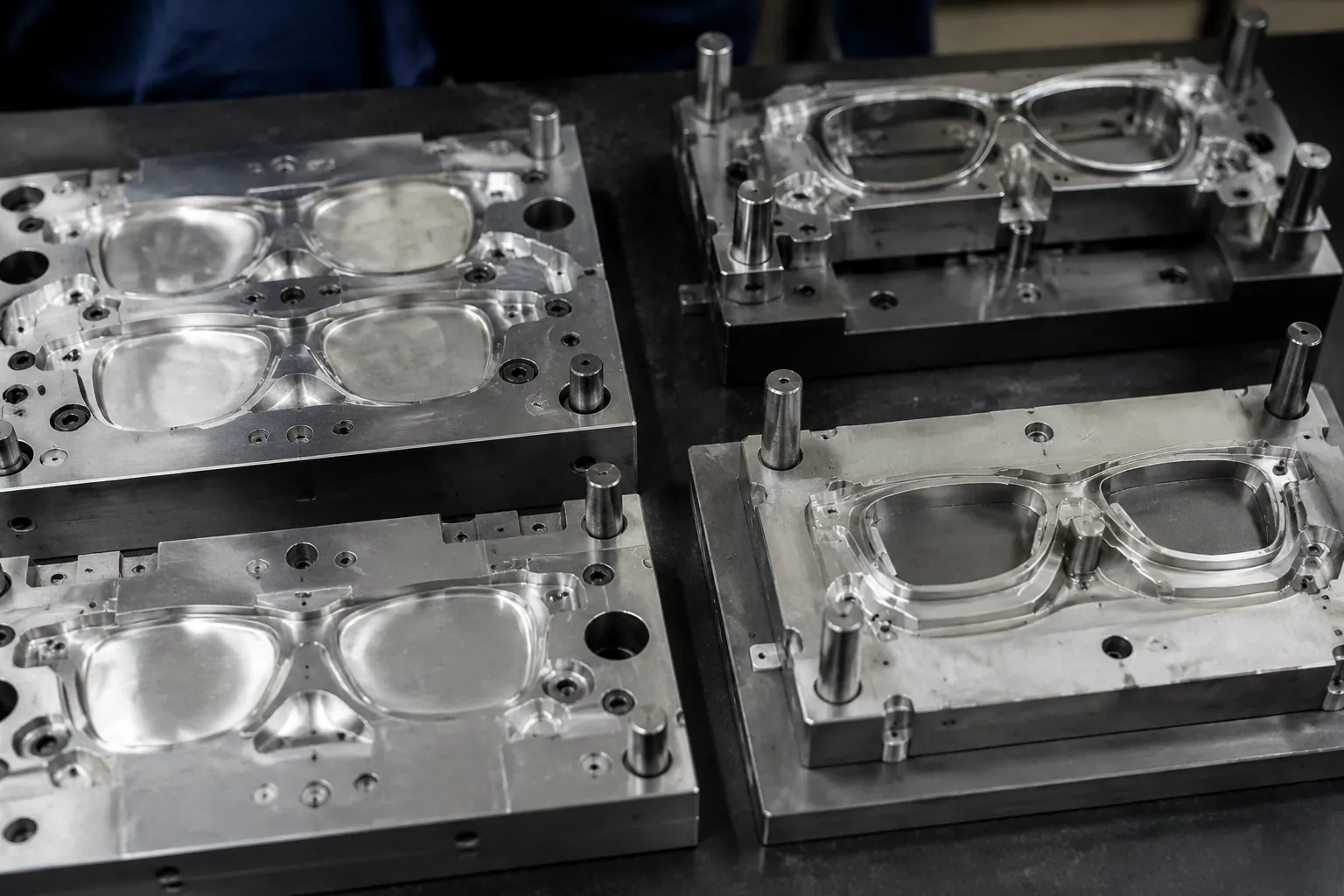
In a controlled sourcing setup, mold making, injection, acetate cutting, CNC milling, lens tinting, decoration, and QC all sit in one flow. That reduces handoff errors. It also makes repeat production easier to manage.
Rule of thumb: If a design needs a new material, a new hinge type, a new lens color, and a new logo process at the same time, it is not a core SKU yet. It is still development.
Think of the first order as building a system, not just buying frames. The right core line should be simple enough that the second and third order need little rework.
Choose the right SKU architecture: fixed chassis, controlled options
The most reliable core programs use a fixed chassis approach. Keep the frame geometry, hinge spec, and lens base curve stable. Change only what the market actually sees: frame color, lens tint, and logo placement. This protects fit, reduces assembly variation, and makes QC easier to repeat.
In practice, a fixed chassis means these should stay locked across reorders: front width, lens height, bridge width, temple length, hinge type, and lens curvature. For repeat production, hold these dimensions to the approved technical file and the factory's agreed tolerance. Cosmetic variation and fit variation are not the same thing. Treat them differently.
- Lock the frame construction. Decide early whether the SKU lives in injection or acetate. Injection is usually better for stable unit cost and scale. Acetate gives a richer visual finish and a more premium feel, but it needs more polishing and fitting labor.
- Keep lens complexity low. Use one lens material and a small tint set across the family. A repeat-order program should not depend on frequent special colors unless the channel truly needs them. More lens variants mean more approval points for color consistency and labeling.
- Standardize branding. Choose one decoration method per family where possible. Pad print is efficient for low-cost volume; laser engraving is durable and clean; metal logo plates add perceived value but introduce extra sourcing and assembly.
- Control pack-out. Keep pouch, cloth, barcode labels, and carton marks standardized. If every SKU has a different packaging stack, the speed advantage disappears.
A common mistake is treating decoration as an afterthought. It is not. A logo moved by 2 mm, a different ink gloss level, or a pouch color changed at the last minute can stop packing even when the frames are finished. For a reorderable line, the decoration spec should be as controlled as the frame mold.
Keep logo placement tied to a written standard, such as temple outside centerline position, allowable shift, and visual orientation. Even a simple note like "logo centered within ±1 mm of approved artwork position" can prevent unnecessary disputes during bulk inspection.
Compare materials by reorder behavior, not just appearance
Buyers often compare materials on look and first cost. For a core SKU program, that is not enough. Compare materials on reorder behavior: color repeatability, scrap exposure, lead-time sensitivity, finishing burden, and how much handwork is needed to pass final inspection.
| Option | Best use in core program | Reorder strengths | Main trade-off |
|---|---|---|---|
| Injection-molded frame | Volume core SKUs, sport styles, promotional programs, chain retail | Stable unit cost, efficient scaling, good for larger order breaks | Less depth in material look; tooling discipline and color approval matter |
| Acetate frame | Fashion core SKUs with higher perceived value | Strong shelf presence, richer pattern depth, better for signature styles | More hand polishing and fitting; greater piece-to-piece variation |
| Pad-printed logo | Entry and mid-tier private label | Low setup burden, fast repeatability, easy to standardize across SKUs | Can wear faster than engraved or metal applications |
| Laser-engraved logo | Minimal branding, durable mark | Consistent placement, clean repeat appearance, durable in wear | Visual effect depends on substrate color and surface finish |
| Metal logo plate | Premium-positioned core items | Strong perceived value and brand recognition | Extra component sourcing and assembly step adds lead-time risk |
Injection-molded frames are often the safest base for repeat orders if the buyer needs stable cost and steady throughput. The same mold can support several frame colors if the masterbatch is controlled tightly and the material drying and processing parameters stay consistent. Color drift usually shows up first at the temple and front edges. Inspect those areas under daylight and neutral light.
Acetate works well when the brand wants richer visual depth and higher perceived value. But it is less forgiving. Small differences in polishing time, heat setting, or manual fitting can affect the final feel. A polished acetate temple that looks good in photos can still fail on comfort if the opening force is inconsistent or the temple tip angle is off.
Decoration choice should follow the price tier. Pad printing is usually the simplest option, but it needs good ink adhesion and cure control. Laser engraving is ideal for subtle branding, though the result varies with color and surface gloss. Metal plates are attractive on premium styles, but they add sourcing complexity and can become a bottleneck if a component supplier slips.
Build the first order around MOQ and price breaks
MOQ should shape the program from day one. A factory may be willing to start as low as 50 pairs per design, but that is mainly useful for sampling, internal review, and market testing. It is not a solid basis for long-run price or production planning. For a true core program, use the factory's actual commercial breaks for setup, labor, and material purchasing.
A practical planning ladder often looks like this:
- 50 pairs/design: sample or test level. Good for fit approval, sales presentations, and early channel feedback.
- 300 pairs/design: first commercial run. Large enough to observe sell-through and reordering behavior.
- 1000 pairs/design: stable commercial level. Better landed-cost control and more efficient packaging decisions.
- 5000+ pairs: volume level. Material purchasing, line balancing, and packing efficiency improve materially; unit price can improve as order size increases.
The pricing logic is simple. Once the order is large enough, the factory can spread setup, decoration, and QC time across more pairs. That is why a 1000-pair order often prices better than two 500-pair orders, even though the total quantity is the same. You are buying efficiency, not just product.
Color splits matter just as much as total quantity. A clean 1000-pair order split across two colors usually runs smoother than the same total split across five colors. Every added color creates more setup, more in-process checks, more changeover time, and more packing complexity. If the program is meant to repeat, keep the color matrix lean.
A bloated color chart is one of the fastest ways to weaken a core SKU program. Fewer variants usually mean better throughput and more predictable landed cost.
Plan lead time backward from approvals, not from ship date
Lead times only help if the approval path is realistic. A factory can quote 7 to 10 days for samples and 25 to 35 days for bulk, but those numbers assume the buyer is not restarting the clock with last-minute changes. Most delays happen before production starts: artwork revision, color confirmation, packaging sign-off, and compliance review.
The cleanest way to manage timing is to plan backward from the target ship date:
- Freeze the tech pack. Confirm dimensions, material, color references, logo artwork, lens tint standard, packaging, labeling, and test requirements. Use one final file set.
- Approve the pre-production sample. Check fit, hinge action, finish quality, logo position, and lens tint. New SKUs should not be approved from photos alone.
- Confirm the compliance route. Align the required market standards before bulk: CE EN ISO 12312-1, ANSI Z80.3, AS/NZS 1067, and REACH where relevant. For U.S. shipments, FDA registration may be part of importer documentation, but it does not replace product testing or market-specific compliance.
- Lock the bulk quantity split. Finalize how many pairs go to each color and each pack configuration before the order is released.
- Schedule pre-shipment QC. Carton marks, barcodes, and quantity counts should be verified before the goods leave the factory.
For repeat orders, reuse is the main time saver: approved mold, approved tint recipe, approved logo method, approved carton artwork. When those are already fixed, a 35-day bulk cycle becomes more predictable.
Allow enough internal review time on the buyer side before asking the factory to reserve production capacity. If the brand takes too long to sign off, the factory cannot hold the slot forever.
Use compliance and QC as filters for core SKUs
A core SKU only works if it can be sold repeatedly in target markets without rework or relabeling. That means compliance and QC must be part of SKU selection, not something added at the end.
For sunglasses, buyers should confirm which standards apply by market and channel. Relevant references include CE EN ISO 12312-1, ANSI Z80.3, AS/NZS 1067, and REACH. Ask for the exact test basis tied to the product category and market claim. A generic compliance file is not enough if the SKU, lens category, or destination market changes.
QC checkpoints should be written around real commercial risk. A product can pass basic appearance review and still fail as a repeat order if the lot is inconsistent. Focus on the following:
- Lens tint consistency between left and right lenses and across the lot
- Frame front symmetry and temple alignment
- Hinge opening and closing force
- Logo placement and visual orientation
- Surface finish defects on high-visibility areas
- Carton quantity accuracy and barcode readability
For acetate, polishing and fitting are the main sources of variation. Watch for edge smoothness, temple openness, and nose bridge comfort. For injection, focus on flash, warpage, sink marks, and post-molding assembly fit. A small amount of flash near the hinge can create a bigger issue than a cosmetic mark elsewhere because it affects function and rejection rates.
If possible, define acceptance criteria in measurable language. For example: logo position within the approved artwork tolerance, no visible chips on front edges under normal retail lighting, lens tint matched to the approved color reference, and temple alignment checked flat on a gauge. The more specific the standard, the easier it is to reorder without debate.
A practical buyer scenario: from test run to stocked core line
Imagine a distributor building an entry-to-mid price program for three markets. The wrong approach is to launch eight shapes at 100 pairs each and hope the winners emerge later. That creates too many approvals, too many packaging combinations, and too little data per SKU. The better approach is to start with two frame families and let the order data decide what stays.
Program example:
- SKU family A: injection square frame, two frame colors, two lens colors
- SKU family B: acetate round frame, two frame colors, one lens color
- One standardized pouch and cloth across all SKUs
- One logo method per family
Phase 1 is sampling and approval. Use the 7 to 10 day sample window to validate fit, appearance, logo placement, tint color, and packaging details. Phase 2 is a first commercial run at about 300 pairs per design, enough to test sell-through and collect reorder data without overcommitting inventory. Phase 3 is consolidation: drop weak colorways, keep the top sellers, and reorder at 1000+ pairs where pricing and production flow improve.
That is the point where a core program starts to behave like an asset. Forecasting gets cleaner because the same base chassis returns. Carton planning becomes easier because pack-outs are standardized. Unit cost becomes less volatile because the factory can plan material and labor around repeat work instead of one-off customization.
If one style proves durable, add channel-specific variations carefully: alternate logo color, a retail box, or a different pouch. Keep the base frame, lens, and fit spec unchanged so the reorder remains the same product in production terms.
Core SKU checklist before you place the PO
Use this checklist before every launch PO and every major reorder. It is basic, but it prevents expensive mistakes.
- SKU count: Have you limited the first program to 3 to 5 true core styles?
- Construction freeze: Are frame material, hinge spec, lens type, and base curve fixed?
- Color discipline: Have you avoided excessive small color splits?
- Branding method: Is the logo process standardized by family?
- Compliance file: Have you matched required standards to the destination market?
- Sample sign-off: Did you approve a physical pre-production sample, not just photos?
- QC criteria: Are defect points and tolerances written into the PO or QC sheet?
- Packaging lock: Are pouch, cloth, carton marks, and barcode files final?
- Reorder trigger: Do you know what sales threshold moves the program from 300 to 1000+ pairs?
Good sunglasses programs are rarely built on ambition alone. They are built on repeatability, clear specifications, and enough volume discipline to stop the factory from reworking the same questions every season.
That is the point of a core SKU program: it should be easy to buy again.
Have a custom sunglasses project in mind?
Send us your styles, target market and quantities and we will return a detailed quote with MOQ, lead time and a sample plan.
Get a QuoteWhy source this from Wenzhou with LumiShades
Wenzhou in Zhejiang Province is widely regarded as China’s eyewear manufacturing capital, producing a large share of the world’s sunglasses. That concentration matters to buyers: a deep local supply chain for acetate sheet, hinges, lens blanks, plating and packaging means shorter component lead times, easier color and material matching, and a workforce with decades of eyewear-specific skill. LumiShades has manufactured in this ecosystem since 2009, and our vertical integration — in-house injection molding, acetate cutting, CNC milling, lens tinting, decoration and quality control — means no part of your order is quietly subcontracted to a workshop you cannot audit.
For international buyers, that vertical control translates into accountability. When a single factory owns every step, defects are traced and fixed at source rather than bounced between vendors, and your specifications survive intact from first sample to bulk. We back this with 15+ years of experience, shipments to 60+ countries, more than 5 million pairs produced per year and a 98.5% on-time delivery rate. Our certifications — CE EN ISO 12312-1, FDA registration, ANSI Z80.3, AS/NZS 1067, REACH, ISO 9001 and BSCI audit — mean the compliance documentation your market requires already exists. Explore our manufacturing capabilities and quality control process to see how this works in practice.
Frequently asked questions
Is 50 pairs per design enough for a real market launch? Usually no. Fifty pairs is best used for fit validation, photography, internal review, and limited sales sampling. For a commercial launch, 300 pairs per design is a more useful starting point because it gives enough volume to evaluate sell-through, defect trends, and packing accuracy.
How should I split colors on a first order? Keep the color count low. Two colors per frame family is a practical starting point for a core program. If the design needs more than that, confirm that each extra color is actually needed for sales, because every additional color adds setup time, approval steps, and packing complexity.
What is the safest construction for a repeat-order core SKU? For many programs, injection-molded frames are the safest repeat-order base because cost and throughput are easier to control. Acetate can also work well, especially for fashion-led styles, but it usually needs tighter control on polishing, fitting, and final appearance approval.
How do I shorten repeat-order lead time? Reuse what has already been approved: the mold, lens tint, logo method, packaging artwork, and QC standard. Then place the reorder against the same technical file instead of reworking the design. The main time loss in repeat orders usually comes from changes and re-approvals, not from molding or assembly itself.
Which compliance points should I confirm before bulk production? Confirm the standards that apply to the product and destination market. The main references commonly used for sunglasses are CE EN ISO 12312-1, ANSI Z80.3, AS/NZS 1067, and REACH. For U.S. shipments, FDA registration may be part of importer documentation, but it does not replace product testing or market-specific compliance. Ask the supplier for test reports tied to the actual SKU, not a generic file.
Ready to start?
Explore our rimless sunglasses or request a quote — our sales team replies within 12 hours.
Request a Quote