
Sunglasses Factory QC Checks to Lock Before Your PO
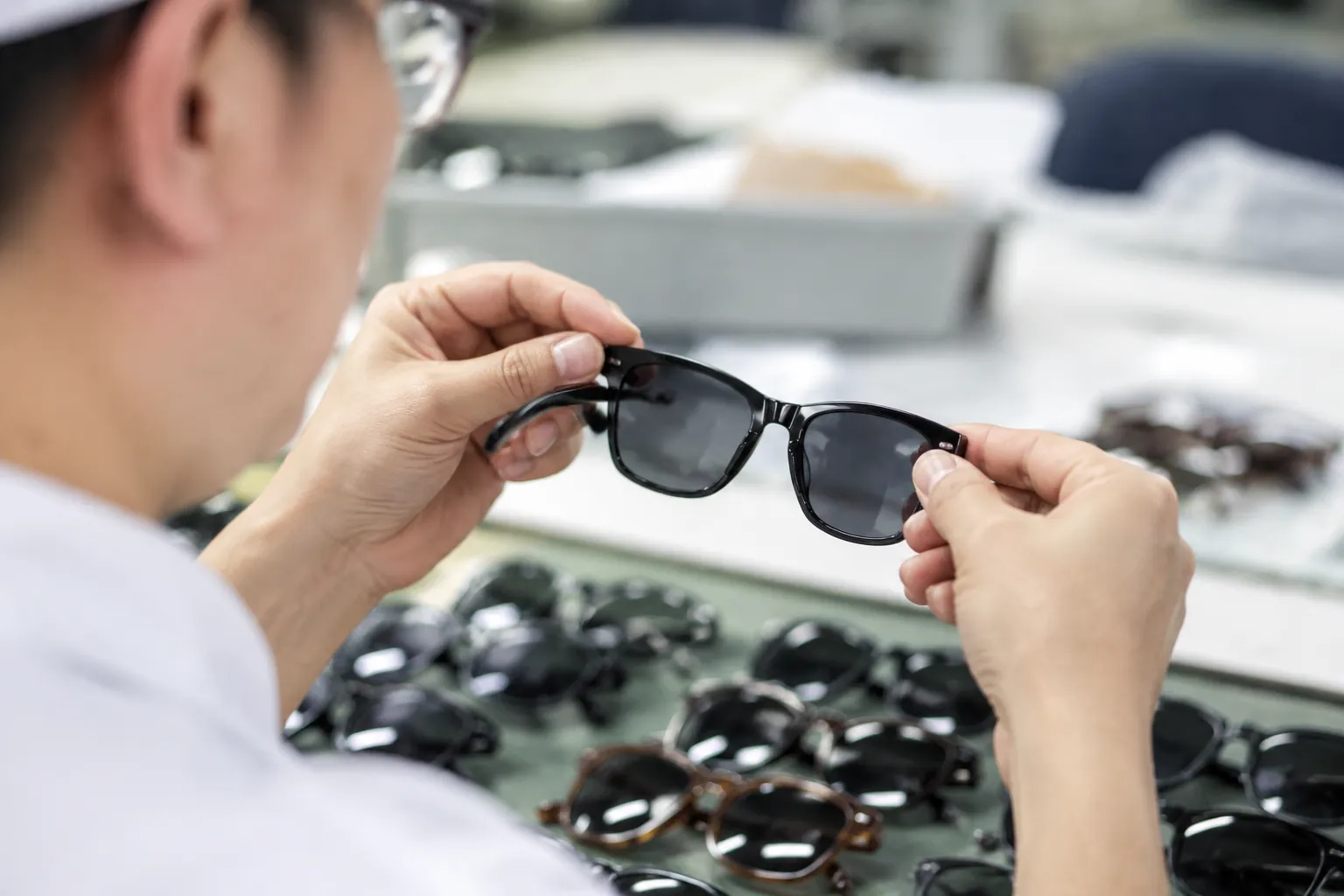
This guide is for brand owners, importers, distributors, and retail buyers placing custom sunglasses orders with an OEM factory. The goal is simple: lock the quality control plan before you send a deposit, not after cartons are sealed. Many claims start with undefined requirements—lens scratches in the viewing area, crooked logos, loose hinges, left-right color mismatch, packaging errors, or compliance files that do not match the final bill of materials. A usable QC plan turns an approved sample into measurable production rules. Then the supplier, inspector, and buyer all work to the same pass-fail standard.
Start with the QC plan, not a sample photo
Many buyers approve a pre-production sample, save a few photos, and assume bulk output will match. It will not. A photo is not a control plan. Before placing a PO, ask for a written QC plan tied to the exact SKU: frame material, lens material, logo method, approved color reference, packing method, inspection stages, defect definitions, and required tests.
A workable plan should state who checks what, when, how, and where the result is recorded. In practice, that usually means incoming inspection for lenses, hinges, screws, logo parts, and packaging; first-piece approval before volume output; in-line inspection during molding, polishing, decoration, and assembly; and final inspection before cartons are sealed. If the factory cannot convert the approved sample into a point-by-point checklist, the order is still being managed on trust.
Ask how each production step is controlled. Injection frames, acetate frames, metal trims, TAC lenses, PC lenses, polarized constructions, pad printing, laser marking, and metal plate application fail in different ways. A vague note such as "QC according to sample" does not prevent disputes. A lens may look fine in casual viewing and still fail a defined left-right color check. A logo may look straight from a distance and still sit outside the approved positional tolerance.
Factories with more in-house control can usually investigate issues faster because molding, acetate cutting, CNC milling, lens processing, decoration, and final QC sit in one workflow. That alone does not guarantee good quality. It does shorten the correction loop when defects show up.
- Ask for an inspection flow that covers incoming materials through carton sealing.
- Require the golden sample to be signed against a written checklist, not just a photo.
- Confirm which checkpoints require 100% inspection and which use sampling.
- Include packaging, barcode, carton mark, and accessory checks in the same QC plan.
Define defects and tolerances before production starts
The fastest route to a dispute is vague language: "good quality," "export standard," or "same as sample." Those phrases mean little in production. Sunglasses need measurable defect criteria. Most claims fall into three groups: appearance defects, functional defects, and packing or labeling defects.
Appearance defects include lens scratches, pits, bubbles, flow lines, polishing burns, color streaks, plating marks, sink marks, burrs, dust in paint, and logo misalignment. Functional defects include loose hinges, uneven opening resistance, warped fronts, weak screw retention, loose lenses, rattling parts, and left-right alignment failure. Packing defects include mixed color assortments, wrong barcode labels, missing pouches or cleaning cloths, missing warning labels, and carton quantity errors.
The key is the reject point. Define it in writing. A light polishing trace on the inside of a temple may be acceptable if it sits outside the agreed visible area. A scratch in the main viewing area of the lens usually is not. If a logo plate may shift no more than 0.5 mm from the approved centerline, write 0.5 mm. If front width tolerance is plus or minus 0.8 mm, write that too. If left and right temple color must match under a D65 daylight lamp, include that viewing condition in the rule.
| Checkpoint | Typical Buyer Requirement | What to Confirm with Factory |
|---|---|---|
| Lens surface | No scratch, bubble, flow mark, or coating defect in the main viewing zone | Inspection distance, lighting, reject zone size, and protective film handling |
| Logo position | Centered within approved tolerance, often within ±0.5 mm | Measurement method, fixture used, and first-piece signoff process |
| Hinge action | Smooth opening with balanced left-right resistance and no looseness | Torque reference, open-close cycle standard, and screw-locking control |
| Frame color | Matches approved chip or sealed sample under agreed light source | Batch color control, recheck after polishing or assembly, and mixed-part matching |
| Retail pack | Correct barcode, labels, accessories, and count per carton | Final carton audit method before sealing and pallet release |
Where possible, define defect severity by type. Major defects usually affect saleability, function, safety, or compliance—visible lens scratches, market-specific labeling errors, or a detached hinge screw. Minor defects may include a faint polishing trace inside the temple or a mold witness line outside the visible area. This matters. Acceptance decisions move much faster when the factory and inspector classify defects the same way.
Control the stages where defects are created
Final inspection matters, but it is only a sorting gate. It does not stop the defect from being made. Strong factories control the process where the defect starts.
For injection-molded frames, review raw material lot control, color masterbatch ratio, drying conditions, mold maintenance, cycle stability, flash, sink, and warpage checks. Small process changes can affect both fit and appearance. A shift in cooling or molding conditions can create front twist that becomes obvious only after lens insertion. For acetate styles, ask how the factory manages sheet lot consistency, CNC dimension control, tumbling time, hand polishing pressure, heat bending, and front-to-temple fit. Acetate moves. Dimension checks should be repeated after assembly.
Lens processing needs its own checkpoints. Confirm the base lens specification, thickness tolerance, tint consistency, polarization orientation if applicable, coating adhesion, lens edge fit, and left-right color matching. Decoration should also be split by method. Pad print adhesion, hot foil stamping, laser engraving depth, and glued metal badge alignment are different risks. Do not group them under one vague "logo check." A metal badge may need an adhesion or pull check after cure. Pad print may need tape or rub testing after drying.
| Process Stage | Main Risk | Typical Control Point |
|---|---|---|
| Injection molding | Warp, flash, uneven color | First-off dimension check, periodic visual check, mold condition log |
| Acetate CNC and polishing | Dimension drift, rounded edges, color inconsistency | CNC sample verification, polishing time control, post-polish remeasurement |
| Lens tinting or coating | Color mismatch, coating marks, left-right transmission difference | Shade comparison, transmission check, adhesion test on trial pieces |
| Logo decoration | Crooked print, weak adhesion, badge shift | First-piece signoff, fixture alignment check, tape or rub test |
| Final assembly | Loose screws, rattling lenses, poor alignment | Torque check, flat-surface balance check, 100% visual review |
If the supplier quotes samples in 7-10 days and bulk in 25-35 days, ask exactly when first-piece approval happens inside that schedule. It must happen before mass output starts. If first-piece review takes place after a meaningful share of the order is already assembled, it is no longer preventive.
Set clear standards for fit, alignment, and hardware
Sunglasses look simple until you measure them. Weak control shows up fast on fit, symmetry, and hardware stability. Ask how the supplier checks front width, lens opening size, temple length, bridge size, face curve, left-right symmetry, and lens seating against your approved sample or drawing.
Production tolerances vary by style, material, and market position. Do not assume the factory default is acceptable. Agree the working tolerance for each critical dimension and define the visual standard for symmetry and lens seating. If the frame must sit level on a flat reference, say so. Both temples should open evenly. Lenses should not rattle when the frame is lightly shaken. The front should not show visible twist, and the end-piece angle should match left to right. Mixed-material styles need extra attention because injection plastic, acetate, and metal react differently to heat, polishing, and assembly force.
Hinges and screws deserve close attention because they drive returns. A frame can look fine in the carton and still fail after limited use if screw torque is unstable or the hinge leaf is poorly seated. Ask whether the factory performs opening and closing cycle checks, torque checks, screw-locking controls, and pull checks on applied decorations. A practical method is to test first-off units through repeated open-close cycles and compare the feel with the approved reference. If left and right temples do not feel balanced, the factory should stop and investigate.
Also confirm edge safety and finish quality. The nose area, temple tips, and lens groove should not have sharp edges, burrs, exposed adhesive, or polishing residue. If the style includes soft-touch paint, mirrored coating, or plated trims, ask how those surfaces are protected during cleaning, bagging, and packing. Damage often happens after assembly. Not during molding.
Do not treat compliance as paperwork
For export sunglasses, compliance is product control, not just file control. Before paying a deposit, confirm which standard applies to the destination market and whether testing or technical review is based on the final construction, not an older "similar style."
Relevant standards and registrations may include CE EN ISO 12312-1, ANSI Z80.3, AS/NZS 1067, REACH, and FDA registration. Factory certifications such as ISO 9001 and BSCI can be useful management signals, but they are not product compliance. A factory can hold management certifications and still ship sunglasses that do not meet the legal or technical requirements of the target market.
Ask the factory to identify the lens category, UV performance requirement, marking requirement, and chemical compliance scope for your market. If your style uses mirrored coatings, polarized TAC lenses, painted temples, soft-touch finishes, nickel-containing metal trims, or glued logo plates, confirm whether those exact materials are covered in the supporting file. Chemical risk often sits in coatings, inks, adhesives, paints, and plated parts—not only in the base frame resin.
- Match the compliance request to the destination market before mass production starts.
- Check whether test reports cover the same frame material, lens construction, and decoration system listed on your PO.
- Verify warning marks, filter category labels, country-specific statements, and packaging artwork before print runs begin.
- For REACH or similar chemical controls, review paints, coatings, plastics, adhesives, and metal components separately.
If the factory says "we have CE," ask for the report details and compare them with the actual bill of materials. A report for a PC lens with no mirror coating does not automatically cover a TAC polarized mirrored lens on the current order. That mismatch causes avoidable sourcing mistakes.
Tie QC to MOQ, price, and lead time
Buyers often negotiate price first and quality later. That creates risk. The QC plan has to fit the order size, setup cost, and production route. MOQ, price, and inspection intensity are linked because decoration setup, packaging preparation, and rework capacity all affect how the order should be controlled.
On low-volume orders, setup variation can have an outsized effect because there are fewer units over which to absorb trial adjustments, decoration setup, and packing prep. On larger runs, the priority usually shifts to process stability, batch traceability, and early detection of repeated defects. Ask how inspection intensity changes by order size and whether the supplier expects more 100% visual review, more in-line control, or a different release method at each volume level.
Price talks should also cover rework assumptions. If the target price leaves no room for replacement lenses, repacking, or decoration correction, the supplier may be more likely to argue over defects that were never defined well. Align unit price, tolerance level, and inspection method before the PO is issued.
| Order Size | Typical QC Focus | Buyer Risk to Watch |
|---|---|---|
| 50 pairs | First-piece approval and near-100% visual check | Sample-to-bulk mismatch, setup variation, decoration inconsistency |
| 300 pairs | In-line checks plus final sampling or full visual review | Logo drift, color variation between lots, packing errors |
| 1000 pairs | Process stability, batch records, final AQL or agreed standard | Repeated minor defects scaling into claim volume |
| 5000+ pairs | Strong in-line control, lot traceability, carton audit | One process error affecting thousands of units before detection |
Lead time promises also need a stress test. If bulk lead time is 25-35 days, ask what happens if inspection fails late. Can lenses be replaced without remaking the full frame? Is spare material reserved for a partial remake? A delivery promise means little without a documented response for nonconforming stock.
Set inspection timing, release rules, and records before you wire money
The commercial side matters as much as the factory floor. Your PO should define when inspections happen, who can approve deviations, and what happens if goods fail. If this is not written before the deposit, you will be negotiating under time pressure later.
At minimum, define pre-production approval, first-piece approval timing, in-line inspection timing, final inspection timing, acceptance standard, and shipment release authority. If a third-party inspector is involved, the factory should know the booking window, minimum packed quantity, and carton accessibility requirement. Inspectors cannot do a useful final inspection if a large share of the order is still open on the line or if random cartons cannot be selected and opened.
Be specific about rework rules. If the visible lens scratch rate exceeds the agreed limit, can the factory replace lenses only, or must complete units be remade? If barcodes are wrong, who pays for relabeling and delay? If metal logo plates are crooked beyond tolerance, are those units repairable or scrap? If hinge torque is unstable, does the supplier rework screws, replace hinges, or sort out the affected lot? These decisions affect lead time, freight booking, and cash flow.
A practical PO does not stop at quantity, unit price, and ship date. It states what will be inspected, how failure is judged, what tolerance applies, and who signs off any exception.
Before sending money, ask for the key records: approved golden sample with notes, product specification sheet, QC checklist, compliance file list, production timeline, and carton pack-out standard. If the supplier controls injection molding, acetate cutting, CNC milling, lens processing, decoration, and QC in-house, ask which records are generated internally and which depend on outside labs or vendors. A simple rule applies: if the factory cannot show how a control point is recorded, review that control point closely.
Have a custom sunglasses project in mind?
Send us your styles, target market and quantities and we will return a detailed quote with MOQ, lead time and a sample plan.
Get a QuoteWhy source this from Wenzhou with LumiShades
Wenzhou in Zhejiang Province is widely regarded as China’s eyewear manufacturing capital, producing a large share of the world’s sunglasses. That concentration matters to buyers: a deep local supply chain for acetate sheet, hinges, lens blanks, plating and packaging means shorter component lead times, easier color and material matching, and a workforce with decades of eyewear-specific skill. LumiShades has manufactured in this ecosystem since 2009, and our vertical integration — in-house injection molding, acetate cutting, CNC milling, lens tinting, decoration and quality control — means no part of your order is quietly subcontracted to a workshop you cannot audit.
For international buyers, that vertical control translates into accountability. When a single factory owns every step, defects are traced and fixed at source rather than bounced between vendors, and your specifications survive intact from first sample to bulk. For procurement review, buyers can request process records, approved samples, quality checkpoints and project-specific compliance files before placing a bulk order. Required testing and documentation are confirmed against the destination market and product specification rather than assumed from a generic certificate list. Explore our manufacturing capabilities and quality control process to see how this works in practice.
Frequently asked questions
Should I ask for AQL, or is a factory checklist enough? Ask for both. The checklist defines what will be inspected and how each checkpoint is judged. AQL, or another agreed acceptance rule, defines how shipment decisions will be made when defects are found in sampled cartons. Action point: put the checklist, defect classification, sampling level, and acceptance numbers directly into the PO or its attached QC specification so the inspector and factory use the same release rule.
Can a 7-10 day sample reliably predict bulk quality? Only to a point. A sample shows that the factory can produce an acceptable piece or small set under controlled conditions. It does not prove that the same result will repeat across bulk production. Action point: approve the sample, then ask for first-piece approval during mass production, in-line inspection records, and confirmation that bulk materials, decoration method, and packaging match the approved sample and bill of materials.
What defect causes the most buyer disputes in sunglasses orders? Visible lens defects are among the most common dispute points because they directly affect retail saleability and are easy for end customers to spot. Logo errors, left-right color mismatch, and unstable hinges also lead to claims. Action point: define the lens viewing zone, inspection lighting, viewing distance, and reject criteria in writing before production starts, then use that same rule in final inspection.
How do I verify compliance documents are relevant to my order? Match each document to the actual bill of materials on your PO: frame material, lens construction, coatings, decoration, labeling, and destination market. Do not rely on a report for a similar style unless the technical construction is the same. Action point: request the report identifiers, material descriptions, and product photos or references used in the file, then compare them against your approved sample, BOM, and packaging artwork before bulk production begins.
Is 50 pairs too small for proper QC? No, but small orders need tighter control earlier in the process. In a 50-pair run, setup variation in color, logo position, or hardware feel can affect a meaningful share of the order. Action point: require signed first-piece approval, near-100% visual review of finished units, and confirmation that packaging and labeling are checked unit by unit before shipment.
Ready to start?
Explore our wayfarer sunglasses or request a quote — our sales team replies within 12 hours.
Request a Quote