
How to Choose a Sunglasses Supplier for 50 to 5,000 Pairs
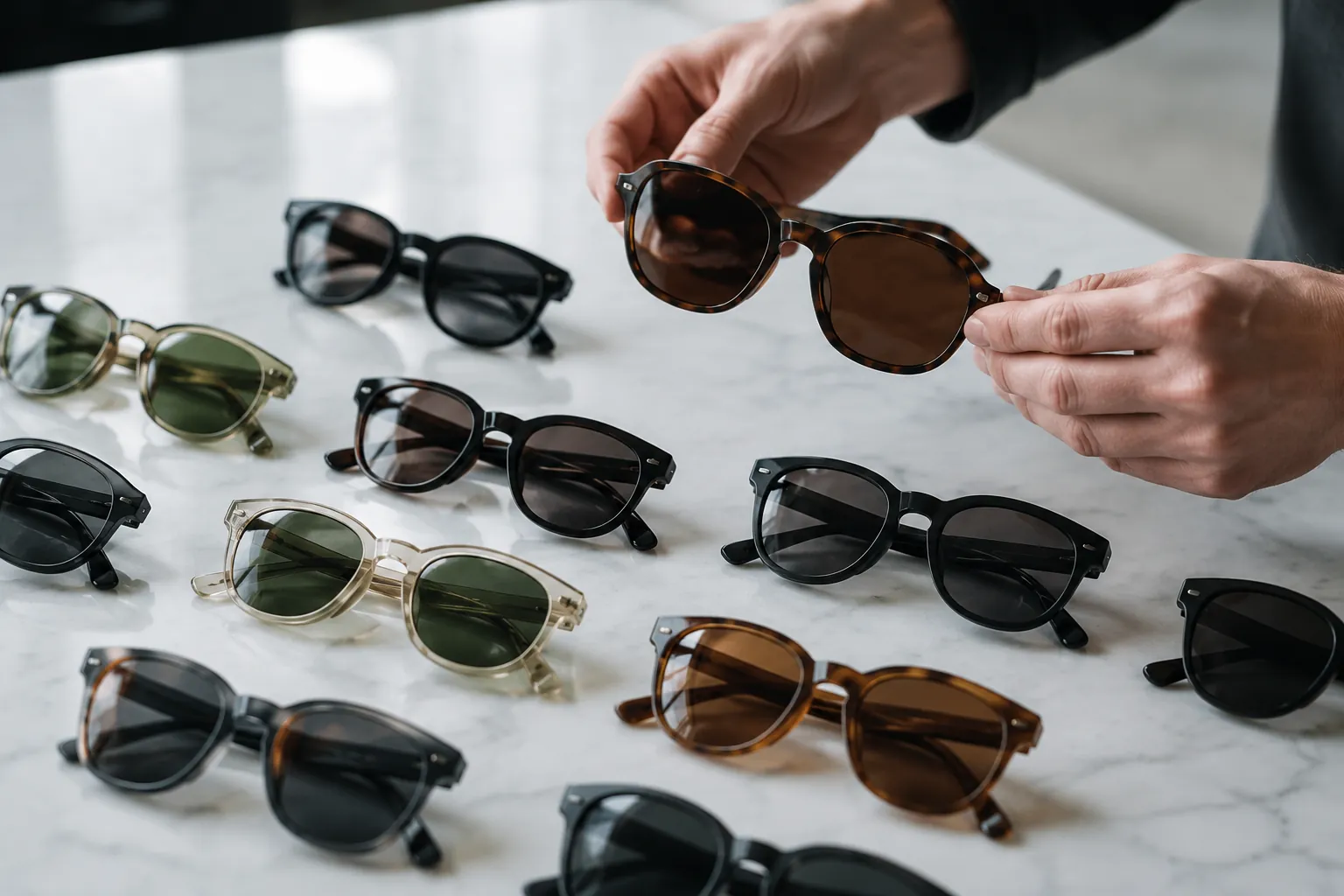
This guide is for brand owners, importers, distributors, and retailers sourcing custom sunglasses in runs from 50 to 5,000 pairs per design. Compare suppliers on the things that affect margin, launch timing, and claim risk: MOQ structure, price breaks, sample control, materials, compliance, QC, and production consistency. Ask direct questions early. Per-color minimums, lens category, hinge torque checks, print adhesion, and rework rules all matter. Miss them, and you pay later.
Start with your order pattern, not the factory size
Do not start with annual output, headcount, or export maps. Start with your order pattern. How many pairs per style? How many colors? Is the frame stock or custom? How often will you reorder? How much inventory risk can you carry?
A factory built for long runs may be able to make 5,000 pairs and still be a bad fit for a 50-pair pilot. Setup cost gets buried in the unit price. Sample handling slows down. Color matching gets treated as optional. The reverse happens too. A shop that looks flexible at 100 pairs may struggle to hold alignment, tint consistency, and packing accuracy once the order reaches 3,000 units across several colors.
Split suppliers into three practical buckets: stock-model customization, modified existing molds, and full custom development. A supplier that can handle 50 pairs per design is useful for market tests, retailer drops, influencer capsules, or pilot private-label runs. MOQ is not just a purchasing term. It is your cash at risk before you know the style will sell.
- 50-100 pairs: Best for testing a shape, logo treatment, or channel response. Expect fewer color options, standard hinges, and limited packaging choices.
- 300-1,000 pairs: The practical zone for better pricing, more decoration options, and smoother production planning.
- 5,000+ pairs: Tooling amortization, resin batching, lens tint sequencing, and freight efficiency can lower landed cost.
Ask one blunt question at quote stage: is the MOQ per style, per color, per logo version, or per shipment total? Many suppliers use those terms loosely. A quote that says "300 pairs MOQ" can still mean 300 per color or 300 only if packaging is identical. Clear that up before artwork approval.
Know how MOQ and price breaks really work
Price breaks come from fixed setup costs spreading across more units, less waste, fewer machine changeovers, and faster packing. If a supplier cannot explain the savings, be careful.
On custom sunglasses, the main cost drivers are frame material, lens spec, logo method, packaging, and the number of labor steps after molding or cutting. At 50 pairs, setup and decoration can take a large share of the total. At 1,000 pairs and above, raw material yield, process stability, and packing efficiency matter more.
| Order Size | Typical Use | What Drives Cost | What Usually Improves |
|---|---|---|---|
| 50 pairs | Style test, capsule launch, account-specific trial | Logo setup, packaging setup, sample-level handling | Low inventory risk and quick market feedback |
| 300 pairs | First commercial run | Material choice, labor content, reject allowance | Better unit price, more color options, cleaner packaging economics |
| 1,000 pairs | Distributor order or chain-store program | Lens consistency, QC sorting, line efficiency | Stronger pricing, steadier output, better freight packing density |
| 5,000+ pairs | National promotion or repeat core SKU | Production scheduling, resin batching, carton optimization | Lower unit cost and more predictable replenishment economics |
Compare suppliers on what is included, not only unit price. Ask whether the quote covers pouch, box, barcode label, logo plate, polarized lens upgrade, testing support, spare screws, and export carton spec. Low quotes often grow later through missing extras.
If a supplier gives price breaks, ask what changes at each step. A credible answer should mention setup time, batching, labor, or packing efficiency. If the answer is vague, the quote may not hold up in planning.
Treat sampling as proof of some things, not all
Sampling speed matters because it shows whether the supplier has control or is just moving messages around. A 7- to 10-day sample lead time is reasonable for stock shapes or light changes. Faster is possible for simple programs. Speed alone proves little.
One counter sample can confirm shape, fit, color direction, logo position, and general finish. It does not prove that the same frame will hold alignment, tint shade, or screw stability across 1,000 pairs. It is a checkpoint, not a guarantee.
- Visual approval: Check front symmetry, temple alignment, lens seating, polish quality, and logo placement. Small errors show fast on compact frames.
- Fit check: Verify lens width, bridge, temple length, and total frame width against your target customer. Small changes can alter perceived fit.
- Construction check: Open and close both temples repeatedly. Watch for hinge looseness, temple flare, stress whitening near screw points, or uneven closing force.
- Specification check: Confirm the UV claim, lens category, polarization if specified, and the exact standard the build is meant to meet before bulk approval.
If the sample is acetate, ask whether the color comes from the same sheet batch or at least the same acetate code planned for production. Pattern variation can be good. It can also create visible drift from pair to pair. If the frame is injection molded, ask whether the sample uses production-grade mold texture and the planned masterbatch ratio. A hand-finished sample can look better than bulk if those points are not fixed.
Ask how many revisions are included. One revision is common. A second revision may add time and cost. That should be stated clearly.
Match material and process to the channel
The wrong material choice can hurt margin fast. Some buyers want the look and weight of acetate, then discover the labor cost will not fit the retail target. Others choose basic injection-molded plastic for a premium channel and end up with a frame that looks too light, too glossy, or too generic.
Match material and process to the channel, not the supplier's preference. Injection molding, acetate cutting, CNC milling, lens tinting, and decoration all have different economics, defect patterns, and lead times.
| Process or Material | Best Fit | Main Advantages | Main Watchouts |
|---|---|---|---|
| Injection molded plastic | Entry to mid-price programs and repeat volume orders | Lower unit cost, good repeatability, fast volume output | Surface marks, sink marks, warp after cooling, mold-related fit issues |
| Acetate cut and milled | Fashion-led styles and higher perceived-value programs | Heavier hand feel, richer patterns, stronger polish potential | Higher labor content, more scrap, longer finishing and polishing time |
| CNC detailing | Shape refinement, bevel detail, metal insert work | Tighter geometry control and more premium detailing | Extra setup time, higher cycle cost, slower throughput |
| Lens tinting and decoration | Brand differentiation and range matching | Color control, logo placement, program coordination | Shade variance, print adhesion risk, alignment errors |
For budget programs, ask how the supplier controls frame-front warp and temple alignment after molding and cooling. For acetate, ask about sheet thickness, polishing sequence, and how color variation is managed between sheet lots. For lenses, ask whether the tint is dipped, sprayed, or pre-tinted, because each route affects consistency, rework, and cost.
Be specific on decoration. A one-color temple print, hot-stamped foil logo, metal logo plate, and laser engraving all behave differently in production. Screen printing is flexible and economical, but adhesion depends on surface prep and ink chemistry. Hot stamping can look clean on some plastics, but registration and foil wear matter. Metal logo applications look premium, yet add assembly steps and tolerance risk.
Do not treat compliance as paperwork
Sunglasses compliance is part testing, part production discipline. A supplier can show a test report and still ship a non-matching bulk lot if lens color, mirror coating, material chemistry, or logo ink changes without control.
For overseas B2B buyers, the discussion often includes CE EN ISO 12312-1, ANSI Z80.3, AS/NZS 1067, REACH, FDA registration, ISO 9001, and BSCI. The point is not to collect acronyms. The point is to confirm that the tested sample matches the actual production build and that the supplier can hold that line after approval.
- CE EN ISO 12312-1: Ask which lens category the style is meant to meet and whether the approved tint range is narrow or broad.
- ANSI Z80.3: Relevant for U.S. programs. Confirm that the tested frame-lens combination matches your actual spec, not a similar one.
- AS/NZS 1067: Relevant for Australia and New Zealand programs, especially where lens performance and labeling must align with local rules.
- REACH: Ask how restricted substances are controlled in frame materials, coatings, inks, nose-pad materials, and packaging accessories.
- FDA registration: Useful for U.S. documentation context, but not a substitute for product-performance compliance.
- ISO 9001 and BSCI: These address quality-management and social-compliance systems. Ask for current, scope-specific documents and verify the supplier name and site.
One rule matters more than most buyers realize: if you change lens color, mirror layer, frame resin, acetate source, or decoration chemistry after testing, ask whether the earlier report still applies. Sometimes it does. Sometimes it does not. Do not assume a dark gray lens and a fashion gradient lens are interchangeable from a compliance view.
Check the production flow before you place bulk
A serious supplier should explain its production path in plain language. If the explanation stays vague, there is usually a reason. You should know where frames are formed, how lenses are processed, when logos are applied, and where final inspection happens.
Ask for the real control points, not generic quality claims. The process should show incoming material checks, in-process checks, and final QC. If those steps are not defined, you are relying on promises, not controls.
- Incoming material check: resin, acetate sheets, lenses, hinges, screws, metal logos, pouches, boxes, and labels
- In-process check: dimensions, left-right balance, hinge torque, lens fit, print position, and surface defects after polishing or molding
- Final QC: appearance, opening and closing function, alignment, carton count, barcode accuracy, and packaging completeness
For bulk timing, many custom sunglass programs fit a 25- to 35-day production window after sample approval, logo files, and packaging artwork are frozen. The exact lead time depends on material choice, decoration complexity, order size, and seasonality. Buyers often lose time not on the line, but in approval lag over pouch material, carton marks, or a logo shift that should have been decided earlier.
Ask what happens if a defect shows up at final QC. Is the lot reworked, re-sorted, or rebuilt? Who decides the acceptance threshold? If the supplier cannot explain its rework logic, you may end up arguing at shipping time, when leverage is low and time is shorter.
Judge capacity by consistency, not one big number
Annual output only matters if it connects to your program. A factory making millions of pairs a year sounds strong, but that number does not tell you whether your 300-pair style will move smoothly during peak season or keep getting pushed behind larger accounts.
Export experience helps, but it is not enough. What matters is whether the supplier can keep your order moving through molding, polishing, tinting, decoration, inspection, and packing without repeated handoffs or unexplained delays.
- Ask monthly capacity by process, not only total pairs. Molding, polishing, lens tinting, logo printing, and packing can each become the bottleneck.
- Ask peak-season lead times. A normal 25- to 35-day promise may stretch if you book late for summer delivery or before holidays.
- Ask reorder rules. Repeat orders should move faster when molds, color codes, and packaging files are unchanged.
- Ask how on-time is defined. Confirm whether it means ex-factory readiness, loading date, port departure, or arrival at destination.
Consistency beats brochure claims. A supplier that can protect delivery for both low-MOQ and volume programs is usually more useful than one that just repeats a large annual capacity number.
Build a scorecard before you negotiate
Negotiation works better when your scorecard is fixed first. Otherwise the cheapest quote wins round one and loses value later through sample delays, compliance gaps, defect sorting, and packaging fixes that were never priced honestly.
Create a simple comparison sheet and weight each factor based on your business model. A distributor launching many SKUs may care most about MOQ flexibility and sample speed. A retail chain with a proven bestseller may care more about 5,000-pair pricing, repeat consistency, and packaging accuracy across stores.
- MOQ fit: Can the supplier support your real per-style and per-color quantities without hidden minimums?
- Price ladder: Are breakpoints clear at 50, 300, 1,000, and 5,000+ pairs, and do you understand what drives each drop?
- Sample control: Can it deliver usable samples in 7 to 10 days and define what the sample does and does not validate?
- Production control: Which steps are in-house, where are the likely defect points, and what is the rework process?
- Compliance match: Can it support the standards relevant to your market with documents for your exact build?
- Delivery reliability: Is the promised bulk lead time realistic, and how is on-time performance measured?
Then negotiate on facts, not just price. If one supplier is a little higher but offers stronger QC, clearer compliance support, faster sample revisions, and better reorder handling, it may still be the lower-cost option over a season. Buy the least troublesome margin.
Have a custom sunglasses project in mind?
Send us your styles, target market and quantities and we will return a detailed quote with MOQ, lead time and a sample plan.
Get a QuoteWhy source this from Wenzhou with LumiShades
Wenzhou in Zhejiang Province is widely regarded as China’s eyewear manufacturing capital, producing a large share of the world’s sunglasses. That concentration matters to buyers: a deep local supply chain for acetate sheet, hinges, lens blanks, plating and packaging means shorter component lead times, easier color and material matching, and a workforce with decades of eyewear-specific skill. LumiShades has manufactured in this ecosystem since 2009, and our vertical integration — in-house injection molding, acetate cutting, CNC milling, lens tinting, decoration and quality control — means no part of your order is quietly subcontracted to a workshop you cannot audit.
For international buyers, that vertical control translates into accountability. When a single factory owns every step, defects are traced and fixed at source rather than bounced between vendors, and your specifications survive intact from first sample to bulk. For procurement review, buyers can request process records, approved samples, quality checkpoints and project-specific compliance files before placing a bulk order. Required testing and documentation are confirmed against the destination market and product specification rather than assumed from a generic certificate list. Explore our manufacturing capabilities and quality control process to see how this works in practice.
Frequently asked questions
What is a realistic MOQ for private label sunglasses? For stock-based customization, 50 pairs per design can work if the supplier supports small-run changes. Modified molds and fully custom development usually need higher quantities because tooling, setup time, and waste have to be spread across more units. Before you commit, ask whether the MOQ applies per style, per color, per logo version, or per shipment.
At what volume do sunglasses prices usually improve in a meaningful way? The first meaningful break is often around 300 pairs, with stronger gains at 1,000 and 5,000+ pairs. The exact point depends on frame material, lens spec, decoration method, packaging, and setup work. Ask the supplier to explain what changes at each tier so you compare quotes on the same basis.
How fast should samples be ready? For existing shapes or light modifications, 7 to 10 days is a reasonable target. Speed matters, but the sample should verify shape, fit, color direction, logo position, finish, and basic function. It does not prove bulk will match every detail, so ask what the sample does and does not validate.
Which compliance documents should I ask for first? Start with the standards relevant to your market and your actual build: CE EN ISO 12312-1, ANSI Z80.3, AS/NZS 1067, REACH, and FDA registration where applicable. Also ask for ISO 9001 and BSCI documents if the supplier claims them, and verify that the documents match the legal entity and factory site you will use.
Is 25 to 35 days a realistic bulk lead time? It can be realistic for many custom sunglass orders after samples, artwork, and packaging are fully approved. It becomes less realistic when lens colors, logo placement, pouch material, or carton details are still changing after the production slot is booked. Ask the supplier to state the lead time from approval to ex-factory readiness, not just from order placement.
Ready to start?
Explore our rimless sunglasses or request a quote — our sales team replies within 12 hours.
Request a Quote